
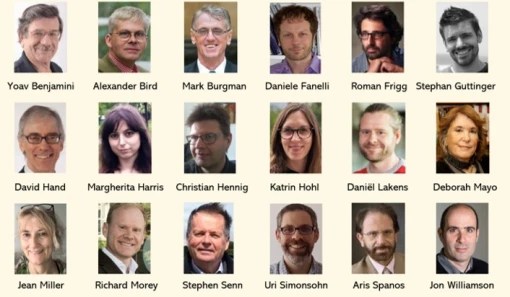
It’s been 1 year (December 8, 2022) since our workshop, The Statistics Wars and Their Casualties! There were four sessions, held over 4 days. Below are the videos and slides from all four sessions of the Workshop. The first two sessions were held on September 22 & 23, 2022. Session 1 speakers were: Deborah Mayo (Virginia Tech), Richard Morey (Cardiff University), Stephen Senn (Edinburgh, Scotland). Session 2 speakers were: Daniël Lakens (Eindhoven University of Technology), Christian Hennig (University of Bologna), Yoav Benjamini (Tel Aviv University). The last two sessions were held on December 1 and 8. Session 3 speakers were: Daniele Fanelli (London School of Economics and Political Science), Stephan Guttinger (University of Exeter), and David Hand (Imperial College London). Session 4 speakers were: Jon Williamson (University of Kent), Margherita Harris (London School of Economics and Political Science), Aris Spanos (Virginia Tech), and Uri Simonsohn (Esade Ramon Llull University).
Abstracts can be found here and the schedule here. Some participant related publications are on this page.
The Statistics Wars and Their Casualties Workshop blog can be found here.
SESSION 1
Brief Intro to Session 1 by David Hand (Imperial College)
Deborah Mayo (Virginia Tech):
The Statistics Wars and Their Casualties
Richard Morey (Cardiff University)
Bayes factors, p values, and the replication crisis
Slide show is posted on his webpage here.
Stephen Senn (Edinburgh)
The replication crisis: are P-values the problem and are Bayes factors the solution?
Session 1 Discussion
SESSION 2
[Brief Intro to Session 2 by Stephen Senn (Edinburgh)]
Daniël Lakens (Eindhoven University of Technology)
The role of background assumptions in severity appraisal
Christian Hennig (University of Bologna)
On the interpretation of the mathematical characteristics of statistical tests
Yoav Benjamini (Tel Aviv University)
The two statistical cornerstones of replicability: addressing selective inference and irrelevant variability
Session 2 Discussion
Below are the videos and slides from the 7 talks from Session 3 and Session 4 of our workshop The Statistics Wars and Their Casualties held on December 1 & 8, 2022.
SESSION 3
Recap of recaps summary of Sessions 1 & 2:
Introduction to Session: Daniël Lakens (Eindhoven University of Technology)
Daniele Fanelli (London School of Economics and Political Science)
The neglected importance of complexity in statistics and Metascience
Stephan Guttinger (University of Exeter)
What are questionable research practices?
David Hand (Imperial College London)
What’s the question?
Discussion (Session 3): (a) Panel discussion of speakers; (b) general audience discussion; (c) “Where do we go from here (Part i)” participant discussion.
SESSION 4
Introduction to Session 4: Deborah Mayo (Virginia Tech)
Jon Williamson (University of Kent)
Causal inference is not statistical inference
Margherita Harris (London School of Economics and Political Science)
On Severity, the Weight of Evidence, and the Relationship Between the Two
Aris Spanos (Virginia Tech)
Revisiting the Two Cultures in Statistical Modeling and Inference as they relate to the Statistics Wars and Their Potential Casualties
Uri Simonsohn (Esade Ramon Llull University)
Mathematically Elegant Answers to Research Questions No One is Asking (meta-analysis, random effects models, and Bayes factors)
Where Should Stat Activists Go From Here? Deborah Mayo (Virginia Tech):
Discussion: (a) Panel discussions; (b) General audience discussion; (c) “Where do we go from here (Part ii)” participants and audience.
The Statistics Wars and Their Casualties Workshop blog can be found here.


 Error Statistics Philosophy


