
.
I. My first post-pandemic movie. Wearing our Barbie shirts, purchased for the occasion, my friend Billie and I* went to see the movie Barbie the other day (open caption—a great idea!).[0] It was quite funny and clever, surprisingly introspective, and self-critical—even though I think it tried a tad bit too hard to remind us it was being surprisingly introspective and self-critical. As I watched, I had the impression the movie creators couldn’t decide on its identity and message. The central goal was to acknowledge criticisms of the Barbie image, notably, perpetuating unrealistic beauty standards, while at the same time disarming critics from pooh-poohing the overall mission of the movie: to reimagine Barbie in a positive, female “empowering”, light. (That term comes up a lot in the movie.) I think Barbie largely succeeds in making Barbie “cool again”. The question that interests me is: what is the image of empowerment being championed?
Two comments to begin: First, this is not a Barbie movie review–you can find a large number of reviews out there. It’s a brief philosophical deconstruction of the meaning of “Barbie,” as drawn from the premises of the movie Barbie. (I may need to report back after seeing it again, whenever it streams.)
Second, anyone who reads this blog knows I really like the color pink. In going to see Barbie, I expected to indulge in nostalgic fashion history, wrapped up in a narrative, enacted in futuristic, whimsical interiors. [1] But the movie didn’t focus on the primary reason that I, and the girls I knew, played with Barbies: fashion experiments. Dozens of girls would set up Barbie boxes on very long benches outside “the projects” to swap, create, and try on different outfits.[2] Barbie isn’t a fashion frolic; it exudes the attitude that fashion is shallow, girly. The movie aspires to wrestle with serious issues: the doll wars, the mommy wars, the gender wars—which, like the statistics wars—are wars of ideas that are not expected to be “won” but perennially fought and disputed. Whatever one thinks of Barbie, it may well serve as a perfect tool for excavating rival positions on the doll wars, past and present.
II. Barbieland, at the outset. Weirdly, we are told by the narrator at the outset that in Barbieland “all problems of feminism and equal rights have been solved” in the real world, what with doctor Barbie, Supreme Court Barbie and President Barbie. “At least that’s what the Barbies think,” she continues. I take it the narrator is being sarcastic, as it would be strange to portray the Barbieland paradigm as the image of “empowered women”. In my experience, career Barbies were sold as collector’s items, and not part of the typical Barbie paradigm. Granted, this is only said to be what the Barbie’s think of the real world, even though it is also claimed the Barbies know nothing about it until Barbie visits. The movie correctly portrays Ken’s role in Barbieland as secondary to Barbie’s, but, as I see it, it is only that male fashions are less interesting and less developed than female fashions.
Regardless, my deconstruction concerns Barbie according to the movie. It is described as a world where females hold all positions of power, while males like Ken are relegated to being accessories, taking a back seat to Barbie with whom he is smitten. (There are many Barbie dolls in Barbieland, all named Barbie.) The Kens are apparently barred from power. To be clear, no one complains about this: they all have a great time on the beach, dance, and every night is girl’s night. Nor do the Kens spend time caring for children–which are absent from Barbieland (there was a pregnant Midge, discontinued). Their job is said to be “beach.
III. Barbie in the real world. Barbie is shocked when she goes to the real world and discovers it’s a sexist Patriarchy. She is further mortified to learn that she has encouraged unrealistic ideals of perfection among women in the real world. Rather than being seen as the feminist hero she imagines, the teenage daughter of the woman who owns Barbie tells Barbie she hates her and calls her a fascist. On the other hand, Ken, who was powerless back in Barbieland, discovers he’s given respect in the real world, simply for being male. He loves it! So he decides to bring the Patriarchy back to Barbieland. Astonishingly, the previously empowered Barbies somehow get brainwashed into becoming subservient creatures who relinquish their powerful roles in exchange for serving the Kens brewsky beer. Barbieland becomes Kendom, and Ken dons a “sugar daddy” fur coat (mirroring an actual collector Ken doll). The Barbies snap out of their trance only when Barbie’s owner from the real world—Gloria—gives a heartfelt, tearjerker speech about the inevitable frustration, guilt, double-standards and depression that women face due to the contradictory and unfair demands they face in a male-dominated real world. Here’s an extract:
It’s literally impossible to be a woman. You are so beautiful, and so smart, and it kills me that you don’t think you’re good enough. …
You have to be thin, but not too thin.
You’re supposed to stay pretty for men, but not so pretty that you tempt them too much or that you threaten other women because you’re supposed to be a part of the sisterhood. … But never forget that the system is rigged. So find a way to acknowledge that but also always be grateful. …
It’s too hard! It’s too contradictory …I’m just so tired of watching myself and every single other woman tie herself into knots so that people will like us.
This supposedly empowering speech ends up with this:
And if all of that is also true for a doll just representing a woman, then I don’t even know.
Is she saying that if even a beautiful and high achieving Barbie doll feels inadequate, and is open to being brainwashed into accepting subservience to males, that maybe, “I don’t even know” but maybe it’s hopeless. Is it something intrinsic to women? Yet these same women, pre-trance, were free of any imposter syndrome
That the Barbie’s meaning embodies some of the self-contradictions of the doll/mommy/gender wars is understandable, but how is Gloria’s speech empowering? Yes, everything in that speech is true, ‘the system is rigged’. But accepting a rigged system is not empowering, it’s depressing, which is the whole reason Gloria (the speech giver), who owns Barbie and works for Mattel in the real world, had contemplated creating a “depressed Barbie” doll. This may be a statement of where we are in 2023, but it strikes me as a step down from “I am woman hear me roar” of Hellen Reddy’s (1972) song.
IV. Emergence of the new Barbieland. Once out of their trance, the Barbie’s don pink overalls and plot to return Kendom to Barbieland. Notice, the males are not able to be brainwashed into giving back their power. But the Barbie’s manage to distract them with fighting male wars, and the Barbie’s restore their original Barbieland laws. However, they concede they weren’t fair to males, and agree to give them a minor share of power. Or something like that. It’s as if the Barbies are saying to the Kens: It’s not fair, but since we’re back in power, we’ll rig the system (in our favor) just as men do in the real world.
We’re not told why this is preferred to equality. Is it fear that, given real power, the Kens will rise up again? Or is it revenge for the inequality men permit in the real world? Neither are very enlightened. Note, the Kens managed the brainwashing of Barbies even without having power. (I may have missed something here, even with open captions.)
V. Barbie meets her Creator. What convinces Barbie to leave (the new) Barbieland for the real world, despite it being a patriarchy? It stems from Barbie’s talk with her Creator (Ruth Handler in real life; Rhea Perlman in the movie). The second stirring, tearjerker, talk ensues; this one about the joys of motherhood. Barbie is shown a beautiful medley of scenes with mothers and daughters. “We mothers stand still, so our daughters can look back to see how far they’ve come,” Handler/Perlman says. The line is so moving that it may be taboo to question it, but shouldn’t mothers also pursue their personal growth?
So is the message behind the feel-good upshot of Barbie the willingness to accept a rigged system, along with the joys motherhood? (This was the same movie that opened with little girls smashing their baby dolls.) This seems far too complacent for a movie purporting to empower women; and by its end, Barbie retreats further to accepting the status quo. I wondered what irked me despite the movie being so enjoyable and so moving. Perhaps the deep feeling evoked by Barbie, whether intended or not, is the recognition that female rights have been going backward as of late. The message, at least in my deconstruction, is that many women, especially the younger generation, might be in retreat. [4] Are we becoming like the Kens at the end who declare that leading was too hard for them? Possibly, in a kind of reversal of that last speech, it’s saying our daughters should look back at the progress made by owners of the earliest Barbies.
Barbie need not have taken on the task it does; it could have revolved around fashion (or been a rom-com, but there’s no rom in this com). Since it gets into the doll wars, it’s interesting to reflect on its meaning. There’s always hope for a sequel.
Here’s a final ironic observation discovered by my friend Billie. It turns out that Ruth Handler designed Barbie based on a German “escort” doll named Lillie. The Washington Post labels it the “Barbie’s ‘pornographic’ origins story as told by historians.” The two dolls are practically identical.
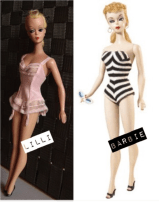
Lillie and Barbie
Share your thoughts, interpretations and viewpoints in the comments.
*And her husband, Barry, who was not wearing a Kenough shirt.
[0] Surely, one of the most enjoyable part of my experience at Barbie is that we were at the movies at all (a first since the Covid pandemic), and that we were wearing Barbie shirts!
[1] I had the original Barbie (pictured at the top of this post) shown in the “cold open” of the movie, re-enacting Kubrick’s 2001 a Space Odyssey. Here, girls smash their baby dolls in favor of Barbie, but rather than show the doll, the movie shows the actress playing Barbie, Margot Robbie.
[2] For me, these became sources for fashion illustrations—a main interest in high school. However, the Barbie body was never in sync with fashion models, even in the 60s (she first appeared in 1959)–think Twiggie. She was more aligned with the shape typical of girdled women of Mad Men, Hollywood actresses, and comic book females of the period. In fact, amusingly, the Barbie doll stemmed from a German comic strip sexpot named Lillie. (See the picture at the end of this post.)
[4] Barbie (Warner Brothers, Mattel) has been strongly influenced by a 2016 version of the movie that never got off the ground. Amy Schumer was initially supposed to play a scientific inventor Barbie who gets kicked out of Barbieland for being too imperfect. When the directors at the time (from Sony) recommended that her invention be high heels made of Jello, Schumer decided they had the wrong gal. The new Barbie movie was determined to be self-consciously “feminist and cool,” which Schumer said the initial attempt was not. Why would anyone make high-heels out of Jello?


 Error Statistics Philosophy
The huge revenues from the trio of the Barbie movie, the Taylor Swift concert tour, and the Beyonce concert tour show the economic power of women and the appeal of strong women in the media in a time of uncertainty and unease for women.
William:
Thanks for your comment. Yes, I saw an article (in the Wall Street Journal) on how these events are boosting the economy. I don’t follow pop music nowadays, but I read someplace that the large crowds at these conferences create a group cohesiveness some call “collective effervescence” (from sociology). I event saw a link to a statistical study of this (frequentist and Bayesian) but I haven’t read it.
Click to access SocSci_v6_27to42.pdf
In the case of the movie Barbie, the feel-good energy, and the fact that it’s done so well, may thwart criticism of the message; but undoubtedly, Mattel is getting the Barbie revival it sought. I will likely see the movie again when it streams, and analyze it further.
I was never empowered by my Barbie. As a budding engineer, I had little interest in dressing up a doll and changing her outfits. My preference in playthings trended towards strategy games and games where deductive reasoning held the key to winning. I’d be interested to know what percentage of women who have ascended to the upper echelons in their professions, academia or the corporate world, attribute their success to playing with Barbies. Greta Gerwig didn’t do too badly.
Interesting read and great t-shirt. Thanks.
Billie:
Thanks for your comment, and for coming with me to the Barbie movie in NYC.
I don’t get many comments nowadays, since I haven’t blogged here much, and this is out of my usual philo of science field. Blogging fell out of favor some years ago (with twitter and such), and after my book came out in 2018, I mainly blogged at two new blogs. Summerseminarphilstat.com and Phil-stat-wars.com, the former in 2019, the latter, from 2020 – 2023. It was a great way to spend the pandemic, together with zoom seminars. I’ve lots of posts on draft on this blog, though.
I doubt many women would say a doll inspired them toward any achievements. In my case, it’s clear that my early fashion illustrations (in high school) were influenced by my Barbie, among other things. It’s interesting if you were seeing yourself as a “budding engineer” at an early age. I would never have thought of that. I was very much into writing imaginary stories and poems in my Barbie years (would that be 7-10?), thought I’d be a poet, artist and philosopher. [My father had a lot of (ancient) philosophy books in our small apartment (he minored in philo at Columbia), so I read Plato at an early age (never mind not understanding it). Of course I wound up in math, formal logic, and philosophy of science, but never gave up drawing.
What are strategic, deductive reasoning games? Frankly, I didn’t like competitive games as a kid, such as Monopoly, because my brother and father would gang up on me.
Stratego was a strategy game, as was chess. Deductive reasoning: games like Clue. or my favorite, Lie Detector. There was a punch card with a picture of a potential villain and a device that you plugged the card into and inserted a wand into one of the holes. It would buzz to let you know if you guessed right about whether your character had one of the right characteristics of the perpetrator.
Clue was a favorite, and I love murder mysteries. With Lie detector as you describe, how are you detecting if someone lied?
Thanks for inviting us to the movie showing, Deborah. You and Billie looked cute in the t-shirts you purchased for the event. Nice job on the commentary. It highlights the synergy of your analytical and artistic talents.
Barry:
Thanks for your comment. I wish we would have taken a picture of Billie and I in our Barbiewear, especially Billie wearing her trompe l’oeil, pink and black Schiaparelli sweater that she herself knitted. That was perfect. I appreciate your compliment on my combined artistic and analytic skills.