AI data centers

Data centers: how about an adversarial collaboration?

.

Data Centers: How About an Adversarial Collaboration?

I live in a state booming with data centers.  They’re also a booming political issue, weirdly scrambling some of the familiar political divides such as Steve Bannon and Bernie Sanders on the same side supporting a proposed temporary ban on building new AI data centers. Here in Virginia, a local delegate Josh Cole claims to be “90% sure that he is against data centers,” but feels he’s moving toward a moratorium. In NY, where I spend part of my time, there’s already a moratorium on (hyperscale) data centers. [i]

We’ve been talking about adversarial collaborations as of late, perhaps the controversy can be put to an adversarial collaboration. An adversarial collaboration (AC) allows rivals who hold opposing hypotheses or positions to work together under a shared framework to design tests of competing views. I blogged on the paper, “Teams of Rivals” by Ceci, Clark, Jussim and Williams (2025) here.“ The strong motivation each side’s members will feel to severely test the other side’s predictions should inspire greater confidence in the collaboration’s eventual conclusions” (Ceci et al., 2025), provided various strictures are held. AC’s, they argue, are more effective than mere pen science or preregistration. It can happen that both sides of an issue continue to replicate their results!

I don’t think an adversarial collaboration on data centers is far-fetched. Even if the data science explosion is inevitable, as I think it is, understanding the disagreements and arriving at any warranted mitigation might thereby be advanced. An AC on the data center debate would at least move the conversation away from emotional meetings and secret lobbying toward a structured, data-driven negotiation. The huge infrastructure growth has been great for the stock market–at least for now. But sufficient public opposition could lead, and is already leading, to restrictions with serious consequences for a market where we know big tech companies have borrowed enormous sums to finance.

The first step in an adversarial collaboration of this sort–which admittedly is not the type typically envisioned in science–is translating vague public resistance and corporate talking points into testable hypotheses. What exactly are the disagreements? Or at least the testable elements? I can imagine the rival hypotheses could be something like:

  • Public advocate hypothesis (pro-data center moratorium): Electricity demands of data centers are putting serious additional stress on the grid, risking blackouts and raised electricity prices.
  • Tech Industry Hypothesis: Our efficiency and green power investments will stabilize the grid and subsidize clean energy; stopping data center growth would halt progress.

The Adversarial Experiment: Suppose an experiment ran for a year or two in an area with lots of large data centers. Experts might identify periods when electricity demand is especially high—during peak periods and summer heatwaves, for example—and randomly select some of those times for the data centers to completely disconnect from the grid and run on their own batteries for several hours. At other times they would operate normally. The opposing sides would agree in advance on what to measure—grid stress, electricity prices, risks of blackouts, or whatever—and make quantitative predictions to test the effect attributable to the data centers. How much additional stress do they put on the grid, and by how much do they affect prices or other risks during these high-demand periods? The results might also point to whether mitigation is needed and if so what kind. The point is to design a test with a good chance of showing each side flawed, just if it is flawed. Both sides would need to agree on a neutral third party to design the empirical tests. Of course, both sides would bring out much more in their defense, this is just an outsider’s approximation of how a testable element might go.

Members of the two sides won’t shift their general stance, you might say. True, but that wouldn’t preclude positive payoffs such as meaningful safeguards, if public fears are warranted, and a basis for limiting public backlash and restrictions, if they are not. At the very least, people will feel listened to. Similar criticisms about water use resulted in the adoption of water-saving closed-loop cooling at data centers. Ideally both sides in an AC move past all or nothing stances

What do people think?

What about the presumably less testable sources of the data center disagreement? What was the term Paul Slovic used in talking about risk perception? Yes, I remember: dread risk. Risks that are outside one’s control, involuntary exposure, unfamiliar new technology with potentially large consequences. Don’t forget the ugliness. Enormous, mostly windowless buildings covering hundreds or thousands of football fields (with entire campuses) springing up without the general community being involved. Another term used in a podcast appropriately called “Why Everyone Hates AI Data Centers,” is “pain sponge”. Data centers have become a “pain sponge” for lots of issues—electricity prices, water, noise, secrecy, land use, AI, distribution of benefits, distrust of powerful firms and billionaires. Only some of these are testable and fixable. Then there’s the hum–a constant low-frequency sound: a drone, a whistle, an airplane engine, a lawn mower that never stops. Fortunately, I read that the newer centers, using the latest AI chips require new data centers to switch from air to the much quieter direct chip liquid cooling.

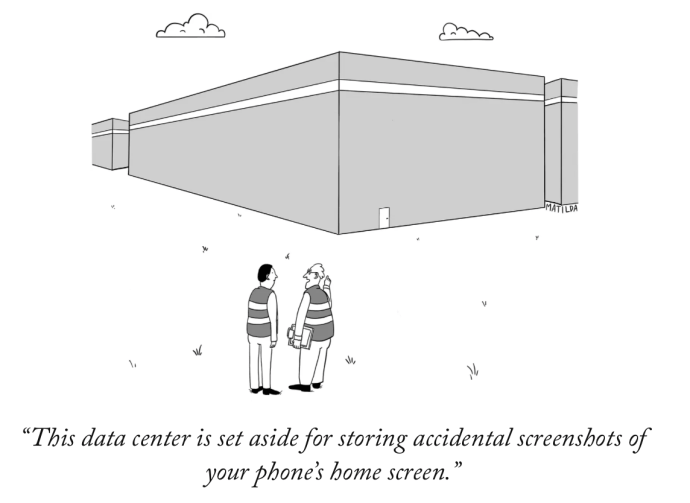
I love the New Yorker cartoon above, which zeros in on what at least some of this fabulous computing and storage capacity actually does.[ii]

Use the comments to share your thoughts.

[i] A poll from University of Pennsylvania finds that about 60% oppose the construction of new data centers in their area, up (a statistically significant) 12 percentage points from a survey fielded in February and March. Interestings, the opposition was greatest among adults under 30 (70%) and declined to 57% among those 65 and older.  https://almanac.upenn.edu/articles/opposition-to-local-data-centers-rises-sharply

[ii] It turns out the cartoon is closer to the truth than I thought. The data centers are essentially digital hoarders—they’d rather build a giant new closet than clean out the old one. Apparently it would cost too much to filter junk. Maybe one day they’ll have a neat way to do it. While even aggressively deleting our digital junk is unlikely to stop the data center explosion (which is largely driven by massive computing and processing power rather than just storage space, and the desire to train on junk), it wouldn’t hurt. At least people should be aware, and I doubt most are. I read that something like 80% of the data stored is of this “dark” and useless sort. I welcome knowledgeable inputs on this!

RELATED BLOG POST:

November 1, 2025: Severity and Adversarial Collaborations i

REFERENCE

Ceci, S. J., Clark, C. J., Jussim, L., & Williams, W. M. (2024). Adversarial collaboration: An undervalued approach in behavioral science. American Psychologist. Advance online publication. https://dx.doi.org/10.1037/amp0001391

Synthese Topical Collection on Severity and learning from error (CFP here)


Categories: adversarial collaboration, AI data centers | Leave a comment

Blog at WordPress.com.