SIST

SIST* Posts: Excerpts & Mementos (to Nov 30, 2018)

Surveying SIST Posts so far

SIST* BLOG POSTS (up to Nov 30, 2018)

Excerpts

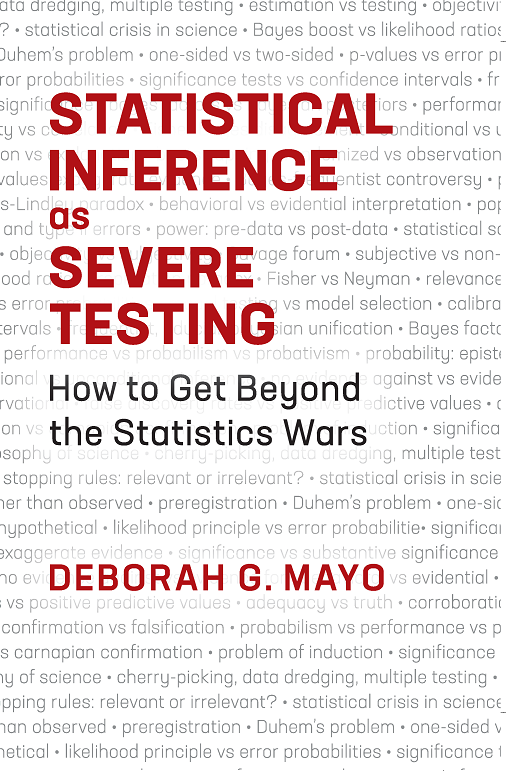
  • 05/19: The Meaning of My Title: Statistical Inference as Severe Testing: How to Get Beyond the Statistics Wars
  • 09/08: Excursion 1 Tour I: Beyond Probabilism and Performance: Severity Requirement (1.1)
  • 09/11: Excursion 1 Tour I (2nd stop): Probabilism, Performance, and Probativeness (1.2)
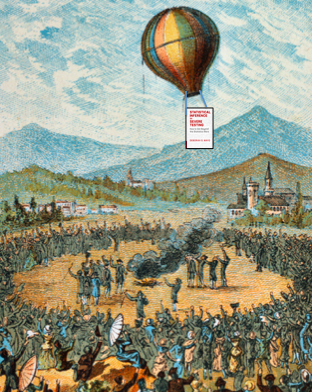
  • 09/15: Excursion 1 Tour I (3rd stop): The Current State of Play in Statistical Foundations: A View From a Hot-Air Balloon (1.3)
  • 09/29: Excursion 2: Taboos of Induction and Falsification: Tour I (first stop)
  • 10/10: Excursion 2 Tour II (3rd stop): Falsification, Pseudoscience, Induction (2.3)
  • 11/30: Where are Fisher, Neyman, Pearson in 1919? Opening of Excursion 3

Mementos, Keepsakes and Souvenirs

  • 10/29: Tour Guide Mementos (Excursion 1 Tour II of How to Get Beyond the Statistics Wars)
  • 11/8:   Souvenir C: A Severe Tester’s Translation Guide (Excursion 1 Tour II)
  • 10/5:  “It should never be true, though it is still often said, that the conclusions are no more accurate than the data on which they are based” (Keepsake by Fisher, 2.1)
  • 11/14: Tour Guide Mementos and Quiz 2.1 (Excursion 2 Tour I Induction and Confirmation)
  • 11/17: Mementos for Excursion 2 Tour II Falsification, Pseudoscience, Induction

*Statistical Inference as Severe Testing: How to Get Beyond the Statistics Wars (Mayo, CUP 2018)

Categories: SIST, Statistical Inference as Severe Testing | 3 Comments

Tour Guide Mementos and QUIZ 2.1 (Excursion 2 Tour I: Induction and Confirmation)

.

Excursion 2 Tour I: Induction and Confirmation (Statistical Inference as Severe Testing: How to Get Beyond the Statistics Wars)

Tour Blurb. The roots of rival statistical accounts go back to the logical Problem of Induction. (2.1) The logical problem of induction is a matter of finding an argument to justify a type of argument (enumerative induction), so it is important to be clear on arguments, their soundness versus their validity. These are key concepts of fundamental importance to our journey. Given that any attempt to solve the logical problem of induction leads to circularity, philosophers turned instead to building logics that seemed to capture our intuitions about induction. This led to confirmation theory and some projects in today’s formal epistemology. There’s an analogy between contrasting views in philosophy and statistics: Carnapian confirmation is to Bayesian statistics, as Popperian falsification is to frequentist error statistics. Logics of confirmation take the form of probabilisms, either in the form of raising the probability of a hypothesis, or arriving at a posterior probability. (2.2) The contrast between these types of probabilisms, and the problems each is found to have in confirmation theory are directly relevant to the types of probabilisms in statistics. Notably, Harold Jeffreys’ non-subjective Bayesianism, and current spin-offs, share features with Carnapian inductive logics. We examine the problem of irrelevant conjunctions: that if x confirms H, it confirms (H & J) for any J. This also leads to what’s called the tacking paradox.

Quiz on 2.1 Soundness vs Validity in Deductive Logic. Let ~C be the denial of claim C. For each of the following argument, indicate whether it is valid and sound, valid but unsound, invalid. Continue reading

Categories: induction, SIST, Statistical Inference as Severe Testing, Statistics | 10 Comments

Tour Guide Mementos (Excursion 1 Tour II of How to Get Beyond the Statistics Wars)

Stat Museum

Excursion 1 Tour II: Error Probing Tools vs. Logics of Evidence 

Blurb. Core battles revolve around the relevance of a method’s error probabilities. What’s distinctive about the severe testing account is that it uses error probabilities evidentially: to assess how severely a claim has passed a test. Error control is necessary but not sufficient for severity. Logics of induction focus on the relationships between given data and hypotheses–so outcomes other than the one observed drop out. This is captured in the Likelihood Principle (LP). Tour II takes us to the crux of central wars in relation to the Law of Likelihood (LL) and Bayesian probabilism. (1.4) Hypotheses deliberately designed to accord with the data can result in minimal severity. The likelihoodist wishes to oust them via degrees of belief captured in prior probabilities. To the severe tester, such gambits directly alter the evidence by leading to inseverity. (1.5) Stopping rules: If a tester tries and tries again until significance is reached–optional stopping–significance will be attained erroneously with high probability. According to the LP, the stopping rule doesn’t alter evidence. The irrelevance of optional stopping is an asset for holders of the LP, it’s the opposite for a severe tester. The warring sides talk past each other. Continue reading

Categories: SIST, Statistical Inference as Severe Testing | 1 Comment

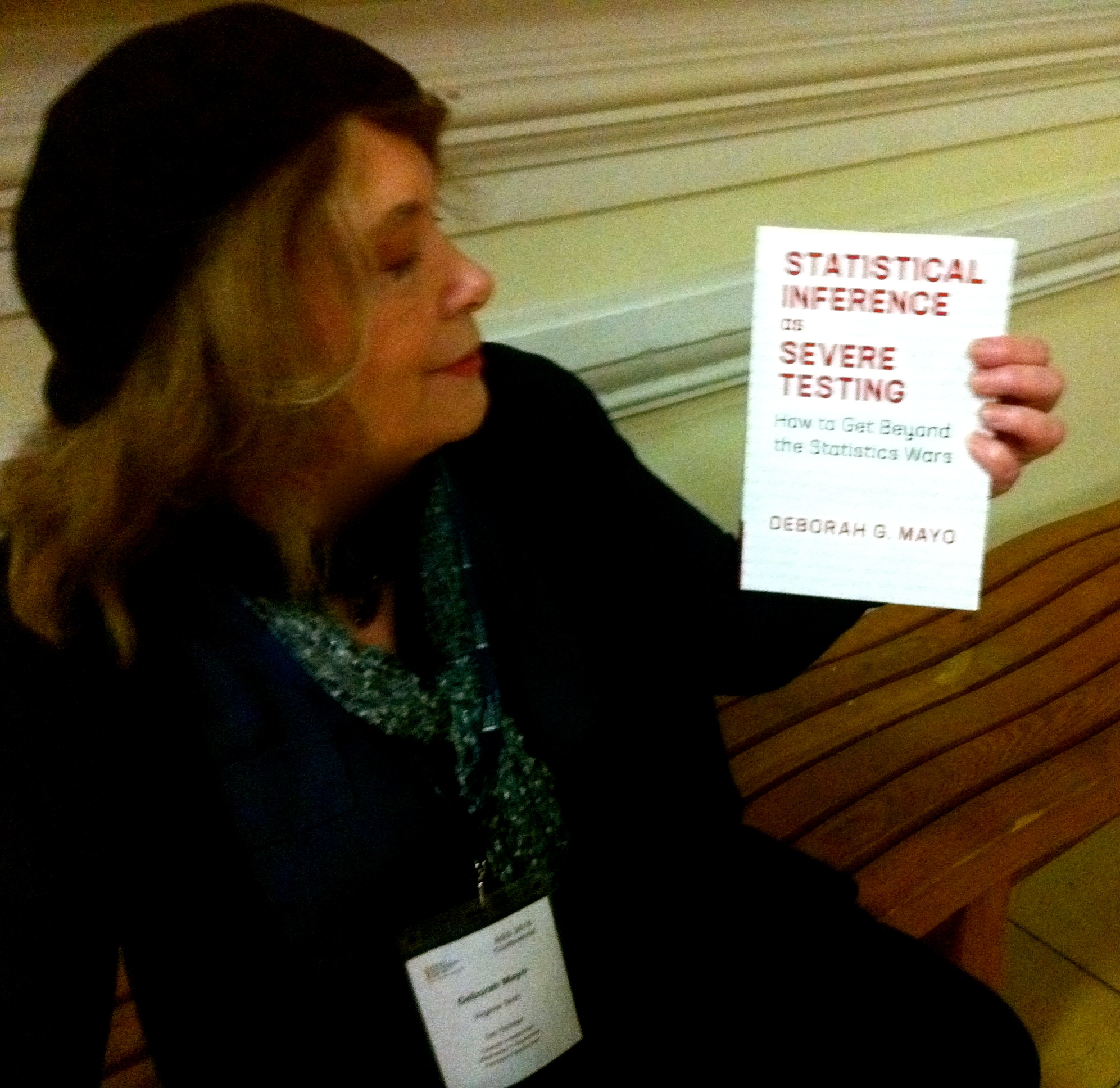
The Physical Reality of My New Book! Here at the RSS Meeting

.

Categories: SIST | 3 Comments

Blog at WordPress.com.