Bayesian/frequentist

Getting Credit (or blame) for Something You Didn’t Do (BP oil spill, comedy hour)

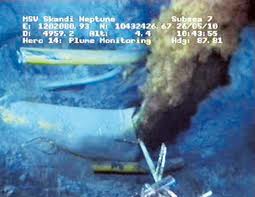
UnknownThree years ago, many of us were glued to the “spill cam” showing, in real time, the gushing oil from the April 20, 2010 explosion sinking the Deepwater Horizon oil rig in the Gulf of Mexico, killing 11, and spewing oil until July 15. Trials have been taking place this month, as people try to meet the 3 year deadline to sue BP and others. But what happened to the 200 million gallons of oil?  (Is anyone up to date on this?)  Has it vanished or just sunk to the bottom of the sea by dispersants which may have caused hidden destruction of sea life? I don’t know, but given it’s Saturday night around the 3 year anniversary, let’s listen into a reblog of a spill-related variation on the second of two original “overheard at the comedy hour” jokes. 

In effect, it accuses the frequentist error-statistical account of licensing the following (make-believe) argument after the 2010 oil spill:

Oil Exec: We had highly reliable evidence that H: the pressure was at normal levels on April 20, 2010!

Senator: But you conceded that whenever your measuring tool showed dangerous or ambiguous readings, you continually lowered the pressure, and that the stringent “cement bond log” test was entirely skipped.

 Oil Exec:  Granted, we omitted reliable checks on April 20, 2010, but usually we do a better job—I am reporting the average!  You see, we use a randomizer that most of the time directs us to run the gold-standard check on pressure. But, but April  20 just happened to be one of those times we did the nonstringent test; but on average we do ok.

Senator:  But you don’t know that your system would have passed the more stringent test you didn’t perform!

Oil Exec:  That’s the beauty of the the frequentist test!

Even if we grant (for the sake of the joke) that overall, this “test” rarely errs in the report it outputs (pass or fail),  that is irrelevant to appraising the inference from the data on April 20, 2010 (which would have differed had the more stringent test been run). That interpretation violates the severity criterion:  the observed passing result was altogether common if generated from a source where the pressure level was unacceptably high, Therefore it misinterprets the actual data. The question is why anyone would saddle the frequentist with such shenanigans on averages?  … Lest anyone think I am inventing a criticism, here is a familiar statistical instantiation, where the choice for each experiment is given to be .5 (Cox 1958).

Two Measuring Instruments with Different Precisions:

 A single observation X is to be made on a normally distributed random variable with unknown mean m, but the measurement instrument is chosen by a coin flip: with heads we use instrument E’ with a known small variance, say 10-4, while with tails, we use E”, with a known large variance, say 104. The full data indicates whether E’ or E” was performed, and the particular value observed, which we can write as x’ and x”, respectively. (This example comes up in, ton o’bricks).

In applying our test T+ (see November 2011 blog post ) to a null hypothesis, say, µ = 0, the “same” value of X would correspond to a much smaller p-value were it to have come from E’ than if it had come from E”.  Denote the two p-values as p’ and p”, respectively.  However, or so the criticism proceeds, the error statistician would report the average p-value:  .5(p’ + p”).

But this would give a misleading assessment of the precision and corresponding severity with either measurement! Instead you should report the p-value of the result in the experiment actually run (this is Cox’s Weak Conditionality Principle, WCP).

But what could lead the critic to suppose the error statistician must average over experiments not even performed?  Rule #2 for legitimate criticism is to give the position being criticized the most generous construal one can think of.  Perhaps the critic supposes what is actually a distortion of even the most radical behavioristic construal:

  •   If you consider outcomes that could have occurred in hypothetical repetitions of this experiment, you must also consider other experiments you did not run (but could have been run) in reasoning from the data observed (from the test you actually ran), and report some kind of frequentist average!

The severity requirement makes explicit that such a construal is to be rejected—I would have thought it obvious, and not in need of identifying a special principle. Since it wasn’t, I articulated this special notion for interpreting tests and the corresponding severity criterion. Continue reading


Categories: Bayesian/frequentist, Comedy, Statistics | 2 Comments

Does statistics have an ontology? Does it need one? (draft 2)

questionmark pinkChance, rational beliefs, decision, uncertainty, probability, error probabilities, truth, random sampling, resampling, opinion, expectations. These are some of the concepts we bandy about by giving various interpretations to mathematical statistics, to statistical theory, and to probabilistic models. But are they real? The question of “ontology” asks about such things, and given the “Ontology and Methodology” conference here at Virginia Tech (May 4, 5), I’d like to get your thoughts (for possible inclusion in a Mayo-Spanos presentation).*  Also, please consider attending**.

Interestingly, I noticed the posts that have garnered the most comments have touched on philosophical questions of the nature of entities and processes behind statistical idealizations (e.g.,https://errorstatistics.com/2012/10/18/query/).copy-cropped-ampersand-logo-blog1

1. When an interpretation is supplied for a formal statistical account, its theorems may well turn out to express approximately true claims, and the interpretation may be deemed useful, but this does not mean the concepts give correct descriptions of reality. The interpreted axioms, and inference principles, are chosen to reflect a given philosophy, or set of intended aims: roughly, to use probabilistic ideas (i) to control error probabilities of methods (Neyman-Pearson, Fisher), or (ii) to assign and update degrees of belief, actual or rational (Bayesian).  But this does not mean its adherents have to take seriously the realism of all the concepts generated. In fact ,we often (on this blog) see supporters of various stripes of frequentist and Bayesian accounts running far away from taking their accounts literally, even as those interpretations are, or at least were, the basis and motivation for the development of the formal edifice (“we never meant this literally”).  But are these caveats on the same order? Or do some threaten the entire edifice of the account?

Starting with the error statistical account, recall Egon Pearson in his “Statistical Concepts in Their Relation to Reality” making it clear to Fisher that the business of controlling erroneous actions in the long run, acceptance sampling in industry and 5-year plans, only arose with Wald, and were never really part of the original Neyman-Pearson tests (declaring that the behaviorist philosophy was Neyman’s, not his).  The paper itself may be found here. I was interested to hear (Mayo 2005)  Neyman’s arch opponent, Bruno de Finetti, remark (quite correctly) that the expression “inductive behavior…that was for Neyman simply a slogan underlining and explaining the difference between his, the Bayesian and the Fisherian formulations” became with Abraham Wald’s work, “something much more substantial” (de Finetti 1972, 176).

Granted, it has not been obvious to people just how to interpret N-P tests “evidentially “ or “inferentially”—the subject of my work over many years. But there always seemed to me to be enough hints and examples to see what was intended: A statistical hypothesis H assigns probabilities to possible outcomes, and the warrant for accepting H as adequate—for an error statistician– is in terms of how well corroborated H is: how well H has stood up to tests that would have detected flaws in H, at least with very high probability. So the grounds for holding or using H are error statistical. The control and assessment of error probabilities may be used inferentially to determine the capabilities of methods to detect the adequacy/inadequacy of models, and express the extent of the discrepancies that have been identified. We also employ these ideas to detect gambits that make it too easy to find evidence for claims, even if the claims have been subjected to weak tests and biased procedures. A recent post is here.

The account has never professed to supply a unified logic, or any kind of logic for inference. The idea that there was a single rational way to make inferences was ridiculed by Neyman (whose birthday is April 16). Continue reading

Categories: Bayesian/frequentist, Error Statistics, Statistics | 61 Comments

Who is allowed to cheat? I.J. Good and that after dinner comedy hour….

UnknownIt was from my Virginia Tech colleague I.J. Good (in statistics), who died four years ago (April 5, 2009), at 93, that I learned most of what I call “howlers” on this blog. His favorites were based on the “paradoxes” of stopping rules.

“In conversation I have emphasized to other statisticians, starting in 1950, that, in virtue of the ‘law of the iterated logarithm,’ by optional stopping an arbitrarily high sigmage, and therefore an arbitrarily small tail-area probability, can be attained even when the null hypothesis is true. In other words if a Fisherian is prepared to use optional stopping (which usually he is not) he can be sure of rejecting a true null hypothesis provided that he is prepared to go on sampling for a long time. The way I usually express this ‘paradox’ is that a Fisherian [but not a Bayesian] can cheat by pretending he has a plane to catch like a gambler who leaves the table when he is ahead” (Good 1983, 135) [*]

This paper came from a conference where we both presented, and he was extremely critical of my error statistical defense on this point. (I was a year out of grad school, and he a University Distinguished Professor.) 

One time, years later, after hearing Jack give this howler for the nth time, “a Fisherian [but not a Bayesian] can cheat, etc.,” I was driving him to his office, and suddenly blurted out what I really thought:

“You know Jack, as many times as I have heard you tell this, I’ve always been baffled as to its lesson about who is allowed to cheat. Error statisticians require the overall and not the ‘computed’ significance level be reported. To us, what would be cheating would be reporting the significance level you got after trying and trying again in just the same way as if the test had a fixed sample size. True, we are forced to fret about how stopping rules alter the error probabilities of tests, while the Bayesian is free to ignore them, but why isn’t the real lesson that the Bayesian is allowed to cheat?” (A published version of my remark may be found in EGEK p. 351: “As often as my distinguished colleague presents this point…”)

 To my surprise, or actually shock, after pondering this a bit, Jack said something like, “Hmm, I never thought of it this way.”

images-3By the way, the story of the “after dinner Bayesian comedy hour” on this blog, did not allude to Jack but to someone who gave a much more embellished version. Since it’s Saturday night, let’s once again listen into the comedy hour that unfolded at my dinner table at an academic conference:

 Did you hear the one about the researcher who gets a phone call from the guy analyzing his data? First the guy congratulates him and says, “The results show a Continue reading

Categories: Bayesian/frequentist, Comedy, Statistics | Tags: , , | 68 Comments

From Gelman’s blog: philosophy and the practice of Bayesian statistics

mayo blackboard b&w 2I hadn’t read Gelman and Shalizi’s response to my comment on their paper in the British Journal of Mathematical and Statistical Psychology. I see the issue is posted on Gelman’s blogHere’s the issue of the journal,

Philosophy and the practice of Bayesian statistics (with all the discussions!)

Philosophy and the practice of Bayesian statistics (pages 8–38)
Andrew Gelman and Cosma Rohilla Shalizi

How to practise Bayesian statistics outside the Bayesian church: What philosophy for Bayesian statistical modelling? (pages 39–44) Denny Borsboom and Brian D. Haig

Posterior predictive checks can and should be Bayesian: Comment on Gelman and Shalizi, ‘Philosophy and the practice of Bayesian statistics’ (pages 45–56)
John K. Kruschke

The error-statistical philosophy and the practice of Bayesian statistics: Comments on Gelman and Shalizi: ‘Philosophy and the practice of Bayesian statistics’ (pages 57–64)
Deborah G. Mayo

Comment on Gelman and Shalizi (pages 65–67)
Stephen Senn

The humble Bayesian: Model checking from a fully Bayesian perspective (pages 68–75)
Richard D. Morey, Jan-Willem Romeijn and Jeffrey N. Rouder

Rejoinder to discussion of ‘Philosophy and the practice of Bayesian statistics’(pages 76–80)
Andrew Gelman and Cosma Shalizi

Categories: Bayesian/frequentist, Error Statistics, Philosophy of Statistics | Leave a comment

Mayo on S. Senn: “How Can We Cultivate Senn’s-Ability?”–reblogs

Since Stephen Senn will be leading our seminar at the LSE tomorrow morning (see PH500 page), I’m reblogging my deconstruction of his paper (“You May Believe You Are a Bayesian But You Probably Are Wrong”) from Jan.15 2012 (though not his main topic tomorrow). At the end I link to other “U-Phils” on Senn’s paper (by Andrew Gelman, Andrew Jaffe, Christian Robert), Senn’s response, and my response to them). Queries, write me at: error@vt.edu

Mayo Philosophizes on Stephen Senn: “How Can We Cultivate Senn’s-Ability?”

Where's Mayo?

Where’s Mayo?

Although, in one sense, Senn’s remarks echo the passage of Jim Berger’s that we deconstructed a few weeks ago, Senn at the same time seems to reach an opposite conclusion. He points out how, in practice, people who claim to have carried out a (subjective) Bayesian analysis have actually done something very different—but that then they heap credit on the Bayesian ideal. (See also “Who Is Doing the Work?”)

“A very standard form of argument I do object to is the one frequently encountered in many applied Bayesian papers where the first paragraphs laud the Bayesian approach on various grounds, in particular its ability to synthesize all sources of information, and in the rest of the paper the authors assume that because they have used the Bayesian machinery of prior distributions and Bayes theorem they have therefore done a good analysis. It is this sort of author who believes that he or she is Bayesian but in practice is wrong.” (Senn 58) Continue reading

Categories: Bayesian/frequentist, U-Phil | 11 Comments

Blog at WordPress.com.