Birnbaum

Midnight With Birnbaum: Happy New Year 2026!

.

Anyone here remember that old Woody Allen movie, “Midnight in Paris,” where the main character (I forget who plays it, I saw it on a plane), a writer finishing a novel, steps into a cab that mysteriously picks him up at midnight and transports him back in time where he gets to run his work by such famous authors as Hemingway and Virginia Wolf?  (It was a new movie when I began the blog in 2011.) He is wowed when his work earns their approval and he comes back each night in the same mysterious cab…Well, ever since I began this blog in 2011, I imagine being picked up in a mysterious taxi at midnight on New Year’s Eve, and lo and behold, find myself in the 1960s New York City, in the company of Allan Birnbaum who is is looking deeply contemplative, perhaps studying his 1962 paper…Birnbaum reveals some new and surprising twists this year! [i] 

(The pic on the left is the only blurry image I have of the club I’m taken to.) It has been a decade since  I published my article in Statistical Science (“On the Birnbaum Argument for the Strong Likelihood Principle”), which includes  commentaries by A. P. David, Michael Evans, Martin and Liu, D. A. S. Fraser, Jan Hannig, and Jan Bjornstad. David Cox, who very sadly did in January 2022, is the one who encouraged me to write and publish it. Not only does the (Strong) Likelihood Principle (LP or SLP) remain at the heart of many of the criticisms of Neyman-Pearson (N-P) statistics and of error statistics in general, but a decade after my 2014 paper, it is more central than ever–even if it is often unrecognized.

OUR EXCHANGE:

ERROR STATISTICIAN: It’s wonderful to meet you Professor Birnbaum; I’ve always been extremely impressed with the important impact your work has had on philosophical foundations of statistics.  I happen to have published on your famous argument about the likelihood principle (LP).  (whispers: I can’t believe this!)

BIRNBAUM: Ultimately you know I rejected the LP as failing to control the error probabilities needed for my Confidence concept. But you know all this, I’ve read it in your book: Statistical Inference as Severe Testing: How to Get Beyond the Statistics Wars (STINT, 2018, CUP).

ERROR STATISTICIAN: You’ve read my book? Wow! Then you know I don’t think your argument shows that the LP follows from such frequentist concepts as sufficiency S and the weak conditionality principle WLP. I don’t rehearse my argument there, but I first found the problem in 2006, when I was writing something on “conditioning” with David Cox. [ii]  Sorry,…I know it’s famous…

BIRNBAUM:  Well, I shall happily invite you to take any case that violates the LP and allow me to demonstrate that the frequentist is led to inconsistency, provided she also wishes to adhere to the WLP and sufficiency (although less than S is needed).

ERROR STATISTICIAN: Well I show that no contradiction follows from holding WCP and S, while denying the LP.

BIRNBAUM: Well, well, well: I’ll bet you a bottle of Elba Grease champagne that I can demonstrate it!

ERROR STATISTICAL PHILOSOPHER:  It is a great drink, I must admit that: I love lemons.

BIRNBAUM: OK.  (A waiter brings a bottle, they each pour a glass and resume talking).  Whoever wins this little argument pays for this whole bottle of vintage Ebar or Elbow or whatever it is Grease.

.

.

ERROR STATISTICAL PHILOSOPHER:  I really don’t mind paying for the bottle.

BIRNBAUM: Good, you will have to. Take any LP violation. Let  x’ be 2-standard deviation difference from the null (asserting μ = 0) in testing a normal mean from the fixed sample size experiment E’, say n = 100; and let x” be a 2-standard deviation difference from an optional stopping experiment E”, which happens to stop at 100.  Do you agree that:

(0) For a frequentist, outcome x’ from E’ (fixed sample size) is NOT evidentially equivalent to x” from E” (optional stopping that stops at n)

ERROR STATISTICAL PHILOSOPHER: Yes, that’s a clear case where we reject the strong LP, and it makes perfect sense to distinguish their corresponding p-values (which we can write as p’ and p”, respectively).  The searching in the optional stopping experiment makes the p-value quite a bit higher than with the fixed sample size.  For n = 100, data x’ yields p’= ~.05; while p”  is ~.3.  Clearly, p’ is not equal to p”, I don’t see how you can make them equal.

BIRNBAUM: Suppose you’ve observed x”, a 2-standard deviation difference from an optional stopping experiment E”, that finally stops at n=100.  You admit, do you not, that this outcome could have occurred as a result of a different experiment?  It could have been that a fair coin was flipped where it is agreed that heads instructs you to perform E’ (fixed sample size experiment, with n = 100) and tails instructs you to perform the optional stopping experiment E”, stopping as soon as you obtain a 2-standard deviation difference, and you happened to get tails, and performed the experiment E”, which happened to stop with n =100. 

ERROR STATISTICAL PHILOSOPHER:  Well, that is not how x” was obtained, but ok, it could have occurred that way.

BIRNBAUM:  Good. Then you must grant further that your result could have come from a special experiment I have dreamt up, call it a BB-experiment.  In a BB-experiment, if the outcome from the experiment you actually performed has an outcome with a proportional likelihood to one in some other experiment not performed, E’, then we say that your result has an “LP pair”.  For any violation of the strong LP, the outcome observed, let it be x”, has an “LP pair”, call it x’, in some other experiment E’.  In that case, a BB-experiment stipulates that you are to report x” as if you had determined whether to run E’ or E” by flipping a fair coin.

(They fill their glasses again)

ERROR STATISTICAL PHILOSOPHER: You’re saying that if my outcome from trying and trying again, that is, optional stopping experiment E”, with an “LP pair” in the fixed sample size experiment I did not perform, then I am to report x” as if the determination to run E” was by flipping a fair  coin (which decides between E’ and E”)?

BIRNBAUM: Yes, and one more thing. If your outcome had actually come from the fixed sample size experiment E’, it too would have  an “LP pair” in the experiment you did not perform, E”.  Whether you actually observed x” from E”, or x’ from E’, you are to report it as x” from E”.

ERROR STATISTICAL PHILOSOPHER: So let’s see if I understand a Birnbaum BB-experiment: whether my observed 2-standard deviation difference came from E’ or E” (with sample size n) the result is reported as x’, as if it came from E’ (fixed sample size), and as a result of this strange type of a mixture experiment.

BIRNBAUM: Yes, or equivalently you could just report x*: my result is a 2-standard deviation difference and it could have come from either E’ (fixed sampling, n= 100) or E” (optional stopping, which happens to stop at the 100th trial).  That’s how I sometimes formulate a BB-experiment.

ERROR STATISTICAL PHILOSOPHER: You’re saying in effect that if my result has an LP pair in the experiment not performed, I should act as if I accept the strong LP and just report it’s likelihood; so if the likelihoods are proportional in the two experiments (both testing the same mean), the outcomes are evidentially equivalent.

BIRNBAUM: Well, but since the BB- experiment is an imagined “mixture” it is a single experiment, so really you only need to apply the weak LP which frequentists accept.  Yes?  (The weak LP is the same as the sufficiency principle).

ERROR STATISTICAL PHILOSOPHER: But what is the sampling distribution in this imaginary BB- experiment?  Suppose I have Birnbaumized my experimental result, just as you describe, and observed a 2-standard deviation difference from optional stopping experiment E”.  How do I calculate the p-value within a Birnbaumized experiment?

BIRNBAUM: I don’t think anyone has ever called it that.

ERROR STATISTICAL PHILOSOPHER: I just wanted to have a shorthand for the operation you are describing, there’s no need to use it, if you’d rather I not.  So how do I calculate the p-value within a BB-experiment?

BIRNBAUM: You would report the overall p-value, which would be the average over the sampling distributions: (p’ + p”)/2

Say p’ is ~.05, and p” is ~.3; whatever they are, we know they are different, that’s what makes this a violation of the strong LP (given in premise (0)).

ERROR STATISTICAL PHILOSOPHER: So you’re saying that if I observe a 2-standard deviation difference from E’, I do not report  the associated p-value p’, but instead I am to report the average p-value, averaging over some other experiment E” that could have given rise to an outcome with a proportional likelihood to the one I observed, even though I didn’t obtain it this way?

BIRNBAUM: I’m saying that you have to grant that x’ from a fixed sample size experiment E’ could have been generated through a BB-experiment.

My this drink is sour!

ERROR STATISTICAL PHILOSOPHER: Yes, I love pure lemon.

BIRNBAUM: Perhaps you’re in want of a gene; never mind.

I’m saying you have to grant that x’ from a fixed sample size experiment E’ could have been generated through a BB-experiment.  If you are to interpret your experiment as if you are within the rules of a BB experiment, then x’ is evidentially equivalent to x” (is equivalent to  x*).  This is premise (1).

ERROR STATISTICAL PHILOSOPHER: But the result would be that the p-value associated with x’ (fixed sample size) is reported to be larger than it actually is (.05), because I’d be averaging over fixed and optional stopping experiments; while observing x” (optional stopping) is reported to be smaller than it is–in both cases because of an experiment I did not perform.

BIRNBAUM: Yes, the BB-experiment computes the P-value in an unconditional manner: it takes the convex combination over the 2 ways the result could have come about. 

ERROR STATISTICAL PHILOSOPHER: this is just a matter of your definitions, it is an analytical or mathematical result, so long as we grant being within your BB experiment.

BIRNBAUM: True, (1) plays the role of the sufficiency assumption, but one need not even appeal to sufficiency, it is just a matter of mathematical equivalence.

By the way, I am focusing just on LP violations, therefore, the outcome, by definition, has an LP pair.  In other cases, where there is no LP pair, you just report things as usual.

ERROR STATISTICAL PHILOSOPHER: OK, but p’ still differs from p”; so I still don’t how I’m forced to infer the strong LP which identifies the two. In short, I don’t see the contradiction with my rejecting the strong LP in premise (0).  (Also we should come back to the “other cases” at some point….)

BIRNBAUM: Wait! Don’t be so impatient; I’m about to get to step (2). Here, let’s toast to the new year: “To Elbar Grease!”

ERROR STATISTICAL PHILOSOPHER: To Elbar Grease!

BIRNBAUM:  So far all of this was step (1).

ERROR STATISTICAL PHILOSOPHER: : Oy, what is step 2?

BIRNBAUM:  STEP 2 is this: Surely, you agree, that once you know from which experiment the observed 2-standard deviation difference actually came, you ought to report the p-value corresponding to that experiment. You ought NOT to report the average (p’ + p”)/2  as you were instructed to do in the BB experiment.

This gives us premise (2a):

(2a) outcome x”, once it is known that it came from E”, should NOT be  analyzed as in a BB- experiment where p-values are averaged. The report should instead use the sampling distribution of the optional stopping test E”, yielding the p-value, p” (~.37). In fact, .37 is the value you give in STINT p. 44 (imagining the experimenter keeps taking 10 more). 

ERROR STATISTICAL PHILOSOPHER:  So, having first insisted I imagine myself in a Birnbaumized, I mean a BB-experiment, and report an average p-value, I’m now to return to my senses and “condition” in order to get back to the only place I ever wanted to be, i.e., back to where I was to begin with?

BIRNBAUM: Yes, at least if you hold to the weak conditionality principle WCP (of D. R. Cox)—surely you agree to this.

(2b) Likewise, if you knew the 2-standard deviation difference came from E’, then

x’ should NOT be deemed evidentially equivalent to x” (as in the BB experiment), the report should instead use the sampling distribution of fixed test E’, (.05).  

ERROR STATISTICAL PHILOSOPHER: So, having first insisted I consider myself in a BB-experiment, in which I report the average p-value, I’m now to return to my senses and allow that if I know the result came from optional stopping, E”, I should “condition” on and report p”.

BIRNBAUM: Yes.  There was no need to repeat the whole spiel.

ERROR STATISTICAL PHILOSOPHER: I just wanted to be clear I understood you. Of course, all of this assumes the model is correct or adequate to begin with.

BIRNBAUM: Yes, the LP (or SLP, to indicate it’s the strong LP) is a principle for parametric inference within a given model. So you arrive at (2a) and (2b), yes?

ERROR STATISTICAL PHILOSOPHER: OK, but it might be noted that unlike premise (1), premises (2a) and (2b) are not given by definition, they concern an evidential standpoint about how one ought to interpret a result once you know which experiment it came from. In particular, premises (2a) and (2b) say I should condition and use the sampling distribution of the experiment known to have been actually performed, when interpreting the result.

BIRNBAUM: Yes, and isn’t this weak conditionality principle WCP one that you happily accept?

ERROR STATISTICAL PHILOSOPHER: Well the WCP originally refers to actual mixtures, where one flipped a coin to determine if E’ or E” is performed, whereas, you’re requiring I consider an imaginary Birnbaum mixture experiment, where the choice of the experiment not performed will vary depending on the outcome that needs an LP pair; and I cannot even determine what this might be until after I’ve observed the result that would violate the LP? I don’t know what the sample size will be ahead of time.

BIRNBAUM: Sure, but you admit that your observed x” could have come about through a BB-experiment, and that’s all I need.  Notice

(1), (2a) and (2b) yield the strong LP!

Outcome x” from E”(optional stopping that stops at n) is evidentially equivalent to x’ from E’ (fixed sample size n).

ERROR STATISTICAL PHILOSOPHER:  Clever, but your “proof” is obviously unsound; and before I demonstrate this, notice that the conclusion, were it to follow, asserts p’ = p”, (e.g.,  .05 = .3!), even though it is unquestioned that p’ is not equal to p”, that is because we must start with an LP violation (premise (0)).

BIRNBAUM: Yes, it is puzzling, but where have I gone wrong?

(The waiter comes by and fills their glasses; they are so deeply engrossed in thought they do not even notice him.)

ERROR STATISTICAL PHILOSOPHER: There are many routes to explaining a fallacious argument.  The one I find most satisfactory is in Mayo (2014). But, given we’ve been partying, here’s a very simple one. What is required for STEP 1 to hold, is the denial of what’s needed for STEP 2 to hold:

Step 1 requires us to analyze results in accordance with a BB- experiment.  If we do so, true enough we get:

premise (1): outcome x” (in a BB experiment) is evidentially equivalent to outcome x’ (in a BB  experiment):

That is because in either case, the p-value would be (p’ + p”)/2

Step 2 now insists that we should NOT calculate  evidential import as if we were in a BB- experiment.  Instead we should consider the experiment from which the data actually came, E’ or E”:

premise (2a): outcome x” (in a BB experiment) is/should be evidentially equivalent to x” from E” (optional stopping that stops at n):  its p-value should be p”.

premise (2b): outcome x’ (within in a BB experiment) is/should be evidentially equivalent to x’ from E’ (fixed sample size):  its p-value should be p’.

If (1) is true, then (2a) and (2b) must be false!

If (1) is true and we keep fixed the stipulation of a BB experiment (which we must to apply step 2), then (2a) is asserting:

The average p-value (p’ + p”)/2  =  p’  which is false.

Likewise if (1) is true, then (2b) is asserting:

the average p-value (p’ + p”)/2  =  p”  which is false

Alternatively, we can see what goes wrong by realizing:

If (2a) and (2b) are true, then premise (1) must be false.

In short your famous argument requires us to assess evidence in a given experiment in two contradictory ways: as if we are within a BB- experiment (and report the average p-value) and also that we are not, but rather should report the actual p-value.

I can render it as formally valid, but then its premises can never all be true; alternatively, I can get the premises to come out true, but then the conclusion is false—so it is invalid.  In no way does it show the frequentist is open to contradiction (by dint of accepting S, WCP, and denying the LP).

BIRNBAUM: Yet some people still think it is a breakthrough. I never agreed to go as far as Jimmy Savage wanted me too, namely, to be a Bayesian….

ERROR STATISTICAL PHILOSOPHER: I’ve come to see that clarifying the entire argument turns on defining the WCP. Have you seen my 2014 paper in Statistical Science?  The key difference is that in (2014), the WCP is stated as an equivalence, as you intended. Cox’s WCP, many claim, was not an equivalence, going in 2 directions. Slides from a presentation may be found on this blogpost

BIRNBAUM: Yes, the “monster of the LP” arises from viewing WCP as an equivalence, instead of going in one direction (from mixtures to the known result).

ERROR STATISTICAL PHILOSOPHER: In my 2014 paper (unlike my earlier treatments) I too construe WCP as giving an “equivalence” but there is an equivocation that invalidates the purported move to the LP.

On the one hand, it’s true that if z is known (and known for example to have come from optional stopping), it’s irrelevant that it could have resulted from either fixed sample testing or optional stopping.

But it does not follow that if z is known, it’s irrelevant whether it resulted from fixed sample testing or optional stopping. It’s the slippery slide into this second statement–which surely sounds the same as the first–that makes your argument such a brain buster. (Mayo 2014)

BIRNBAUM: Yes I have seen your 2014 paper! Your Rejoinder to some of the critics is gutsy, to say the least. I’ve also seen the slides on your blog.

ERROR STATISTICAL PHILOSOPHER: Thank you, I’m amazed you follow my blog! I haven’t kept it up that much lately; blogs have fallen out of fashion.

BIRNBAUM: As has inferential statistics it seems–it’s all AI/ML. But I have to admit that CHAT GPT illuminates at least part of your argument as to why my reasoning was flawed.

ERROR STATISTICAL PHILOSOPHER: I never thought to check CHAT GPT on my paper, that’s amazing.

BIRNBAUM: Here is what I found on the Chatbot:

CHAT GPT

Birnbaum’s Argument and the Likelihood Principle

In his 1962 paper, Birnbaum argued that if frequentists accept two principles—sufficiency and weak conditionality—they are logically compelled to accept the likelihood principle. The likelihood principle states that all the evidence in data is contained in the likelihood function, meaning that the sampling distribution (and hence frequentist error probabilities) is irrelevant to evidential assessment….

Error Statistician’s Dilemma

If Birnbaum’s argument is correct, then frequentist methods (which rely on error probabilities) would be rendered irrelevant for assessing evidence. This would make it difficult for frequentists to defend their approach as coherent, particularly in the face of Bayesian methods that naturally adhere to the likelihood principle.

However, Deborah Mayo, in her 2014 work, critiques Birnbaum’s argument, exposing a logical flaw in his alleged proof. 

BIRNBAUM: The bot does not get your argument right. The whole experience  has encouraged me to write the first draft of a completely revised paper, reflecting a large advance in my thinking on this. It’s not quite ready to share….

ERROR STATISTICAL PHILOSOPHER: Wow! I’d love to read it…have you identified the problem? In your last couple of papers, you suggest you’d discovered the flaw in your argument for the LP. Am I right? Even in the discussion of your (1962) paper, you seemed to agree with Pratt that WCP can’t do the job you intend. I just want to know, and won’t share your answer with anyone….

(She notices Birnbaum is holding a paper on long legal-sized yellow sheets filled with tiny hand-written comments, covering both sides.)

Sudden interruption by the waiter:

WAITER: Who gets the tab? 

BIRNBAUM: I do. To Elbar Grease!  To Severe Testing!
Happy New Year!

BIRNBAUM (looking wistful): Savage, you know, never got off my case about remaining at “the half-way house” of likelihood, and not going full Bayesian. Then I wrote the review about the Confidence Concept as the one rock on a shifting scene… Pratt thought the argument should instead appeal to a Censoring Principle (basically, it doesn’t matter if your instrument cannot measure beyond k units if the measurement you’re making is under k units.)

ERROR STATISTICAL PHILOSOPHER: Yes, but who says frequentist error statisticians deny the Censoring Principle? So back to my question,…you did uncover the flaw in your argument, yes?

WAITER: We’re closing now; shall I call a Taxi?

BIRNBAUM: Yes, yes!

ERROR STATISTICAL PHILOSOPHER: ‘Yes’, you discovered the flaw in the argument, or ‘yes’ to the taxi? 

MANAGER: We’re closing now; I’m sorry you must leave.

ERROR STATISTICAL PHILOSOPHER: We’re leaving I just need him to clarify his answer….

BIRNBAUM: I predict that 2026 will be the year that people will finally take seriously your paper from a decade ago (30 years from your Lakatos Prize)!

ERROR STATISTICAL PHILOSOPHER: I’ll drink to that!

Suddenly a large group of people bustle past the manager…it’s all chaos.

Prof. Birnbaum…? Allan? Where did he go? (oy, not again!)


Link to complete discussion: 

Mayo, Deborah G. On the Birnbaum Argument for the Strong Likelihood Principle (with discussion & rejoinder).Statistical Science 29 (2014), no. 2, 227-266.

stat-sci

[i] Many links on the strong likelihood principle (LP or SLP) and Birnbaum may be found by searching this blog. Good sources for where to start as well as classic background papers may be found in this blogpost. A link to slides and video of a very introductory presentation of my argument from the 2021 Phil Stat Forum is here.

January 7: “Putting the Brakes on the Breakthrough: On the Birnbaum Argument for the Strong Likelihood Principle” (D.Mayo)

[ii] In 2023 I wrote a paper on Cox’s statistical philosophy. Sadly he died in 2022. (The first David R. Cox Foundations of Statistics Prize, currently given by the ASA on even-numbered years, was awarded to Nancy Reid at the JSM 2023. The second went to Phil Dawid. The Award is now to be given yearly, thanks to the contributions of Friends of David Cox (on this blog!))

Categories: Birnbaum, CHAT GPT, Likelihood Principle, Sir David Cox | Leave a comment

67 Years of Cox’s (1958) Chestnut: Excerpt from Excursion 3 Tour II

2025-26 Cruise

.

We’re stopping to consider one of the “chestnuts” in the exhibits of “chestnuts and howlers” in Excursion 3 (Tour II) of Statistical Inference as Severe Testing: How to Get Beyond the Statistics Wars (SIST 2018). It is now 67 years since Cox gave his famous weighing machine example in Sir David Cox (1958)[1]. It will play a vital role in our discussion of the (strong) Likelihood Principle later this week. The excerpt is from SIST (pp. 170-173).

Exhibit (vi): Two Measuring Instruments of Different Precisions. Did you hear about the frequentist who, knowing she used a scale that’s right only half the time, claimed her method of weighing is right 75% of the time? 

She says, “I flipped a coin to decide whether to use a scale that’s right 100% of the time, or one that’s right only half the time, so, overall, I’m right 75% of the time.” (She wants credit because she could have used a better scale, even knowing she used a lousy one.)

Basis for the joke: An N-P test bases error probability on all possible outcomes or measurements that could have occurred in repetitions, but did not. Continue reading

Categories: 2025 leisurely cruise, Birnbaum, Likelihood Principle | Leave a comment

Midnight With Birnbaum: Happy New Year 2025!

.

Remember that old Woody Allen movie, “Midnight in Paris,” where the main character (I forget who plays it, I saw it on a plane), a writer finishing a novel, steps into a cab that mysteriously picks him up at midnight and transports him back in time where he gets to run his work by such famous authors as Hemingway and Virginia Wolf?  (It was a new movie when I began the blog in 2011.) He is wowed when his work earns their approval and he comes back each night in the same mysterious cab…Well, ever since I began this blog in 2011, I imagine being picked up in a mysterious taxi at midnight on New Year’s Eve, and lo and behold, find myself in the 1960s New York City, in the company of Allan Birnbaum who is is looking deeply contemplative, perhaps studying his 1962 paper…Birnbaum reveals some new and surprising twists this year! [i] 

(The pic on the left is the only blurry image I have of the club I’m taken to.) It has been a decade since  I published my article in Statistical Science (“On the Birnbaum Argument for the Strong Likelihood Principle”), which includes  commentaries by A. P. David, Michael Evans, Martin and Liu, D. A. S. Fraser, Jan Hannig, and Jan Bjornstad. David Cox, who very sadly did in January 2022, is the one who encouraged me to write and publish it. Not only does the (Strong) Likelihood Principle (LP or SLP) remain at the heart of many of the criticisms of Neyman-Pearson (N-P) statistics and of error statistics in general, but a decade after my 2014 paper, it is more central than ever–even if it is often unrecognized.

OUR EXCHANGE: Continue reading

Categories: Birnbaum, CHAT GPT, Likelihood Principle, Sir David Cox | 2 Comments

Midnight With Birnbaum: Happy New Year 2024!

.

For three of the last four years, it was not feasible to actually revisit that spot in the road, looking to get into a strange-looking taxi, to head to “Midnight With Birnbaum”.  Even last year was iffy. But this year I will, and I’m about to leave at 9pm. (The pic on the left is the only blurry image I have of the club I’m taken to.) My book Statistical Inference as Severe Testing: How to Get Beyond the Statistics Wars (CUP, 2018)  doesn’t include the argument from my article in Statistical Science (“On the Birnbaum Argument for the Strong Likelihood Principle”), but you can read it at that link along with commentaries by A. P. David, Michael Evans, Martin and Liu, D. A. S. Fraser, Jan Hannig, and Jan Bjornstad. David Cox, who very sadly did in January 2022, is the one who encouraged me to write and publish it. (The first David R. Cox Foundations of Statistics Prize will be awarded at the JSM 2023.) Not only does the (Strong) Likelihood Principle (LP or SLP) remain at the heart of many of the criticisms of Neyman-Pearson (N-P) statistics and of error statistics in general, but a decade after my 2014 paper, it is more central than ever–even if it is often unrecognized.  Continue reading

Categories: Birnbaum | Leave a comment

“A [very informal] Conversation Between Sir David Cox & D.G. Mayo”

In June 2011, Sir David Cox agreed to a very informal ‘interview’ on the topics of the 2010 workshop that I co-ran at the London School of Economics (CPNSS), Statistical Science and Philosophy of Science, where he was a speaker. Soon after I began taping, Cox stopped me in order to show me how to do a proper interview. He proceeded to ask me questions, beginning with:

COX: Deborah, in some fields foundations do not seem very important, but we both think foundations of statistical inference are important; why do you think that is?

MAYO: I think because they ask about fundamental questions of evidence, inference, and probability. I don’t think that foundations of different fields are all alike; because in statistics we’re so intimately connected to the scientific interest in learning about the world, we invariably cross into philosophical questions about empirical knowledge and inductive inference.

Continue reading

Categories: Birnbaum, Likelihood Principle, Sir David Cox, StatSci meets PhilSci | Tags: , | Leave a comment

Midnight With Birnbaum (Remote, Virtual Happy New Year 2021)!

.

.For the second year in a row, unlike the previous 9 years that I’ve been blogging, it’s not feasible to actually revisit that spot in the road, looking to get into a strange-looking taxi, to head to “Midnight With Birnbaum”.  Because of the extended pandemic, I am not going out this New Year’s Eve again, so the best I can hope for is a zoom link of the sort I received last year, not long before midnight– that will link me to a hypothetical party with him. (The pic on the left is the only blurry image I have of the club I’m taken to.) I just keep watching my email, to see if a zoom link arrives. My book Statistical Inference as Severe Testing: How to Get Beyond the Statistics Wars (CUP, 2018)  doesn’t include the argument from my article in Statistical Science (“On the Birnbaum Argument for the Strong Likelihood Principle”), but you can read it at that link along with commentaries by A. P. David, Michael Evans, Martin and Liu, D. A. S. Fraser (who sadly passed away in 2021), Jan Hannig, and Jan Bjornstad  but there’s much in it that I’d like to discuss with him. The (Strong) Likelihood Principle (LP or SLP)–whether or not it is named–remains at the heart of many of the criticisms of Neyman-Pearson (N-P) statistics and statistical significance testing in general. Continue reading

Categories: Birnbaum, Birnbaum Brakes, strong likelihood principle | Tags: , , , | 1 Comment

Next Phil Stat Forum: January 7: D. Mayo: Putting the Brakes on the Breakthrough (or “How I used simple logic to uncover a flaw in …..statistical foundations”)

The fourth meeting of our New Phil Stat Forum*:

The Statistics Wars
and Their Casualties

January 7, 16:00 – 17:30  (London time)
11 am-12:30 pm (New York, ET)**
**note time modification and date change

Putting the Brakes on the Breakthrough,

or “How I used simple logic to uncover a flaw in a controversial 60-year old ‘theorem’ in statistical foundations” 

Deborah G. Mayo

.

Continue reading
Categories: Birnbaum, Birnbaum Brakes, Likelihood Principle | 5 Comments

A Perfect Time to Binge Read the (Strong) Likelihood Principle

.

An essential component of inference based on familiar frequentist notions: p-values, significance and confidence levels, is the relevant sampling distribution (hence the term sampling theory, or my preferred error statistics, as we get error probabilities from the sampling distribution). This feature results in violations of a principle known as the strong likelihood principle (SLP). To state the SLP roughly, it asserts that all the evidential import in the data (for parametric inference within a model) resides in the likelihoods. If accepted, it would render error probabilities irrelevant post data. Continue reading

Categories: Birnbaum, Birnbaum Brakes, law of likelihood | 3 Comments

Cox’s (1958) Chestnut: You should not get credit (or blame) for something you didn’t do

.

Just as you keep up your physical exercise during the pandemic (sure), you want to keep up with mental gymnastics too. With that goal in mind, and given we’re just a few days from the New Year (and given especially my promised presentation for January 7), here’s one of the two simple examples that will limber you up for the puzzle to ensue. It’s the famous weighing machine example from Sir David Cox (1958)[1]. It is one of the “chestnuts” in the museum exhibits of “chestnuts and howlers” in Excursion 3 (Tour II) of my book Statistical Inference as Severe Testing: How to Get Beyond the Statistics Wars (SIST, 2018). So block everything else out for a few minutes and consider 3 pages from SIST …  Continue reading

Categories: Birnbaum, Statistical Inference as Severe Testing, strong likelihood principle | 5 Comments

Next Phil Stat Forum: January 7: D. Mayo: Putting the Brakes on the Breakthrough (or “How I used simple logic to uncover a flaw in …..statistical foundations”)

The fourth meeting of our New Phil Stat Forum*:

The Statistics Wars
and Their Casualties

January 7, 16:00 – 17:30  (London time)
11 am-12:30 pm (New York, ET)**
**note time modification and date change

Putting the Brakes on the Breakthrough,

or “How I used simple logic to uncover a flaw in a controversial 60-year old ‘theorem’ in statistical foundations” 

Deborah G. Mayo

.

HOW TO JOIN US: SEE THIS LINK

ABSTRACT: An essential component of inference based on familiar frequentist (error statistical) notions p-values, statistical significance and confidence levels, is the relevant sampling distribution (hence the term sampling theory). This results in violations of a principle known as the strong likelihood principle (SLP), or just the likelihood principle (LP), which says, in effect, that outcomes other than those observed are irrelevant for inferences within a statistical model. Now Allan Birnbaum was a frequentist (error statistician), but he found himself in a predicament: He seemed to have shown that the LP follows from uncontroversial frequentist principles! Bayesians, such as Savage, heralded his result as a “breakthrough in statistics”! But there’s a flaw in the “proof”, and that’s what I aim to show in my presentation by means of 3 simple examples:

  • Example 1: Trying and Trying Again
  • Example 2: Two instruments with different precisions
    (you shouldn’t get credit/blame for something you didn’t do)
  • The Breakthrough: Don’t Birnbaumize that data my friend

As in the last 9 years, I will post an imaginary dialogue with Allan Birnbaum at the stroke of midnight, New Year’s Eve, and this will be relevant for the talk.

The Phil Stat Forum schedule is at the Phil-Stat-Wars.com blog 


Categories: Birnbaum, Birnbaum Brakes, Likelihood Principle | 1 Comment

Birthday of Allan Birnbaum: Foundations of Probability and Statistics (27 May 1923 – 1 July 1976)

27 May 1923-1 July 1976

27 May 1923-1 July 1976

Today is Allan Birnbaum’s birthday. In honor of his birthday, I’m posting the articles in the Synthese volume that was dedicated to his memory in 1977. The editors describe it as their way of  “paying homage to Professor Birnbaum’s penetrating and stimulating work on the foundations of statistics”. I had posted the volume before, but there are several articles that are very worth rereading. I paste a few snippets from the articles by Giere and Birnbaum. If you’re interested in statistical foundations, and are unfamiliar with Birnbaum, here’s a chance to catch up. (Even if you are, you may be unaware of some of these key papers.) Continue reading

Categories: Birnbaum, Likelihood Principle, Statistics, strong likelihood principle | Tags: | 3 Comments

A Perfect Time to Binge Read the (Strong) Likelihood Principle

An essential component of inference based on familiar frequentist notions: p-values, significance and confidence levels, is the relevant sampling distribution (hence the term sampling theory, or my preferred error statistics, as we get error probabilities from the sampling distribution). This feature results in violations of a principle known as the strong likelihood principle (SLP). To state the SLP roughly, it asserts that all the evidential import in the data (for parametric inference within a model) resides in the likelihoods. If accepted, it would render error probabilities irrelevant post data. Continue reading

Categories: Birnbaum, Birnbaum Brakes, law of likelihood | 8 Comments

Cox’s (1958) Chestnut: You shouldn’t get credit (or blame) for something you didn’t do

.

Just as you regularly keep up your physical exercise during the pandemic (sure), you also want to keep up with brain exercise. Given we’re just a few days from New Year’s eve, and given especially that on January 7 I will attempt (for the first time) a highly informal presentation of a controversial result in statistical foundations), here’s a little 2018 marked 60 years since the famous weighing machine example from Sir David Cox (1958)[1]. it is now 61. It’s one of the “chestnuts” in the exhibits of “chestnuts and howlers” in Excursion 3 (Tour II) of my (still) new book Statistical Inference as Severe Testing: How to Get Beyond the Statistics Wars (SIST, 2018). It’s especially relevant to take this up now, just before we leave 2019, for reasons that will be revealed over the next day or two. For a sneak preview of those reasons, see the “note to the reader” at the end of this post. So, let’s go back to it, with an excerpt from SIST (pp. 170-173). Continue reading

Categories: Birnbaum, Statistical Inference as Severe Testing, strong likelihood principle | Leave a comment

60 Years of Cox’s (1958) Chestnut: Excerpt from Excursion 3 Tour II (Mayo 2018, CUP)

.

2018 marked 60 years since the famous weighing machine example from Sir David Cox (1958)[1]. It’s one of the “chestnuts” in the exhibits of “chestnuts and howlers” in Excursion 3 (Tour II) of my new book Statistical Inference as Severe Testing: How to Get Beyond the Statistics Wars (SIST). It’s especially relevant to take this up now, just before we leave 2018, for reasons that will be revealed over the next day or two. So, let’s go back to it, with an excerpt from SIST (pp. 170-173).

Exhibit (vi): Two Measuring Instruments of Different Precisions. Did you hear about the frequentist who, knowing she used a scale that’s right only half the time, claimed her method of weighing is right 75% of the time?

She says, “I flipped a coin to decide whether to use a scale that’s right 100% of the time, or one that’s right only half the time, so, overall, I’m right 75% of the time.” (She wants credit because she could have used a better scale, even knowing she used a lousy one.)

Basis for the joke: An N-P test bases error probability on all possible outcomes or measurements that could have occurred in repetitions, but did not. Continue reading

Categories: Birnbaum, Statistical Inference as Severe Testing, strong likelihood principle | 3 Comments

“Intentions (in your head)” is the code word for “error probabilities (of a procedure)”: Allan Birnbaum’s Birthday

27 May 1923-1 July 1976

27 May 1923-1 July 1976

Today is Allan Birnbaum’s Birthday. Birnbaum’s (1962) classic “On the Foundations of Statistical Inference,” in Breakthroughs in Statistics (volume I 1993), concerns a principle that remains at the heart of today’s controversies in statistics–even if it isn’t obvious at first: the Likelihood Principle (LP) (also called the strong likelihood Principle SLP, to distinguish it from the weak LP [1]). According to the LP/SLP, given the statistical model, the information from the data are fully contained in the likelihood ratio. Thus, properties of the sampling distribution of the test statistic vanish (as I put it in my slides from this post)! But error probabilities are all properties of the sampling distribution. Thus, embracing the LP (SLP) blocks our error statistician’s direct ways of taking into account “biasing selection effects” (slide #10). [Posted earlier here.] Interesting, as seen in a 2018 post on Neyman, Neyman did discuss this paper, but had an odd reaction that I’m not sure I understand. (Check it out.) Continue reading

Categories: Birnbaum, Birnbaum Brakes, frequentist/Bayesian, Likelihood Principle, phil/history of stat, Statistics | 7 Comments

Allan Birnbaum: Foundations of Probability and Statistics (27 May 1923 – 1 July 1976)

27 May 1923-1 July 1976

27 May 1923-1 July 1976

Today is Allan Birnbaum’s birthday. In honor of his birthday, I’m posting the articles in the Synthese volume that was dedicated to his memory in 1977. The editors describe it as their way of  “paying homage to Professor Birnbaum’s penetrating and stimulating work on the foundations of statistics”. I paste a few snippets from the articles by Giere and Birnbaum. If you’re interested in statistical foundations, and are unfamiliar with Birnbaum, here’s a chance to catch up. (Even if you are, you may be unaware of some of these key papers.)

HAPPY BIRTHDAY ALLAN!

Synthese Volume 36, No. 1 Sept 1977: Foundations of Probability and Statistics, Part I

Editorial Introduction:

This special issue of Synthese on the foundations of probability and statistics is dedicated to the memory of Professor Allan Birnbaum. Professor Birnbaum’s essay ‘The Neyman-Pearson Theory as Decision Theory; and as Inference Theory; with a Criticism of the Lindley-Savage Argument for Bayesian Theory’ was received by the editors of Synthese in October, 1975, and a decision was made to publish a special symposium consisting of this paper together with several invited comments and related papers. The sad news about Professor Birnbaum’s death reached us in the summer of 1976, but the editorial project could nevertheless be completed according to the original plan. By publishing this special issue we wish to pay homage to Professor Birnbaum’s penetrating and stimulating work on the foundations of statistics. We are grateful to Professor Ronald Giere who wrote an introductory essay on Professor Birnbaum’s concept of statistical evidence and who compiled a list of Professor Birnbaum’s publications.

THE EDITORS

Continue reading

Categories: Birnbaum, Likelihood Principle, Statistics, strong likelihood principle | Tags: | 1 Comment

A. Birnbaum: Statistical Methods in Scientific Inference (May 27, 1923 – July 1, 1976)

Allan Birnbaum: May 27, 1923- July 1, 1976

Allan Birnbaum died 40 years ago today. He lived to be only 53 [i]. From the perspective of philosophy of statistics and philosophy of science, Birnbaum is best known for his work on likelihood, the Likelihood Principle [ii], and for his attempts to blend concepts of likelihood with error probability ideas to arrive at what he termed “concepts of statistical evidence”. Failing to find adequate concepts of statistical evidence, Birnbaum called for joining the work of “interested statisticians, scientific workers and philosophers and historians of science”–an idea I have heartily endorsed. While known for a result that the (strong) Likelihood Principle followed from sufficiency and conditionality principles (a result that Jimmy Savage deemed one of the greatest breakthroughs in statistics), a few years after publishing it, he turned away from it, perhaps discovering gaps in his argument. A post linking to a 2014 Statistical Science issue discussing Birnbaum’s result is here. Reference [5] links to the Synthese 1977 volume dedicated to his memory. The editors describe it as their way of “paying homage to Professor Birnbaum’s penetrating and stimulating work on the foundations of statistics”. Ample weekend reading! Continue reading

Categories: Birnbaum, Likelihood Principle, phil/history of stat, Statistics | Tags: | 62 Comments

Allan Birnbaum: Foundations of Probability and Statistics (27 May 1923 – 1 July 1976)

27 May 1923-1 July 1976

27 May 1923-1 July 1976

Today is Allan Birnbaum’s birthday. In honor of his birthday this year, I’m posting the articles in the Synthese volume that was dedicated to his memory in 1977. The editors describe it as their way of  “paying homage to Professor Birnbaum’s penetrating and stimulating work on the foundations of statistics”. I paste a few snippets from the articles by Giere and Birnbaum. If you’re interested in statistical foundations, and are unfamiliar with Birnbaum, here’s a chance to catch up.(Even if you are,you may be unaware of some of these key papers.)

HAPPY BIRTHDAY ALLAN!

Synthese Volume 36, No. 1 Sept 1977: Foundations of Probability and Statistics, Part I

Editorial Introduction:

This special issue of Synthese on the foundations of probability and statistics is dedicated to the memory of Professor Allan Birnbaum. Professor Birnbaum’s essay ‘The Neyman-Pearson Theory as Decision Theory; and as Inference Theory; with a Criticism of the Lindley-Savage Argument for Bayesian Theory’ was received by the editors of Synthese in October, 1975, and a decision was made to publish a special symposium consisting of this paper together with several invited comments and related papers. The sad news about Professor Birnbaum’s death reached us in the summer of 1976, but the editorial project could nevertheless be completed according to the original plan. By publishing this special issue we wish to pay homage to Professor Birnbaum’s penetrating and stimulating work on the foundations of statistics. We are grateful to Professor Ronald Giere who wrote an introductory essay on Professor Birnbaum’s concept of statistical evidence and who compiled a list of Professor Birnbaum’s publications.

THE EDITORS

Continue reading

Categories: Birnbaum, Error Statistics, Likelihood Principle, Statistics, strong likelihood principle | 7 Comments

“Intentions” is the new code word for “error probabilities”: Allan Birnbaum’s Birthday

27 May 1923-1 July 1976

27 May 1923-1 July 1976

Today is Allan Birnbaum’s Birthday. Birnbaum’s (1962) classic “On the Foundations of Statistical Inference,” in Breakthroughs in Statistics (volume I 1993), concerns a principle that remains at the heart of today’s controversies in statistics–even if it isn’t obvious at first: the Likelihood Principle (LP) (also called the strong likelihood Principle SLP, to distinguish it from the weak LP [1]). According to the LP/SLP, given the statistical model, the information from the data are fully contained in the likelihood ratio. Thus, properties of the sampling distribution of the test statistic vanish (as I put it in my slides from my last post)! But error probabilities are all properties of the sampling distribution. Thus, embracing the LP (SLP) blocks our error statistician’s direct ways of taking into account “biasing selection effects” (slide #10).

Intentions is a New Code Word: Where, then, is all the information regarding your trying and trying again, stopping when the data look good, cherry picking, barn hunting and data dredging? For likelihoodists and other probabilists who hold the LP/SLP, it is ephemeral information locked in your head reflecting your “intentions”!  “Intentions” is a code word for “error probabilities” in foundational discussions, as in “who would want to take intentions into account?” (Replace “intentions” (or the “researcher’s intentions”) with “error probabilities” (or the method’s error probabilities”) and you get a more accurate picture.) Keep this deciphering tool firmly in mind as you read criticisms of methods that take error probabilities into account[2]. For error statisticians, this information reflects real and crucial properties of your inference procedure.

Continue reading

Categories: Birnbaum, Birnbaum Brakes, frequentist/Bayesian, Likelihood Principle, phil/history of stat, Statistics | 48 Comments

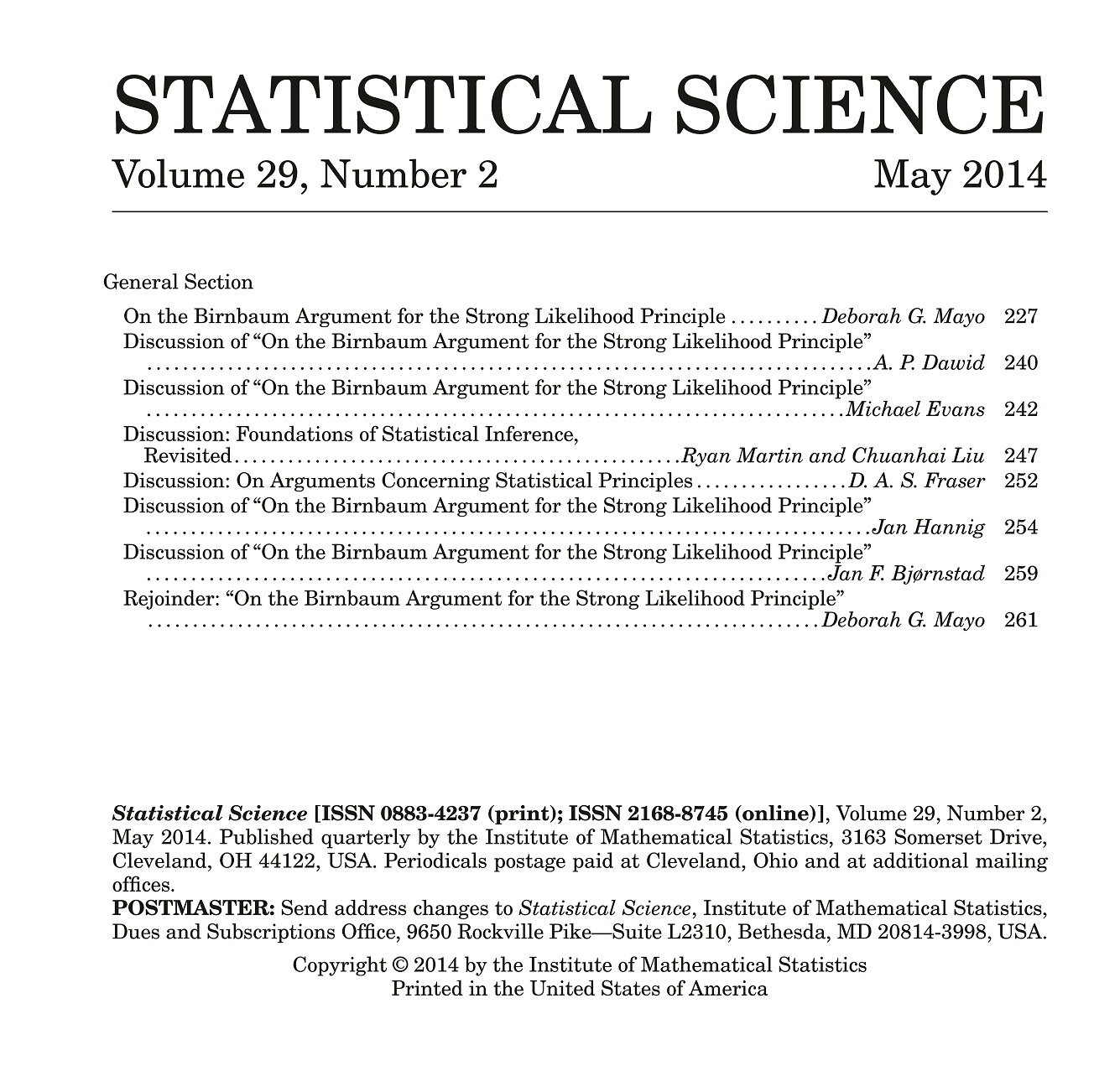
Statistical Science: The Likelihood Principle issue is out…!

Stat SciAbbreviated Table of Contents:

Table of ContentsHere are some items for your Saturday-Sunday reading. 

Link to complete discussion: 

Mayo, Deborah G. On the Birnbaum Argument for the Strong Likelihood Principle (with discussion & rejoinder). Statistical Science 29 (2014), no. 2, 227-266.

Links to individual papers:

Mayo, Deborah G. On the Birnbaum Argument for the Strong Likelihood Principle. Statistical Science 29 (2014), no. 2, 227-239.

Dawid, A. P. Discussion of “On the Birnbaum Argument for the Strong Likelihood Principle”. Statistical Science 29 (2014), no. 2, 240-241.

Evans, Michael. Discussion of “On the Birnbaum Argument for the Strong Likelihood Principle”. Statistical Science 29 (2014), no. 2, 242-246.

Martin, Ryan; Liu, Chuanhai. Discussion: Foundations of Statistical Inference, Revisited. Statistical Science 29 (2014), no. 2, 247-251.

Fraser, D. A. S. Discussion: On Arguments Concerning Statistical Principles. Statistical Science 29 (2014), no. 2, 252-253.

Hannig, Jan. Discussion of “On the Birnbaum Argument for the Strong Likelihood Principle”. Statistical Science 29 (2014), no. 2, 254-258.

Bjørnstad, Jan F. Discussion of “On the Birnbaum Argument for the Strong Likelihood Principle”. Statistical Science 29 (2014), no. 2, 259-260.

Mayo, Deborah G. Rejoinder: “On the Birnbaum Argument for the Strong Likelihood Principle”. Statistical Science 29 (2014), no. 2, 261-266.

Abstract: An essential component of inference based on familiar frequentist notions, such as p-values, significance and confidence levels, is the relevant sampling distribution. This feature results in violations of a principle known as the strong likelihood principle (SLP), the focus of this paper. In particular, if outcomes x and y from experiments E1 and E2 (both with unknown parameter θ), have different probability models f1( . ), f2( . ), then even though f1(xθ) = cf2(yθ) for all θ, outcomes x and ymay have different implications for an inference about θ. Although such violations stem from considering outcomes other than the one observed, we argue, this does not require us to consider experiments other than the one performed to produce the data. David Cox [Ann. Math. Statist. 29 (1958) 357–372] proposes the Weak Conditionality Principle (WCP) to justify restricting the space of relevant repetitions. The WCP says that once it is known which Ei produced the measurement, the assessment should be in terms of the properties of Ei. The surprising upshot of Allan Birnbaum’s [J.Amer.Statist.Assoc.57(1962) 269–306] argument is that the SLP appears to follow from applying the WCP in the case of mixtures, and so uncontroversial a principle as sufficiency (SP). But this would preclude the use of sampling distributions. The goal of this article is to provide a new clarification and critique of Birnbaum’s argument. Although his argument purports that [(WCP and SP), entails SLP], we show how data may violate the SLP while holding both the WCP and SP. Such cases also refute [WCP entails SLP].

Key words: Birnbaumization, likelihood principle (weak and strong), sampling theory, sufficiency, weak conditionality

Regular readers of this blog know that the topic of the “Strong Likelihood Principle (SLP)” has come up quite frequently. Numerous informal discussions of earlier attempts to clarify where Birnbaum’s argument for the SLP goes wrong may be found on this blog. [SEE PARTIAL LIST BELOW.[i]] These mostly stem from my initial paper Mayo (2010) [ii]. I’m grateful for the feedback.

In the months since this paper has been accepted for publication, I’ve been asked, from time to time, to reflect informally on the overall journey: (1) Why was/is the Birnbaum argument so convincing for so long? (Are there points being overlooked, even now?) (2) What would Birnbaum have thought? (3) What is the likely upshot for the future of statistical foundations (if any)?

I’ll try to share some responses over the next week. (Naturally, additional questions are welcome.)

[i] A quick take on the argument may be found in the appendix to: “A Statistical Scientist Meets a Philosopher of Science: A conversation between David Cox and Deborah Mayo (as recorded, June 2011)”

 UPhils and responses



Categories: Birnbaum, Birnbaum Brakes, frequentist/Bayesian, Likelihood Principle, phil/history of stat, Statistics | 45 Comments

Blog at WordPress.com.