 U-Phil: I would like to open up this post, together with Gandenberger’s (Oct. 30, 2012), to reader U-Phils, from December 6- 19 (< 1000 words) for posting on this blog (please see # at bottom of post). Where Gandenberger claims, “Birnbaum’s proof is valid and his premises are intuitively compelling,” I have shown that if Birnbaum’s premises are interpreted so as to be true, the argument is invalid. If construed as formally valid, I argue, the premises contradict each other. Who is right? Gandenberger doesn’t wrestle with my critique of Birnbaum, but I invite you (and Greg!) to do so. I’m pasting a new summary of my argument below.
The main premises may be found on pp. 11-14. While these points are fairly straightforward (and do not require technical statistics), they offer an intriguing logical, statistical and linguistic puzzle. The following is an overview of my latest take on the Birnbaum argument. See also “Breaking Through the Breakthrough” posts: Dec. 6 and Dec 7, 2011.
Gandenberger also introduces something called the methodological likelihood principle. A related idea for a U-Phil is to ask: can one mount a sound, non-circular argument for that variant? And while one is at it, do his methodological variants of sufficiency and conditionality yield plausible principles?
Graduate students and others invited!
______________________________________________________
New Summary of Mayo Critique of Birnbaum’s Argument for the SLP
Deborah Mayo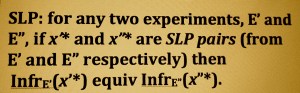
See also a (draft) of the full PAPER corresponding to this summary, a later and more satisfactory draft is here. Yet other links to the Strong Likelihood Principle SLP: Mayo 2010; Cox & Mayo 2011 (appendix).
Continue reading →

 Dear Reader: We just arrived in London[i][ii]. Jean Miller has put together some materials for Birnbaum LP aficionados in connection with my 28 November seminar. Great to have ready links to some of the early comments and replies by Birnbaum, Durbin, Kalbfleish and others, possibly of interest to those planning contributions to the current “U-Phil“. I will try to make some remarks on Birnbaum’s 1970 letter to the editor tomorrow.








 Error Statistics Philosophy