First draft of PhilStat Announcement
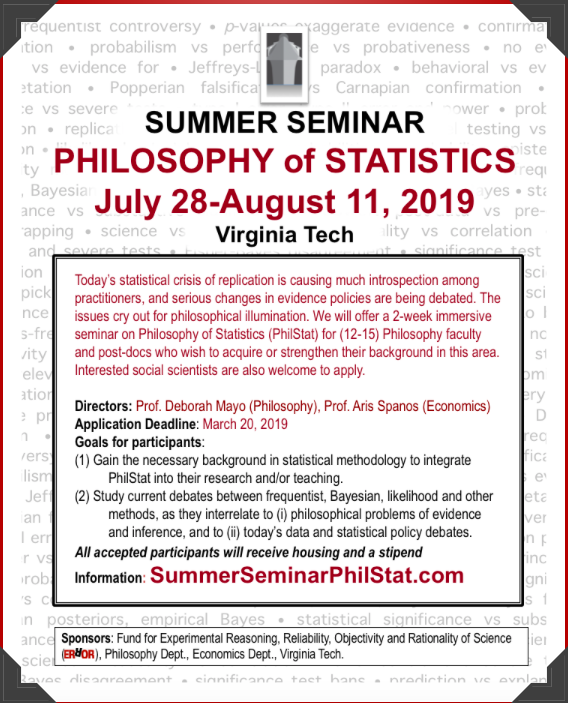
First draft of PhilStat Announcement
.
Excerpts from the Preface:
The Statistics Wars:
Today’s “statistics wars” are fascinating: They are at once ancient and up to the minute. They reflect disagreements on one of the deepest, oldest, philosophical questions: How do humans learn about the world despite threats of error due to incomplete and variable data? At the same time, they are the engine behind current controversies surrounding high-profile failures of replication in the social and biological sciences. How should the integrity of science be restored? Experts do not agree. This book pulls back the curtain on why. Continue reading
 I predicted that the degree of agreement behind the ASA’s “6 principles” on p-values , partial as it was,was unlikely to be replicated when it came to most of the “other approaches” with which some would supplement or replace significance tests– notably Bayesian updating, Bayes factors, or likelihood ratios (confidence intervals are dual to hypotheses tests). [My commentary is here.] So now they may be advising a “hold off” or “go slow” approach until some consilience is achieved. Is that it? There’s word that the ASA will hold meeting where the other approaches are put through their paces. I don’t know when. I was tweeted an article about the background chatter taking place behind the scenes; I wasn’t one of people interviewed for this. Here are some excerpts, I may add more later after it has had time to sink in.
“Restoring Credibility in Statistical Science: Proceed with Caution Until a Balanced Critique Is In”
J. Hossiason Continue reading
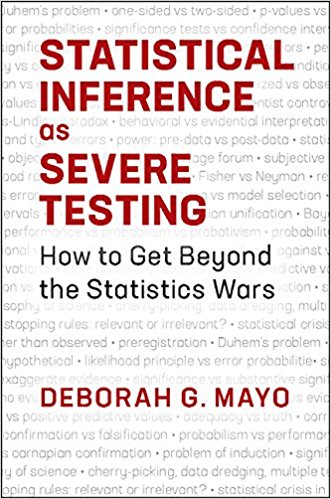
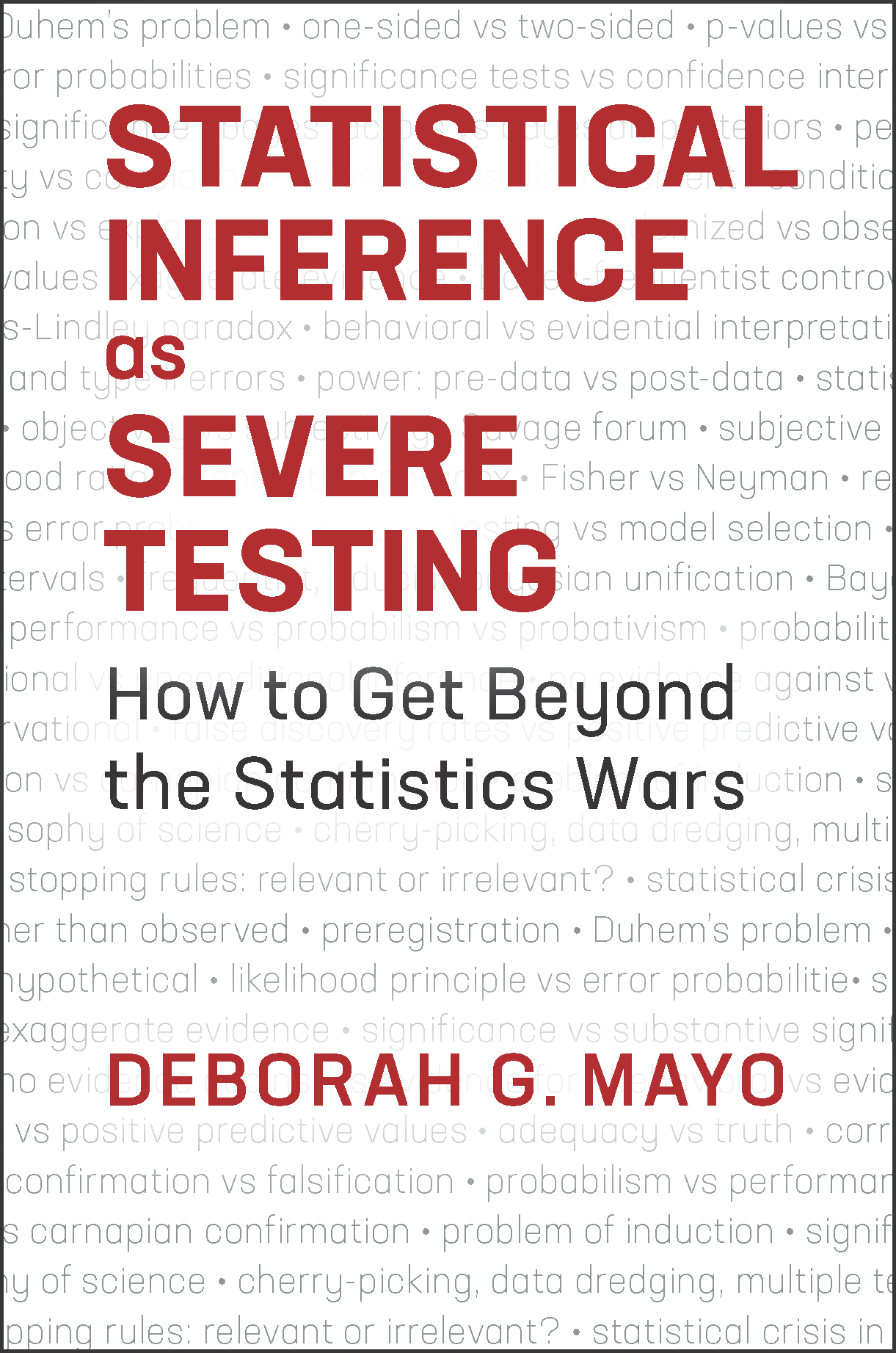
SNEAK PREVIEW: Here’s the cover of Statistical Inference as Severe Testing: How to Get Beyond the Statistics Wars:
It should be out in July 2018. The “Itinerary”, generally known as the Table of Contents, is below. I forgot to mention that this is not the actual pagination, I don’t have the page proofs yet. These are the pages of the draft I submitted. It should be around 50 pages shorter in the actual page proofs, maybe 380 pages.

.
There will be a roundtable on reproducibility Friday, October 27th (noon Eastern time), hosted by the International Methods Colloquium, on the reproducibility crisis in social sciences motivated by the paper, “Redefine statistical significance.” Recall, that was the paper written by a megateam of researchers as part of the movement to require p ≤ .005, based on appraising significance tests by a Bayes Factor analysis, with prior probabilities on a point null and a given alternative. It seems to me that if you’re prepared to scrutinize your frequentist (error statistical) method on grounds of Bayes Factors, then you must endorse using Bayes Factors (BFs) for inference to begin with. If you don’t endorse BFs–and, in particular, the BF required to get the disagreement with p-values–*, then it doesn’t make sense to appraise your non-Bayesian method on grounds of agreeing or disagreeing with BFs. For suppose you assess the recommended BFs from the perspective of an error statistical account–that is, one that checks how frequently the method would uncover or avoid the relevant mistaken inference.[i] Then, if you reach the stipulated BF level against a null hypothesis, you will find the situation is reversed, and the recommended BF exaggerates the evidence! (In particular, with high probability, it gives an alternative H’ fairly high posterior probability, or comparatively higher probability, even though H’ is false.) Failing to reach the BF cut-off, by contrast, can find no evidence against, and even finds evidence for, a null hypothesis with high probability, even when non-trivial discrepancies exist. They’re measuring very different things, and it’s illicit to expect an agreement on numbers.[ii] We’ve discussed this quite a lot on this blog (2 are linked below [iii]).
If the given list of panelists is correct, it looks to be 4 against 1, but I’ve no doubt that Lakens can handle it.
I was part of something called “a brains blog roundtable” on the business of p-values earlier this week–I’m glad to see philosophers getting involved.
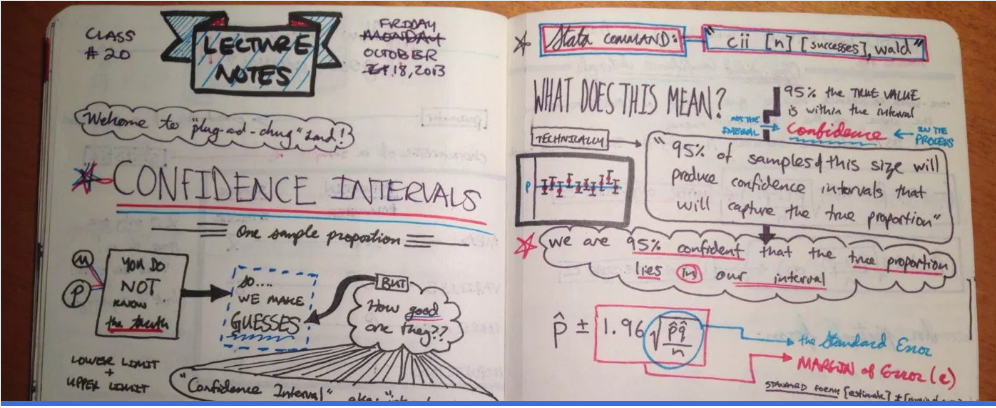
Next week I’ll be in a session that I think is intended to explain what’s right about P-values at an ASA Symposium on Statistical Inference : “A World Beyond p < .05”. Continue reading
.
 May 1-3, 2017
The Department of Statistics is pleased to announce the 4th Bayesian, Fiducial and Frequentist Workshop (BFF4), to be held on May 1-3, 2017 at Harvard University. The BFF workshop series celebrates foundational thinking in statistics and inference under uncertainty. The three-day event will present talks, discussions and panels that feature statisticians and philosophers whose research interests synergize at the interface of their respective disciplines. Confirmed featured speakers include Sir David Cox and Stephen Stigler.
Featured Speakers and Discussants: Arthur Dempster (Harvard); Cynthia Dwork (Harvard); Andrew Gelman (Columbia); Ned Hall (Harvard); Deborah Mayo (Virginia Tech); Nancy Reid (Toronto); Susanna Rinard (Harvard); Christian Robert (Paris-Dauphine/Warwick); Teddy Seidenfeld (CMU); Glenn Shafer (Rutgers); Stephen Senn (LIH); Stephen Stigler (Chicago); Sandy Zabell (Northwestern)
Invited Speakers and Panelists: Jim Berger (Duke); Emery Brown (MIT/MGH); Larry Brown (Wharton); David Cox (Oxford; remote participation); Paul Edlefsen (Hutch); Don Fraser (Toronto); Ruobin Gong (Harvard); Jan Hannig (UNC); Alfred Hero (Michigan); Nils Hjort (Oslo); Pierre Jacob (Harvard); Keli Liu (Stanford); Regina Liu (Rutgers); Antonietta Mira (USI); Ryan Martin (NC State); Vijay Nair (Michigan); James Robins (Harvard); Daniel Roy (Toronto); Donald B. Rubin (Harvard); Peter XK Song (Michigan); Gunnar Taraldsen (NUST); Tyler VanderWeele (HSPH); Vladimir Vovk (London); Nanny Wermuth (Chalmers/Gutenberg); Min-ge Xie (Rutgers)
I’m speaking on “Probing with Severity” at the “Columbia Workshop on Probability and Learning” On April 8:
Meetings of the Formal Philosophy Group at Columbia
April 8, 2017
Department of Philosophy, Columbia University
Room 716
Philosophy Hall, 1150 Amsterdam Avenue
New York 10027
United States
Sponsor(s):
Main speakers:
Gordon Belot (University of Michigan, Ann Arbor)
Simon Huttegger (University of California, Irvine)
Deborah Mayo (Virginia Tech)
Teddy Seidenfeld (Carnegie Mellon University)
Organisers:
Michael Nielsen (Columbia University)
Rush Stewart (Columbia University)
Details
Unfortunately, access to Philosophy Hall is by swipe access on the weekends. However, students and faculty will be entering and exiting the building throughout the day (with relateively high frequency since there is a popular cafe on the main floor).

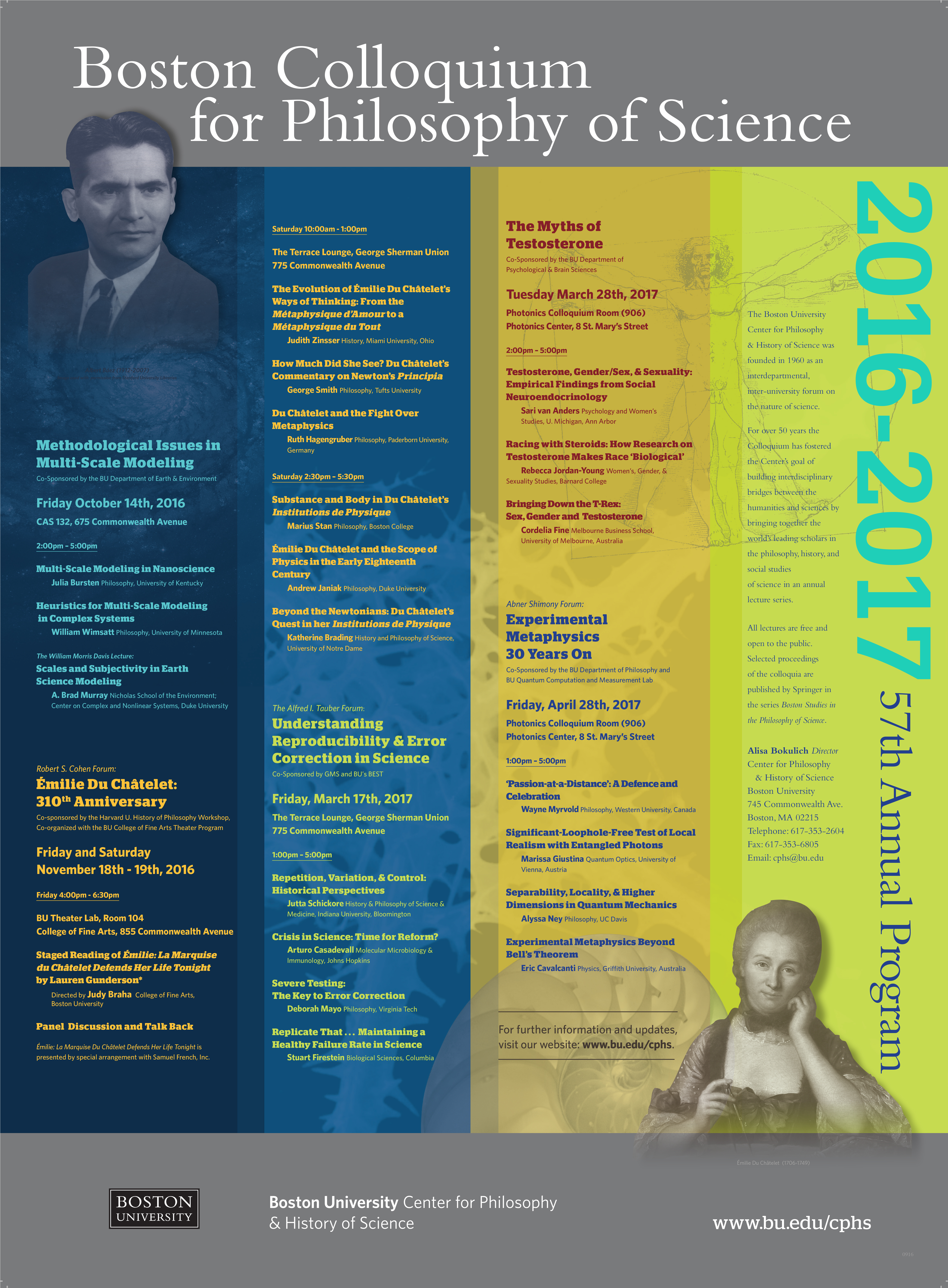
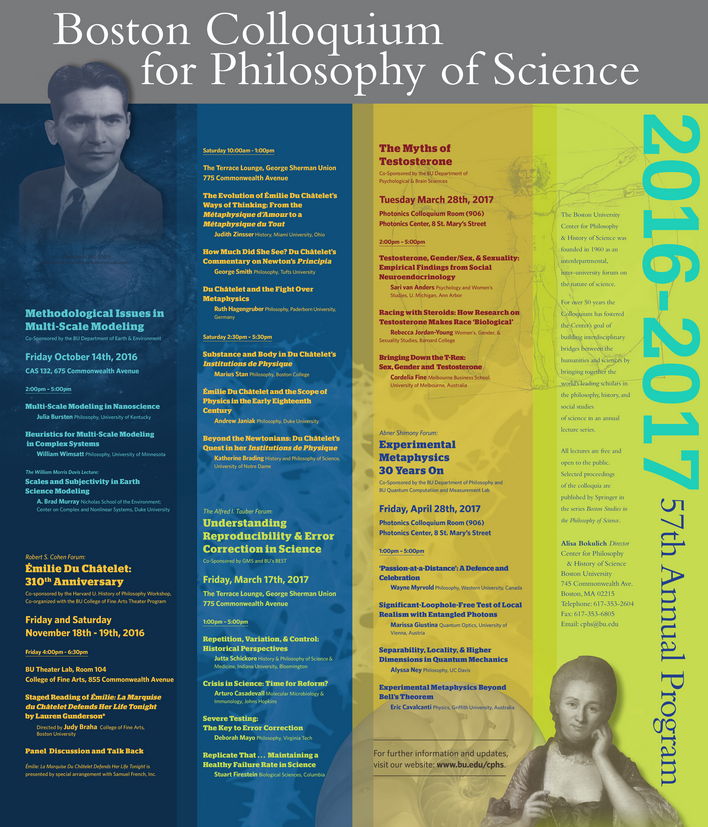
Download the 57th Annual Program
The Alfred I. Taub forum:
UNDERSTANDING REPRODUCIBILITY & ERROR CORRECTION IN SCIENCE
Cosponsored by GMS and BU’s BEST at Boston University.
Friday, March 17, 2017
1:00 p.m. – 5:00 p.m.
The Terrace Lounge, George Sherman Union
775 Commonwealth Avenue
Winners of the December 2016 Palindrome contest
Since both November and December had the contest word verifies/reverifies, the judges decided to give two prizes this month. Thank you both for participating!

.
Kyle Griffiths
Palindrome: Sleep, raw Elba, ere verified ire; Sir, rise, ride! If I revere able war peels.
The requirement: A palindrome using “verifies” (reverifies) or “verified” (reverified) and Elba, of course.
Statement: Here’s my December submission, hope you like it, it has a kind of revolutionary war theme. I have no particular history of palindrome-writing or contest-entering. Instead, I found Mayo’s work via the recommendation of Jeremy Fox of Dynamic Ecology. I am interested in her take on modern statistical practices in ecology, and generally in understanding what makes scientific methods robust and reliable. I’m an outsider to philosophy and stats (I have an MS in Biology), so I appreciate the less-formal tone of the blog. I’m really looking forward to Mayo’s next book.
Book choice (out of 12 or more): Principles of Applied Statistics (D. R. Cox and C. A. Donnelly 2011, Cambridge: Cambridge University Press)
Bio: Part-time Biology Instructor, Scientific Aide for California Dept. of Fish & Wildlife. Interested in aquatic ecology, fish population dynamics.
*******************************************************************************************

.
Eileen Flanagan
Palindrome: Elba man, error reels inanities. I verified art I trade, if I revise it in an isle. Error renamable.
The requirement: A palindrome using “verifies” (reverifies) or “verified” (reverified) and Elba, of course.
Bio: Retired civil servant with a philosophy Ph.D; a bit camera shy so used a stand-in for my photo. 🙂
Statement: I found your blog searching for information on fraud in science a few years ago, and now that I am retired, I am enjoying twisting my mind around palindromes and other word games that I find on-line. 🙂
Book choice (out of 12 or more): For my book, I would like a copy of Error and the Growth of Experimental Knowledge (D. G. Mayo, 1996, Chicago: Chicago University Press).
*******************************************************************************************
Some of Mayo’s attempts, posted through Nov-Dec:
Elba felt busy, reverifies use. I fire very subtle fable.
To I: disabled racecar ties. I verified or erode, if I revise it. Race card: Elba’s idiot.
Elba, I rave to men: “I felt busy!” Reverified, I hide, I fire very subtle fine mote variable.
I deified able deities. I verified a rap parade. If I revise, I tied. Elba deified I.
Download the 57th Annual Program
The Alfred I. Taub forum:
UNDERSTANDING REPRODUCIBILITY & ERROR CORRECTION IN SCIENCE
Cosponsored by GMS and BU’s BEST at Boston University.
Friday, March 17, 2017
1:00 p.m. – 5:00 p.m.
The Terrace Lounge, George Sherman Union
775 Commonwealth Avenue
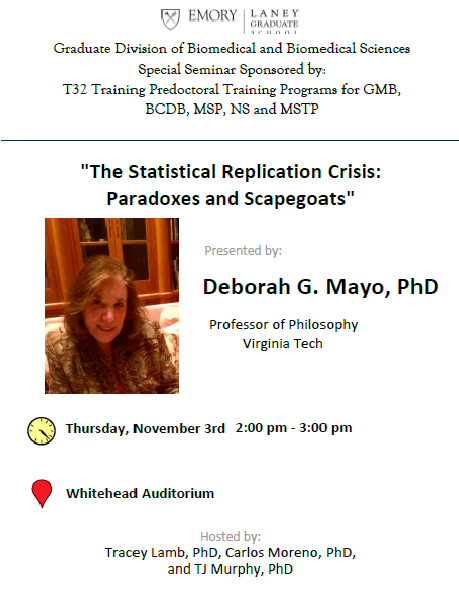
Link to Seminar Flyer pdf.
 PSA 2016 Symposium:
Philosophy of Statistics in the Age of Big Data and Replication Crises
Friday November 4th 9-11:45 am (includes coffee break 10-10:15)
Location: Piedmont 4 (12th Floor) Westin Peachtree Plaza
Speakers:
Key Words: big data, frequentist and Bayesian philosophies, history and philosophy of statistics, meta-research, p-values, replication, significance tests.
Summary:
Science is undergoing a crisis over reliability and reproducibility. High-powered methods are prone to cherry-picking correlations, significance-seeking, and assorted modes of extraordinary rendition of data. The Big Data revolution may encourage a reliance on statistical methods without sufficient scrutiny of whether they are teaching us about causal processes of interest. Mounting failures of replication in the social and biological sciences have resulted in new institutes for meta-research, replication research, and widespread efforts to restore scientific integrity and transparency. Statistical significance test controversies, long raging in the social sciences, have spread to all fields using statistics. At the same time, foundational debates over frequentist and Bayesian methods have shifted in important ways that are often overlooked in the debates. The problems introduce philosophical and methodological questions about probabilistic tools, and science and pseudoscience—intertwined with technical statistics and the philosophy and history of statistics. Our symposium goal is to address foundational issues around which the current crisis in science revolves. We combine the insights of philosophers, psychologists, and statisticians whose work interrelates philosophy and history of statistics, data analysis and modeling. Continue reading
.
| Home | Call For Papers | Schedule | Venue | Travel and Accommodations |
|---|
Submission Deadline: December 1st, 2016
Authors Notified: February 8th, 2017
We invite papers in formal epistemology, broadly construed. FEW is an interdisciplinary conference, and so we welcome submissions from researchers in philosophy, statistics, economics, computer science, psychology, and mathematics.
Submissions should be prepared for blind review. Contributors ought to upload a full paper of no more than 6000 words and an abstract of up to 300 words to the Easychair website. Please submit your full paper in .pdf format. The deadline for submissions is December 1st, 2016. Authors will be notified on February 1st, 2017.
The final selection of the program will be made with an eye towards diversity. We especially encourage submissions from PhD candidates, early career researchers and members of groups that are underrepresented in philosophy. Continue reading


.
International Prize in Statistics Awarded to Sir David Cox for
Survival Analysis Model Applied in Medicine, Science, and Engineering
EMBARGOED until October 19, 2016, at 9 p.m. ET
ALEXANDRIA, VA (October 18, 2016) – Prominent British statistician Sir David Cox has been named the inaugural recipient of the International Prize in Statistics. Like the acclaimed Fields Medal, Abel Prize, Turing Award and Nobel Prize, the International Prize in Statistics is considered the highest honor in its field. It will be bestowed every other year to an individual or team for major achievements using statistics to advance science, technology and human welfare.
Cox is a giant in the field of statistics, but the International Prize in Statistics Foundation is recognizing him specifically for his 1972 paper in which he developed the proportional hazards model that today bears his name. The Cox Model is widely used in the analysis of survival data and enables researchers to more easily identify the risks of specific factors for mortality or other survival outcomes among groups of patients with disparate characteristics. From disease risk assessment and treatment evaluation to product liability, school dropout, reincarceration and AIDS surveillance systems, the Cox Model has been applied essentially in all fields of science, as well as in engineering. Continue reading
Departament de Filosofia & Centre d’Història de la Ciència (CEHIC), Universitat Autònoma de Barcelona (UAB)
Location: CEHIC, Mòdul de Recerca C, Seminari L3-05, c/ de Can Magrans s/n, Campus de la UAB, 08193 Bellaterra (Barcelona)
Organized by Thomas Sturm & Agustí Nieto-Galan
Current science is full of uncertainties and risks that weaken the authority of experts. Moreover, sometimes scientists themselves act in ways that weaken their standing: they manipulate data, exaggerate research results, do not give credit where it is due, violate the norms for the acquisition of academic titles, or are unduly influenced by commercial and political interests. Such actions, of which there are numerous examples in past and present times, are widely conceived of as violating standards of good scientific practice. At the same time, while codes of scientific conduct have been developed in different fields, institutions, and countries, there is no universally agreed canon of them, nor is it clear that there should be one. The workshop aims to bring together historians and philosophers of science in order to discuss questions such as the following: What exactly is scientific misconduct? Under which circumstances are researchers more or less liable to misconduct? How far do cases of misconduct undermine scientific authority? How have standards or mechanisms to avoid misconduct, and to regain scientific authority, been developed? How should they be developed?
All welcome – but since space is limited, please register in advance. Write to: Thomas.Sturm@uab.cat
09:30 Welcome (Thomas Sturm & Agustí Nieto-Galan) Continue reading

.
 I’m giving a joint presentation with Caitlin Parker[1] on Friday (June 17) at the meeting of the Society for Philosophy of Science in Practice (SPSP): “Using Philosophy of Statistics to Make Progress in the Replication Crisis in Psychology” (Rowan University, Glassboro, N.J.)[2] The Society grew out of a felt need to break out of the sterile straightjacket wherein philosophy of science occurs divorced from practice. The topic of the relevance of PhilSci and PhilStat to Sci has often come up on this blog, so people might be interested in the SPSP mission statement below our abstract.
Using Philosophy of Statistics to Make Progress in the Replication Crisis in Psychology
Deborah Mayo Virginia Tech, Department of Philosophy United States
Caitlin Parker Virginia Tech, Department of Philosophy United States
I’m giving a Popper talk at the London School of Economics next Tuesday (10 May). If you’re in the neighborhood, I hope you’ll stop by.
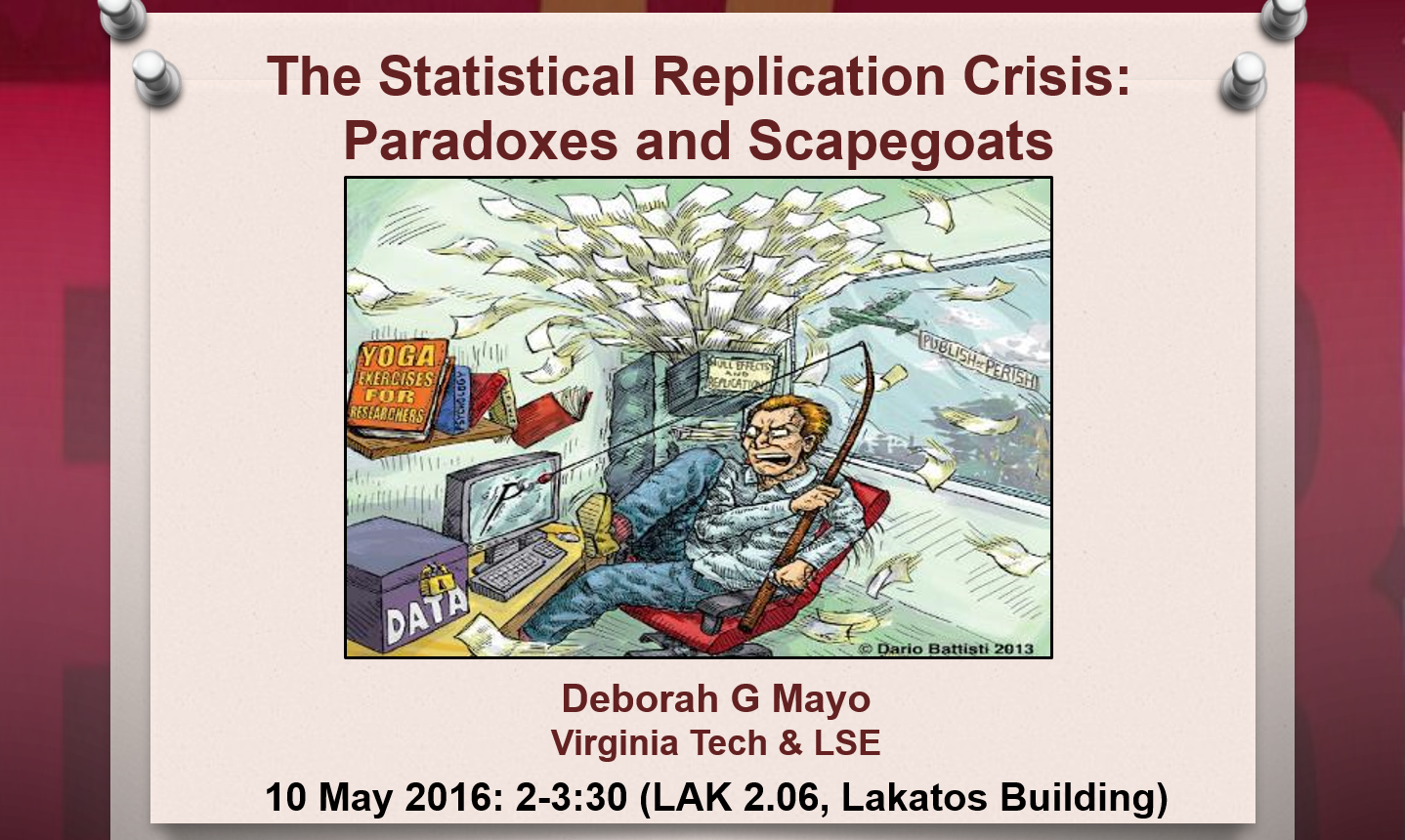
A somewhat accurate blurb is here. I say “somewhat” because it doesn’t mention that I’ll talk a bit about the replication crisis in psychology, and the issues that crop up (or ought to) in connecting statistical results and the causal claim of interest.

.


Experts convene to explore new philosophy of statistics field

 Error Statistics Philosophy