
ASA Guide to P-values

5-year Review: B. Haig: [TAS] 2019 update on P-values and significance (ASA II)(Guest Post)

This is the guest post by Bran Haig on July 12, 2019 in response to the “abandon statistical significance” editorial in The American Statistician (TAS) by Wasserstein, Schirm, and Lazar (WSL 2019). In the post it is referred to as ASAII with a note added once we learned that it is actually not a continuation of the 2016 ASA policy statement. (I decided to leave it that way, as otherwise the context seems lost. But in the title to this post, I refer to the journal TAS.) Brian lists some of the benefits that were to result from abandoning statistical significance. I welcome your constructive thoughts in the comments.

Brian Haig, Professor Emeritus
Department of Psychology
University of Canterbury
Christchurch, New Zealand Continue reading

Categories: 5-year memory lane, abandon statistical significance, ASA Guide to P-values, Brian Haig | Tags: | Leave a comment

5-year review: The NEJM Issues New Guidelines on Statistical Reporting: Is the ASA P-Value Project Backfiring? (i)

In a July 19, 2019 post I discussed The New England Journal of Medicine’s response to Wasserstein’s (2019) call for journals to change their guidelines in reaction to the “abandon significance” drive. The NEJM said “no thanks” [A]. However confidence intervals CIs got hurt in the mix. In this reblog, I kept the reference to “ASA II” with a note, because that best conveys the context of the discussion at the time. Switching it to WSL (2019) just didn’t read right. I invite your comments. Continue reading

Categories: 5-year memory lane, abandon statistical significance, ASA Guide to P-values | 6 Comments

My 2019 friendly amendments to that “abandon significance” editorial

.

It was 3 months before I decided to write a blogpost in response to Wasserstein, Schirm and Lazar (2019)’s editorial in The American Statistician in which they recommend that the concept of “statistical significance” be abandoned, hereafter, WSL 2019. (I titled it “Don’t Say What You don’t Mean”.) In that June 17, 2019 blogpost, pasted below, I proposed 3 “friendly amendments” to the language of that document. (There are 97 comments on that post!) The problem is that WSL 2019 presents several of the 6 principles from ASA I (the 2016 ASA statement on Statistical Significance) in a far stronger fashion so as to be inconsistent or at least in tension with some of them. I didn’t think they really meant what they said. I discussed these amendments with Ron Wasserstein, Executive Director of the ASA at the time. Had these friendly amendments been carried out, the document would not have caused as much of a problem, and people might focus more on the positive recommendations it includes about scientific integrity. The proposed ban on a key concept of statistics would still be problematic, resulting in the 2019 ASA President’s Task Force, but it would have helped the document.  At the time, it was still not known whether WSL 2019 was intended as a continuation of the 2016 ASA policy document [ASA I]. That explains why I first referred to WSL 2019 in this blogpost as ASA II. Once it was revealed that it was not official policy at all (many months later), but only the recommendations of the 3 authors, I placed a “note” after each mention of ASA II. But given it caused sufficient confusion as to result in the then ASA president (Karen Kafadar) appointing an ASA Task Force on Statistical Significance and Replicability in 2019 (see here and here), and later, a disclaimer by the authors, in this reblog I refer to it as WSL 2019. You can search this blog for other posts on the 2019 Task Force: their report is here, and the disclaimer here. Continue reading

Categories: 2016 ASA Statement on P-values, ASA Guide to P-values, ASA Task Force on Significance and Replicability | Leave a comment

Too little, too late? The “Don’t say significance…” editorial gets a disclaimer (ii)

.

Someone sent me an email the other day telling me that a disclaimer had been added to the editorial written by the ASA Executive Director and 2 co-authors (Wasserstein et al., 2019) (“Moving to a world beyond ‘p < 0.05′”). It reads:


The editorial was written by the three editors acting as individuals and reflects their scientific views not an an endorsed position of the American Statistical Association.

Continue reading

Categories: ASA Guide to P-values, ASA Task Force on Significance and Replicability, editorial COIs, WSL 2019 | 20 Comments

January 11 Forum: “Statistical Significance Test Anxiety” : Benjamini, Mayo, Hand

Here are all the slides along with the video from the 11 January Phil Stat Forum with speakers: Deborah G. Mayo, Yoav Benjamini and moderator/discussant David Hand.

D. Mayo                 Y. Benjamini.           D. Hand

Continue reading

Categories: ASA Guide to P-values, ASA Task Force on Significance and Replicability, P-values, statistical significance | 2 Comments

Nathan Schactman: Of Significance, Error, Confidence, and Confusion – In the Law and In Statistical Practice (Guest Post)

.

Nathan Schachtman,  Esq., J.D.
Legal Counsel for Scientific Challenges

Of Significance, Error, Confidence, and Confusion – In the Law and In Statistical Practice

The metaphor of law as an “empty vessel” is frequently invoked to describe the law generally, as well as pejoratively to describe lawyers. The metaphor rings true at least in describing how the factual content of legal judgments comes from outside the law. In many varieties of litigation, not only the facts and data, but the scientific and statistical inferences must be added to the “empty vessel” to obtain a correct and meaningful outcome. Continue reading

Categories: ASA Guide to P-values, ASA Task Force on Significance and Replicability, PhilStat Law, Schachtman | 3 Comments

Reminder: March 25 “How Should Applied Science Journal Editors Deal With Statistical Controversies?” (Mark Burgman)

The seventh meeting of our Phil Stat Forum*:

The Statistics Wars
and Their Casualties

25 March, 2021

TIME: 15:00-16:45 (London); 11:00-12:45 (New York, NOTE TIME CHANGE TO MATCH UK TIME**)

For information about the Phil Stat Wars forum and how to join, click on this link.

How should applied science journal editors deal with statistical controversies?

Mark Burgman Continue reading

Categories: ASA Guide to P-values, confidence intervals and tests, P-values, significance tests | Tags: , | 1 Comment

March 25 “How Should Applied Science Journal Editors Deal With Statistical Controversies?” (Mark Burgman)

The seventh meeting of our Phil Stat Forum*:

The Statistics Wars
and Their Casualties

25 March, 2021

TIME: 15:00-16:45 (London); 11:00-12:45 (New York, NOTE TIME CHANGE)

For information about the Phil Stat Wars forum and how to join, click on this link.

How should applied science journal editors deal with statistical controversies?

Mark Burgman Continue reading

Categories: ASA Guide to P-values, confidence intervals and tests, P-values, significance tests | Tags: , | 1 Comment

Live Exhibit: Bayes Factors & Those 6 ASA P-value Principles

.

Live Exhibit: So what happens if you replace “p-values” with “Bayes Factors” in the 6 principles from the 2016 American Statistical Association (ASA) Statement on P-values? (Remove “or statistical significance” in question 5.)

Does the one positive assertion hold? Are the 5 “don’ts” true? Continue reading

Categories: ASA Guide to P-values, bayes factors | 2 Comments

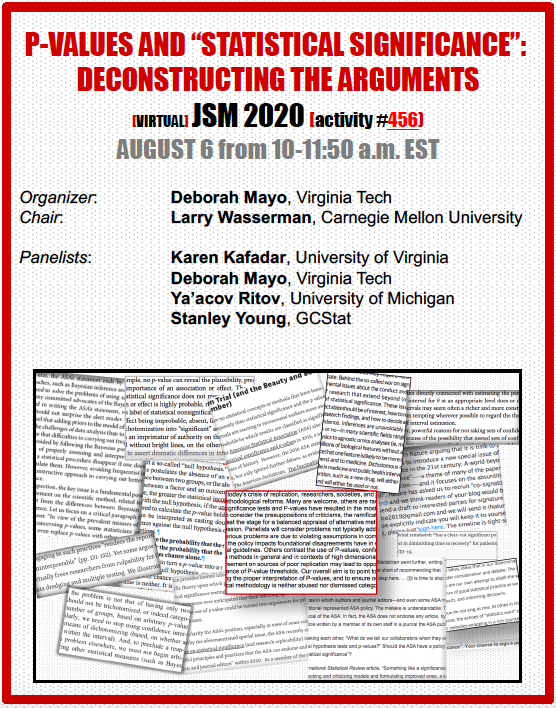
August 6: JSM 2020 Panel on P-values & “Statistical Significance”

SLIDES FROM MY PRESENTATION

July 30 PRACTICE VIDEO for JSM talk (All materials for Practice JSM session here)

JSM 2020 Panel Flyer (PDF)
JSM online program w/panel abstract & information):

Categories: ASA Guide to P-values, Error Statistics, evidence-based policy, JSM 2020, P-values, Philosophy of Statistics, science communication, significance tests | 3 Comments

Bad Statistics is Their Product: Fighting Fire With Fire (ii)

Mayo fights fire w/ fire

I. Doubt is Their Product is the title of a (2008) book by David Michaels, Assistant Secretary for OSHA from 2009-2017. I first mentioned it on this blog back in 2011 (“Will the Real Junk Science Please Stand Up?) The expression is from a statement by a cigarette executive (“doubt is our product”), and the book’s thesis is explained in its subtitle: How Industry’s Assault on Science Threatens Your Health. Imagine you have just picked up a book, published in 2020: Bad Statistics is Their Product. Is the author writing about how exaggerating bad statistics may serve in the interest of denying well-established risks? [Interpretation A]. Or perhaps she’s writing on how exaggerating bad statistics serves the interest of denying well-established statistical methods? [Interpretation B]. Both may result in distorting science and even in dismantling public health safeguards–especially if made the basis of evidence policies in agencies. A responsible philosopher of statistics should care. Continue reading

Categories: ASA Guide to P-values, Error Statistics, P-values, replication research, slides | 33 Comments

“Les stats, c’est moi”: We take that step here! (Adopt our fav word or phil stat!)(iii)

les stats, c’est moi

When it comes to the statistics wars, leaders of rival tribes sometimes sound as if they believed “les stats, c’est moi”.  [1]. So, rather than say they would like to supplement some well-known tenets (e.g., “a statistically significant effect may not be substantively important”) with a new rule that advances their particular preferred language or statistical philosophy, they may simply blurt out: “we take that step here!” followed by whatever rule of language or statistical philosophy they happen to prefer (as if they have just added the new rule to the existing, uncontested tenets). Karan Kefadar, in her last official (December) report as President of the American Statistical Association (ASA), expresses her determination to call out this problem at the ASA itself. (She raised it first in her June article, discussed in my last post.) Continue reading

Categories: ASA Guide to P-values | 85 Comments

P-Value Statements and Their Unintended(?) Consequences: The June 2019 ASA President’s Corner (b)

2208388671_0d8bc38714

Mayo writing to Kafadar

I never met Karen Kafadar, the 2019 President of the American Statistical Association (ASA), but the other day I wrote to her in response to a call in her extremely interesting June 2019 President’s Corner: “Statistics and Unintended Consequences“:

  • “I welcome your suggestions for how we can communicate the importance of statistical inference and the proper interpretation of p-values to our scientific partners and science journal editors in a way they will understand and appreciate and can use with confidence and comfort—before they change their policies and abandon statistics altogether.”

I only recently came across her call, and I will share my letter below. First, here are some excerpts from her June President’s Corner (her December report is due any day). Continue reading

Categories: ASA Guide to P-values, Bayesian/frequentist, P-values | 3 Comments

The ASA’s P-value Project: Why it’s Doing More Harm than Good (cont from 11/4/19)


cure by committee

Everything is impeach and remove these days! Should that hold also for the concept of statistical significance and P-value thresholds? There’s an active campaign that says yes, but I aver it is doing more harm than good. In my last post, I said I would count the ways it is detrimental until I became “too disconsolate to continue”. There I showed why the new movement, launched by Executive Director of the ASA (American Statistical Association), Ronald Wasserstein (in what I dub ASA II(note)), is self-defeating: it instantiates and encourages the human-all-too-human tendency to exploit researcher flexibility, rewards, and openings for bias in research (F, R & B Hypothesis). That was reason #1. Just reviewing it already fills me with such dismay, that I fear I will become too disconsolate to continue before even getting to reason #2. So let me just quickly jot down reasons #2, 3, 4, and 5 (without full arguments) before I expire. Continue reading

Categories: ASA Guide to P-values | 7 Comments

National Academies of Science: Please Correct Your Definitions of P-values

Mayo banging head

If you were on a committee to highlight issues surrounding P-values and replication, what’s the first definition you would check? Yes, exactly. Apparently, when it came to the recently released National Academies of Science “Consensus Study” Reproducibility and Replicability in Science 2019, no one did. Continue reading

Categories: ASA Guide to P-values, Error Statistics, P-values | 20 Comments

Hardwicke and Ioannidis, Gelman, and Mayo: P-values: Petitions, Practice, and Perils (and a question for readers)

.

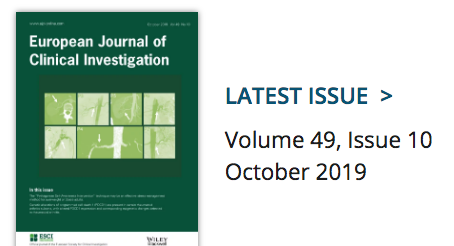
The October 2019 issue of the European Journal of Clinical Investigations came out today. It includes the PERSPECTIVE article by Tom Hardwicke and John Ioannidis, an invited editorial by Gelman and one by me:

Petitions in scientific argumentation: Dissecting the request to retire statistical significance, by Tom Hardwicke and John Ioannidis

When we make recommendations for scientific practice, we are (at best) acting as social scientists, by Andrew Gelman

P-value thresholds: Forfeit at your peril, by Deborah Mayo

I blogged excerpts from my preprint, and some related posts, here.

All agree to the disagreement on the statistical and metastatistical issues: Continue reading

Categories: ASA Guide to P-values, P-values, stat wars and their casualties | 16 Comments

(Excerpts from) ‘P-Value Thresholds: Forfeit at Your Peril’ (free access)

.

A key recognition among those who write on the statistical crisis in science is that the pressure to publish attention-getting articles can incentivize researchers to produce eye-catching but inadequately scrutinized claims. We may see much the same sensationalism in broadcasting metastatistical research, especially if it takes the form of scapegoating or banning statistical significance. A lot of excitement was generated recently when Ron Wasserstein, Executive Director of the American Statistical Association (ASA), and co-editors A. Schirm and N. Lazar, updated(note) the 2016 ASA Statement on P-Values and Statistical Significance (ASA I). In their 2019 interpretation, ASA I “stopped just short of recommending that declarations of ‘statistical significance’ be abandoned,” and in their new statement (ASA II)(note) announced: “We take that step here….’statistically significant’ –don’t say it and don’t use it”. To herald the ASA II(note), and the special issue “Moving to a world beyond ‘p < 0.05’”, the journal Nature requisitioned a commentary from Amrhein, Greenland and McShane “Retire Statistical Significance” (AGM). With over 800 signatories, the commentary received the imposing title “Scientists rise up against significance tests”! Continue reading

Categories: ASA Guide to P-values, P-values, stat wars and their casualties | 6 Comments

Palavering about Palavering about P-values

.

Nathan Schachtman (who was a special invited speaker at our recent Summer Seminar in Phil Stat) put up a post on his law blog the other day (“Palavering About P-values”) on an article by a statistics professor at Stanford, Helena Kraemer. “Palavering” is an interesting word choice of Schachtman’s. Its range of meanings is relevant here [i]; in my title, I intend both, in turn. You can read Schachtman’s full post here, it begins like this:

The American Statistical Association’s most recent confused and confusing communication about statistical significance testing has given rise to great mischief in the world of science and science publishing.[ASA II 2019]note Take for instance last week’s opinion piece about “Is It Time to Ban the P Value?” Please.

Admittedly, their recent statement, which I refer to as ASA II,note has seemed to open the floodgates to some very zany remarks about P-values, their meaning and role in statistical testing. Continuing with Schachtman’s post: Continue reading

Categories: ASA Guide to P-values, P-values | Tags: | 12 Comments

The NEJM Issues New Guidelines on Statistical Reporting: Is the ASA P-Value Project Backfiring? (i)

The New England Journal of Medicine NEJM announced new guidelines for authors for statistical reporting  yesterday*. The ASA describes the change as “in response to the ASA Statement on P-values and Statistical Significance and subsequent The American Statistician special issue on statistical inference” (ASA I and II,(note) in my abbreviation). If so, it seems to have backfired. I don’t know all the differences in the new guidelines, but those explicitly noted appear to me to move in the reverse direction from where the ASA I and II(note) guidelines were heading.

The most notable point is that the NEJM highlights the need for error control, especially for constraining the Type I error probability, and pays a lot of attention to adjusting P-values for multiple testing and post hoc subgroups. ASA I included an important principle (#4) that P-values are altered and may be invalidated by multiple testing, but they do not call for adjustments for multiplicity, nor do I find a discussion of Type I or II error probabilities in the ASA documents. NEJM gives strict requirements for controlling family-wise error rate or false discovery rates (understood as the Benjamini and Hochberg frequentist adjustments). Continue reading

Categories: ASA Guide to P-values | 23 Comments

B. Haig: The ASA’s 2019 update on P-values and significance (ASA II)(Guest Post)

Brian Haig, Professor Emeritus
Department of Psychology
University of Canterbury
Christchurch, New Zealand

The American Statistical Association’s (ASA) recent effort to advise the statistical and scientific communities on how they should think about statistics in research is ambitious in scope. It is concerned with an initial attempt to depict what empirical research might look like in “a world beyond p<0.05” (The American Statistician, 2019, 73, S1,1-401). Quite surprisingly, the main recommendation of the lead editorial article in the Special Issue of The American Statistician devoted to this topic (Wasserstein, Schirm, & Lazar, 2019; hereafter, ASA II(note)) is that “it is time to stop using the term ‘statistically significant’ entirely”. (p.2) ASA II(note) acknowledges the controversial nature of this directive and anticipates that it will be subject to critical examination. Indeed, in a recent post, Deborah Mayo began her evaluation of ASA II(note) by making constructive amendments to three recommendations that appear early in the document (‘Error Statistics Philosophy’, June 17, 2019). These amendments have received numerous endorsements, and I record mine here. In this short commentary, I briefly state a number of general reservations that I have about ASA II(note). Continue reading

Categories: ASA Guide to P-values, Brian Haig | Tags: | 33 Comments

Blog at WordPress.com.