Having discussed the “p-values overstate the evidence against the null fallacy” many times over the past few years, I leave it to readers to disinter the issues (pro and con), and appraise the assumptions, in the most recent rehearsal of the well-known Bayesian argument. There’s nothing intrinsically wrong with demanding everyone work with a lowered p-value–if you’re so inclined to embrace a single, dichotomous standard without context-dependent interpretations, especially if larger sample sizes are required to compensate the loss of power. But lowering the p-value won’t solve the problems that vex people (biasing selection effects), and is very likely to introduce new ones (see my comment). Kelly Servick, a reporter from Science, gives the ingredients of the main argument given by “a megateam of reproducibility-minded scientists” in an article out today: Continue reading
P-values
3 YEARS AGO (JULY 2014): MEMORY LANE
MONTHLY MEMORY LANE: 3 years ago: July 2014. I mark in red 3-4 posts from each month that seem most apt for general background on key issues in this blog, excluding those reblogged recently[1]. Posts that are part of a “unit” or a group count as one. This month there are three such groups: 7/8 and 7/10; 7/14 and 7/23; 7/26 and 7/31.
July 2014
- (7/7) Winner of June Palindrome Contest: Lori Wike
- (7/8) Higgs Discovery 2 years on (1: “Is particle physics bad science?”)
- (7/10) Higgs Discovery 2 years on (2: Higgs analysis and statistical flukes)
- (7/14) “P-values overstate the evidence against the null”: legit or fallacious? (revised)
- (7/23) Continued:”P-values overstate the evidence against the null”: legit or fallacious?
- (7/26) S. Senn: “Responder despondency: myths of personalized medicine” (Guest Post)
- (7/31) Roger Berger on Stephen Senn’s “Blood Simple” with a response by Senn (Guest Posts)
[1] Monthly memory lanes began at the blog’s 3-year anniversary in Sept, 2014.
If you’re seeing limb-sawing in P-value logic, you’re sawing off the limbs of reductio arguments
I was just reading a paper by Martin and Liu (2014) in which they allude to the “questionable logic of proving H0 false by using a calculation that assumes it is true”(p. 1704). They say they seek to define a notion of “plausibility” that
“fits the way practitioners use and interpret p-values: a small p-value means H0 is implausible, given the observed data,” but they seek “a probability calculation that does not require one to assume that H0 is true, so one avoids the questionable logic of proving H0 false by using a calculation that assumes it is true“(Martin and Liu 2014, p. 1704).
Questionable? A very standard form of argument is a reductio (ad absurdum) wherein a claim C is inferred (i.e., detached) by falsifying ~C, that is, by showing that assuming ~C entails something in conflict with (if not logically contradicting) known results or known truths [i]. Actual falsification in science is generally a statistical variant of this argument. Supposing H0 in p-value reasoning plays the role of ~C. Yet some aver it thereby “saws off its own limb”! Continue reading
Er, about those other approaches, hold off until a balanced appraisal is in
I could have told them that the degree of accordance enabling the ASA’s “6 principles” on p-values was unlikely to be replicated when it came to most of the “other approaches” with which some would supplement or replace significance tests– notably Bayesian updating, Bayes factors, or likelihood ratios (confidence intervals are dual to hypotheses tests). [My commentary is here.] So now they may be advising a “hold off” or “go slow” approach until some consilience is achieved. Is that it? I don’t know. I was tweeted an article about the background chatter taking place behind the scenes; I wasn’t one of people interviewed for this. Here are some excerpts, I may add more later after it has had time to sink in. (check back later)
“Reaching for Best Practices in Statistics: Proceed with Caution Until a Balanced Critique Is In”
J. Hossiason
“[A]ll of the other approaches*, as well as most statistical tools, may suffer from many of the same problems as the p-values do. What level of likelihood ratio in favor of the research hypothesis will be acceptable to the journal? Should scientific discoveries be based on whether posterior odds pass a specific threshold (P3)? Does either measure the size of an effect (P5)?…How can we decide about the sample size needed for a clinical trial—however analyzed—if we do not set a specific bright-line decision rule? 95% confidence intervals or credence intervals…offer no protection against selection when only those that do not cover 0, are selected into the abstract (P4). (Benjamini, ASA commentary, pp. 3-4)
What’s sauce for the goose is sauce for the gander right? Many statisticians seconded George Cobb who urged “the board to set aside time at least once every year to consider the potential value of similar statements” to the recent ASA p-value report. Disappointingly, a preliminary survey of leaders in statistics, many from the original p-value group, aired striking disagreements on best and worst practices with respect to these other approaches. The Executive Board is contemplating a variety of recommendations, minimally, that practitioners move with caution until they can put forward at least a few agreed upon principles for interpreting and applying Bayesian inference methods. The words we heard ranged from “go slow” to “moratorium“ [emphasis mine]. Having been privy to some of the results of this survey, we at Stat Report Watch decided to contact some of the individuals involved. Continue reading
The ASA Document on P-Values: One Year On
I’m surprised it’s a year already since posting my published comments on the ASA Document on P-Values. Since then, there have been a slew of papers rehearsing the well-worn fallacies of tests (a tad bit more than the usual rate). Doubtless, the P-value Pow Wow raised people’s consciousnesses. I’m interested in hearing reader reactions/experiences in connection with the P-Value project (positive and negative) over the past year. (Use the comments, share links to papers; and/or send me something slightly longer for a possible guest post.)
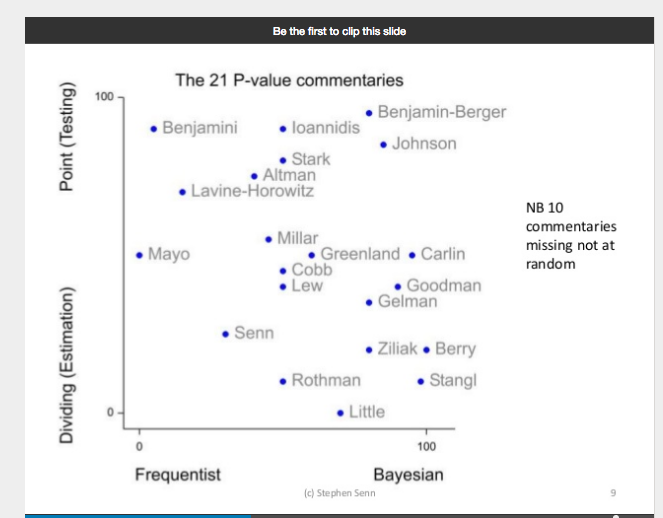
Some people sent me a diagram from a talk by Stephen Senn (on “P-values and the art of herding cats”). He presents an array of different cat commentators, and for some reason Mayo cat is in the middle but way over on the left side,near the wall. I never got the key to interpretation. My contribution is below:
“Don’t Throw Out The Error Control Baby With the Bad Statistics Bathwater”
D. Mayo*[1]
The American Statistical Association is to be credited with opening up a discussion into p-values; now an examination of the foundations of other key statistical concepts is needed. Continue reading
Hocus pocus! Adopt a magician’s stance, if you want to reveal statistical sleights of hand
Here’s the follow-up post to the one I reblogged on Feb 3 (please read that one first). When they sought to subject Uri Geller to the scrutiny of scientists, magicians had to be brought in because only they were sufficiently trained to spot the subtle sleight of hand shifts by which the magician tricks by misdirection. We, too, have to be magicians to discern the subtle misdirections and shifts of meaning in the discussions of statistical significance tests (and other methods)—even by the same statistical guide. We needn’t suppose anything deliberately devious is going on at all! Often, the statistical guidebook reflects shifts of meaning that grow out of one or another critical argument. These days, they trickle down quickly to statistical guidebooks, thanks to popular articles on the “statistics crisis in science”. The danger is that their own guidebooks contain inconsistencies. To adopt the magician’s stance is to be on the lookout for standard sleights of hand. There aren’t that many.[0]
I don’t know Jim Frost, but he gives statistical guidance at the minitab blog. The purpose of my previous post is to point out that Frost uses the probability of a Type I error in two incompatible ways in his posts on significance tests. I assumed he’d want to clear this up, but so far he has not. His response to a comment I made on his blog is this: Continue reading
The “P-values overstate the evidence against the null” fallacy
The allegation that P-values overstate the evidence against the null hypothesis continues to be taken as gospel in discussions of significance tests. All such discussions, however, assume a notion of “evidence” that’s at odds with significance tests–generally Bayesian probabilities of the sort used in Jeffrey’s-Lindley disagreement (default or “I’m selecting from an urn of nulls” variety). Szucs and Ioannidis (in a draft of a 2016 paper) claim “it can be shown formally that the definition of the p value does exaggerate the evidence against H0” (p. 15) and they reference the paper I discuss below: Berger and Sellke (1987). It’s not that a single small P-value provides good evidence of a discrepancy (even assuming the model, and no biasing selection effects); Fisher and others warned against over-interpreting an “isolated” small P-value long ago. But the formulation of the “P-values overstate the evidence” meme introduces brand new misinterpretations into an already confused literature! The following are snippets from some earlier posts–mostly this one–and also includes some additions from my new book (forthcoming).
1. What you should ask…
When you hear the familiar refrain, “We all know that P-values overstate the evidence against the null hypothesis”, what you should ask is:
“What do you mean by overstating the evidence against a hypothesis?”
One honest answer is: Continue reading
Szucs & Ioannidis Revive the Limb-Sawing Fallacy
When logical fallacies of statistics go uncorrected, they are repeated again and again…and again. And so it is with the limb-sawing fallacy I first posted in one of my “Overheard at the Comedy Hour” posts.* It now resides as a comic criticism of significance tests in a paper by Szucs and Ioannidis (posted this week), Here’s their version:
“[P]aradoxically, when we achieve our goal and successfully reject H0 we will actually be left in complete existential vacuum because during the rejection of H0 NHST ‘saws off its own limb’ (Jaynes, 2003; p. 524): If we manage to reject H0then it follows that pr(data or more extreme data|H0) is useless because H0 is not true” (p.15).
Here’s Jaynes (p. 524):
“Suppose we decide that the effect exists; that is, we reject [null hypothesis] H0. Surely, we must also reject probabilities conditional on H0, but then what was the logical justification for the decision? Orthodox logic saws off its own limb.’ “
Ha! Ha! By this reasoning, no hypothetical testing or falsification could ever occur. As soon as H is falsified, the grounds for falsifying disappear! If H: all swans are white, then if I see a black swan, H is falsified. But according to this criticism, we can no longer assume the deduced prediction from H! What? Continue reading
“Tests of Statistical Significance Made Sound”: excerpts from B. Haig
I came across a paper, “Tests of Statistical Significance Made Sound,” by Brian Haig, a psychology professor at the University of Canterbury, New Zealand. It hits most of the high notes regarding statistical significance tests, their history & philosophy and, refreshingly, is in the error statistical spirit! I’m pasting excerpts from his discussion of “The Error-Statistical Perspective”starting on p.7.[1]
The Error-Statistical Perspective
An important part of scientific research involves processes of detecting, correcting, and controlling for error, and mathematical statistics is one branch of methodology that helps scientists do this. In recognition of this fact, the philosopher of statistics and science, Deborah Mayo (e.g., Mayo, 1996), in collaboration with the econometrician, Aris Spanos (e.g., Mayo & Spanos, 2010, 2011), has systematically developed, and argued in favor of, an error-statistical philosophy for understanding experimental reasoning in science. Importantly, this philosophy permits, indeed encourages, the local use of ToSS, among other methods, to manage error. Continue reading
Glymour at the PSA: “Exploratory Research is More Reliable Than Confirmatory Research”
I resume my comments on the contributions to our symposium on Philosophy of Statistics at the Philosophy of Science Association. My earlier comment was on Gerd Gigerenzer’s talk. I move on to Clark Glymour’s “Exploratory Research Is More Reliable Than Confirmatory Research.” His complete slides are after my comments.
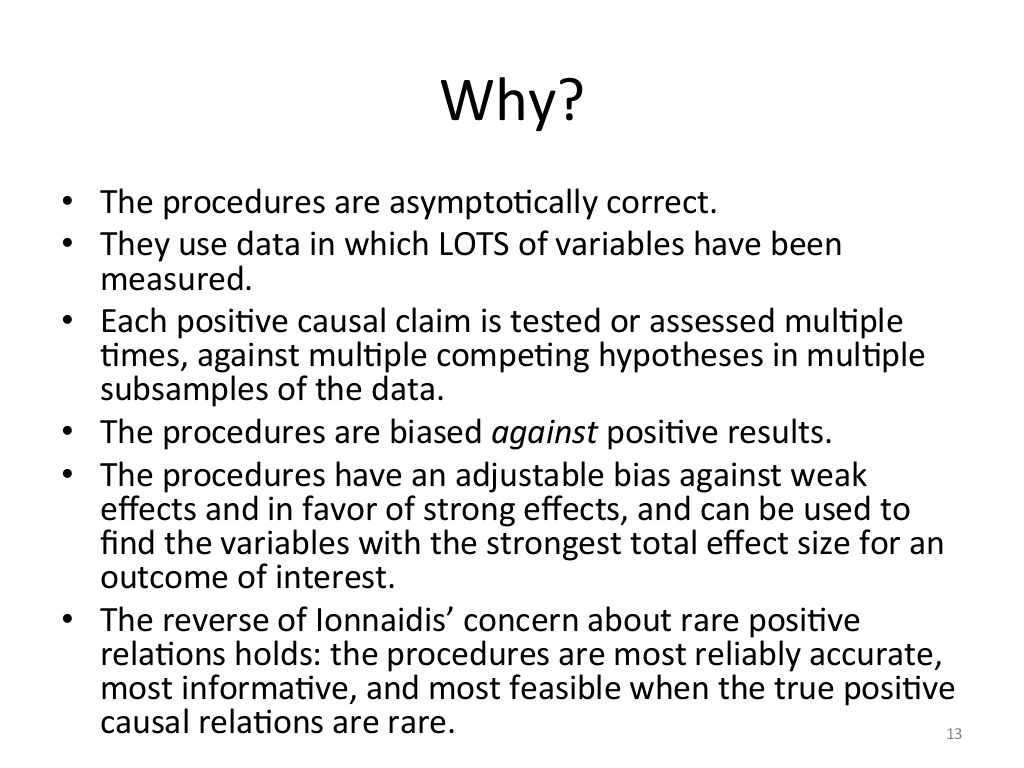
GLYMOUR’S ARGUMENT (in a nutshell):
“The anti-exploration argument has everything backwards,” says Glymour (slide #11). While John Ioannidis maintains that “Research findings are more likely true in confirmatory designs,” the opposite is so, according to Glymour. (Ioannidis 2005, Glymour’s slide #6). Why? To answer this he describes an exploratory research account for causal search that he has been developing:
What’s confirmatory research for Glymour? It’s moving directly from rejecting a null hypothesis with a low P-value to inferring a causal claim. Continue reading
Gigerenzer at the PSA: “How Fisher, Neyman-Pearson, & Bayes Were Transformed into the Null Ritual”: Comments and Queries (ii)
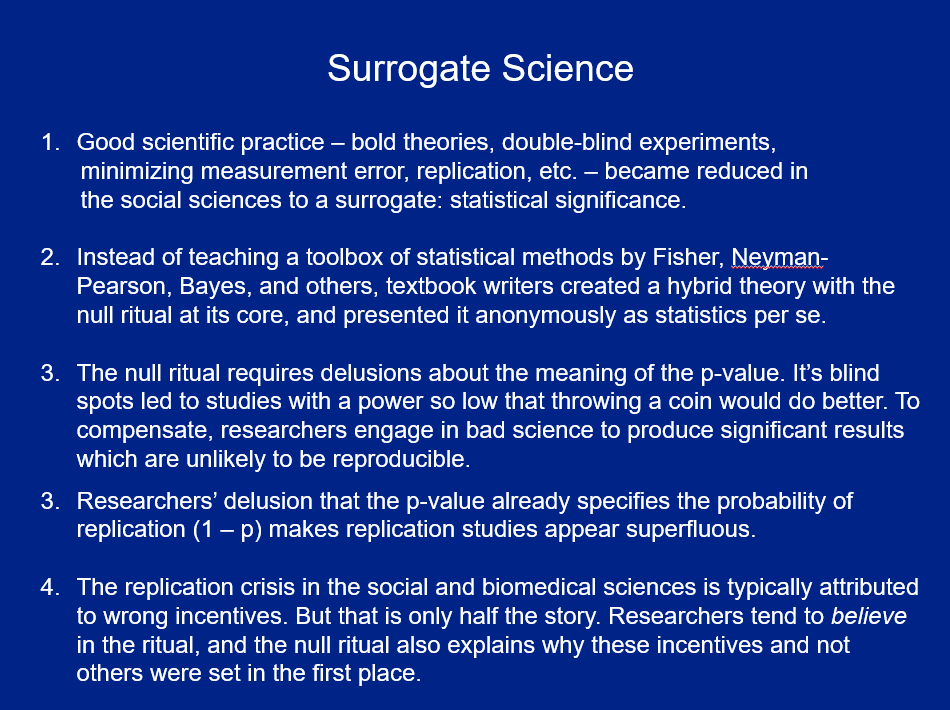
Gerd Gigerenzer, Andrew Gelman, Clark Glymour and I took part in a very interesting symposium on Philosophy of Statistics at the Philosophy of Science Association last Friday. I jotted down lots of notes, but I’ll limit myself to brief reflections and queries on a small portion of each presentation in turn, starting with Gigerenzer’s “Surrogate Science: How Fisher, Neyman-Pearson, & Bayes Were Transformed into the Null Ritual.” His complete slides are below my comments. I may write this in stages, this being (i).
SLIDE #19
- Good scientific practice–bold theories, double-blind experiments, minimizing measurement error, replication, etc.–became reduced in the social science to a surrogate: statistical significance.
I agree that “good scientific practice” isn’t some great big mystery, and that “bold theories, double-blind experiments, minimizing measurement error, replication, etc.” are central and interconnected keys to finding things out in error prone inquiry. Do the social sciences really teach that inquiry can be reduced to cookbook statistics? Or is it simply that, in some fields, carrying out surrogate science suffices to be a “success”? Continue reading
For Statistical Transparency: Reveal Multiplicity and/or Just Falsify the Test (Remark on Gelman and Colleagues)
Gelman and Loken (2014) recognize that even without explicit cherry picking there is often enough leeway in the “forking paths” between data and inference so that by artful choices you may be led to one inference, even though it also could have gone another way. In good sciences, measurement procedures should interlink with well-corroborated theories and offer a triangulation of checks– often missing in the types of experiments Gelman and Loken are on about. Stating a hypothesis in advance, far from protecting from the verification biases, can be the engine that enables data to be “constructed”to reach the desired end [1].
[E]ven in settings where a single analysis has been carried out on the given data, the issue of multiple comparisons emerges because different choices about combining variables, inclusion and exclusion of cases…..and many other steps in the analysis could well have occurred with different data (Gelman and Loken 2014, p. 464).
An idea growing out of this recognition is to imagine the results of applying the same statistical procedure, but with different choices at key discretionary junctures–giving rise to a multiverse analysis, rather than a single data set (Steegen, Tuerlinckx, Gelman, and Vanpaemel 2016). One lists the different choices thought to be plausible at each stage of data processing. The multiverse displays “which constellation of choices corresponds to which statistical results” (p. 797). The result of this exercise can, at times, mimic the delineation of possibilities in multiple testing and multiple modeling strategies. Continue reading
If you think it’s a scandal to be without statistical falsification, you will need statistical tests (ii)
1. PhilSci and StatSci. I’m always glad to come across statistical practitioners who wax philosophical, particularly when Karl Popper is cited. Best of all is when they get the philosophy somewhere close to correct. So, I came across an article by Burnham and Anderson (2014) in Ecology:
“While the exact definition of the so-called ‘scientific method’ might be controversial, nearly everyone agrees that the concept of ‘falsifiability’ is a central tenant [sic] of empirical science (Popper 1959). It is critical to understand that historical statistical approaches (i.e., P values) leave no way to ‘test’ the alternative hypothesis. The alternative hypothesis is never tested, hence cannot be rejected or falsified!… Surely this fact alone makes the use of significance tests and P values bogus. Lacking a valid methodology to reject/falsify the alternative science hypotheses seems almost a scandal.” (Burnham and Anderson p. 629)
Well I am (almost) scandalized by this easily falsifiable allegation! I can’t think of a single “alternative”, whether in a “pure” Fisherian or a Neyman-Pearson hypothesis test (whether explicit or implicit) that’s not falsifiable; nor do the authors provide any. I grant that understanding testability and falsifiability is far more complex than the kind of popularized accounts we hear about; granted as well, theirs is just a short paper.[1] But then why make bold declarations on the topic of the “scientific method and statistical science,” on falsifiability and testability? Continue reading
Mayo & Parker “Using PhilStat to Make Progress in the Replication Crisis in Psych” SPSP Slides
Here are the slides from our talk at the Society for Philosophy of Science in Practice (SPSP) conference. I covered the first 27, Parker the rest. The abstract is here:
“So you banned p-values, how’s that working out for you?” D. Lakens exposes the consequences of a puzzling “ban” on statistical inference
I came across an excellent post on a blog kept by Daniel Lakens: “So you banned p-values, how’s that working out for you?” He refers to the journal that recently banned significance tests, confidence intervals, and a vague assortment of other statistical methods, on the grounds that all such statistical inference tools are “invalid” since they don’t provide posterior probabilities of some sort (see my post). The editors’ charge of “invalidity” could only hold water if these error statistical methods purport to provide posteriors based on priors, which is false. The entire methodology is based on methods in which probabilities arise to qualify the method’s capabilities to detect and avoid erroneous interpretations of data [0]. The logic is of the falsification variety found throughout science. Lakens, an experimental psychologist, does a great job delineating some of the untoward consequences of their inferential ban. I insert some remarks in black. Continue reading
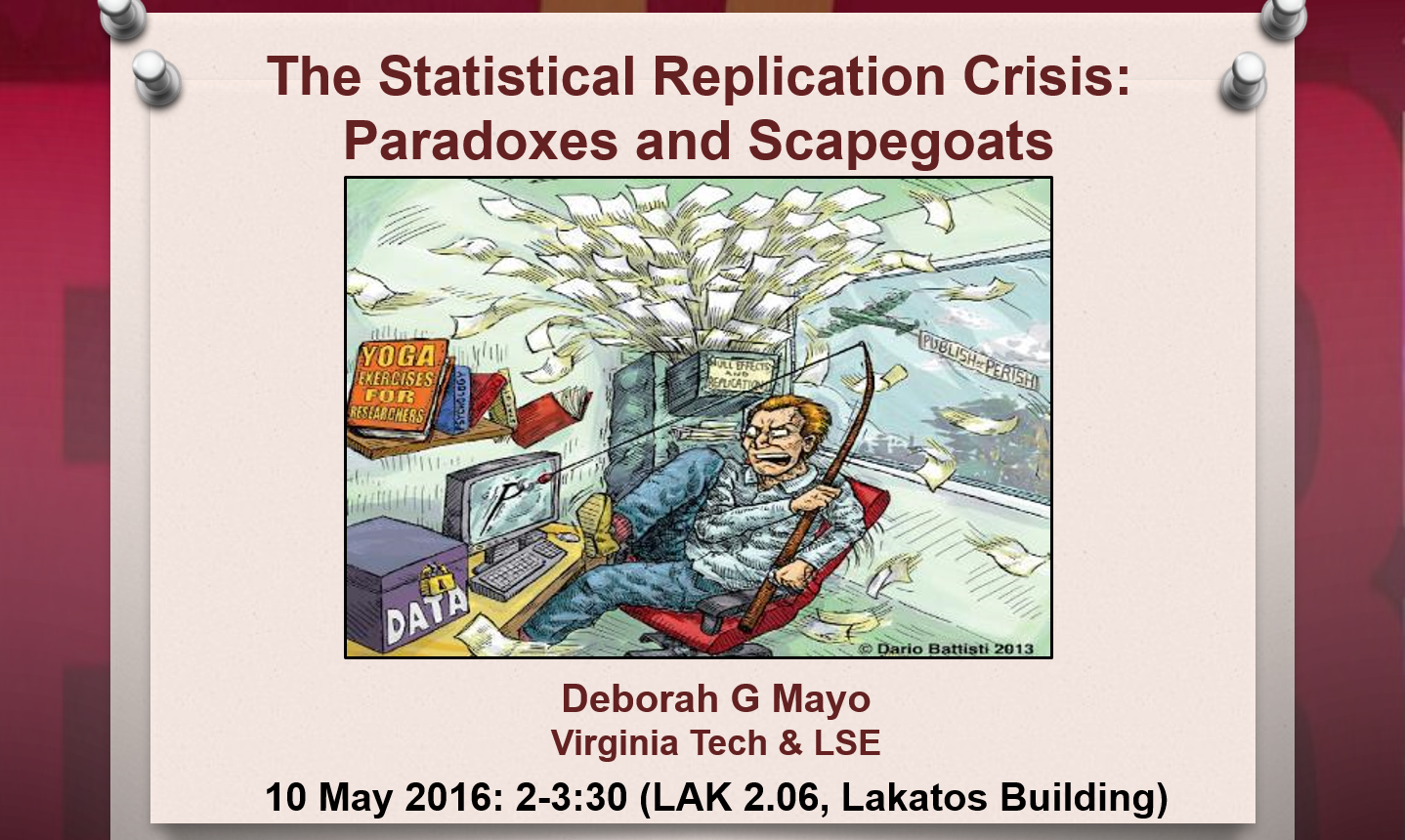
My Slides: “The Statistical Replication Crisis: Paradoxes and Scapegoats”
Below are the slides from my Popper talk at the LSE today (up to slide 70): (post any questions in the comments)
Your chance to continue the “due to chance” discussion in roomier quarters
Comments get unwieldy after 100, so here’s a chance to continue the “due to chance” discussion in some roomier quarters. (There seems to be at least two distinct lanes being travelled.) Now one of the main reasons I run this blog is to discover potential clues to solving or making progress on thorny philosophical problems I’ve been wrangling with for a long time. I think I extracted some illuminating gems from the discussion here, but I don’t have time to write them up, and won’t for a bit, so I’ve parked a list of comments wherein the golden extracts lie (I think) over at my Rejected Posts blog[1]. (They’re all my comments, but as influenced by readers, so I thank you!) Over there, there’s no “return and resubmit”, but around a dozen posts have eventually made it over here, tidied up. Please continue the discussion on this blog (I don’t even recommend going over there). You can link to your earlier comments by clicking on the date.
[1] The Spiegelhalter (PVP) link is here.
“A small p-value indicates it’s improbable that the results are due to chance alone” –fallacious or not? (more on the ASA p-value doc)
There’s something about “Principle 2” in the ASA document on p-values that I couldn’t address in my brief commentary, but is worth examining more closely.
2. P-values do not measure (a) the probability that the studied hypothesis is true , or (b) the probability that the data were produced by random chance alone,
(a) is true, but what about (b)? That’s what I’m going to focus on, because I think it is often misunderstood. It was discussed earlier on this blog in relation to the Higgs experiments and deconstructing “the probability the results are ‘statistical flukes'”. So let’s examine: Continue reading
Don’t throw out the error control baby with the bad statistics bathwater
My invited comments on the ASA Document on P-values*
The American Statistical Association is to be credited with opening up a discussion into p-values; now an examination of the foundations of other key statistical concepts is needed.
Statistical significance tests are a small part of a rich set of “techniques for systematically appraising and bounding the probabilities (under respective hypotheses) of seriously misleading interpretations of data” (Birnbaum 1970, p. 1033). These may be called error statistical methods (or sampling theory). The error statistical methodology supplies what Birnbaum called the “one rock in a shifting scene” (ibid.) in statistical thinking and practice. Misinterpretations and abuses of tests, warned against by the very founders of the tools, shouldn’t be the basis for supplanting them with methods unable or less able to assess, control, and alert us to erroneous interpretations of data. Continue reading