
power

To raise the power of a test is to lower (not raise) the “hurdle” for rejecting the null (Ziliac and McCloskey 3 years on)

Part 2 Prionvac: The Will to Understand PowerI said I’d reblog one of the 3-year “memory lane” posts marked in red, with a few new comments (in burgundy), from time to time. So let me comment on one referring to Ziliac and McCloskey on power. (from Oct.2011). I would think they’d want to correct some wrong statements, or explain their shifts in meaning. My hope is that, 3 years on, they’ll be ready to do so. By mixing some correct definitions with erroneous ones, they introduce more confusion into the discussion.

From my post 3 years ago: “The Will to Understand Power”: In this post, I will adhere precisely to the text, and offer no new interpretation of tests. Type 1 and 2 errors and power are just formal notions with formal definitions.  But we need to get them right (especially if we are giving expert advice).  You can hate the concepts; just define them correctly please.  They write:

“The error of the second kind is the error of accepting the null hypothesis of (say) zero effect when the null is in face false, that is, then (say) such and such a positive effect is true.”

So far so good (keeping in mind that “positive effect” refers to a parameter discrepancy, say δ, not an observed difference.

And the power of a test to detect that such and such a positive effect δ is true is equal to the probability of rejecting the null hypothesis of (say) zero effect when the null is in fact false, and a positive effect as large as δ is present.

Fine.

Let this alternative be abbreviated H’(δ):

H’(δ): there is a positive effect as large as δ.

Suppose the test rejects the null when it reaches a significance level of .01.

(1) The power of the test to detect H’(δ) =

P(test rejects null at .01 level; H’(δ) is true).

Say it is 0.85.

“If the power of a test is high, say, 0.85 or higher, then the scientist can be reasonably confident that at minimum the null hypothesis (of, again, zero effect if that is the null chosen) is false and that therefore his rejection of it is highly probably correct”. (Z & M, 132-3).

But this is not so.  Perhaps they are slipping into the cardinal error of mistaking (1) as a posterior probability:

(1’) P(H’(δ) is true| test rejects null at .01 level)! Continue reading

Categories: 3-year memory lane, power, Statistics | Tags: , , | 6 Comments

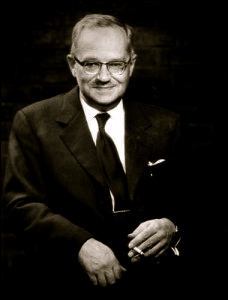
Neyman, Power, and Severity

April 16, 1894 – August 5, 1981

NEYMAN: April 16, 1894 – August 5, 1981

Jerzy Neyman: April 16, 1894-August 5, 1981. This reblogs posts under “The Will to Understand Power” & “Neyman’s Nursery” here & here.

Way back when, although I’d never met him, I sent my doctoral dissertation, Philosophy of Statistics, to one person only: Professor Ronald Giere. (And he would read it, too!) I knew from his publications that he was a leading defender of frequentist statistical methods in philosophy of science, and that he’d worked for at time with Birnbaum in NYC.

Some ten 15 years ago, Giere decided to quit philosophy of statistics (while remaining in philosophy of science): I think it had to do with a certain form of statistical exile (in philosophy). He asked me if I wanted his papers—a mass of work on statistics and statistical foundations gathered over many years. Could I make a home for them? I said yes. Then came his caveat: there would be a lot of them.

As it happened, we were building a new house at the time, Thebes, and I designed a special room on the top floor that could house a dozen or so file cabinets. (I painted it pale rose, with white lacquered book shelves up to the ceiling.) Then, for more than 9 months (same as my son!), I waited . . . Several boxes finally arrived, containing hundreds of files—each meticulously labeled with titles and dates.  More than that, the labels were hand-typed!  I thought, If Ron knew what a slob I was, he likely would not have entrusted me with these treasures. (Perhaps he knew of no one else who would  actually want them!) Continue reading

Categories: Neyman, phil/history of stat, power, Statistics | Tags: , , , | 5 Comments

A. Spanos: “Recurring controversies about P values and confidence intervals revisited”

A SPANOS

Aris Spanos
Wilson E. Schmidt Professor of Economics
Department of Economics, Virginia Tech

Recurring controversies about P values and confidence intervals revisited*
Ecological Society of America (ESA) ECOLOGY
Forum—P Values and Model Selection (pp. 609-654)
Volume 95, Issue 3 (March 2014): pp. 645-651

INTRODUCTION

The use, abuse, interpretations and reinterpretations of the notion of a P value has been a hot topic of controversy since the 1950s in statistics and several applied fields, including psychology, sociology, ecology, medicine, and economics.

The initial controversy between Fisher’s significance testing and the Neyman and Pearson (N-P; 1933) hypothesis testing concerned the extent to which the pre-data Type  I  error  probability  α can  address the arbitrariness and potential abuse of Fisher’s post-data  threshold for the value. Continue reading

Categories: CIs and tests, Error Statistics, Fisher, P-values, power, Statistics | 32 Comments

Power taboos: Statue of Liberty, Senn, Neyman, Carnap, Severity

Unknown-3Is it taboo to use a test’s power to assess what may be learned from the data in front of us? (Is it limited to pre-data planning?) If not entirely taboo, some regard power as irrelevant post-data[i], and the reason I’ve heard is along the lines of an analogy Stephen Senn gave today (in a comment discussing his last post here)[ii].

Senn comment: So let me give you another analogy to your (very interesting) fire alarm analogy (My analogy is imperfect but so is the fire alarm.) If you want to cross the Atlantic from Glasgow you should do some serious calculations to decide what boat you need. However, if several days later you arrive at the Statue of Liberty the fact that you see it is more important than the size of the boat for deciding that you did, indeed, cross the Atlantic.

My fire alarm analogy is here. My analogy presumes you are assessing the situation (about the fire) long distance. Continue reading

Categories: exchange with commentators, Neyman's Nursery, P-values, Phil6334, power, Stephen Senn | 6 Comments

Stephen Senn: “Delta Force: To what extent is clinical relevance relevant?” (Guest Post)

Stephen Senn

Senn

Stephen Senn
Head, Methodology and Statistics Group,
Competence Center for Methodology and Statistics (CCMS),
Luxembourg

Delta Force
To what extent is clinical relevance relevant?

Inspiration
This note has been inspired by a Twitter exchange with respected scientist and famous blogger  David Colquhoun. He queried whether a treatment that had 2/3 of an effect that would be described as clinically relevant could be useful. I was surprised at the question, since I would regard it as being pretty obvious that it could but, on reflection, I realise that things that may seem obvious to some who have worked in drug development may not be obvious to others, and if they are not obvious to others are either in need of a defence or wrong. I don’t think I am wrong and this note is to explain my thinking on the subject. Continue reading

Categories: power, Statistics, Stephen Senn | 39 Comments

Get empowered to detect power howlers

questionmark pinkIf a test’s power to detect µ’ is low then a statistically significant result is good/lousy evidence of discrepancy µ’? Which is it?

If your smoke alarm has little capability of triggering unless your house is fully ablaze, then if it has triggered, is that a strong or weak indication of a fire? Compare this insensitive smoke alarm to one that is so sensitive that burning toast sets it off. The answer is: that the alarm from the insensitive detector is triggered is a good indication of the presence of (some) fire, while hearing the ultra sensitive alarm go off is not.[i]

Yet I often hear people say things to the effect that: Continue reading

Categories: confidence intervals and tests, power, Statistics | 34 Comments

Blog at WordPress.com.