statistical tests

Neyman-Pearson Tests: An Episode in Anglo-Polish Collaboration: (3.2)

Neyman & Pearson

November Cruise: 3.2

This third of November’s stops in the leisurely cruise of SIST aligns well with my recent BJPS paper Severe Testing: Error Statistics vs Bayes Factor Tests.  In tomorrow’s zoom, 11 am New York time, we’ll have an overview of the topics in SIST so far, as well as a discussion of this paper. (If you don’t have a link, and want one, write to me at error@vt.edu). 

3.2 N-P Tests: An Episode in Anglo-Polish Collaboration*

We proceed by setting up a specific hypothesis to test, Hin Neyman’s and my terminology, the null hypothesis in R. A. Fisher’s . . . in choosing the test, we take into account alternatives to Hwhich we believe possible or at any rate consider it most important to be on the look out for . . .Three steps in constructing the test may be defined: Continue reading

Categories: 2024 Leisurely Cruise, E.S. Pearson, Neyman, statistical tests | Leave a comment

Call for reader replacements! First Look at N-P Methods as Severe Tests: Water plant accident [Exhibit (i) from Excursion 3]

November Cruise

Although the numbers used in the introductory example are fine, I’m unhappy with it and seek a replacement–ideally with the same or similar numbers. It is assumed that there is a concern both with inferring larger, as well as smaller, discrepancies than warranted. Actions taken if too high a temperature is inferred would be deleterious. But, given the presentation, the more “serious” error would be failing to report an increase, calling for  H0: μ ≥ 150  as the null. But the focus on one-sided positive discrepancies is used through the book, so I wanted to keep to that. I needed a one-sided test with a null value other than 0, and saw an example like this in a book. I think it was ecology. Of course, the example is purely for a simple. numerical illustration.  Fortunately, the severity analysis gives the same interpretation of the data regardless of how the test and alternative hypotheses are specified. Still, I’m calling for reader replacements, a suitable reward to be ascertained. Continue reading

Categories: 2024 Leisurely Cruise, severe tests, severity function, statistical tests, water plant accident | 1 Comment

Neyman-Pearson Tests: An Episode in Anglo-Polish Collaboration: (3.2)

Neyman & Pearson

November Cruise: 3.2

This second of November’s stops in the leisurely cruise of SIST aligns well with my recent Neyman Seminar at Berkeley. Egon Pearson’s description of the three steps in formulating tests is too rarely recognized today. Note especially the order of the steps. Share queries and thoughts in the comments.

3.2 N-P Tests: An Episode in Anglo-Polish Collaboration*

We proceed by setting up a specific hypothesis to test, Hin Neyman’s and my terminology, the null hypothesis in R. A. Fisher’s . . . in choosing the test, we take into account alternatives to Hwhich we believe possible or at any rate consider it most important to be on the look out for . . .Three steps in constructing the test may be defined:

Step 1. We must first specify the set of results . . .

Step 2. We then divide this set by a system of ordered boundaries . . .such that as we pass across one boundary and proceed to the next, we come to a class of results which makes us more and more inclined, on the information available, to reject the hypothesis tested in favour of alternatives which differ from it by increasing amounts.

Step 3. We then, if possible, associate with each contour level the chance that, if H0 is true, a result will occur in random sampling lying beyond that level . . .

In our first papers [in 1928] we suggested that the likelihood ratio criterion, λ, was a very useful one . . . Thus Step 2 proceeded Step 3. In later papers [1933–1938] we started with a fixed value for the chance, ε, of Step 3 . . . However, although the mathematical procedure may put Step 3 before 2, we cannot put this into operation before we have decided, under Step 2, on the guiding principle to be used in choosing the contour system. That is why I have numbered the steps in this order. (Egon Pearson 1947, p. 173)

Continue reading

Categories: 2024 Leisurely Cruise, E.S. Pearson, Neyman, statistical tests | Leave a comment

5-year review: Don’t let the tail wag the dog by being overly influenced by flawed statistical inferences

.

On June 1, 2019, I posted portions of an article [i],“There is Still a Place for Significance Testing in Clinical Trials,” in Clinical Trials responding to the 2019 call to abandon significance. I reblog it here. While very short, it effectively responds to the 2019 movement (by some) to abandon the concept of statistical significance [ii]. I have recently been involved in researching drug trials for a condition of a family member, and I can say that I’m extremely grateful that they are still reporting error statistical assessments of new treatments, and using carefully designed statistical significance tests with thresholds. Without them, I think we’d be lost in a sea of potential treatments and clinical trials. Please share any of your own experiences in the comments. The emphasis in this excerpt is mine: 

Much hand-wringing has been stimulated by the reflection that reports of clinical studies often misinterpret and misrepresent the findings of the statistical analyses. Recent proposals to address these concerns have included abandoning p-values and much of the traditional classical approach to statistical inference, or dropping the concept of statistical significance while still allowing some place for p-values. How should we in the clinical trials community respond to these concerns? Responses may vary from bemusement, pity for our colleagues working in the wilderness outside the relatively protected environment of clinical trials, to unease about the implications for those of us engaged in clinical trials…. Continue reading

Categories: 5-year memory lane, abandon statistical significance, statistical tests | 9 Comments

Power howlers return as criticisms of severity

Mayo bangs head

Suppose you are reading about a statistically significant result x that just reaches a threshold p-value α from a test T+ of the mean of a Normal distribution

 H0: µ ≤  0 against H1: µ >  0

with n iid samples, and (for simplicity) known σ.  The test “rejects” H0 at this level & infers evidence of a discrepancy in the direction of H1.

I have heard some people say:

A. If the test’s power to detect alternative µ’ is very low, then the just statistically significant x is poor evidence of a discrepancy (from the null) corresponding to µ’.  (i.e., there’s poor evidence that  µ > µ’ ). See point* on language in notes.

They will generally also hold that if POW(µ’) is reasonably high (at least .5), then the inference to µ > µ’ is warranted, or at least not problematic.

I have heard other people say:

B. If the test’s power to detect alternative µ’ is very low, then the just statistically significant x is good evidence of a discrepancy (from the null) corresponding to µ’ (i.e., there’s good evidence that  µ > µ’).

They will generally also hold that if POW(µ’) is reasonably high (at least .5), then the inference to µ > µ’ is unwarranted.

Which is correct, from the perspective of the frequentist error statistical philosophy? Continue reading

Categories: Statistical power, statistical tests | Tags: , , , , | 7 Comments

Kent Staley: Commentary on “The statistics wars and intellectual conflicts of interest” (Guest Post)

.


Kent Staley

Professor
Department of Philosophy
Saint Louis University


Commentary on “The statistics wars and intellectual conflicts of interest” (Mayo editorial)

In her recent Editorial for Conservation Biology, Deborah Mayo argues that journal editors “should avoid taking sides” regarding “heated disagreements about statistical significance tests.” Particularly, they should not impose bans suggested by combatants in the “statistics wars” on statistical methods advocated by the opposing side, such as Wasserstein et al.’s (2019) proposed ban on the declaration of statistical significance and use of p value thresholds. Were journal editors to adopt such proposals, Mayo argues, they would be acting under a conflict of interest (COI) of a special kind: an “intellectual” conflict of interest.

Conflicts of interest are worrisome because of the potential for bias. Researchers will no doubt be all too familiar with the institutional/bureaucratic requirement of declaring financial interests. Whether such disclosures provide substantive protections against bias or simply satisfy a “CYA” requirement of administrators, the rationale is that assessment of research outcomes can incorporate information relevant to the question of whether the investigators have arrived at a conclusion that overstates (or even fabricates) the support for a claim, when the acceptance of that claim would financially benefit them. This in turn ought to reduce the temptation of investigators to engage in such inflation or fabrication of support. The idea obviously applies quite naturally to editorial decisions as well as research conclusions. Continue reading

Categories: conflicts of interest, editors, intellectual COI, significance tests, statistical tests | 6 Comments

The Statistics Wars and Intellectual Conflicts of Interest

.

My editorial in Conservation Biology is published (open access): “The Statistical Wars and Intellectual Conflicts of Interest”. Share your comments, here and/or send a separate item (to Error), if you wish, for possible guest posting*. (All readers are invited to a special January 11 Phil Stat Session with Y. Benjamini and D. Hand described here.) Here’s most of the editorial:

The Statistics Wars and Intellectual Conflicts of Interest

How should journal editors react to heated disagreements about statistical significance tests in applied fields, such as conservation science, where statistical inferences often are the basis for controversial policy decisions? They should avoid taking sides. They should also avoid obeisance to calls for author guidelines to reflect a particular statistical philosophy or standpoint. The question is how to prevent the misuse of statistical methods without selectively favoring one side.

The statistical‐significance‐test controversies are well known in conservation science. In a forum revolving around Murtaugh’s (2014) “In Defense of P values,” Murtaugh argues, correctly, that most criticisms of statistical significance tests “stem from misunderstandings or incorrect interpretations, rather than from intrinsic shortcomings of the P value” (p. 611). However, underlying those criticisms, and especially proposed reforms, are often controversial philosophical presuppositions about the proper uses of probability in uncertain inference. Should probability be used to assess a method’s probability of avoiding erroneous interpretations of data (i.e., error probabilities) or to measure comparative degrees of belief or support? Wars between frequentists and Bayesians continue to simmer in calls for reform.

Consider how, in commenting on Murtaugh (2014), Burnham and Anderson (2014 : 627) aver that “P‐values are not proper evidence as they violate the likelihood principle (Royall, 1997).” This presupposes that statistical methods ought to obey the likelihood principle (LP), a long‐standing point of controversy in the statistics wars. The LP says that all the evidence is contained in a ratio of likelihoods (Berger & Wolpert, 1988). Because this is to condition on the particular sample data, there is no consideration of outcomes other than those observed and thus no consideration of error probabilities. One should not write this off because it seems technical: methods that obey the LP fail to directly register gambits that alter their capability to probe error. Whatever one’s view, a criticism based on presupposing the irrelevance of error probabilities is radically different from one that points to misuses of tests for their intended purpose—to assess and control error probabilities.

Error control is nullified by biasing selection effects: cherry‐picking, multiple testing, data dredging, and flexible stopping rules. The resulting (nominal) p values are not legitimate p values. In conservation science and elsewhere, such misuses can result from a publish‐or‐perish mentality and experimenter’s flexibility (Fidler et al., 2017). These led to calls for preregistration of hypotheses and stopping rules–one of the most effective ways to promote replication (Simmons et al., 2012). However, data dredging can also occur with likelihood ratios, Bayes factors, and Bayesian updating, but the direct grounds to criticize inferences as flouting error probability control is lost. This conflicts with a central motivation for using p values as a “first line of defense against being fooled by randomness” (Benjamini, 2016). The introduction of prior probabilities (subjective, default, or empirical)–which may also be data dependent–offers further flexibility.

Signs that one is going beyond merely enforcing proper use of statistical significance tests are that the proposed reform is either the subject of heated controversy or is based on presupposing a philosophy at odds with that of statistical significance testing. It is easy to miss or downplay philosophical presuppositions, especially if one has a strong interest in endorsing the policy upshot: to abandon statistical significance. Having the power to enforce such a policy, however, can create a conflict of interest (COI). Unlike a typical COI, this one is intellectual and could threaten the intended goals of integrity, reproducibility, and transparency in science.

If the reward structure is seducing even researchers who are aware of the pitfalls of capitalizing on selection biases, then one is dealing with a highly susceptible group. For a journal or organization to take sides in these long-standing controversies—or even to appear to do so—encourages groupthink and discourages practitioners from arriving at their own reflective conclusions about methods.

The American Statistical Association (ASA) Board appointed a President’s Task Force on Statistical Significance and Replicability in 2019 that was put in the odd position of needing to “address concerns that a 2019 editorial [by the ASA’s executive director (Wasserstein et al., 2019)] might be mistakenly interpreted as official ASA policy” (Benjamini et al., 2021)—as if the editorial continues the 2016 ASA Statement on p-values (Wasserstein & Lazar, 2016). That policy statement merely warns against well‐known fallacies in using p values. But Wasserstein et al. (2019) claim it “stopped just short of recommending that declarations of ‘statistical significance’ be abandoned” and announce taking that step. They call on practitioners not to use the phrase statistical significance and to avoid p value thresholds. Call this the no‐threshold view. The 2016 statement was largely uncontroversial; the 2019 editorial was anything but. The President’s Task Force should be commended for working to resolve the confusion (Kafadar, 2019). Their report concludes: “P-values are valid statistical measures that provide convenient conventions for communicating the uncertainty inherent in quantitative results” (Benjamini et al., 2021). A disclaimer that Wasserstein et al., 2019 was not ASA policy would have avoided both the confusion and the slight to opposing views within the Association.

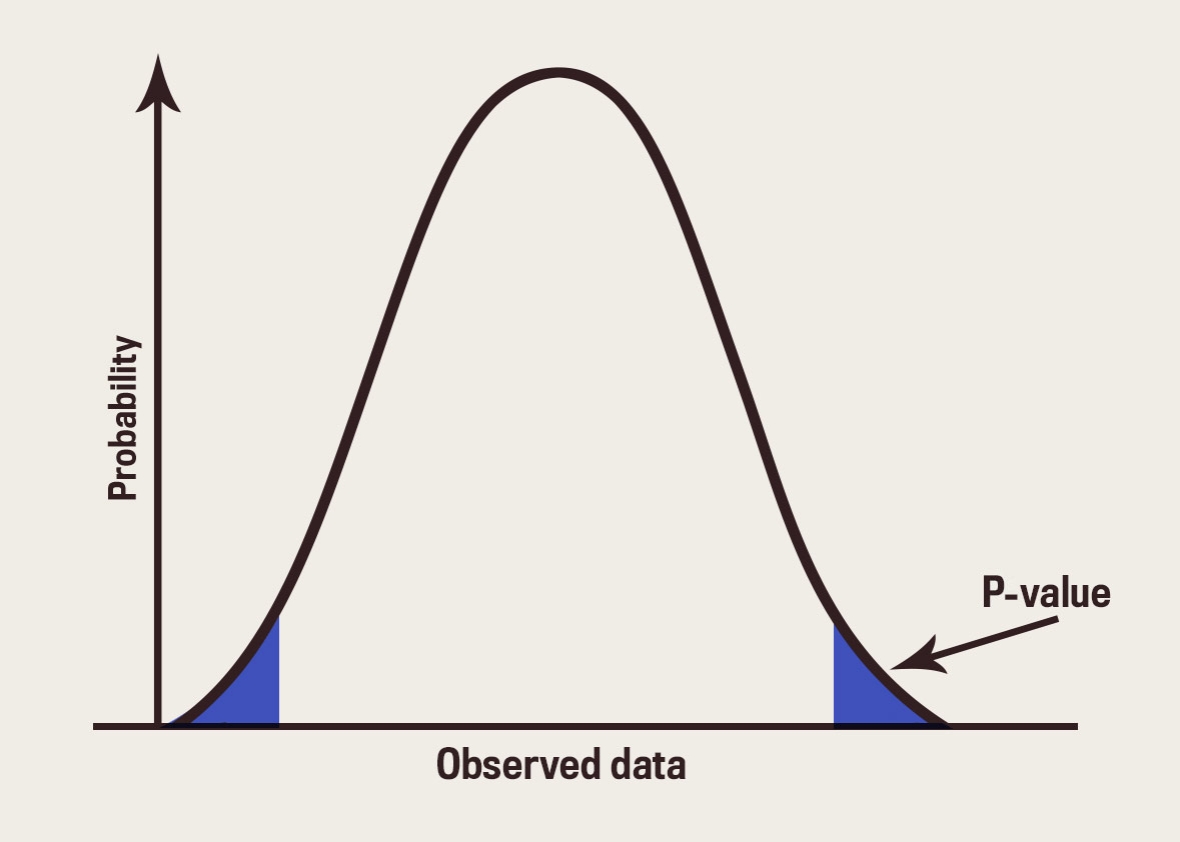
The no‐threshold view has consequences (likely unintended). Statistical significance tests arise “to test the conformity of the particular data under analysis with [a statistical hypothesis] H0 in some respect to be specified” (Mayo & Cox, 2006: 81). There is a function D of the data, the test statistic, such that the larger its value (d), the more inconsistent are the data with H0. The p value is the probability the test would have given rise to a result more discordant from H0 than d is were the results due to background or chance variability (as described in H0). In computing p, hypothesis H0 is assumed merely for drawing out its probabilistic implications. If even larger differences than d are frequently brought about by chance alone (p is not small), the data are not evidence of inconsistency with H0. Requiring a low pvalue before inferring inconsistency with H0 controls the probability of a type I error (i.e., erroneously finding evidence against H0).

Whether interpreting a simple Fisherian or an N‐P test, avoiding fallacies calls for considering one or more discrepancies from the null hypothesis under test. Consider testing a normal mean H0: μ ≤ μ0 versus H1: μ > μ0. If the test would fairly probably have resulted in a smaller p value than observed, if μ = μ1 were true (where μ1 = μ0 + γ, for γ > 0), then the data provide poor evidence that μ exceeds μ1. It would be unwarranted to infer evidence of μ > μ1. Tests do not need to be abandoned when the fallacy is easily avoided by computing p values for one or two additional benchmarks (Burgman, 2005; Hand, 2021; Mayo, 2018; Mayo & Spanos, 2006).

The same is true for avoiding fallacious interpretations of nonsignificant results. These are often of concern in conservation, especially when interpreted as no risks exist. In fact, the test may have had a low probability to detect risks. But nonsignificant results are not uninformative. If the test very probably would have resulted in a more statistically significant result were there a meaningful effect, say μ > μ1 (where μ1 = μ0 + γ, for γ > 0), then the data are evidence that μ < μ1. (This is not to infer μ ≤ μ0.) “Such an assessment is more relevant to specific data than is the notion of power” (Mayo & Cox, 2006: 89). This also matches inferring that μ is less than the upper bound of the corresponding confidence interval (at the associated confidence level) or a severity assessment (Mayo, 2018). Others advance equivalence tests (Lakens, 2017; Wellek, 2017). An N‐P test tells one to specify H0 so that the type I error is the more serious (considering costs); that alone can alleviate problems in the examples critics adduce (H0would be that the risk exists).

Many think the no‐threshold view merely insists that the attained p value be reported. But leading N‐P theorists already recommend reporting p, which “gives an idea of how strongly the data contradict the hypothesis…[and] enables others to reach a verdict based on the significance level of their choice” (Lehmann & Romano, 2005: 63−64). What the no‐threshold view does, if taken strictly, is preclude testing. If one cannot say ahead of time about any result that it will not be allowed to count in favor of a claim, then one does not test that claim. There is no test or falsification, even of the statistical variety. What is the point of insisting on replication if at no stage can one say the effect failed to replicate? One may argue for approaches other than tests, but it is unwarranted to claim by fiat that tests do not provide evidence. (For a discussion of rival views of evidence in ecology, see Taper & Lele, 2004.)

Many sign on to the no‐threshold view thinking it blocks perverse incentives to data dredge, multiple test, and p hack when confronted with a large, statistically nonsignificant p value. Carefully considered, the reverse seems true. Even without the word significance, researchers could not present a large (nonsignificant) p value as indicating a genuine effect. It would be nonsensical to say that even though more extreme results would frequently occur by random variability alone that their data are evidence of a genuine effect. The researcher would still need a small value, which is to operate with a threshold. However, it would be harder to hold data dredgers culpable for reporting a nominally small p value obtained through data dredging. What distinguishes nominal p values from actual ones is that they fail to meet a prespecified error probability threshold.


While it is well known that stopping when the data look good inflates the type I error probability, a strict Bayesian is not required to adjust for interim checking because the posterior probability is unaltered. Advocates of Bayesian clinical trials are in a quandary because “The [regulatory] requirement of Type I error control for Bayesian [trials] causes them to lose many of their philosophical advantages, such as compliance with the likelihood principle” (Ryan etal., 2020: 7).

It may be retorted that implausible inferences will indirectly be blocked by appropriate prior degrees of belief (informative priors), but this misses the crucial point. The key function of statistical tests is to constrain the human tendency to selectively favor views they believe in. There are ample forums for debating statistical methodologies. There is no call for executive directors or journal editors to place a thumb on the scale. Whether in dealing with environmental policy advocates, drug lobbyists, or avid calls to expel statistical significance tests, a strong belief in the efficacy of an intervention is distinct from its having been well tested. Applied science will be well served by editorial policies that uphold that distinction.

For the acknowledgments and references, see the full editorial here.

I will cite as many (constructive) readers’ views as I can at the upcoming forum with Yoav Benjamini and David Hand on January 11 on zoom (see this post). *Authors of articles I put up as guest posts or cite at the Forum will get a free copy of my Statistical Inference as Severe Testing: How to Get Beyond the Statistics Wars (CUP, 2018).

Categories: significance tests, spurious p values, stat wars and their casualties, strong likelihood principle | 4 Comments

Memory Lane (4 years ago): Why significance testers should reject the argument to “redefine statistical significance”, even if they want to lower the p-value*

.

An argument that assumes the very thing that was to have been argued for is guilty of begging the question; signing on to an argument whose conclusion you favor even though you cannot defend its premises is to argue unsoundly, and in bad faith. When a whirlpool of “reforms” subliminally alter  the nature and goals of a method, falling into these sins can be quite inadvertent. Start with a simple point on defining the power of a statistical test. Continue reading

Categories: Bayesian/frequentist, fallacy of rejection, P-values, reforming the reformers, spurious p values | 3 Comments

Don’t let the tail wag the dog by being overly influenced by flawed statistical inferences

.

An article [i],“There is Still a Place for Significance Testing in Clinical Trials,” appearing recently in Clinical Trials, while very short, effectively responds to recent efforts to stop error statistical testing [ii]. We need more of this. Much more. The emphasis in this excerpt is mine: 

Much hand-wringing has been stimulated by the reflection that reports of clinical studies often misinterpret and misrepresent the findings of the statistical analyses. Recent proposals to address these concerns have included abandoning p-values and much of the traditional classical approach to statistical inference, or dropping the concept of statistical significance while still allowing some place for p-values. How should we in the clinical trials community respond to these concerns? Responses may vary from bemusement, pity for our colleagues working in the wilderness outside the relatively protected environment of clinical trials, to unease about the implications for those of us engaged in clinical trials….

However, we should not be shy about asserting the unique role that clinical trials play in scientific research. A clinical trial is a much safer context within which to carry out a statistical test than most other settings. Properly designed and executed clinical trials have opportunities and safeguards that other types of research do not typically possess, such as protocolisation of study design; scientific review prior to commencement; prospective data collection; trial registration; specification of outcomes of interest including, importantly, a primary outcome; and others. For randomised trials, there is even more protection of scientific validity provided by the randomisation of the interventions being compared. It would be a mistake to allow the tail to wag the dog by being overly influenced by flawed statistical inferences that commonly occur in less carefully planned settings….

Furthermore, the research question addressed by clinical trials (comparing alternative strategies) fits well with such an approach and the corresponding decision-making settings (e.g. regulatory agencies, data and safety monitoring committees and clinical guideline bodies) are often ones within which statistical experts are available to guide interpretation. The carefully designed clinical trial based on a traditional statistical testing framework has served as the benchmark for many decades. It enjoys broad support in both the academic and policy communities. There is no competing paradigm that has to date achieved such broad support. The proposals for abandoning p-values altogether often suggest adopting the exclusive use of Bayesian methods. For these proposals to be convincing, it is essential their presumed superior attributes be demonstrated without sacrificing the clear merits of the traditional framework. Many of us have dabbled with Bayesian approaches and find them to be useful for certain aspects of clinical trial design and analysis, but still tend to default to the conventional approach notwithstanding its limitations. While attractive in principle, the reality of regularly using Bayesian approaches on important clinical trials has been substantially less appealing – hence their lack of widespread uptake.

The issues that have led to the criticisms of conventional statistical testing are of much greater concern where statistical inferences are derived from observational data. … Even when the study is appropriately designed, there is also a common converse misinterpretation of statistical tests whereby the investigator incorrectly infers and reports that a non-significant finding conclusively demonstrates no effect. However, it is important to recognise that an appropriately designed and powered clinical trial enables the investigators to potentially conclude there is ‘no meaningful effect’ for the principal analysis.[iii]  More generally, these problems are largely due to the fact that many individuals who perform statistical analyses are not sufficiently trained in statistics. It is naive to suggest that banning statistical testing and replacing it with greater use of confidence intervals, or Bayesian methods, or whatever, will resolve any of these widespread interpretive problems. Even the more modest proposal of dropping the concept of ‘statistical significance’ when conducting statistical tests could make things worse. By removing the prespecified significance level, typically 5%, interpretation could become completely arbitrary. It will also not stop data-dredging, selective reporting, or the numerous other ways in which data analytic strategies can result in grossly misleading conclusions.

These considerations notwithstanding, the field of clinical trials is in rapid evolution and it is entirely possible and appropriate that the statistical framework used for their evaluation must also change. However, such evolution should emerge from careful methodological research and open-minded, self-critical enquiry. We earnestly hope that Clinical Trials will continue to be seen as a natural academic home for exploration and debate about alternative statistical frameworks for making inferences from clinical trials. The Editors welcome articles that evaluate or debate the merits of such alternative paradigms along with the conventional one within the context of clinical trials. Especially welcome are exemplar trial articles and those which are illustrated using practical examples from clinical trials that permit a realistic evaluation of the strengths and weaknesses of the approach.

You can read the full article here.

We may reject, with reasonable severity, the supposition that promoting correctly interpreted statistical tests is the real goal of the most powerful leaders of the movement to Stop Statistical Tests. The goal is just to stop (error) statistical tests altogether.[iv] That today’s CI leaders advance this goal is especially unwarranted and self-defeating, in that confidence intervals are just inversions of N-P tests, and were developed at the same time by the same man (Neyman) who developed (with E. Pearson) the theory of error statistical tests. See this recent post.

Reader: I’ve placed on draft a number of posts while traveling in England over the past week, but haven’t had the chance to read them over, or find pictures for them. This will soon change, so stay tuned!

*****************************************************************

[i] Jonathan A Cook, Dean A Fergusson, Ian Ford , Mithat Gonen, Jonathan Kimmelman, Edward L Korn and Colin B Begg (2019). “There is still a place for significance testing in clinical trials”, Clinical Trials 2019, Vol. 16(3) 223–224.

[ii] Perhaps we should call those driven to Stop Error Statistical Tests “Obsessed”. I thank Nathan Schachtman for sending me the article.

[iii] It’s disappointing how many critics of tests seem unaware of this simple power analysis point, and how it avoids egregious fallacies of non-rejection, or moderate P-value. It precisely follows simple significance test reasoning. The severity account that I favor gives a more custom-tailored approach that is sensitive to the actual outcome. (See, for example, Excursion 5 of Statistical Inference as Severe Testing: How to Get Beyond the Statistics Wars (2018, CUP). 

[iv] Bayes factors, like other comparative measures, are not “tests”, and do not falsify (even statistically). They can only say one hypothesis or model is better than a selected other hypothesis or model, based on some^ selected criteria. They can both (all) be improbable, unlikely, or terribly tested. One can always add a “falsification rule”, but it must be shown that the resulting test avoids frequently passing/failing claims erroneously. 

^The Anti-Testers would have to say “arbitrary criterion”, to be consistent with their considering any P-value “arbitrary”, and denying that a statistically significant difference, reaching any P-value, indicates a genuine difference from a reference hypothesis.


Categories: statistical tests | Leave a comment

Neyman-Pearson Tests: An Episode in Anglo-Polish Collaboration: Excerpt from Excursion 3 (3.2)

Neyman & Pearson

3.2 N-P Tests: An Episode in Anglo-Polish Collaboration*

We proceed by setting up a specific hypothesis to test, Hin Neyman’s and my terminology, the null hypothesis in R. A. Fisher’s . . . in choosing the test, we take into account alternatives to Hwhich we believe possible or at any rate consider it most important to be on the look out for . . .Three steps in constructing the test may be defined:

Step 1. We must first specify the set of results . . .

Step 2. We then divide this set by a system of ordered boundaries . . .such that as we pass across one boundary and proceed to the next, we come to a class of results which makes us more and more inclined, on the information available, to reject the hypothesis tested in favour of alternatives which differ from it by increasing amounts.

Step 3. We then, if possible, associate with each contour level the chance that, if H0 is true, a result will occur in random sampling lying beyond that level . . .

In our first papers [in 1928] we suggested that the likelihood ratio criterion, λ, was a very useful one . . . Thus Step 2 proceeded Step 3. In later papers [1933–1938] we started with a fixed value for the chance, ε, of Step 3 . . . However, although the mathematical procedure may put Step 3 before 2, we cannot put this into operation before we have decided, under Step 2, on the guiding principle to be used in choosing the contour system. That is why I have numbered the steps in this order. (Egon Pearson 1947, p. 173)

In addition to Pearson’s 1947 paper, the museum follows his account in “The Neyman–Pearson Story: 1926–34” (Pearson 1970). The subtitle is “Historical Sidelights on an Episode in Anglo-Polish Collaboration”!

We meet Jerzy Neyman at the point he’s sent to have his work sized up by Karl Pearson at University College in 1925/26. Neyman wasn’t that impressed: Continue reading

Categories: E.S. Pearson, Neyman, Statistical Inference as Severe Testing, statistical tests, Statistics | 1 Comment

Why significance testers should reject the argument to “redefine statistical significance”, even if they want to lower the p-value*

.

An argument that assumes the very thing that was to have been argued for is guilty of begging the question; signing on to an argument whose conclusion you favor even though you cannot defend its premises is to argue unsoundly, and in bad faith. When a whirlpool of “reforms” subliminally alter  the nature and goals of a method, falling into these sins can be quite inadvertent. Start with a simple point on defining the power of a statistical test.

I. Redefine Power?

Given that power is one of the most confused concepts from Neyman-Pearson (N-P) frequentist testing, it’s troubling that in “Redefine Statistical Significance”, power gets redefined too. “Power,” we’re told, is a Bayes Factor BF “obtained by defining H1 as putting ½ probability on μ = ± m for the value of m that gives 75% power for the test of size α = 0.05. This H1 represents an effect size typical of that which is implicitly assumed by researchers during experimental design.” (material under Figure 1). Continue reading

Categories: Bayesian/frequentist, fallacy of rejection, P-values, reforming the reformers, spurious p values | 15 Comments

Statistical skepticism: How to use significance tests effectively: 7 challenges & how to respond to them

Here are my slides from the ASA Symposium on Statistical Inference : “A World Beyond p < .05”  in the session, “What are the best uses for P-values?”. (Aside from me,our session included Yoav Benjamini and David Robinson, with chair: Nalini Ravishanker.)

7 QUESTIONS

  • Why use a tool that infers from a single (arbitrary) P-value that pertains to a statistical hypothesis H0 to a research claim H*?
  • Why use an incompatible hybrid (of Fisher and N-P)?
  • Why apply a method that uses error probabilities, the sampling distribution, researcher “intentions” and violates the likelihood principle (LP)? You should condition on the data.
  • Why use methods that overstate evidence against a null hypothesis?
  • Why do you use a method that presupposes the underlying statistical model?
  • Why use a measure that doesn’t report effect sizes?
  • Why do you use a method that doesn’t provide posterior probabilities (in hypotheses)?


Categories: P-values, spurious p values, statistical tests, Statistics | Leave a comment

Thieme on the theme of lowering p-value thresholds (for Slate)

.

Here’s an article by Nick Thieme on the same theme as my last blogpost. Thieme, who is Slate’s 2017 AAAS Mass Media Fellow, is the first person to interview me on p-values who (a) was prepared to think through the issue for himself (or herself), and (b) included more than a tiny fragment of my side of the exchange.[i]. Please share your comments.

Will Lowering P-Value Thresholds Help Fix Science? P-values are already all over the map, and they’re also not exactly the problem.


Illustration by Slate

                 Illustration by Slate

Last week a team of 72 scientists released the preprint of an article attempting to address one aspect of the reproducibility crisis, the crisis of conscience in which scientists are increasingly skeptical about the rigor of our current methods of conducting scientific research.

Their suggestion? Change the threshold for what is considered statistically significant. The team, led by Daniel Benjamin, a behavioral economist from the University of Southern California, is advocating that the “probability value” (p-value) threshold for statistical significance be lowered from the current standard of 0.05 to a much stricter threshold of 0.005. Continue reading

Categories: P-values, reforming the reformers, spurious p values | 14 Comments

Gigerenzer at the PSA: “How Fisher, Neyman-Pearson, & Bayes Were Transformed into the Null Ritual”: Comments and Queries (ii)

screen-shot-2016-10-26-at-10-23-07-pm

.

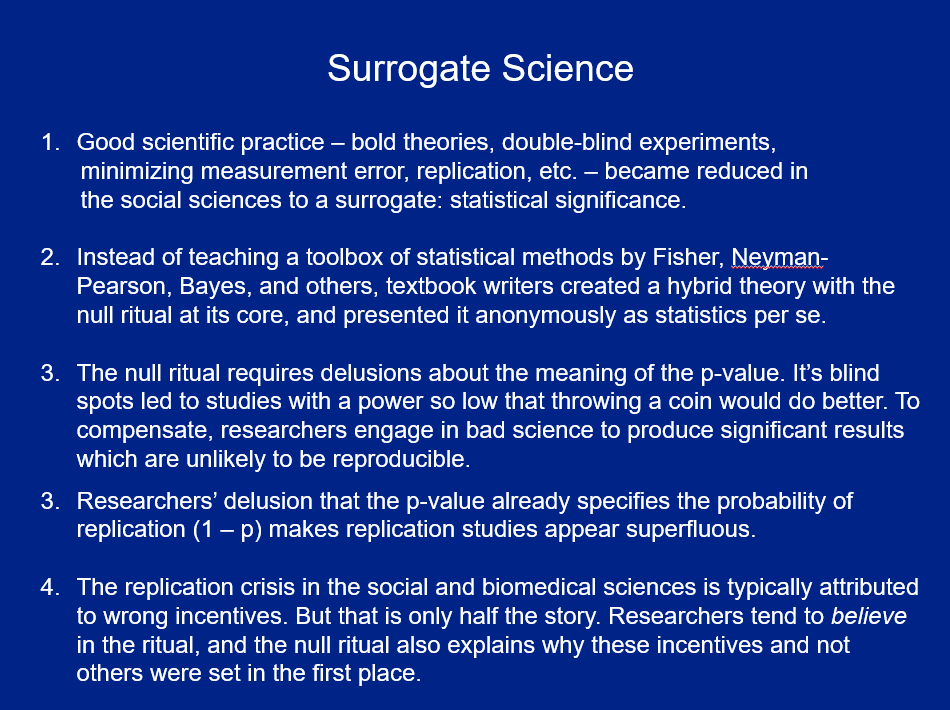
Gerd Gigerenzer, Andrew Gelman, Clark Glymour and I took part in a very interesting symposium on Philosophy of Statistics at the Philosophy of Science Association last Friday. I jotted down lots of notes, but I’ll limit myself to brief reflections and queries on a small portion of each presentation in turn, starting with Gigerenzer’s “Surrogate Science: How Fisher, Neyman-Pearson, & Bayes Were Transformed into the Null Ritual.” His complete slides are below my comments. I may write this in stages, this being (i).

SLIDE #19

gigerenzer-slide-19

  1. Good scientific practice–bold theories, double-blind experiments, minimizing measurement error, replication, etc.–became reduced in the social science to a surrogate: statistical significance.

I agree that “good scientific practice” isn’t some great big mystery, and that “bold theories, double-blind experiments, minimizing measurement error, replication, etc.” are central and interconnected keys to finding things out in error prone inquiry. Do the social sciences really teach that inquiry can be reduced to cookbook statistics? Or is it simply that, in some fields, carrying out surrogate science suffices to be a “success”? Continue reading

Categories: Fisher, frequentist/Bayesian, Gigerenzer, Gigerenzer, P-values, spurious p values, Statistics | 11 Comments

If you think it’s a scandal to be without statistical falsification, you will need statistical tests (ii)

Screen Shot 2016-08-09 at 2.55.33 PM

.

1. PhilSci and StatSci. I’m always glad to come across statistical practitioners who wax philosophical, particularly when Karl Popper is cited. Best of all is when they get the philosophy somewhere close to correct. So, I came across an article by Burnham and Anderson (2014) in Ecology:

While the exact definition of the so-called ‘scientific method’ might be controversial, nearly everyone agrees that the concept of ‘falsifiability’ is a central tenant [sic] of empirical science (Popper 1959). It is critical to understand that historical statistical approaches (i.e., P values) leave no way to ‘test’ the alternative hypothesis. The alternative hypothesis is never tested, hence cannot be rejected or falsified!… Surely this fact alone makes the use of significance tests and P values bogus. Lacking a valid methodology to reject/falsify the alternative science hypotheses seems almost a scandal.” (Burnham and Anderson p. 629)

Well I am (almost) scandalized by this easily falsifiable allegation! I can’t think of a single “alternative”, whether in a “pure” Fisherian or a Neyman-Pearson hypothesis test (whether explicit or implicit) that’s not falsifiable; nor do the authors provide any. I grant that understanding testability and falsifiability is far more complex than the kind of popularized accounts we hear about; granted as well, theirs is just a short paper.[1] But then why make bold declarations on the topic of the “scientific method and statistical science,” on falsifiability and testability? Continue reading

Categories: P-values, Severity, statistical tests, Statistics, StatSci meets PhilSci | 22 Comments

Some statistical dirty laundry: have the stains become permanent?

images

.

Right after our session at the SPSP meeting last Friday, I chaired a symposium on replication that included Brian Earp–an active player in replication research in psychology (Replication and Evidence: A tenuous relationship p. 80). One of the first things he said, according to my notes, is that gambits such as cherry picking, p-hacking, hunting for significance, selective reporting, and other QRPs, had been taught as acceptable become standard practice in psychology, without any special need to adjust p-values or alert the reader to their spuriousness [i]. (He will correct me if I’m wrong[2].) It shocked me to hear it, even though it shouldn’t have, given what I’ve learned about statistical practice in social science. It was the Report on Stapel that really pulled back the curtain on this attitude toward QRPs in social psychology–as discussed in this blogpost 3 years ago. (If you haven’t read Section 5 of the report on flawed science, you should.) Many of us assumed that QRPs, even if still committed, were at least recognized to be bad statistical practices since the time of Morrison and Henkel’s (1970) Significance Test Controversy. A question now is this: have all the confessions of dirty laundry, the fraudbusting of prominent researchers, the pledges to straighten up and fly right, the years of replication research, done anything to remove the stains? I leave the question open for now. Here’s my “statistical dirty laundry” post from 2013: Continue reading

Categories: junk science, reproducibility, spurious p values, Statistics | 4 Comments

Fallacies of Rejection, Nouvelle Cuisine, and assorted New Monsters

images-17

Jackie Mason

Whenever I’m in London, my criminologist friend Katrin H. and I go in search of stand-up comedy. Since it’s Saturday night (and I’m in London), we’re setting out in search of a good comedy club (I’ll complete this post upon return). A few years ago we heard Jackie Mason do his shtick, a one-man show billed as his swan song to England.  It was like a repertoire of his “Greatest Hits” without a new or updated joke in the mix.  Still, hearing his rants for the nth time was often quite hilarious. It turns out that he has already been back doing another “final shtick tour” in England, but not tonight.

A sample: If you want to eat nothing, eat nouvelle cuisine. Do you know what it means? No food. The smaller the portion the more impressed people are, so long as the food’s got a fancy French name, haute cuisine. An empty plate with sauce!

As one critic wrote, Mason’s jokes “offer a window to a different era,” one whose caricatures and biases one can only hope we’ve moved beyond:

But it’s one thing for Jackie Mason to scowl at a seat in the front row and yell to the shocked audience member in his imagination, “These are jokes! They are just jokes!” and another to reprise statistical howlers, which are not jokes, to me. This blog found its reason for being partly as a place to expose, understand, and avoid them. I had earlier used this Jackie Mason opening to launch into a well-known fallacy of rejection using statistical significance tests. I’m going to go further this time around. I began by needling some leading philosophers of statistics: Continue reading

Categories: reforming the reformers, science-wise screening, Statistical power, statistical tests, Statistics | Tags: , , , , | 5 Comments

A. Spanos: Talking back to the critics using error statistics

spanos 2014

.

Given all the recent attention given to kvetching about significance tests, it’s an apt time to reblog Aris Spanos’ overview of the error statistician talking back to the critics [1]. A related paper for your Saturday night reading is Mayo and Spanos (2011).[2] It mixes the error statistical philosophy of science with its philosophy of statistics, introduces severity, and responds to 13 criticisms and howlers.

I’m going to comment on some of the ASA discussion contributions I hadn’t discussed earlier. Please share your thoughts in relation to any of this.

[1]It was first blogged here, as part of our seminar 2 years ago.

[2] For those seeking a bit more balance to the main menu offered in the ASA Statistical Significance Reference list.


See also on this blog:

A. Spanos, “Recurring controversies about p-values and confidence intervals revisited

A. Spanos, “Lecture on frequentist hypothesis testing


Categories: Error Statistics, frequentist/Bayesian, reforming the reformers, statistical tests, Statistics | 72 Comments

“A small p-value indicates it’s improbable that the results are due to chance alone” –fallacious or not? (more on the ASA p-value doc)

images-9

.

There’s something about “Principle 2” in the ASA document on p-values that I couldn’t address in my brief commentary, but is worth examining more closely.

2. P-values do not measure (a) the probability that the studied hypothesis is true , or (b) the probability that the data were produced  by random chance alone,

(a) is true, but what about (b)? That’s what I’m going to focus on, because I think it is often misunderstood. It was discussed earlier on this blog in relation to the Higgs experiments and deconstructing “the probability the results are ‘statistical flukes'”. So let’s examine: Continue reading

Categories: P-values, statistical tests, Statistics | 170 Comments

Hocus pocus! Adopt a magician’s stance, if you want to reveal statistical sleights of hand

images-3

.

When they sought to subject Uri Geller to the scrutiny of scientists, magicians had to be brought in because only they were sufficiently trained to spot the subtle sleight of hand shifts by which the magician tricks by misdirection. We, too, have to be magicians to discern the subtle misdirections and shifts of meaning in the discussions of statistical significance tests (and other methods)—even by the same statistical guide. We needn’t suppose anything deliberately devious is going on at all! Often, the statistical guidebook reflects shifts of meaning that grow out of one or another critical argument. These days, they trickle down quickly to statistical guidebooks, thanks to popular articles on the “statistics crisis in science”. The danger is that their own guidebooks contain inconsistencies. To adopt the magician’s stance is to be on the lookout for standard sleights of hand. There aren’t that many.[0]

I don’t know Jim Frost, but he gives statistical guidance at the minitab blog. The purpose of my previous post is to point out that Frost uses the probability of a Type I error in two incompatible ways in his posts on significance tests. I assumed he’d want to clear this up, but so far he has not. His response to a comment I made on his blog is this: Continue reading

Categories: P-values, reforming the reformers, statistical tests | 2 Comments

Blog at WordPress.com.