Author Archives: Mayo

U-Phil: Deconstructing Dynamic Dutch-Books?

Oh, she takes care of herself, she can wait if she wants,
She’s ahead of her time.
Oh, and s
he never gives out and she never gives in,
She just changes her mind.

(Billy Joel, “She’s Always a Woman”)

If we agree that we have degrees of belief in any and all propositions, then, it is often argued (by Bayesians), that if your beliefs do not conform to the probability calculus, you are being incoherent, and will lose money for sure (by a clever enough bookie). We can accept the claim that, were we required to take bets on our degrees of belief, then given that we prefer not to lose, we would not accept bets that ensured our losing. But this is a tautology, as others have pointed out, and entails nothing about degree of belief assignments. “That an agent ought not to accept a set of wagers according to which she loses come what may, if she would prefer not to lose, is a matter of deductive logic and not a property of beliefs” (Bacchus, Kyburg, and Thalos 1990: 476).[i] Nor need coerced (or imaginary) betting rates actually measure an agent’s degrees of belief in the truth of scientific hypothesis..

Nowadays, surprisingly, most Bayesian philosophers seem to dismiss as irrelevant the variety of threats of being Dutch-booked. Confronted with counterexamples in which violating Bayes’s rule seems perfectly rational on intuitive grounds, Bayesians contort themselves into a great many knots in order to retain the underlying Bayesian philosophy while sacrificing updating rules, long held to be the very essence of Bayesian reasoning. To face contemporary positions squarely calls for rather imaginative deconstructions. I invite your deconstructions (to error@vt.edu) by April 23 (see So You Want to Do a Philosophical Analysis). Says Howson:

“It is the entirely rational claim that I may be induced to act irrationally that the dynamic Dutch book argument, absurdly, would condemn as incoherent”. (Howson 1997: 287)[ii] [iii]

It used to be that frequentists and others who sounded the alarm about temporal incoherency were declared irrational. Now, it is the traditional insistence on updating by Bayes’s rule that was irrational all along. Continue reading

Categories: Statistics, U-Phil | Tags: , | 22 Comments

That Promissory Note From Lehmann’s Letter; Schmidt to Speak

Juliet Shaffer and Erich Lehmann

Monday, April 16, is Jerzy Neyman’s birthday, but this post is not about Neyman (that comes later, I hope). But in thinking of Neyman, I’m reminded of Erich Lehmann, Neyman’s first student, and a promissory note I gave in a post on September 15, 2011.  I wrote:

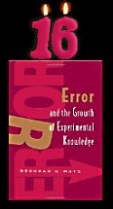
“One day (in 1997), I received a bulging, six-page, handwritten letter from him in tiny, extremely neat scrawl (and many more after that).  …. I remember it contained two especially noteworthy pieces of information, one intriguing, the other quite surprising.  The intriguing one (I’ll come back to the surprising one another time, if reminded) was this:  He told me he was sitting in a very large room at an ASA meeting where they were shutting down the conference book display (or maybe they were setting it up), and on a very long, dark table sat just one book, all alone, shiny red.  He said he wondered if it might be of interest to him!  So he walked up to it….  It turned out to be my Error and the Growth of Experimental Knowledge (1996, Chicago), which he reviewed soon after.”

But what about the “surprising one” that I was to come back to “if reminded”? (yes, one person did remind me last month). The surprising one is that Lehmann’s letter—this is his first letter to me– asked me to please read a paper by Frank Schmidt to appear in his wife Juliet Shaffer’s new (at the time) journal, Psychological Methods, as he wondered if I had any ideas as to what may be done to answer such criticisms of frequentist tests!   But, clearly, few people could have been in a better position than Lehmann to “do something about” these arguments …hence my surprise.  But I think he was reluctant…. Continue reading

Categories: Statistics | Tags: , , , , | 1 Comment

Call for papers: Philosepi?

Dear Reader: Here’s something of interest that was sent to me today (“philosepi”!)

Call for papers: Preventive Medicine special section on philosepi

The epidemiology and public health journal Preventive Medicine is devoting a special section to the Philosophy of Epidemiology, and published the first call for papers in its April 2012 issue. Papers will be published as they are received and reviewed. Deadline for inclusion in the first issue is 30 June 2012. See the Call For Papers for further information or contact Alex Broadbent who is happy to discuss possible topics, etc. All papers will be subject to peer review.

Preventive Medicine invites submissions from epidemiologists, statisticians, philosophers, lawyers, and others with a professional interest in the conceptual and methodological challenges that emerge from the field of epidemiology for a Special Section entitled “Philoso- phy of Epidemiology” with Guest Editor Dr Alex Broadbent of the University of Johannesburg. Dr Broadent also served as the Guest Editor of a related previous Special Section, “Epidemiology, Risk, and Causation”, that appeared in the October–November 2011 issue (Prev Med 53(4–5):213–259 http://www.sciencedirect.com/science/ journal/00917435/53/4-5). Continue reading

Categories: Announcement, philosophy of science | Tags: , , | 1 Comment

N. Schachtman: Judge Posner’s Digression on Regression

I am pleased to post Nathan Schactman’s most recent blog entry on statistics in the law: he has gratefully agreed to respond to comments and queries on this blog*.
April 6th, 2012

Cases that deal with linear regression are not particularly exciting except to a small brand of “quant” lawyers who see such things “differently.”  Judge Posner, the author of several books, including Economic Analysis of Law (8th ed. 2011), is a judge who sees things differently as well.

In a case decided late last year, Judge Posner took the occasion to chide the district court and the parties’ legal counsel for failing to assess critically a regression analysis offered by an expert witness on the quantum of damages in a contract case.  ATA Airlines Inc. (ATA), a subcontractor of Federal Express Corporation, sued FedEx for breaching an alleged contract to include ATA in a lucrative U.S. military deal.

Remarkably, the contract liability was a non-starter; the panel of the Seventh Circuit reversed and rendered the judgment in favor of the plaintiff.  There never was a contract, and so the case should never have gone to trial.  ATA Airlines, Inc. v. Federal Exp. Corp., 665 F.3d 882, 888-89 (2011).

End of Story?

In a diversity case, based upon state law, with no liability, you would think that the panel would and perhaps should stop once it reached the conclusion that there was no contract upon which to predicate liability.  Anything more would be, of course, pure obiter dictum, but Judge Posner could not resist the teaching moment, both for the trial judge below, the parties, their counsel, and the bar: Continue reading

Categories: Statistics | Tags: , , , , , | 2 Comments

Going Where the Data Take Us

A reader, Cory J, sent me a question in relation to a talk of mine he once attended:

I have the vague ‘memory’ of an example that was intended to bring out a central difference between broadly Bayesian methodology and broadly classical statistics.  I had thought it involved a case in which a Bayesian would say that the data should be conditionalized on, and supports H, whereas a classical statistician effectively says that the data provides no support to H.  …We know the data, but we also know of the data that only ‘supporting’ data would be given us.  A Bayesian was then supposed to say that we should conditionalize on the data that we have, even if we know that we wouldn’t have been given contrary data had it been available.

That only “supporting” data would be presented need not be problematic in itself; it all depends on how this is interpreted.  There might be no negative results to be had (H might be true) , and thus none to “be given us”.  Your last phrase, however, does describe a pejorative case for a frequentist error statistician, in that, if “we wouldn’t have been given contrary data” to H (in the sense of data in conflict with what H asserts), even “had it been available” then the procedure had no chance of finding or reporting flaws in H.  Thus only data in accordance with H would be presented, even if H is false; so H passes a “test” with minimal stringency or severity. I discuss several examples in papers below (I think the reader had in mind Mayo and Kruse 2001). Continue reading

Categories: double-counting, Statistics | Tags: , , | 4 Comments

Fallacy of Rejection and the Fallacy of Nouvelle Cuisine

In February, in London, criminologist Katrin H. and I went to see Jackie Mason do his shtick, a one-man show billed as his swan song to England.  It was like a repertoire of his “Greatest Hits” without a new or updated joke in the mix.  Still, hearing his rants for the nth time was often quite hilarious.

A sample: If you want to eat nothing, eat nouvelle cuisine. Do you know what it means? No food. The smaller the portion the more impressed people are, so long as the food’s got a fancy French name, haute cuisine. An empty plate with sauce!

As one critic wrote, Mason’s jokes “offer a window to a different era,” one whose caricatures and biases one can only hope we’ve moved beyond: http://www.guardian.co.uk/stage/2012/feb/21/jackie-mason-live-review

But it’s one thing for Jackie Mason to scowl at a seat in the front row and yell to the shocked audience member in his imagination, “These are jokes! They are just jokes!” and another to reprise statistical howlers, which are not jokes, to me. This blog found its reason for being partly as a place to expose, understand, and avoid them. Recall the September 26, 2011 post “Whipping Boys and Witch Hunters”: https://errorstatistics.com/2011/09/26/whipping-boys-and-witch-hunters-comments-are-now-open/: [i]

Fortunately, philosophers of statistics would surely not reprise decades-old howlers and fallacies. After all, it is the philosopher’s job to clarify and expose the conceptual and logical foibles of others; and even if we do not agree, we would never merely disregard and fail to address the criticisms in published work by other philosophers.  Oh wait, ….one of the leading texts repeats the fallacy in their third edition: Continue reading

Categories: Statistics | Tags: , , , , | 1 Comment

History and Philosophy of Evidence-Based Health Care (EBHC)

Here is an announcement I received of an unusual short course on History and Philosophy of Evidence-Based Health Care (EBHC):  “Historical anecdotes are often easier to grasp than numbers,” the ad reads, but I hope they’re not going to be recommending the latter be replaced by the former?

Overview

The relationship between medicine and philosophy has a distinguished history. Maimonides, Avicenna, Galen, Descartes, and Locke were all philosophers and medical doctors. More recently, Peter Medawar and Archie Cochrane were strongly influenced by Karl Popper. There is an increasing body of evidence that combining History and Philosophy of Science on the one hand, and health care on the other creates synergies for the mutual benefit of all disciplines.

The course will consider:

  • How and why did the idea that comparative studies were necessary to inform health care decisions replace other ‘methods’ such as reasoning from more basic sciences and ‘expertise’?
  • Can average results be applied to individuals?
  • What is the role of values?

We believe that the history and philosophy of science is an integrated discipline, and we will explore these issues with appeal to current and historical examples.… it is fair to say that not very much attention was paid by the originators of EBM to the philosophy of science… One hopes that the attention of philosophers will be drawn to these questions (Haynes, 2002)

A wise man proportions his belief to the evidence – David Hume

History of science without philosophy of science is blind … philosophy of science without history of science is empty – Norwood Russell Hanson

Categories: Announcement | Tags: , | 9 Comments

Philosophy of Statistics: Retraction Watch, Vol. 1, No. 1

This morning I received a paper I have been asked to review (anonymously as is typical). It is to head up a forthcoming issue of a new journal called Philosophy of Statistics: Retraction Watch.  This is the first I’ve heard of the journal, and I plan to recommend they publish the piece, conditional on revisions. I thought I would post the abstract here. It’s that interesting.

“Some Slightly More Realistic Self-Criticism in Recent Work in Philosophy of Statistics,” Philosophy of Statistics: Retraction Watch, Vol. 1, No. 1 (2012), pp. 1-19.

In this paper we delineate some serious blunders that we and others have made in published work on frequentist statistical methods. First, although we have claimed repeatedly that a core thesis of the frequentist testing approach is that a hypothesis may be rejected with increasing confidence as the power of the test increases, we now see that this is completely backwards, and we regret that we have never addressed, or even fully read, the corrections found in Deborah Mayo’s work since at least 1983, and likely even before that.

Second, we have been wrong to claim that Neyman-Pearson (N-P) confidence intervals are inconsistent because in special cases it is possible for a specific 95% confidence interval to be known to be correct. Not only are the examples required to show this absurdly artificial, but the frequentist could simply interpret this “vacuous interval” “as a statement that all parameter values are consistent with the data at a particular level,” which, as Cox and Hinkley note, is an informative statement about the limitations in the data (Cox and Hinkley 1974, 226). Continue reading

Categories: Comedy, Statistics | Tags: , , , , , | 4 Comments

Comment on the Barnard and Copas (2002) Empirical Example: Aris Spanos

I am grateful to A. Spanos for letting me post a link to his comments on a paper S. Senn shared last week. You can find a pdf of his comments here.

You can read the original Bernard and Copas (2002) article here

Categories: Statistics | Tags: , , , , | 21 Comments

Announcement: Philosophy of Scientific Experiment Conference

Call for papers

PSX Philosophy of Scientific Experimentation 3 (PSX3)

Friday and Saturday, October 5 and 6, 2012

University of Colorado, Boulder

Keynote Speakers:   Professor Eric Cornell, University of Colorado, Nobel Prize (Physics, 2001)

 Professor Friedrich Steinle, History of Science, University of Berlin

Experiments play essential roles in science. Philosophers of science have emphasized their role in the testing of theories but they also play other important roles. They are, for example, essential in exploring new phenomenological realms and discovering new effects and phenomena. Nevertheless, experiments are still an underrepresented topic in mainstream philosophy of science. This conference on the philosophy of scientific experimentation, the third in a series,  is intended to give a home to philosophical interests in, and concerns about, experiment. Among the questions that will be discussed are the following: How is experimental practice organized, around theories or around something else? How independent is experimentation from theories? Does it have a life of its own? Can experiments undermine the threat posed to the objectivity of science by the thesis of theory-ladenness, underdetermination, or the Duhem-Quine thesis? What are the important similarities and differences between experiments in different sciences? What are the experimental strategies scientists use for making sure that their experiments work correctly? How are phenomena discovered or created in the laboratory? Is experimental knowledge epistemically more secure than observational knowledge? Can experiments give us good reasons for belief in theoretical entities? What role do computer simulations play in the assessment of experimental background? How trustworthy are they? Do they warrant the same kind of inferences as experimental knowledge? Are they theory by other means?

Submissions on any aspect of experiment and simulation are welcome. They should be in the form of an extended abstract (1000 words) submitted through EasyChair https://www.easychair.org/conferences/?conf=psx3 Continue reading

Categories: Announcement | Tags: , , , | Leave a comment

The New York Times Goes to War Against Generic Drug Manufacturers: Schactman

Schachtman gives an interesting legal update today on his blog concerning the issue in my post Generic Drugs Resistant to Lawsuits” (Mar. 22, 2012).  I post it here:

The New York Times Goes to War Against Generic Drug Manufacturers

By: Nathan Schachtman, Esq., PC*

Last week marked the launch of a New York Times a rhetorically fevered, legally sophomoric campaign against generic drug preemption.  Saturday saw an editorial, “A Bizarre Outcome on Generic Drugs,” New York Times (March 24, 2012), which screamed, “Bizarre”!  “Outrageous”!

The New York Times editorialists have their knickers in a knot over the inability of people, who are allegedly harmed by adverse drug reactions from generic medications, to sue the generic manufacturers.  The editorial follows a front-page article, from earlier last week, which decried the inability to sue generic drug sellers. See Katie Thomas, “Generic Drugs Proving Resistant to Damage Suits,” New York Times (Mar. 21, 2012).

The Times‘ writers think that it is “bizarre” and “outrageous” that these people are out of court due to federal preemption of state court tort laws that might have provided a remedy.

In particular, the Times suggests that the law is irrational for allowing Ms. Diana Levine to recover against Wyeth for the loss of her arm to gangrene after receiving Phenergan by intravenous push, while another plaintiff, Ms. Schork, cannot recover for a similar injury, from a generic manufacturer of promethazine, the same medication.  Wyeth v. Levine, 555 U.S. 555 (2009).  See also Brief of Petitioner Wyeth, in Wyeth v. Levine (May 2008).

Of course, both Ms. Levine and Ms. Schork received compensation from their healthcare providers, who deviated from their standard of care when they carelessly injected the medication into arteries, contrary to clear instructions.   At the time that Levine received her treatment, the Phenergan package insert contained four separate warnings about the risk of gangrene from improper injection of the medication into an artery.  For instance, the “Adverse Reactions” section of the Phenergan label indicated: “INTRA-ARTERIAL INJECTION [CAN] RESULT IN GANGRENE OF THE AFFECTED EXTREMITY.” Continue reading

Categories: Statistics | Tags: , , , , , | Leave a comment

Generic Drugs Resistant to Lawsuits

Waiting for my plane at La Guardia, I see that the NYT has an article on page one about the disparity between suing brand name vs. generic drug makers for failure to adequately warn of serious side effects on their drug labels. Can it be that no one is responsible for monitoring/updating drug label warnings once a drug becomes generic?

Debbie Schork, a deli worker at a supermarket in Indiana, had to have her hand amputated after an emergency room nurse injected her with an anti-nausea drug, causing gangrene. She sued the manufacturer named in the hospital’s records for failing to warn about the risks of injecting it. Her case was quietly thrown out of court last fall.

That result stands in sharp contrast to the highly publicized case of Diana Levine, a professional musician from Vermont. Her hand and forearm were amputated because of gangrene after a physician assistant at a health clinic injected her with the same drug. She sued the drug maker, Wyeth, and won $6.8 million.

The financial outcomes were radically different for one reason: Ms. Schork had received the generic version of the drug, known as promethazine, while Ms. Levine had been given the brand name, Phenergan.

“Explain the difference between the generic and the real one — it’s just a different company making the same thing,” Ms. Schork said.

Continue reading

Categories: Statistics | Tags: , , , , | 4 Comments

Objectivity (#5): Three Reactions to the Challenge of Objectivity (in inference):

(1) If discretionary judgments are thought to introduce subjectivity in inference, a classic strategy thought to achieve objectivity is to extricate such choices, replacing them with purely formal a priori computations or agreed-upon conventions (see March 14).  If leeway for discretion introduces subjectivity, then cutting off discretion must yield objectivity!  Or so some argue. Such strategies may be found, to varying degrees, across the different approaches to statistical inference.

The inductive logics of the type developed by Carnap promised to be an objective guide for measuring degrees of confirmation in hypotheses, despite much-discussed problems, paradoxes, and conflicting choices of confirmation logics.  In Carnapian inductive logics, initial assignments of probability are based on a choice of language and on intuitive, logical principles. The consequent logical probabilities can then be updated (given the statements of evidence) with Bayes’s Theorem. The fact that the resulting degrees of confirmation are at the same time analytical and a priori—giving them an air of objectivity–reveals the central weakness of such confirmation theories as “guides for life”, e.g., —as guides, say, for empirical frequencies or for finding things out in the real world. Something very similar  happens with the varieties of “objective’” Bayesian accounts, both in statistics and in formal Bayesian epistemology in philosophy (a topic to which I will return; if interested, see my RMM contribution).

A related way of trying to remove latitude for discretion might be to define objectivity in terms of the consensus of a specified group, perhaps of experts, or of agents with “diverse” backgrounds. Once again, such a convention may enable agreement yet fail to have the desired link-up with the real world.  It would be necessary to show why consensus reached by the particular choice of group (another area for discretion) achieves the learning goals of interest.

Continue reading

Categories: Objectivity, Objectivity, Statistics | Tags: , , | Leave a comment

Objectivity (#4) and the “Argument From Discretion”

We constantly hear that procedures of inference are inescapably subjective because of the latitude of human judgment as it bears on the collection, modeling, and interpretation of data. But this is seriously equivocal: Being the product of a human subject is hardly the same as being subjective, at least not in the sense we are speaking of—that is, as a threat to objective knowledge. Are all these arguments about the allegedly inevitable subjectivity of statistical methodology rooted in equivocations? I argue that they are!

Insofar as humans conduct science and draw inferences, it is obvious that human judgments and human measurements are involved. True enough, but too trivial an observation to help us distinguish among the different ways judgments should enter, and how, nevertheless, to avoid introducing bias and unwarranted inferences. The issue is not that a human is doing the measuring, but whether we can reliably use the thing being measured to find out about the world.

Continue reading

Categories: Objectivity, Objectivity, Statistics | Tags: , | 29 Comments

RMM-7: Commentary and Response on Senn published: Special Volume on Stat Scie Meets Phil Sci

Dear Reold blogspot typewriterader: My commentary, “How Can We Cultivate Senn’s Ability, Comment on Stephen Senn, ‘You May Believe You are a Bayesian But You’re Probably Wrong’” and Senn’s, “Names and Games, A Reply to Deborah G. Mayo” have been published under the Discussion Section of Rationality, Markets, and Morals.(Special Topic: Statistical Science and Philosophy of Science: Where Do/Should They Meet?”)

I encourage you to submit your comments/exchanges on any of the papers in this special volume [this is the first].  (Information may be found on their webpage [no longer active 3/21/2021]. Questions/Ideas: please write to me at error@vt.edu.)

Categories: Philosophy of Statistics, Statistics | Tags: | Leave a comment

Blogologue*

Gelman responds on his blog today: “Gelman on Hennig on Gelman on Bayes”.

http://andrewgelman.com/2012/03/gelman-on-hennig-on-gelman-on-bayes/

I invite comments here….

*An ongoing exchange among a group of blogs that remain distinct (just coined)

Categories: Philosophy of Statistics, Statistics, U-Phil | Tags: , , | Leave a comment

U-PHIL: A Further Comment on Gelman by Christian Hennig (UCL, Statistics)

Comment on Gelman’sInduction and Deduction in Bayesian Data Analysis” (RMM)

Dr. Christian Hennig (Senior Lecturer, Department of Statistical Science, University College London)

I have read quite a bit of what Andrew Gelman has written in recent years, including some of his blog. One thing that I find particularly refreshing and important about his approach is that he contrasts the Bayesian and frequentist philosophical conceptions honestly with what happens in the practice of data analysis, which often cannot (or does better not to) proceed according to an inflexible dogmatic book of rules.

I also like the emphasis on the fact that all models are wrong. I personally believe that a good philosophy of statistics should consistently take into account that models are rather tools for thinking than able to “match” reality, and in the vast majority of cases we know clearly that they are wrong (all continuous models are wrong because all observed data are discrete, for a start).

There is, however, one issue on which I find his approach unsatisfactory (or at least not well enough explained), and on which both frequentism and subjective Bayesianism seem superior to me.

Continue reading

Categories: Philosophy of Statistics, Statistics, U-Phil | Tags: , , , | 5 Comments

Lifting a piece from Spanos’ contribution* will usefully add to the mix

The following two sections from Aris Spanos’ contribution to the RMM volume are relevant to the points raised by Gelman (as regards what I am calling the “two slogans”)**.

 6.1 Objectivity in Inference (From Spanos, RMM 2011, pp. 166-7)

The traditional literature seems to suggest that ‘objectivity’ stems from the mere fact that one assumes a statistical model (a likelihood function), enabling one to accommodate highly complex models. Worse, in Bayesian modeling it is often misleadingly claimed that as long as a prior is determined by the assumed statistical model—the so called reference prior—the resulting inference procedures are objective, or at least as objective as the traditional frequentist procedures:

“Any statistical analysis contains a fair number of subjective elements; these include (among others) the data selected, the model assumptions, and the choice of the quantities of interest. Reference analysis may be argued to provide an ‘objective’ Bayesian solution to statistical inference in just the same sense that conventional statistical methods claim to be ‘objective’: in that the solutions only depend on model assumptions and observed data.” (Bernardo 2010, 117)

This claim brings out the unfathomable gap between the notion of ‘objectivity’ as understood in Bayesian statistics, and the error statistical viewpoint. As argued above, there is nothing ‘subjective’ about the choice of the statistical model Mθ(z) because it is chosen with a view to account for the statistical regularities in data z0, and its validity can be objectively assessed using trenchant M-S testing. Model validation, as understood in error statistics, plays a pivotal role in providing an ‘objective scrutiny’ of the reliability of the ensuing inductive procedures.

Continue reading

Categories: Philosophy of Statistics, Statistics, Testing Assumptions, U-Phil | Tags: , , , , | 43 Comments

Mayo, Senn, and Wasserman on Gelman’s RMM** Contribution

Picking up the pieces…

Continuing with our discussion of contributions to the special topic,  Statistical Science and Philosophy of Science in Rationality, Markets and Morals (RMM),* I am pleased to post some comments on Andrew **Gelman’s paper “Induction and Deduction in Bayesian Data Analysis”.  (More comments to follow—as always, feel free to comment.)

Note: March 9, 2012: Gelman has commented to some of our comments on his blog today: http://andrewgelman.com/2012/03/coming-to-agreement-on-philosophy-of-statistics/

D. Mayo

For now, I will limit my own comments to two: First, a fairly uncontroversial point, while Gelman writes that “Popper has argued (convincingly, in my opinion) that scientific inference is not inductive but deductive,” a main point of my series (Part 123) of “No-Pain” philosophy was that “deductive” falsification involves inductively inferring a “falsifying hypothesis”.

More importantly, and more challengingly, Gelman claims the view he recommends “corresponds closely to the error-statistics idea of Mayo (1996)”.  Now the idea that non-Bayesian ideas might afford a foundation for strands of Bayesianism is not as implausible as it may seem. On the face of it, any inference to a claim, whether to the adequacy of a model (for a given purpose), or even to a posterior probability, can be said to be warranted just to the extent that the claim has withstood a severe test (i.e, a test that would, at least with reasonable probability, have discerned a flaw with the claim, were it false).  The question is: How well do Gelman’s methods for inferring statistical models satisfy severity criteria?  (I’m not sufficiently familiar with his intended applications to say.)

Continue reading

Categories: Philosophy of Statistics, Statistics, U-Phil | Tags: , , , | 1 Comment

Statistical Science Court?

Nathan Schactman has an interesting blog post onScientific illiteracy among the judiciary”:

February 29th, 2012

Ken Feinberg, speaking at a symposium on mass torts, asks what legal challenges do mass torts confront in the federal courts. The answer seems obvious.

Pharmaceutical cases that warrant federal court multi-district litigation (MDL) treatment typically involve complex scientific and statistical issues. The public deserves having MDL cases assigned to judges who have special experience and competence to preside in cases in which these complex issues predominate. There appears to be no procedural device to ensure that the judges selected in the MDL process have the necessary experience and competence, and a good deal of evidence to suggest that the MDL judges are not up to the task at hand.

In the aftermath of the Supreme Court’s decision in Daubert, the Federal Judicial Center assumed responsibility for producing science and statistics tutorials to help judges grapple with technical issues in their cases. The Center has produced videotaped lectures as well as the Reference Manual on Scientific Evidence, now in its third edition. Despite the Center’s best efforts, many federal judges have shown themselves to be incorrigible. It is time to revive the discussions and debates about implementing a “science court.”

I am intrigued to hear Schachtman revive the old and controversial idea of a “science court”, although it has actually never left, but has come up for debate every few years for the past 35 or 40 years! In the 80s, it was a hot topic in the new “science and values” movement, but I do not think it was ever really put to an adequate experimental test. The controversy directly relates to the whole issue of distinguishing evidential and policy issues (in evidence-based policy), Continue reading
Categories: philosophy of science, PhilStatLaw, Statistics | Tags: , , , , | 2 Comments

Blog at WordPress.com.