Announcement

2025 Leisurely cruise through Statistical Inference as Severe Testing: First Announcement

Ship Statinfasst

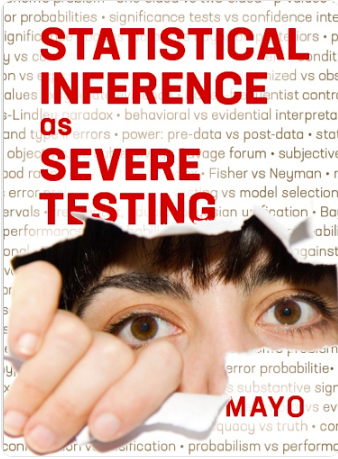
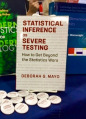
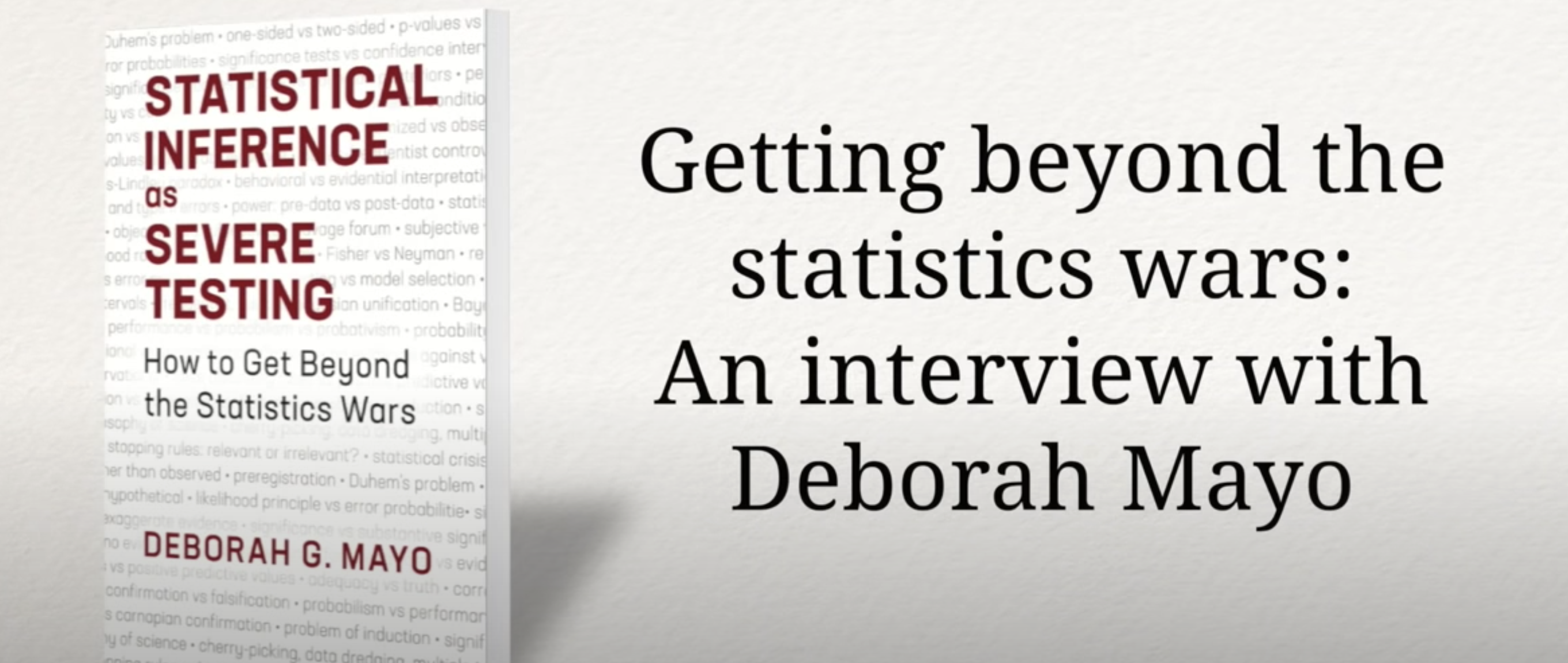
We’re embarking on a leisurely cruise through the highlights of Statistical Inference as Severe Testing [SIST]: How to Get Beyond the Statistics Wars (CUP 2018) this fall (Oct-Jan), following the 5 seminars I led for a 2020 London School of Economics (LSE) Graduate Research Seminar. It had to be run online due to Covid (as were the workshops that followed). Unlike last fall, this time I will include some zoom meetings on the material, as well as new papers and topics of interest to attendees. In this relaxed (self-paced) journey, excursions that had been covered in a week, will be spread out over a month [i] and I’ll be posting abbreviated excerpts on this blog. Look for the posts marked with the picture of ship StatInfAsSt. [ii]  Continue reading

Categories: 2024 Leisurely Cruise, Announcement | Leave a comment

Leisurely cruise through Statistical Inference as Severe Testing: First Announcement

Ship Statinfasst

We’re embarking on a leisurely cruise through the highlights of Statistical Inference as Severe Testing [SIST]: How to Get Beyond the Statistics Wars (CUP 2018) this fall (Oct-Jan), following the 5 seminars I led for a 2020 London School of Economics (LSE) Graduate Research Seminar. It was run entirely online due to Covid (as were the workshops that followed). In this new, relaxed (self-paced) journey, excursions that had been covered in a week, will be spread out over a month [i] and I’ll be posting abbreviated excerpts on this blog a few times a month. Look for the posts marked with the picture of ship StatInfAsSt. [ii] Continue reading

Categories: 2024 Leisurely Cruise, Announcement | Leave a comment

Conference: Is Philosophy Useful for Science, and/or Vice Versa? (Jan 30- Feb 2, 2024)

I will be giving an online talk on Friday, Feb 2, 4:30-5:45 NYC time, at a conference you can watch on zoom this week (Jan 30-Feb 2): Is Philosophy Useful for Science, and/or Vice Versa?  It’s taking place in-person and online at Chapman University. My talk is: “The importance of philosophy of science for Statistical Science and vice versa”. I’ll touch on a current paper I’m writing that (finally) gets back to “Bayesian conceptions of severity”, (in contrast to error statistical severity) as begun on the post on Van Dongen, Springer, and Wagenmaker (2022). Continue reading
Categories: Announcement | Leave a comment

Happy Birthday David Cox! Upcoming events August 8 & 9 at JSM 2023

Sir David Cox: 15, July 1924-18 January, 2022

Today is Sir David Cox’s birthday. He would have been 99 today. 2023 marks the first year that the David R. Cox Award in Foundations of Statistics will be given at the upcoming Joint Statistical Meetings (JSM) in Toronto. For information on the Award, see this post. I’m excited to announce the inaugural winner, Nancy Reid! She will speak on “The Importance of Foundations in Statistical Science” Wednesday August 9:  10:30-12:20. The day before, Tuesday August 8: 9:35-9:50 am., I will give a brief talk on “Sir David Cox’s Statistical Philosophy“. The abstracts and locations for the two talks are below.

HAPPY BIRTHDAY DAVID COX! Continue reading

Categories: Announcement, David R. Cox Foundations of Statistics Award, JSM 2023, Philosophy of Statistics | 4 Comments

2023 Syllabus for Philosophy of Inductive-Statistical Inference

PHIL 6014 (crn: 20919): Spring 2023 

Philosophy of Inductive-Statistical Inference
(This is an IN-PERSON class*)
Wed 4:00-6:30 pm, McBryde 223
(Office hours: Tuesdays 3-4; Wednesdays 1:30-2:30)

Syllabus: Third Installment (PDF)
Syllabus Evaluation & Advice (enrolled members (PDF))

D. Mayo (2018) Statistical Inference as Severe Testing: How to Get Beyond the Statistics Wars (SIST) CUP, 2018: SIST (electronic and paper provided to those taking the class; proofs are at errorstatistics.com, see below).
Supplemental text: Hacking, I. (2001). An introduction to probability and inductive logic. Cambridge University Press.
Articles from the Captain’s Bibliography (links to new articles will be provided). 
Other useful information can be found on the SIST Abstracts & Keywords and this post with SIST Excerpts & Mementos)

Date Themes/readings
1. 1/18       Introduction to the Course:
How to tell what’s true about statistical inference

(1/18/23 SLIDES here)

Reading: Statistical Inference as Severe Testing: How to Get Beyond the Statistics Wars (SIST): Preface, Excursion 1 Tour I 1.1-1.3, 9-29

MISC: Souvenir A; SIST Abstracts & Keywords for all excursions and tours
2. 1/25
Q #2
 
Error Probing Tools vs Comparative Evidence: Likelihood & Probability
What counts as cheating?
Intro to Logic: arguments validity & soundness

(1/25/23 SLIDES here)

Reading: SIST: Excursion 1 Tour II 1.4-1.5, 30-55
Session #2 Questions: (PDF)

MISC: NOTES on Excursion 1, SIST: Souvenirs B, C & D, Logic Primer (PDF)
3. 2/1
   Q #3
UPDATED
Induction and Confirmation: PhilStat & Formal Epistemology
The Traditional Problem of Induction
Is Probability a Good Measure of Confirmation? Tacking Paradox

(2/1/23 SLIDES here)

Reading: SIST: Excursion 2, Tour I: 2.1-2.2, 59-74
Hacking “The Basic Rules of Probability” Hand Out (PDF)
UPDATED: Session #3 Questions: (PDF)

MISC: Excursion 2 Tour I Blurb & notes
4. 2/8 &
5. 2/15
Assign 1 2/15 
Falsification, Science vs Pseudoscience, Induction
Statistical Crises of Replication in Psychology & other sciences
Popper, severity and novelty, array of problems and models
Fallacies of rejection, Duhem’s problem; solving induction now

(/2/8/23 SLIDES here)

Reading for 2/8: Popper, Ch 1 from Conjectures and Refutations up to p. 59. (PDF),
This class overlaps with the next, so if you have time read Excursion 2, Tour II: (p. 75-82); Exhibit vi. (p. 82); and p. 108

Session #4 Questions: (PDF)
MISC (2/8): Self-quiz on Popper for Fun! (PDF); Cartoon Guide to Statistics (Link to VT Library link is here)
———————-
Reading for 2/15: SIST: Excursion 2, Tour II: read sections that interest you from those not covered last week. You can choose the example in 2.6 (or one from your field) or the discussion of solving induction in 2.7. Optional for 2/15: Gelman & Loken (2014)

(2/15/23 SLIDES here)

ASSIGNMENT 1 (due 2/15) (PDF)
MISC (2/15): SIST Souvenirs (E), (F), (G), (H); Excursion 2 Tour II Blurb & notes
  Fisher Birthday: February 17: Celebration on 2/22
6. 2/22
 Q #6
&
7. 3/1


Ingenious and Severe Tests: Fisher, Neyman-Pearson, Cox: Concepts of Tests


Reading for 2/22 from SIST: Excursion 3 Tour I: 3.1-3.3: read the sections that interest you, choosing to focus on the statistical tests, the history and philosophy of Fisher, Neiman and Pearson, the example of GTR. Choose 2 from the Triad (they’re very short): Fisher (1955), Pearson (1955), Neyman (1956)

(2/22/23 SLIDES here)

Session #6 Questions: (PDF)

Optional: The pathological Fisher (fiducial) and Neyman (performance) battle: SIST 388-391

——————————————-

Reading for 3/1: Sections from SIST skipped last week: Excursion 3 Tour I: (If time, look at the discussion of trade-offs 328-330) If interested in fiducial frequencies, see Neyman’s Performance and Fisher’s fiducial Section 5.8
Optional: Excursion 3 tour II: It’s the methods, stupid!

(3/1/23 SLIDES here)


MISC: Excursion 3 Tour I Blurb & notes; Souvenirs (I), (J), (K)
Morey app including Examples & Instructions (here);(Morey app) (SEV Apps)

SPRING BREAK Statistical Exercises While Sunning (March 4-12)

Sessions #11-14 are tentative;  please have a look at what’s in them so we can decide which to skip 
8. 3/15
Assign 2
Deeper Concepts (2 parts): Stat in the Higg’s discovery, and Confidence intervals and their duality with tests

Reading (for first part): Excursion 3 Tour III, 3.8 Higgs Discovery (See the ASA 6 principles on P-values: Note 4, P. 216, and Live Exhibit (ix) p. 200: Souv. N p. 201
Reading (for second part): Excursion 3 Tour III, 3.7: pp. 189-195

Assignment 2
(PDF) due 3/17/23

(3/15/23 (revised) SLIDES here)

Misc. Excursion 3 Tour III blurb & notes
9. 3/22

Testing Assumptions of Statistical Models (Guest Speaker: Aris Spanos on misspecification testing in statistics)

Reading: Excursion 4 Tour IV 4.8

(3/22/23 A. Spanos’ SLIDES here)

Misc. Excursion 4 Tour IV blurb & notes

10. 3/29


Who’s Exaggerating what? Bayes factors and Bayes/Fisher Disagreement, Jeffreys-Lindley Paradox (Guest Speaker: Richard Morey on Bayes Factors)

Reading. Excursion 4 Tour II  and Excursion 6, Tour I: 395-423 
(We will spend 2 weeks on these: Excursion 6 Tour I will be post zoom.)
Redefine Statistical Significance” Benjamin et al. 2017. (PDF)

Session #10 Questions (PDF
Richard Morey’s slides (Link); (R. Morey blog post, which goes into more detail.)

Misc. Excursion 4 Tour II blurb & notes

11. 4/5

Mini essay

More on: Bayes factors and Bayes/Fisher Disagreement, Jeffreys-Lindley Paradox
Reading. Excursion 4 Tour II  and Excursion 6, Tour I: 395-423 (We are spending 2 weeks on these: Excursion 6 Tour I will be post zoom.)
Peek Ahead: 6.7 Farewell Keepsake: 436-444 
 
4/05/23 SLIDES (PDF)
 
Mini-essay (PDF)
12. 4/12

Biasing Selection Effects and Randomization
4/12/23 Slides (PDF)
Reading: Excursion 4 Tour III  
ASA Statement on P-values (link)
Optional: Mayo: P-values on Trial

13. 4/19


Power: Pre-data and Post-data

Reading: Excursion 5 Tour I

4/19/23 Slides (PDF)
Slides “Farewell Keepsake” (Sessions 14 & 15): (PDF)
Misc.
Excursion 5 Tours I & II blurbs-notes

14. 4/26

Assign 3

Positive Predictive Value and Probabilistic Instantiation

Controversies about inferring probabilities from frequencies (in law and epistemology)

Reading: Tail end of Excursion 5 Tour I: Exhibit (v), Souvenir X: SIN and SIR; Excursion 5 Tour II: Section 5.6 (excursion 5 Tour II); Farewell Keepsake: (Section 6.7 in Excursion 6 Tour II)

Optional:
(1)
 C. Howson “Error Probabilities in Error” (1997);
(2) Mayo “Response to Howson and Laudan'” (1997) [only the portion responding to Howson];

4/26/23/Slides (PDF

We won’t consider the following, but I leave it here in case anyone wants to look at it:Gardiner and Zaharatos (2022), “The Safe, the Sensitive, and the Severely Tested”

ASSIGNMENT 3 (due 4/26) (PDF)

15. 5/3

Review of the main themes of the seminar
Current Reforms and Stat Activism: Practicing our skills on some recent  papers

5/3/23 Slides (PDF)
Reading: 6.6 (pp 432-6) Error Statistical Bayesians; one of the following: (they can also be your “new” reading for the final paper (Excursion 6 Tour II)

Optional: Gardiner and Zaharatos (2022), “The Safe, the Sensitive, and the Severely Tested”

5/3/23 Slides (PDF)

   FINAL PAPER: (PDF)
Categories: Announcement, new course | 5 Comments

I’m teaching a New Intro to PhilStat Course Starting Wednesday:

Ship StatInfasst (Statistical Inference as Severe Testing: SIST) will set sail on Wednesday January 18 when I begin a weekly seminar on the Philosophy of Inductive-statistical inference. I’m planning to write a new edition and/or companion to SIST (Mayo 2018, CUP), so it will be good to retrace the journey. I’m not requiring a statistics or philosophy background. All materials will be on this blog, and around halfway through there may be an opportunity to zoom, if there’s interest. Continue reading

Categories: Announcement, new course | 2 Comments

Final Session: The Statistics Wars and Their Casualties: 8 December, Session 4

Thursday, December 8 will be the Final Session (Session 4) of my workshop, The Statistics Wars and Their Casualties. There will be 4 new speakers. It’s not too late to register:

registration form

At the end of this post is “A recap of recaps”, the short video we showed at the beginning of Session 3 last week that summarizes the presentations from Sessions 1 & 2 back in September 22-23. Continue reading

Categories: Announcement, Stistics Wars and Their Casualties Workshop | Leave a comment

SCHEDULE: The Statistics Wars and Their Casualties: 1 Dec & 8 Dec: Sessions 3 & 4

It’s not too late to register for Sessions #3 and #4 of our online Workshop. There will be 7 new (live) speakers and, for the the first time ever, the (short) movie; “The Recap of recaps” will be shown at the start of session #3. registration form

Categories: Announcement, Stistics Wars and Their Casualties Workshop | Leave a comment

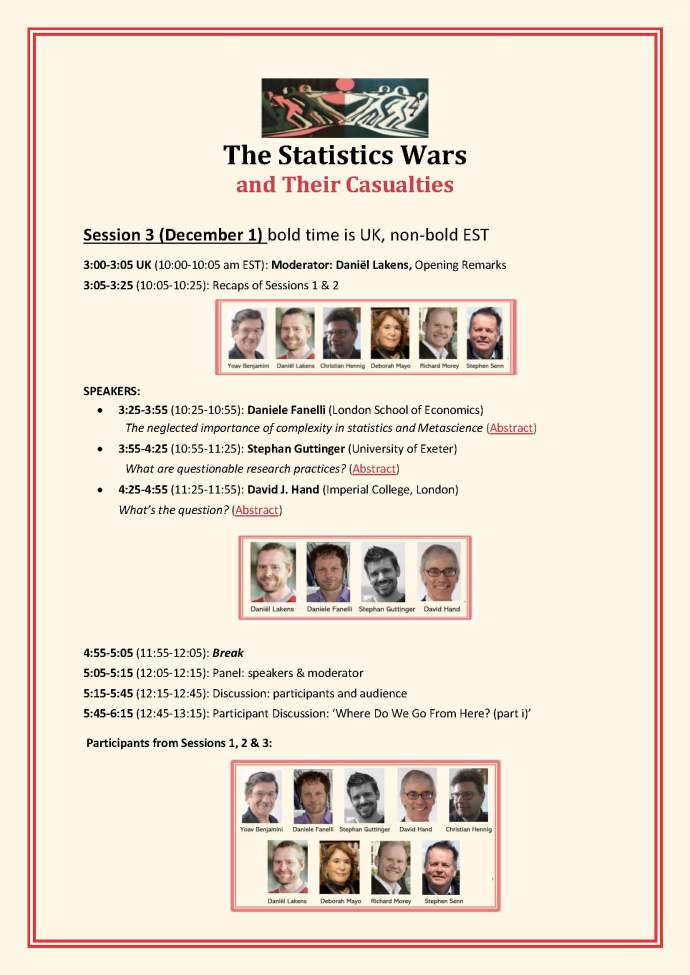
Final Sessions: The Statistics Wars and Their Casualties: 1 December and 8 December

The Statistics Wars

and Their Casualties

1 December and 8 December 2022
Sessions #3 and #4

15:00-18:15 pm London Time/10:00am-1:15pm EST
ONLINE
(London School of Economics, CPNSS)
registration form

For slides and videos of Sessions #1 and #2: see the workshop page

1 December

Session 3 (Moderator: Daniël Lakens, Eindhoven University of Technology)

OPENING 

  • “What Happened So Far”: A medley (20 min) of recaps from Sessions 1 & 2: Deborah Mayo (Virginia Tech), Richard Morey (Cardiff), Stephen Senn (Edinburgh), Daniël Lakens (Eindhoven), Christian Hennig (Bologna) & Yoav Benjamini (Tel Aviv).

SPEAKERS

  • Daniele Fanelli (London School of Economics and Political Science) The neglected importance of complexity in statistics and Metascience  (Abstract)
  • Stephan Guttinger (University of Exeter) What are questionable research practices? (Abstract)
  • David J. Hand (Imperial College, London) What’s the question? (Abstract)

DISCUSSIONS:

  • Closing Panel: “Where Should Stat Activists Go From Here (Part i)?”: Yoav Benjamini, Daniele Fanelli, Stephan Guttinger, David Hand, Christian Hennig, Daniël Lakens, Deborah Mayo, Richard Morey, Stephen Senn

8 December

Session 4 (Moderator: Deborah Mayo, Virginia Tech)

SPEAKERS

  • Jon Williamson (University of Kent) Causal inference is not statistical inference (Abstract)
  • Margherita Harris (London School of Economics and Political Science) On Severity, the Weight of Evidence, and the Relationship Between the Two (Abstract)
  • Aris Spanos (Virginia Tech) Revisiting the Two Cultures in Statistical Modeling and Inference as they relate to the Statistics Wars and Their Potential Casualties (Abstract)
  • Uri Simonsohn (Esade Ramon Llull University) Mathematically Elegant Answers to Research Questions No One is Asking (meta-analysis, random effects models, and Bayes factors) (Abstract)

DISCUSSIONS;

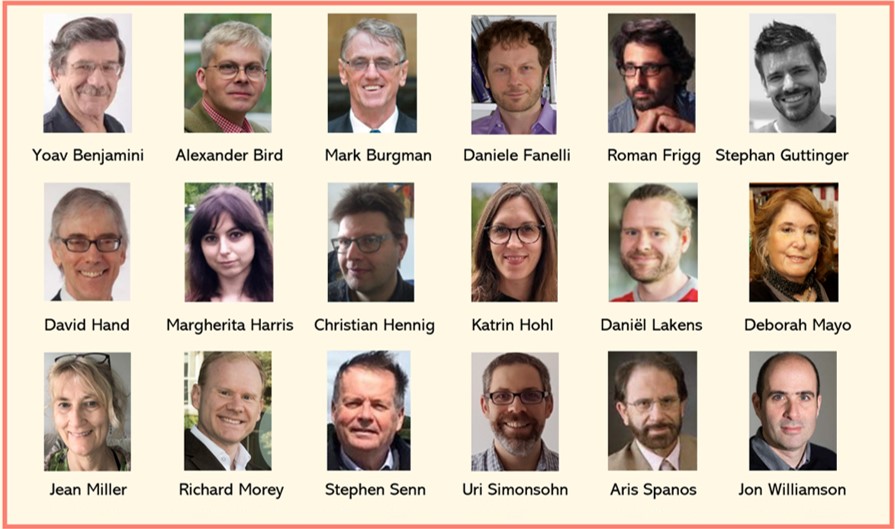
  • Closing Panel: “Where Should Stat Activists Go From Here (Part ii)?”: Workshop Participants: Yoav Benjamini, Alexander Bird, Mark Burgman, Daniele Fanelli, Stephan Guttinger, David Hand, Margherita Harris, Christian Hennig, Daniël Lakens, Deborah Mayo, Richard Morey, Stephen Senn, Uri Simonsohn, Aris Spanos, Jon Williamson

**********************************************************************

  • DESCRIPTION: While the field of statistics has a long history of passionate foundational controversy, the last decade has, in many ways, been the most dramatic. Misuses of statistics, biasing selection effects, and high-powered methods of big-data analysis, have helped to make it easy to find impressive-looking but spurious results that fail to replicate. As the crisis of replication has spread beyond psychology and social sciences to biomedicine, genomics, machine learning and other fields, the need for critical appraisal of proposed reforms is growing. Many are welcome (transparency about data, eschewing mechanical uses of statistics); some are quite radical. The experts do not agree on the best ways to promote trustworthy results, and these disagreements often reflect philosophical battles–old and new– about the nature of inductive-statistical inference and the roles of probability in statistical inference and modeling. Intermingled in the controversies about evidence are competing social, political, and economic values. If statistical consumers are unaware of assumptions behind rival evidence-policy reforms, they cannot scrutinize the consequences that affect them. What is at stake is a critical standpoint that we may increasingly be in danger of losing. Critically reflecting on proposed reforms and changing standards requires insights from statisticians, philosophers of science, psychologists, journal editors, economists and practitioners from across the natural and social sciences. This workshop will bring together these interdisciplinary insights–from speakers as well as attendees.

Speakers/Panellists:

Sponsors/Affiliations:

  • The Foundation for the Study of Experimental Reasoning, Reliability, and the Objectivity and Rationality of Science (E.R.R.O.R.S.); Centre for Philosophy of Natural and Social Science (CPNSS), London School of Economics; Virginia Tech Department of Philosophy
  • Organizers: D. Mayo, R. Frigg and M. Harris
    Logistician
    (chief logistics and contact person): Jean Miller
    Executive Planning Committee: Y. Benjamini, D. Hand, D. Lakens, S. Senn
Categories: Announcement, Stistics Wars and Their Casualties Workshop | Leave a comment

Multiplicity, Data-Dredging, and Error Control Symposium at PSA 2022: Mayo, Thornton, Glymour, Mayo-Wilson, Berger

.

Some claim that no one attends Sunday morning (9am) sessions at the Philosophy of Science Association. But if you’re attending the PSA (in Pittsburgh), we hope you’ll falsify this supposition and come to hear us (Mayo, Thornton, Glymour, Mayo-Wilson, Berger) wrestle with some rival views on the trenchant problems of multiplicity, data-dredging, and error control. Coffee and donuts to all who show up.

Multiplicity, Data-Dredging, and Error Control
November 13, 9:00 – 11:45 AM
(link to symposium on PSA website)

Speakers: Continue reading

Categories: Announcement, PSA | Leave a comment

Upcoming Workshop: The Statistics Wars and Their Casualties workshop

The Statistics Wars
and Their Casualties

22-23 September 2022
15:00-18:00 pm London Time*
ONLINE
(London School of Economics, CPNSS)

To register for the  workshop,
please fill out the registration form here.

For schedules and updated details, please see the workshop webpage: phil-stat-wars.com.

*These will be sessions 1 & 2, there will be two more
online sessions (3 & 4) on December 1 & 8.

Continue reading

Categories: Announcement, stat wars and their casualties | 1 Comment

Free access to Statistical Inference as Severe Testing: How to Get Beyond the Stat Wars” (CUP, 2018) for 1 more week

.

Thanks to CUP, the electronic version of my book, Statistical Inference as Severe Testing: How to Get Beyond the Statistics Wars (2018), is available for free for one more week (through August 31) at this link:  https://www.cambridge.org/core/books/statistical-inference-as-severe-testing/D9DF409EF568090F3F60407FF2B973B2  Blurbs of the 16 tours in the book may be found here: blurbs of the 16 tours.

Categories: Announcement, SIST | Leave a comment

Read It Free: “Stat Inference as Severe Testing: How to Get Beyond the Stat Wars” during August

CUP will make the electronic version of my book, Statistical Inference as Severe Testing: How to Get Beyond the Statistics Wars (2018), available to access for free from August 1-31 at this link:  https://www.cambridge.org/core/books/statistical-inference-as-severe-testing/D9DF409EF568090F3F60407FF2B973B2 However, they will confirm the link closer to August, so check this blog on Aug 1 for any update, if you’re interested. (July 31, the link works!) (August 5, the link is working. Let me know if you have problems getting in.) Blurbs of the 16 tours in the book may be found here: blurbs of the 16 tours.

Here’s a CUP interview from when the book first came out.

Categories: Announcement, SIST | Leave a comment

The Statistics Wars and Their Casualties Workshop-Now Online

The Statistics Wars
and Their Casualties 

22-23 September 2022
15:00-18:00 pm London Time*

ONLINE 

To register for the workshop, please fill out the registration form here.

*These will be sessions 1 & 2, there will be two more
The future online sessions (3 & 4)  at 15:00-18:00 pm London Time on December 1 & 8.

Yoav Benjamini (Tel Aviv University), Alexander Bird (University of Cambridge), Mark Burgman (Imperial College London),  Daniele Fanelli (London School of Economics and Political Science), Roman Frigg (London School of Economics and Political Science),
Stephan Guttinger
(University of Exeter), David Hand (Imperial College London), Margherita Harris (London School of Economics and Political Science), Christian Hennig (University of Bologna), Daniël Lakens (Eindhoven University of Technology), Deborah Mayo (Virginia Tech), Richard Morey (Cardiff University), Stephen Senn (Edinburgh, Scotland), Jon Williamson (University of Kent) Continue reading

Categories: Announcement, Error Statistics | Leave a comment

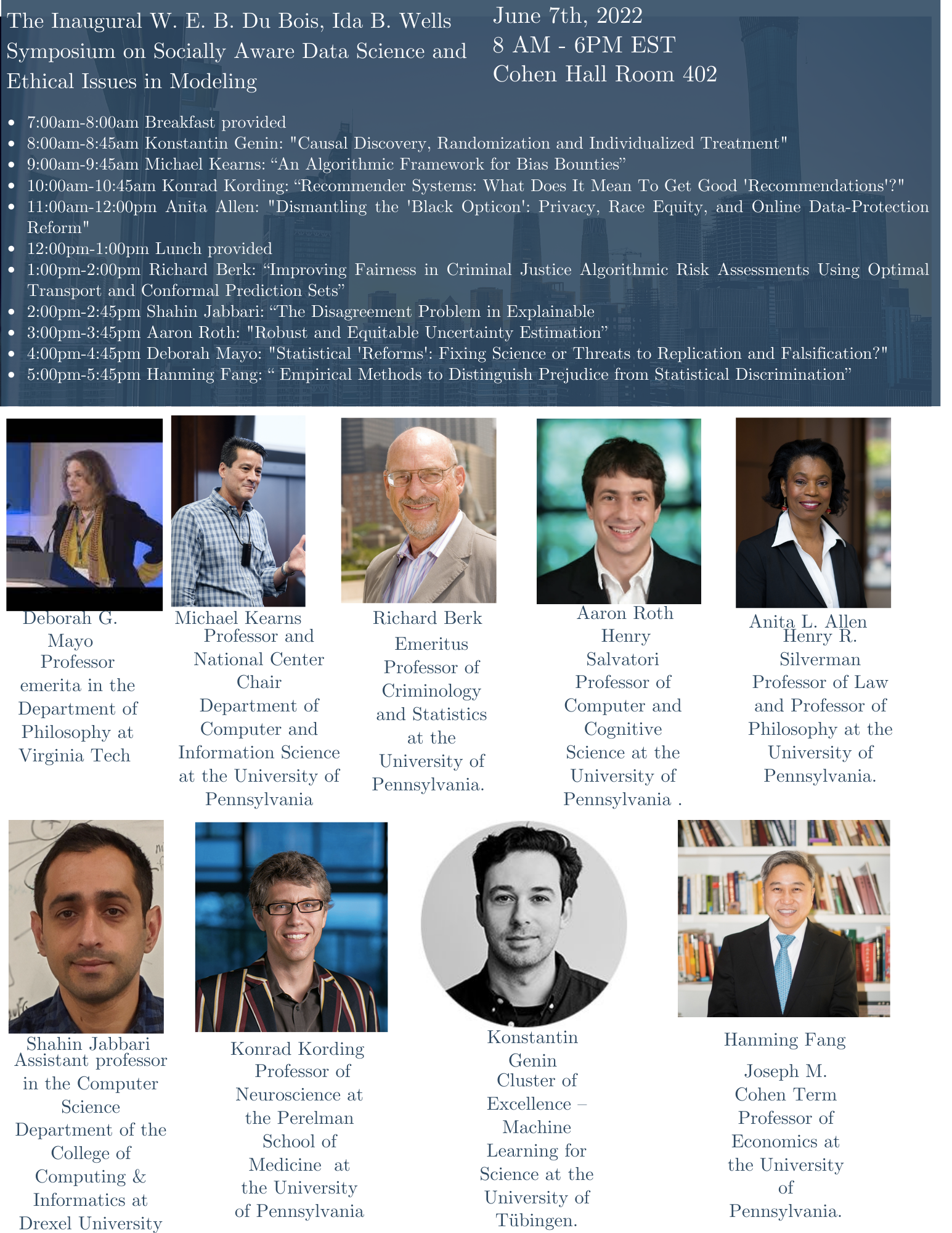
Philosophy of socially aware data science conference

I’ll be speaking at this conference in Philly tomorrow. My slides are also below.


PDF of my slides: Statistical “Reforms”: Fixing Science or Threats to Replication and Falsification. Continue reading

Categories: Announcement, Philosophy of Statistics, socially aware data science | Leave a comment

Philosophy of Science Association (PSA) 22 Call for Contributed Papers

PSA2022: Call for Contributed Papers

https://psa2022.dryfta.com/

Twenty-Eighth Biennial Meeting of the Philosophy of Science Association
November 10 – November 13, 2022
Pittsburgh, Pennsylvania


Submissions open on March 9, 2022 for contributed papers to be presented at the PSA2022 meeting in Pittsburgh, Pennsylvania, on November 10-13, 2022. The deadline for submitting a paper is 11:59 PM Pacific Standard Time on April 6, 2022. 

Contributed papers may be on any topic in the philosophy of science. The PSA2022 Program Committee is committed to assembling a program with high-quality papers on a variety of topics and diverse presenters that reflects the full range of current work in the philosophy of science. Continue reading

Categories: Announcement | Leave a comment

“Should Science Abandon Statistical Significance?” Session at AAAS Annual Meeting, Feb 18

Karen Kafadar, Yoav Benjamini, and Donald Macnaughton will be in a session:

Should Science Abandon Statistical Significance?

Friday, Feb 18 from 2-2:45 PM (EST) at the AAAS 2022 annual meeting.

The general program is here. To register*, go to this page.

Synopsis

The concept of statistical significance is central in scientific research. However, the concept is often poorly understood and thus is often unfairly criticized. This presentation includes three independent but overlapping arguments about the usefulness of the concept of statistical significance to reliably detect “effects” in frontline scientific research data. We illustrate the arguments with examples of scientific importance from genomics, physics, and medicine. We explain how the concept of statistical significance provides a cost-efficient objective way to empower scientific research with evidence.

Papers Continue reading

Categories: AAAS, Announcement, statistical significance | Tags: | Leave a comment

ENBIS Webinar: Statistical Significance and p-values

Yesterday’s event video recording is available at:
https://www.youtube.com/watch?v=2mWYbcVflyE&t=10s

European Network for Business and Industrial Statistics (ENBIS) Webinar:
Statistical Significance and p-values
Europe/Amsterdam (CET); 08:00-09:30 am (EST)

ENBIS will dedicate this webinar to the memory of Sir David Cox, who sadly passed away in January 2022.

Continue reading

Categories: Announcement, significance tests, Sir David Cox | Tags: , | 2 Comments

January 11: Phil Stat Forum (remote): Statistical Significance Test Anxiety

Special Session of the (remote)
Phil Stat Forum:

11 January 2022

“Statistical Significance Test Anxiety”

TIME: 15:00-17:00 (London, GMT); 10:00-12:00 (EST)

Presenters: Deborah Mayo (Virginia Tech) &
Yoav Benjamini (Tel Aviv University)

Moderator: David Hand (Imperial College London)

Deborah Mayo       Yoav Benjamini        David Hand

Continue reading

Categories: Announcement, David Hand, Phil Stat Forum, significance tests, Yoav Benjamini | Leave a comment

January 11: Phil Stat Forum (remote)

Special Session of the (remote)
Phil Stat Forum:

11 January 2022

“Statistical Significance Test Anxiety”

TIME: 15:00-17:00 (London, GMT); 10:00-12:00 (EST)

Presenters: Deborah Mayo (Virginia Tech) &
Yoav Benjamini (Tel Aviv University)

Moderator: David Hand (Imperial College London)

Deborah Mayo       Yoav Benjamini        David Hand


Focus of the Session: 

Continue reading

Categories: Announcement, David Hand, Phil Stat Forum, significance tests, Yoav Benjamini | Leave a comment

Blog at WordPress.com.