Sir David Cox

Midnight With Birnbaum: Happy New Year 2026!

.

Anyone here remember that old Woody Allen movie, “Midnight in Paris,” where the main character (I forget who plays it, I saw it on a plane), a writer finishing a novel, steps into a cab that mysteriously picks him up at midnight and transports him back in time where he gets to run his work by such famous authors as Hemingway and Virginia Wolf?  (It was a new movie when I began the blog in 2011.) He is wowed when his work earns their approval and he comes back each night in the same mysterious cab…Well, ever since I began this blog in 2011, I imagine being picked up in a mysterious taxi at midnight on New Year’s Eve, and lo and behold, find myself in the 1960s New York City, in the company of Allan Birnbaum who is is looking deeply contemplative, perhaps studying his 1962 paper…Birnbaum reveals some new and surprising twists this year! [i] 

(The pic on the left is the only blurry image I have of the club I’m taken to.) It has been a decade since  I published my article in Statistical Science (“On the Birnbaum Argument for the Strong Likelihood Principle”), which includes  commentaries by A. P. David, Michael Evans, Martin and Liu, D. A. S. Fraser, Jan Hannig, and Jan Bjornstad. David Cox, who very sadly did in January 2022, is the one who encouraged me to write and publish it. Not only does the (Strong) Likelihood Principle (LP or SLP) remain at the heart of many of the criticisms of Neyman-Pearson (N-P) statistics and of error statistics in general, but a decade after my 2014 paper, it is more central than ever–even if it is often unrecognized.

OUR EXCHANGE:

ERROR STATISTICIAN: It’s wonderful to meet you Professor Birnbaum; I’ve always been extremely impressed with the important impact your work has had on philosophical foundations of statistics.  I happen to have published on your famous argument about the likelihood principle (LP).  (whispers: I can’t believe this!)

BIRNBAUM: Ultimately you know I rejected the LP as failing to control the error probabilities needed for my Confidence concept. But you know all this, I’ve read it in your book: Statistical Inference as Severe Testing: How to Get Beyond the Statistics Wars (STINT, 2018, CUP).

ERROR STATISTICIAN: You’ve read my book? Wow! Then you know I don’t think your argument shows that the LP follows from such frequentist concepts as sufficiency S and the weak conditionality principle WLP. I don’t rehearse my argument there, but I first found the problem in 2006, when I was writing something on “conditioning” with David Cox. [ii]  Sorry,…I know it’s famous…

BIRNBAUM:  Well, I shall happily invite you to take any case that violates the LP and allow me to demonstrate that the frequentist is led to inconsistency, provided she also wishes to adhere to the WLP and sufficiency (although less than S is needed).

ERROR STATISTICIAN: Well I show that no contradiction follows from holding WCP and S, while denying the LP.

BIRNBAUM: Well, well, well: I’ll bet you a bottle of Elba Grease champagne that I can demonstrate it!

ERROR STATISTICAL PHILOSOPHER:  It is a great drink, I must admit that: I love lemons.

BIRNBAUM: OK.  (A waiter brings a bottle, they each pour a glass and resume talking).  Whoever wins this little argument pays for this whole bottle of vintage Ebar or Elbow or whatever it is Grease.

.

.

ERROR STATISTICAL PHILOSOPHER:  I really don’t mind paying for the bottle.

BIRNBAUM: Good, you will have to. Take any LP violation. Let  x’ be 2-standard deviation difference from the null (asserting μ = 0) in testing a normal mean from the fixed sample size experiment E’, say n = 100; and let x” be a 2-standard deviation difference from an optional stopping experiment E”, which happens to stop at 100.  Do you agree that:

(0) For a frequentist, outcome x’ from E’ (fixed sample size) is NOT evidentially equivalent to x” from E” (optional stopping that stops at n)

ERROR STATISTICAL PHILOSOPHER: Yes, that’s a clear case where we reject the strong LP, and it makes perfect sense to distinguish their corresponding p-values (which we can write as p’ and p”, respectively).  The searching in the optional stopping experiment makes the p-value quite a bit higher than with the fixed sample size.  For n = 100, data x’ yields p’= ~.05; while p”  is ~.3.  Clearly, p’ is not equal to p”, I don’t see how you can make them equal.

BIRNBAUM: Suppose you’ve observed x”, a 2-standard deviation difference from an optional stopping experiment E”, that finally stops at n=100.  You admit, do you not, that this outcome could have occurred as a result of a different experiment?  It could have been that a fair coin was flipped where it is agreed that heads instructs you to perform E’ (fixed sample size experiment, with n = 100) and tails instructs you to perform the optional stopping experiment E”, stopping as soon as you obtain a 2-standard deviation difference, and you happened to get tails, and performed the experiment E”, which happened to stop with n =100. 

ERROR STATISTICAL PHILOSOPHER:  Well, that is not how x” was obtained, but ok, it could have occurred that way.

BIRNBAUM:  Good. Then you must grant further that your result could have come from a special experiment I have dreamt up, call it a BB-experiment.  In a BB-experiment, if the outcome from the experiment you actually performed has an outcome with a proportional likelihood to one in some other experiment not performed, E’, then we say that your result has an “LP pair”.  For any violation of the strong LP, the outcome observed, let it be x”, has an “LP pair”, call it x’, in some other experiment E’.  In that case, a BB-experiment stipulates that you are to report x” as if you had determined whether to run E’ or E” by flipping a fair coin.

(They fill their glasses again)

ERROR STATISTICAL PHILOSOPHER: You’re saying that if my outcome from trying and trying again, that is, optional stopping experiment E”, with an “LP pair” in the fixed sample size experiment I did not perform, then I am to report x” as if the determination to run E” was by flipping a fair  coin (which decides between E’ and E”)?

BIRNBAUM: Yes, and one more thing. If your outcome had actually come from the fixed sample size experiment E’, it too would have  an “LP pair” in the experiment you did not perform, E”.  Whether you actually observed x” from E”, or x’ from E’, you are to report it as x” from E”.

ERROR STATISTICAL PHILOSOPHER: So let’s see if I understand a Birnbaum BB-experiment: whether my observed 2-standard deviation difference came from E’ or E” (with sample size n) the result is reported as x’, as if it came from E’ (fixed sample size), and as a result of this strange type of a mixture experiment.

BIRNBAUM: Yes, or equivalently you could just report x*: my result is a 2-standard deviation difference and it could have come from either E’ (fixed sampling, n= 100) or E” (optional stopping, which happens to stop at the 100th trial).  That’s how I sometimes formulate a BB-experiment.

ERROR STATISTICAL PHILOSOPHER: You’re saying in effect that if my result has an LP pair in the experiment not performed, I should act as if I accept the strong LP and just report it’s likelihood; so if the likelihoods are proportional in the two experiments (both testing the same mean), the outcomes are evidentially equivalent.

BIRNBAUM: Well, but since the BB- experiment is an imagined “mixture” it is a single experiment, so really you only need to apply the weak LP which frequentists accept.  Yes?  (The weak LP is the same as the sufficiency principle).

ERROR STATISTICAL PHILOSOPHER: But what is the sampling distribution in this imaginary BB- experiment?  Suppose I have Birnbaumized my experimental result, just as you describe, and observed a 2-standard deviation difference from optional stopping experiment E”.  How do I calculate the p-value within a Birnbaumized experiment?

BIRNBAUM: I don’t think anyone has ever called it that.

ERROR STATISTICAL PHILOSOPHER: I just wanted to have a shorthand for the operation you are describing, there’s no need to use it, if you’d rather I not.  So how do I calculate the p-value within a BB-experiment?

BIRNBAUM: You would report the overall p-value, which would be the average over the sampling distributions: (p’ + p”)/2

Say p’ is ~.05, and p” is ~.3; whatever they are, we know they are different, that’s what makes this a violation of the strong LP (given in premise (0)).

ERROR STATISTICAL PHILOSOPHER: So you’re saying that if I observe a 2-standard deviation difference from E’, I do not report  the associated p-value p’, but instead I am to report the average p-value, averaging over some other experiment E” that could have given rise to an outcome with a proportional likelihood to the one I observed, even though I didn’t obtain it this way?

BIRNBAUM: I’m saying that you have to grant that x’ from a fixed sample size experiment E’ could have been generated through a BB-experiment.

My this drink is sour!

ERROR STATISTICAL PHILOSOPHER: Yes, I love pure lemon.

BIRNBAUM: Perhaps you’re in want of a gene; never mind.

I’m saying you have to grant that x’ from a fixed sample size experiment E’ could have been generated through a BB-experiment.  If you are to interpret your experiment as if you are within the rules of a BB experiment, then x’ is evidentially equivalent to x” (is equivalent to  x*).  This is premise (1).

ERROR STATISTICAL PHILOSOPHER: But the result would be that the p-value associated with x’ (fixed sample size) is reported to be larger than it actually is (.05), because I’d be averaging over fixed and optional stopping experiments; while observing x” (optional stopping) is reported to be smaller than it is–in both cases because of an experiment I did not perform.

BIRNBAUM: Yes, the BB-experiment computes the P-value in an unconditional manner: it takes the convex combination over the 2 ways the result could have come about. 

ERROR STATISTICAL PHILOSOPHER: this is just a matter of your definitions, it is an analytical or mathematical result, so long as we grant being within your BB experiment.

BIRNBAUM: True, (1) plays the role of the sufficiency assumption, but one need not even appeal to sufficiency, it is just a matter of mathematical equivalence.

By the way, I am focusing just on LP violations, therefore, the outcome, by definition, has an LP pair.  In other cases, where there is no LP pair, you just report things as usual.

ERROR STATISTICAL PHILOSOPHER: OK, but p’ still differs from p”; so I still don’t how I’m forced to infer the strong LP which identifies the two. In short, I don’t see the contradiction with my rejecting the strong LP in premise (0).  (Also we should come back to the “other cases” at some point….)

BIRNBAUM: Wait! Don’t be so impatient; I’m about to get to step (2). Here, let’s toast to the new year: “To Elbar Grease!”

ERROR STATISTICAL PHILOSOPHER: To Elbar Grease!

BIRNBAUM:  So far all of this was step (1).

ERROR STATISTICAL PHILOSOPHER: : Oy, what is step 2?

BIRNBAUM:  STEP 2 is this: Surely, you agree, that once you know from which experiment the observed 2-standard deviation difference actually came, you ought to report the p-value corresponding to that experiment. You ought NOT to report the average (p’ + p”)/2  as you were instructed to do in the BB experiment.

This gives us premise (2a):

(2a) outcome x”, once it is known that it came from E”, should NOT be  analyzed as in a BB- experiment where p-values are averaged. The report should instead use the sampling distribution of the optional stopping test E”, yielding the p-value, p” (~.37). In fact, .37 is the value you give in STINT p. 44 (imagining the experimenter keeps taking 10 more). 

ERROR STATISTICAL PHILOSOPHER:  So, having first insisted I imagine myself in a Birnbaumized, I mean a BB-experiment, and report an average p-value, I’m now to return to my senses and “condition” in order to get back to the only place I ever wanted to be, i.e., back to where I was to begin with?

BIRNBAUM: Yes, at least if you hold to the weak conditionality principle WCP (of D. R. Cox)—surely you agree to this.

(2b) Likewise, if you knew the 2-standard deviation difference came from E’, then

x’ should NOT be deemed evidentially equivalent to x” (as in the BB experiment), the report should instead use the sampling distribution of fixed test E’, (.05).  

ERROR STATISTICAL PHILOSOPHER: So, having first insisted I consider myself in a BB-experiment, in which I report the average p-value, I’m now to return to my senses and allow that if I know the result came from optional stopping, E”, I should “condition” on and report p”.

BIRNBAUM: Yes.  There was no need to repeat the whole spiel.

ERROR STATISTICAL PHILOSOPHER: I just wanted to be clear I understood you. Of course, all of this assumes the model is correct or adequate to begin with.

BIRNBAUM: Yes, the LP (or SLP, to indicate it’s the strong LP) is a principle for parametric inference within a given model. So you arrive at (2a) and (2b), yes?

ERROR STATISTICAL PHILOSOPHER: OK, but it might be noted that unlike premise (1), premises (2a) and (2b) are not given by definition, they concern an evidential standpoint about how one ought to interpret a result once you know which experiment it came from. In particular, premises (2a) and (2b) say I should condition and use the sampling distribution of the experiment known to have been actually performed, when interpreting the result.

BIRNBAUM: Yes, and isn’t this weak conditionality principle WCP one that you happily accept?

ERROR STATISTICAL PHILOSOPHER: Well the WCP originally refers to actual mixtures, where one flipped a coin to determine if E’ or E” is performed, whereas, you’re requiring I consider an imaginary Birnbaum mixture experiment, where the choice of the experiment not performed will vary depending on the outcome that needs an LP pair; and I cannot even determine what this might be until after I’ve observed the result that would violate the LP? I don’t know what the sample size will be ahead of time.

BIRNBAUM: Sure, but you admit that your observed x” could have come about through a BB-experiment, and that’s all I need.  Notice

(1), (2a) and (2b) yield the strong LP!

Outcome x” from E”(optional stopping that stops at n) is evidentially equivalent to x’ from E’ (fixed sample size n).

ERROR STATISTICAL PHILOSOPHER:  Clever, but your “proof” is obviously unsound; and before I demonstrate this, notice that the conclusion, were it to follow, asserts p’ = p”, (e.g.,  .05 = .3!), even though it is unquestioned that p’ is not equal to p”, that is because we must start with an LP violation (premise (0)).

BIRNBAUM: Yes, it is puzzling, but where have I gone wrong?

(The waiter comes by and fills their glasses; they are so deeply engrossed in thought they do not even notice him.)

ERROR STATISTICAL PHILOSOPHER: There are many routes to explaining a fallacious argument.  The one I find most satisfactory is in Mayo (2014). But, given we’ve been partying, here’s a very simple one. What is required for STEP 1 to hold, is the denial of what’s needed for STEP 2 to hold:

Step 1 requires us to analyze results in accordance with a BB- experiment.  If we do so, true enough we get:

premise (1): outcome x” (in a BB experiment) is evidentially equivalent to outcome x’ (in a BB  experiment):

That is because in either case, the p-value would be (p’ + p”)/2

Step 2 now insists that we should NOT calculate  evidential import as if we were in a BB- experiment.  Instead we should consider the experiment from which the data actually came, E’ or E”:

premise (2a): outcome x” (in a BB experiment) is/should be evidentially equivalent to x” from E” (optional stopping that stops at n):  its p-value should be p”.

premise (2b): outcome x’ (within in a BB experiment) is/should be evidentially equivalent to x’ from E’ (fixed sample size):  its p-value should be p’.

If (1) is true, then (2a) and (2b) must be false!

If (1) is true and we keep fixed the stipulation of a BB experiment (which we must to apply step 2), then (2a) is asserting:

The average p-value (p’ + p”)/2  =  p’  which is false.

Likewise if (1) is true, then (2b) is asserting:

the average p-value (p’ + p”)/2  =  p”  which is false

Alternatively, we can see what goes wrong by realizing:

If (2a) and (2b) are true, then premise (1) must be false.

In short your famous argument requires us to assess evidence in a given experiment in two contradictory ways: as if we are within a BB- experiment (and report the average p-value) and also that we are not, but rather should report the actual p-value.

I can render it as formally valid, but then its premises can never all be true; alternatively, I can get the premises to come out true, but then the conclusion is false—so it is invalid.  In no way does it show the frequentist is open to contradiction (by dint of accepting S, WCP, and denying the LP).

BIRNBAUM: Yet some people still think it is a breakthrough. I never agreed to go as far as Jimmy Savage wanted me too, namely, to be a Bayesian….

ERROR STATISTICAL PHILOSOPHER: I’ve come to see that clarifying the entire argument turns on defining the WCP. Have you seen my 2014 paper in Statistical Science?  The key difference is that in (2014), the WCP is stated as an equivalence, as you intended. Cox’s WCP, many claim, was not an equivalence, going in 2 directions. Slides from a presentation may be found on this blogpost

BIRNBAUM: Yes, the “monster of the LP” arises from viewing WCP as an equivalence, instead of going in one direction (from mixtures to the known result).

ERROR STATISTICAL PHILOSOPHER: In my 2014 paper (unlike my earlier treatments) I too construe WCP as giving an “equivalence” but there is an equivocation that invalidates the purported move to the LP.

On the one hand, it’s true that if z is known (and known for example to have come from optional stopping), it’s irrelevant that it could have resulted from either fixed sample testing or optional stopping.

But it does not follow that if z is known, it’s irrelevant whether it resulted from fixed sample testing or optional stopping. It’s the slippery slide into this second statement–which surely sounds the same as the first–that makes your argument such a brain buster. (Mayo 2014)

BIRNBAUM: Yes I have seen your 2014 paper! Your Rejoinder to some of the critics is gutsy, to say the least. I’ve also seen the slides on your blog.

ERROR STATISTICAL PHILOSOPHER: Thank you, I’m amazed you follow my blog! I haven’t kept it up that much lately; blogs have fallen out of fashion.

BIRNBAUM: As has inferential statistics it seems–it’s all AI/ML. But I have to admit that CHAT GPT illuminates at least part of your argument as to why my reasoning was flawed.

ERROR STATISTICAL PHILOSOPHER: I never thought to check CHAT GPT on my paper, that’s amazing.

BIRNBAUM: Here is what I found on the Chatbot:

CHAT GPT

Birnbaum’s Argument and the Likelihood Principle

In his 1962 paper, Birnbaum argued that if frequentists accept two principles—sufficiency and weak conditionality—they are logically compelled to accept the likelihood principle. The likelihood principle states that all the evidence in data is contained in the likelihood function, meaning that the sampling distribution (and hence frequentist error probabilities) is irrelevant to evidential assessment….

Error Statistician’s Dilemma

If Birnbaum’s argument is correct, then frequentist methods (which rely on error probabilities) would be rendered irrelevant for assessing evidence. This would make it difficult for frequentists to defend their approach as coherent, particularly in the face of Bayesian methods that naturally adhere to the likelihood principle.

However, Deborah Mayo, in her 2014 work, critiques Birnbaum’s argument, exposing a logical flaw in his alleged proof. 

BIRNBAUM: The bot does not get your argument right. The whole experience  has encouraged me to write the first draft of a completely revised paper, reflecting a large advance in my thinking on this. It’s not quite ready to share….

ERROR STATISTICAL PHILOSOPHER: Wow! I’d love to read it…have you identified the problem? In your last couple of papers, you suggest you’d discovered the flaw in your argument for the LP. Am I right? Even in the discussion of your (1962) paper, you seemed to agree with Pratt that WCP can’t do the job you intend. I just want to know, and won’t share your answer with anyone….

(She notices Birnbaum is holding a paper on long legal-sized yellow sheets filled with tiny hand-written comments, covering both sides.)

Sudden interruption by the waiter:

WAITER: Who gets the tab? 

BIRNBAUM: I do. To Elbar Grease!  To Severe Testing!
Happy New Year!

BIRNBAUM (looking wistful): Savage, you know, never got off my case about remaining at “the half-way house” of likelihood, and not going full Bayesian. Then I wrote the review about the Confidence Concept as the one rock on a shifting scene… Pratt thought the argument should instead appeal to a Censoring Principle (basically, it doesn’t matter if your instrument cannot measure beyond k units if the measurement you’re making is under k units.)

ERROR STATISTICAL PHILOSOPHER: Yes, but who says frequentist error statisticians deny the Censoring Principle? So back to my question,…you did uncover the flaw in your argument, yes?

WAITER: We’re closing now; shall I call a Taxi?

BIRNBAUM: Yes, yes!

ERROR STATISTICAL PHILOSOPHER: ‘Yes’, you discovered the flaw in the argument, or ‘yes’ to the taxi? 

MANAGER: We’re closing now; I’m sorry you must leave.

ERROR STATISTICAL PHILOSOPHER: We’re leaving I just need him to clarify his answer….

BIRNBAUM: I predict that 2026 will be the year that people will finally take seriously your paper from a decade ago (30 years from your Lakatos Prize)!

ERROR STATISTICAL PHILOSOPHER: I’ll drink to that!

Suddenly a large group of people bustle past the manager…it’s all chaos.

Prof. Birnbaum…? Allan? Where did he go? (oy, not again!)


Link to complete discussion: 

Mayo, Deborah G. On the Birnbaum Argument for the Strong Likelihood Principle (with discussion & rejoinder).Statistical Science 29 (2014), no. 2, 227-266.

stat-sci

[i] Many links on the strong likelihood principle (LP or SLP) and Birnbaum may be found by searching this blog. Good sources for where to start as well as classic background papers may be found in this blogpost. A link to slides and video of a very introductory presentation of my argument from the 2021 Phil Stat Forum is here.

January 7: “Putting the Brakes on the Breakthrough: On the Birnbaum Argument for the Strong Likelihood Principle” (D.Mayo)

[ii] In 2023 I wrote a paper on Cox’s statistical philosophy. Sadly he died in 2022. (The first David R. Cox Foundations of Statistics Prize, currently given by the ASA on even-numbered years, was awarded to Nancy Reid at the JSM 2023. The second went to Phil Dawid. The Award is now to be given yearly, thanks to the contributions of Friends of David Cox (on this blog!))

Categories: Birnbaum, CHAT GPT, Likelihood Principle, Sir David Cox | Leave a comment

The ASA Sir David R. Cox Foundations of Statistics Award is now annual

15 July 1924 – 18 January 2022

The Sir David R. Cox Foundations of Statistics Award will now be given annually by the American Statistical Association (ASA), thanks to generous contributions by “Friends” of David Cox, solicited on this blog!*

Nominations for the 2026 Sir David R. Cox Foundations of Statistics Award are due on November 1, 2025 requiring the following:

  • Nomination letter
  • Candidate’s CV
  • Two letters of support, not to exceed two pages each

Continue reading

Categories: Sir David Cox, Sir David Cox Foundations of Statistics Award | Leave a comment

Midnight With Birnbaum: Happy New Year 2025!

.

Remember that old Woody Allen movie, “Midnight in Paris,” where the main character (I forget who plays it, I saw it on a plane), a writer finishing a novel, steps into a cab that mysteriously picks him up at midnight and transports him back in time where he gets to run his work by such famous authors as Hemingway and Virginia Wolf?  (It was a new movie when I began the blog in 2011.) He is wowed when his work earns their approval and he comes back each night in the same mysterious cab…Well, ever since I began this blog in 2011, I imagine being picked up in a mysterious taxi at midnight on New Year’s Eve, and lo and behold, find myself in the 1960s New York City, in the company of Allan Birnbaum who is is looking deeply contemplative, perhaps studying his 1962 paper…Birnbaum reveals some new and surprising twists this year! [i] 

(The pic on the left is the only blurry image I have of the club I’m taken to.) It has been a decade since  I published my article in Statistical Science (“On the Birnbaum Argument for the Strong Likelihood Principle”), which includes  commentaries by A. P. David, Michael Evans, Martin and Liu, D. A. S. Fraser, Jan Hannig, and Jan Bjornstad. David Cox, who very sadly did in January 2022, is the one who encouraged me to write and publish it. Not only does the (Strong) Likelihood Principle (LP or SLP) remain at the heart of many of the criticisms of Neyman-Pearson (N-P) statistics and of error statistics in general, but a decade after my 2014 paper, it is more central than ever–even if it is often unrecognized.

OUR EXCHANGE: Continue reading

Categories: Birnbaum, CHAT GPT, Likelihood Principle, Sir David Cox | 2 Comments

Happy Birthday Sir David R. Cox

15 July 1924-18 January 2022

HAPPY BIRTHDAY SIR DAVID COX!  Today is David Cox’s birthday, he would have been 98 years old today. Below is a remembrance I contributed to Significance when he died, with a link to others in that same issue.

“In celebrating Cox’s immense contributions, we should recognise how much there is yet to learn from him” Continue reading

Categories: Sir David Cox | 1 Comment

ENBIS Webinar: Statistical Significance and p-values

Yesterday’s event video recording is available at:
https://www.youtube.com/watch?v=2mWYbcVflyE&t=10s

European Network for Business and Industrial Statistics (ENBIS) Webinar:
Statistical Significance and p-values
Europe/Amsterdam (CET); 08:00-09:30 am (EST)

ENBIS will dedicate this webinar to the memory of Sir David Cox, who sadly passed away in January 2022.

Continue reading

Categories: Announcement, significance tests, Sir David Cox | Tags: , | 2 Comments

“A [very informal] Conversation Between Sir David Cox & D.G. Mayo”

In June 2011, Sir David Cox agreed to a very informal ‘interview’ on the topics of the 2010 workshop that I co-ran at the London School of Economics (CPNSS), Statistical Science and Philosophy of Science, where he was a speaker. Soon after I began taping, Cox stopped me in order to show me how to do a proper interview. He proceeded to ask me questions, beginning with:

COX: Deborah, in some fields foundations do not seem very important, but we both think foundations of statistical inference are important; why do you think that is?

MAYO: I think because they ask about fundamental questions of evidence, inference, and probability. I don’t think that foundations of different fields are all alike; because in statistics we’re so intimately connected to the scientific interest in learning about the world, we invariably cross into philosophical questions about empirical knowledge and inductive inference.

Continue reading

Categories: Birnbaum, Likelihood Principle, Sir David Cox, StatSci meets PhilSci | Tags: , | Leave a comment

Sir David Cox: An intellectual interview by Nancy Reid

Hinkley, Reid & Cox

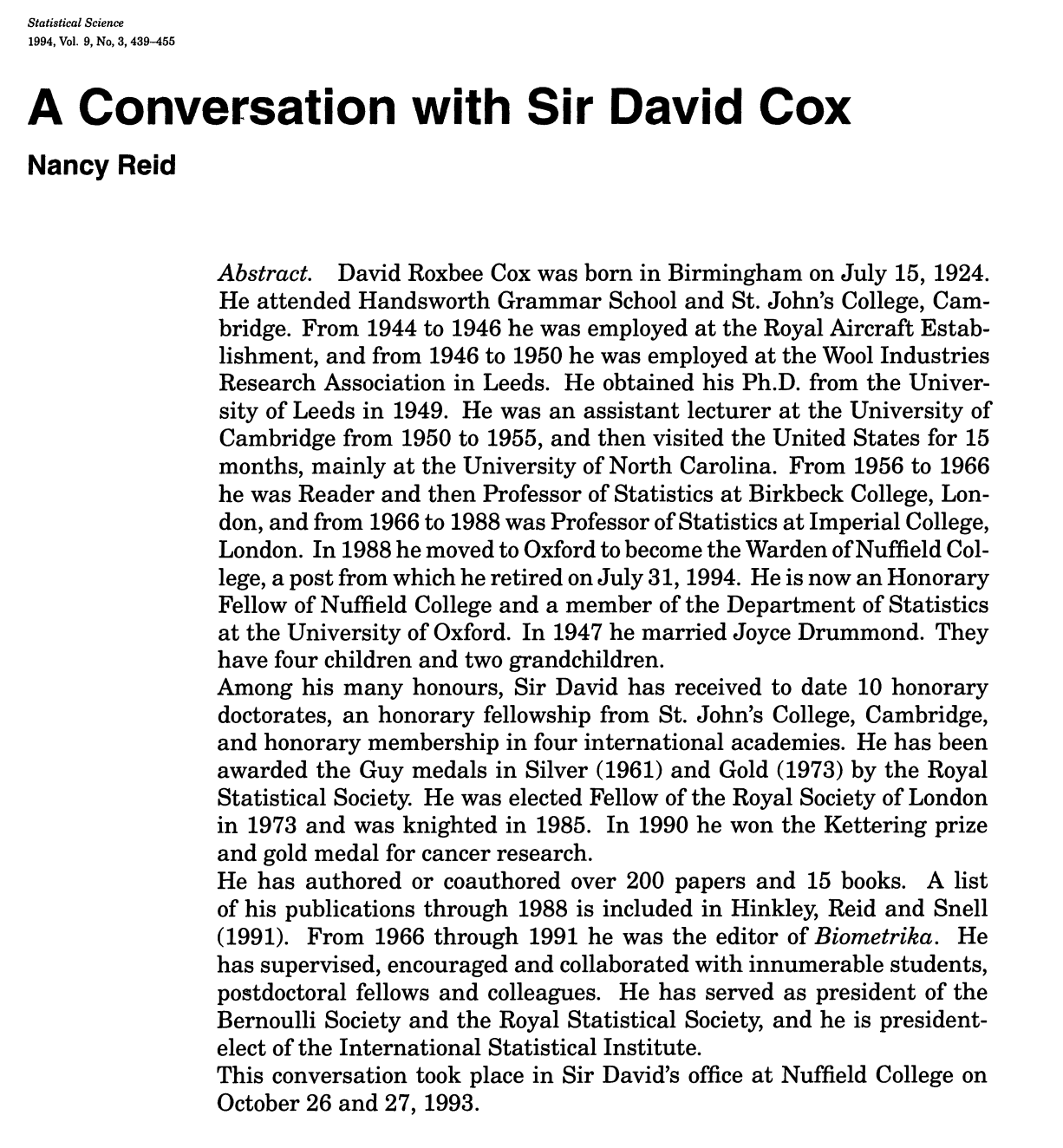
Here’s an in-depth interview of Sir David Cox by Nancy Reid that brings out a rare, intellectual understanding and appreciation of some of Cox’s work. Only someone truly in the know could have managed to elicit these fascinating reflections. The interview was in Oct 1993, published in 1994.

Nancy Reid (1994). A Conversation with Sir David Cox, Statistical Science 9(3): 439-455.


Categories: Sir David Cox | Leave a comment

A interview with Sir David Cox by “Statistics Views” (upon turning 90)

Sir David Cox

Sir David Cox: July 15, 1924-Jan 18, 2022

The original Statistics Views interview is here:

“I would like to think of myself as a scientist, who happens largely to specialise in the use of statistics”– An interview with Sir David Cox

FEATURES

  • Author: Statistics Views
  • Date: 24 Jan 2014

Sir David Cox is arguably one of the world’s leading living statisticians. He has made pioneering and important contributions to numerous areas of statistics and applied probability over the years, of which perhaps the best known is the proportional hazards model, which is widely used in the analysis of survival data. The Cox point process was named after him. Continue reading

Categories: Sir David Cox | 4 Comments

Sir David Cox: Significance tests: rethinking the controversy (September 5, 2018 RSS keynote)

Sir David Cox speaking at the RSS meeting in a session: “Significance Tests: Rethinking the Controversy” on 5 September 2018.

Continue reading

Categories: Sir David Cox, statistical significance tests | Tags: | Leave a comment

60 yrs of Cox’s (1958) weighing machine, & links to binge-read the Likelihood Principle

IMG_0079

.

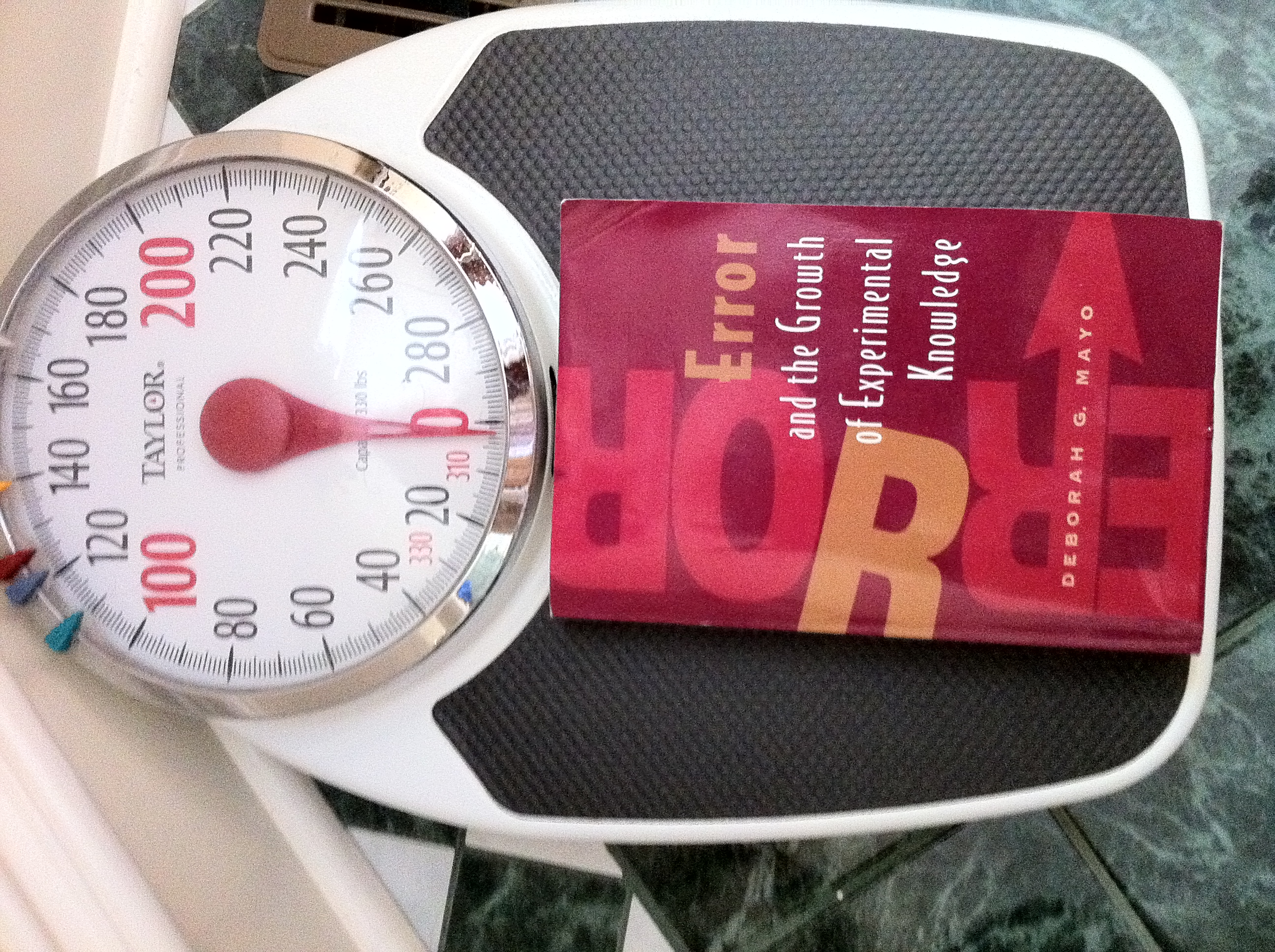
2018 will mark 60 years since the famous chestnut from Sir David Cox (1958). The example  “is now usually called the ‘weighing machine example,’ which draws attention to the need for conditioning, at least in certain types of problems” (Reid 1992, p. 582). When I describe it, you’ll find it hard to believe many regard it as causing an earthquake in statistical foundations, unless you’re already steeped in these matters. A simple version: If half the time I reported my weight from a scale that’s always right, and half the time use a scale that gets it right with probability .5, would you say I’m right with probability ¾? Well, maybe. But suppose you knew that this measurement was made with the scale that’s right with probability .5? The overall error probability is scarcely relevant for giving the warrant of the particular measurement, knowing which scale was used. So what’s the earthquake? First a bit more on the chestnut. Here’s an excerpt from Cox and Mayo (2010, 295-8): Continue reading

Categories: Sir David Cox, Statistics, strong likelihood principle | 5 Comments

Cox’s (1958) weighing machine example

IMG_0079

.

A famous chestnut given by Cox (1958) recently came up in conversation. The example  “is now usually called the ‘weighing machine example,’ which draws attention to the need for conditioning, at least in certain types of problems” (Reid 1992, p. 582). When I describe it, you’ll find it hard to believe many regard it as causing an earthquake in statistical foundations, unless you’re already steeped in these matters. If half the time I reported my weight from a scale that’s always right, and half the time use a scale that gets it right with probability .5, would you say I’m right with probability ¾? Well, maybe. But suppose you knew that this measurement was made with the scale that’s right with probability .5? The overall error probability is scarcely relevant for giving the warrant of the particular measurement,knowing which scale was used. Continue reading

Categories: Error Statistics, Sir David Cox, Statistics, strong likelihood principle | 1 Comment

Erich Lehmann: Statistician and Poet

Erich Lehmann 20 November 1917 – 12 September 2009

Erich Lehmann                       20 November 1917 –              12 September 2009

Memory Lane 1 Year (with update): Today is Erich Lehmann’s birthday. The last time I saw him was at the Second Lehmann conference in 2004, at which I organized a session on philosophical foundations of statistics (including David Freedman and D.R. Cox).

I got to know Lehmann, Neyman’s first student, in 1997.  One day, I received a bulging, six-page, handwritten letter from him in tiny, extremely neat scrawl (and many more after that).  He told me he was sitting in a very large room at an ASA meeting where they were shutting down the conference book display (or maybe they were setting it up), and on a very long, dark table sat just one book, all alone, shiny red.  He said he wondered if it might be of interest to him!  So he walked up to it….  It turned out to be my Error and the Growth of Experimental Knowledge (1996, Chicago), which he reviewed soon after. Some related posts on Lehmann’s letter are here and here.

That same year I remember having a last-minute phone call with Erich to ask how best to respond to a “funny Bayesian example” raised by Colin Howson. It is essentially the case of Mary’s positive result for a disease, where Mary is selected randomly from a population where the disease is very rare. See for example here. (It’s just like the case of our high school student Isaac). His recommendations were extremely illuminating, and with them he sent me a poem he’d written (which you can read in my published response here*). Aside from being a leading statistician, Erich had a (serious) literary bent. Continue reading

Categories: highly probable vs highly probed, phil/history of stat, Sir David Cox, Spanos, Statistics | Tags: , | Leave a comment

A (Jan 14, 2014) interview with Sir David Cox by “Statistics Views”

Sir David Cox

Sir David Cox

The original Statistics Views interview is here:

“I would like to think of myself as a scientist, who happens largely to specialise in the use of statistics”– An interview with Sir David Cox

FEATURES

  • Author: Statistics Views
  • Date: 24 Jan 2014
  • Copyright: Image appears courtesy of Sir David Cox

Sir David Cox is arguably one of the world’s leading living statisticians. He has made pioneering and important contributions to numerous areas of statistics and applied probability over the years, of which perhaps the best known is the proportional hazards model, which is widely used in the analysis of survival data. The Cox point process was named after him.

Sir David studied mathematics at St John’s College, Cambridge and obtained his PhD from the University of Leeds in 1949. He was employed from 1944 to 1946 at the Royal Aircraft Establishment, from 1946 to 1950 at the Wool Industries Research Association in Leeds, and from 1950 to 1955 worked at the Statistical Laboratory at the University of Cambridge. From 1956 to 1966 he was Reader and then Professor of Statistics at Birkbeck College, London. In 1966, he took up the Chair position in Statistics at Imperial College Londonwhere he later became Head of the Department of Mathematics for a period. In 1988 he became Warden of Nuffield College and was a member of the Department of Statistics at Oxford University. He formally retired from these positions in 1994 but continues to work in Oxford.

Sir David has received numerous awards and honours over the years. He has been awarded the Guy Medals in Silver (1961) and Gold (1973) by the Royal Statistical Society. He was elected Fellow of the Royal Society of London in 1973, was knighted in 1985 and became an Honorary Fellow of the British Academy in 2000. He is a Foreign Associate of the US National Academy of Sciences and a foreign member of the Royal Danish Academy of Sciences and Letters. In 1990 he won the Kettering Prize and Gold Medal for Cancer Research for “the development of the Proportional Hazard Regression Model” and 2010 he was awarded the Copley Medal by the Royal Society.

He has supervised and collaborated with many students over the years, many of whom are now successful in statistics in their own right such as David Hinkley and Past President of the Royal Statistical Society, Valerie Isham. Sir David has served as President of theBernoulli Society, Royal Statistical Society, and the International Statistical Institute.

This year, Sir David is to turn 90*. Here Statistics Views talks to Sir David about his prestigious career in statistics, working with the late Professor Lindley, his thoughts on Jeffreys and Fisher, being President of the Royal Statistical Society during the Thatcher Years, Big Data and the best time of day to think of statistical methods.

1. With an educational background in mathematics at St Johns College, Cambridge and the University of Leeds, when and how did you first become aware of statistics as a discipline?

I was studying at Cambridge during the Second World War and after two years, one was sent either into the Forces or into some kind of military research establishment. There were very few statisticians then, although it was realised there was a need for statisticians. It was assumed that anybody who was doing reasonably well at mathematics could pick up statistics in a week or so! So, aged 20, I went to the Royal Aircraft Establishment in Farnborough, which is enormous and still there to this day if in a different form, and I worked in the Department of Structural and Mechanical Engineering, doing statistical work. So statistics was forced upon me, so to speak, as was the case for many mathematicians at the time because, aside from UCL, there had been very little teaching of statistics in British universities before the Second World War. Afterwards, it all started to expand.

2. From 1944 to 1946 you worked at the Royal Aircraft Establishment and then from 1946 to 1950 at the Wool Industries Research Association in Leeds. Did statistics have any role to play in your first roles out of university?

Totally. In Leeds, it was largely statistics but also to some extent, applied mathematics because there were all sorts of problems connected with the wool and textile industry in terms of the physics, chemistry and biology of the wool and some of these problems were mathematical but the great majority had a statistical component to them. That experience was not totally uncommon at the time and many who became academic statisticians had, in fact, spent several years working in a research institute first.

3. From 1950 to 1955, you worked at the Statistical Laboratory at Cambridge and would have been there at the same time as Fisher and Jeffreys. The late Professor Dennis Lindley, who was also there at that time, told me that the best people working on statistics were not in the statistics department at that time. What are your memories when you look back on that time and what do you feel were your main achievements?

Lindley was exactly right about Jeffreys and Fisher. They were two great scientists outside statistics – Jeffreys founded modern geophysics and Fisher was a major figure in genetics. Dennis was a contemporary and very impressive and effective. We were colleagues for five years and our children even played together.

The first lectures on statistics I attended as a student consisted of a short course by Harold Jeffreys who had at the time a massive reputation as virtually the inventor of modern geophysics. His Theory of Probability, published first as a monograph in physics was and remains of great importance but, amongst other things, his nervousness limited the appeal of his lectures, to put it gently. I met him personally a couple of times – he was friendly but uncommunicative. When I was later at the Statistical Laboratory in Cambridge, relations between the Director, Dr Wishart and R.A. Fisher had been at a very low ebb for 20 years and contact between the Lab and Fisher was minimal. I hear him speak on three of four occasions, interesting if often rambunctious occasions. To some, Fisher showed great generosity but not to the Statistics Lab, which was sad in view of the towering importance of his work.

“To some, Fisher showed great generosity but not to the Statistics Lab, which was sad in view of the towering importance of his work.”

Continue reading

Categories: Sir David Cox | 3 Comments

Blog at WordPress.com.