3-year memory lane

3 YEARS AGO: (FEBRUARY 2012) MEMORY LANE

3 years ago...

3 years ago…

MONTHLY MEMORY LANE: 3 years ago: February 2012. I am to mark in red three posts (or units) that seem most apt for general background on key issues in this blog. Given our Fisher reblogs, we’ve already seen many this month. So, I’m marking in red (1) The Triad, and (2) the Unit on Spanos’ misspecification tests. Plase see those posts for their discussion. The two posts from 2/8 are apt if you are interested in a famous case involving statistics at the Supreme Court. Beyond that it’s just my funny theatre of the absurd piece with Barnard. (Gelman’s is just a link to his blog.)


February 2012

TRIAD:

  • (2/11) R.A. Fisher: Statistical Methods and Scientific Inference
  • (2/11)  JERZY NEYMAN: Note on an Article by Sir Ronald Fisher
  • (2/12) E.S. Pearson: Statistical Concepts in Their Relation to Reality

REBLOGGED LAST WEEK


M-S TESTING UNIT


This new, once-a-month, feature began at the blog’s 3-year anniversary in Sept, 2014.

Previous 3 YEAR MEMORY LANES:

Jan. 2012

Dec. 2011

Nov. 2011

Oct. 2011

Sept. 2011 (Within “All She Wrote (so far))

Categories: 3-year memory lane, Statistics | 1 Comment

3 YEARS AGO: (JANUARY 2012) MEMORY LANE

3 years ago...

3 years ago…

MONTHLY MEMORY LANE: 3 years ago: January 2012. I mark in red three posts that seem most apt for general background on key issues in this blog.

January 2012

This new, once-a-month, feature began at the blog’s 3-year anniversary in Sept, 2014. I will count U-Phil’s on a single paper as one of the three I highlight (else I’d have to choose between them). I will comment on  3-year old posts from time to time.

This Memory Lane needs a bit of explanation. This blog began largely as a forum to discuss a set of contributions from a conference I organized (with A. Spanos and J. Miller*) “Statistical Science and Philosophy of Science: Where Do (Should) They meet?”at the London School of Economics, Center for the Philosophy of Natural and Social Science, CPNSS, in June 2010 (where I am a visitor). Additional papers grew out of conversations initiated soon after (with Andrew Gelman and Larry Wasserman). The conference site is here.  My reflections in this general arena (Sept. 26, 2012) are here.

As articles appeared in a special topic of the on-line journal, Rationality, Markets and Morals (RMM), edited by Max Albert[i]—also a conference participant —I would announce an open invitation to readers to take a couple of weeks to write an extended comment.  Each “U-Phil”–which stands for “U philosophize”- was a contribution to this activity. I plan to go back to that exercise at some point.  Generally I would give a “deconstruction” of the paper first, followed by U-Phils, and then the author gave responses to U-Phils and me as they wished. You can readily search this blog for all the U-Phils and deconstructions**.

I was also keeping a list of issues that we either haven’t taken up, or need to return to. One example here is: Bayesian updating and down dating. Further notes about the origins of this blog are here. I recommend everyone reread Senn’s paper.** 

For newcomers, here’s your chance to catch-up; for old timers,this is philosophy: rereading is essential!

[i] Along with Hartmut Kliemt and Bernd Lahno.

*For a full list of collaborators, sponsors, logisticians, and related collaborations, see the conference page. The full list of speakers is found there as well.

**The U-Phil exchange between Mayo and Senn was published in the same special topic of RIMM. But I still wish to know how we can cultivate “Senn’s-ability.” We could continue that activity as well, perhaps.

Previous 3 YEAR MEMORY LANES:

Dec. 2011
Nov. 2011
Oct. 2011
Sept. 2011 (Within “All She Wrote (so far))

Categories: 3-year memory lane, blog contents, Statistics, Stephen Senn, U-Phil | 2 Comments

“When Bayesian Inference Shatters” Owhadi and Scovel (reblog)

images-9I’m about to post an update of this, most viewed, blogpost, so I reblog it here as a refresher. If interested, you might check the original discussion.

^^^^^^^^^^^^^^^^^^^^^^^^^^^^^^^^^^^^^^^

I am grateful to Drs. Owhadi and Scovel for replying to my request for “a plain Jane” explication of their interesting paper, “When Bayesian Inference Shatters”, and especially for permission to post it. 

—————————————-

owhadiHouman Owhadi
Professor of Applied and Computational Mathematics and Control and Dynamical Systems, Computing + Mathematical Sciences,
California Institute of Technology, USA

 Clint Scovel
ClintpicSenior Scientist,
Computing + Mathematical Sciences,
California Institute of Technology, USA

“When Bayesian Inference Shatters: A plain Jane explanation”

This is an attempt at a “plain Jane” presentation of the results discussed in the recent arxiv paper “When Bayesian Inference Shatters” located at http://arxiv.org/abs/1308.6306 with the following abstract:

“With the advent of high-performance computing, Bayesian methods are increasingly popular tools for the quantification of uncertainty throughout science and industry. Since these methods impact the making of sometimes critical decisions in increasingly complicated contexts, the sensitivity of their posterior conclusions with respect to the underlying models and prior beliefs is becoming a pressing question. We report new results suggesting that, although Bayesian methods are robust when the number of possible outcomes is finite or when only a finite number of marginals of the data-generating distribution are unknown, they are generically brittle when applied to continuous systems with finite information on the data-generating distribution. This brittleness persists beyond the discretization of continuous systems and suggests that Bayesian inference is generically ill-posed in the sense of Hadamard when applied to such systems: if closeness is defined in terms of the total variation metric or the matching of a finite system of moments, then (1) two practitioners who use arbitrarily close models and observe the same (possibly arbitrarily large amount of) data may reach diametrically opposite conclusions; and (2) any given prior and model can be slightly perturbed to achieve any desired posterior conclusions.”

Now, it is already known from classical Robust Bayesian Inference that Bayesian Inference has some robustness if the random outcomes live in a finite space or if the class of priors considered is finite-dimensional (i.e. what you know is infinite and what you do not know is finite). What we have shown is that if the random outcomes live in an approximation of a continuous space (for instance, when they are decimal numbers given to finite precision) and your class of priors is finite co-dimensional (i.e. what you know is finite and what you do not know may be infinite) then, if the data is observed at a fine enough resolution, the range of posterior values is the deterministic range of the quantity of interest, irrespective of the size of the data. Continue reading

Categories: 3-year memory lane, Bayesian/frequentist, Statistics | 1 Comment

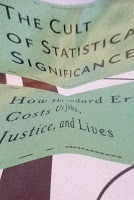
To raise the power of a test is to lower (not raise) the “hurdle” for rejecting the null (Ziliac and McCloskey 3 years on)

Part 2 Prionvac: The Will to Understand PowerI said I’d reblog one of the 3-year “memory lane” posts marked in red, with a few new comments (in burgundy), from time to time. So let me comment on one referring to Ziliac and McCloskey on power. (from Oct.2011). I would think they’d want to correct some wrong statements, or explain their shifts in meaning. My hope is that, 3 years on, they’ll be ready to do so. By mixing some correct definitions with erroneous ones, they introduce more confusion into the discussion.

From my post 3 years ago: “The Will to Understand Power”: In this post, I will adhere precisely to the text, and offer no new interpretation of tests. Type 1 and 2 errors and power are just formal notions with formal definitions.  But we need to get them right (especially if we are giving expert advice).  You can hate the concepts; just define them correctly please.  They write:

“The error of the second kind is the error of accepting the null hypothesis of (say) zero effect when the null is in face false, that is, then (say) such and such a positive effect is true.”

So far so good (keeping in mind that “positive effect” refers to a parameter discrepancy, say δ, not an observed difference.

And the power of a test to detect that such and such a positive effect δ is true is equal to the probability of rejecting the null hypothesis of (say) zero effect when the null is in fact false, and a positive effect as large as δ is present.

Fine.

Let this alternative be abbreviated H’(δ):

H’(δ): there is a positive effect as large as δ.

Suppose the test rejects the null when it reaches a significance level of .01.

(1) The power of the test to detect H’(δ) =

P(test rejects null at .01 level; H’(δ) is true).

Say it is 0.85.

“If the power of a test is high, say, 0.85 or higher, then the scientist can be reasonably confident that at minimum the null hypothesis (of, again, zero effect if that is the null chosen) is false and that therefore his rejection of it is highly probably correct”. (Z & M, 132-3).

But this is not so.  Perhaps they are slipping into the cardinal error of mistaking (1) as a posterior probability:

(1’) P(H’(δ) is true| test rejects null at .01 level)! Continue reading

Categories: 3-year memory lane, power, Statistics | Tags: , , | 6 Comments

3 YEARS AGO: MONTHLY (Dec.) MEMORY LANE

3 years ago...

3 years ago…

MONTHLY MEMORY LANE: 3 years ago: December 2011. I mark in red 3 posts that seem most apt for general background on key issues in this blog.*

*I announced this new, once-a-month feature at the blog’s 3-year anniversary. I will repost and comment on one of the 3-year old posts from time to time. [I’ve yet to repost and comment on the one from Oct. 2011, but will very shortly.] For newcomers, here’s your chance to catch-up; for old timers,this is philosophy: rereading is essential!

Previous 3 YEAR MEMORY LANES:

Nov. 2011

Oct. 2011

Sept. 2011 (Within “All She Wrote (so far))

Categories: 3-year memory lane, blog contents, Statistics | Leave a comment

3 YEARS AGO: MONTHLY (Nov.) MEMORY LANE

3 years ago...

3 years ago…

MONTHLY MEMORY LANE: 3 years ago: November 2011. I mark in red 3 posts that seem most apt for general background on key issues in this blog.*

  • (11/1) RMM-4:“Foundational Issues in Statistical Modeling: Statistical Model Specification and Validation*” by Aris Spanos, in Rationality, Markets, and Morals (Special Topic: Statistical Science and Philosophy of Science: Where Do/Should They Meet?”)
  • (11/3) Who is Really Doing the Work?*
  • (11/5) Skeleton Key and Skeletal Points for (Esteemed) Ghost Guest
  • (11/9) Neyman’s Nursery 2: Power and Severity [Continuation of Oct. 22 Post]
  • (11/12) Neyman’s Nursery (NN) 3: SHPOWER vs POWER
  • (11/15) Logic Takes a Bit of a Hit!: (NN 4) Continuing: Shpower (“observed” power) vs Power
  • (11/18) Neyman’s Nursery (NN5): Final Post
  • (11/21) RMM-5: “Low Assumptions, High Dimensions” by Larry Wasserman, in Rationality, Markets, and Morals (Special Topic: Statistical Science and Philosophy of Science: Where Do/Should They Meet?”) See also my deconstruction of Larry Wasserman.
  • (11/23) Elbar Grease: Return to the Comedy Hour at the Bayesian Retreat
  • (11/28) The UN Charter: double-counting and data snooping
  • (11/29) If you try sometime, you find you get what you need!

*I announced this new, once-a-month feature at the blog’s 3-year anniversary. I will repost and comment on one of the 3-year old posts from time to time. [I’ve yet to repost and comment on the one from Oct. 2011, but will shortly.] For newcomers, here’s your chance to catch-up; for old timers,this is philosophy: rereading is essential!

Previous 3 YEAR MEMORY LANES:

 Oct. 2011

Sept. 2011 (Within “All She Wrote (so far))


Categories: 3-year memory lane, Bayesian/frequentist, Statistics | Leave a comment

Oxford Gaol: Statistical Bogeymen

Memory Lane: 3 years ago. Oxford Jail (also called Oxford Castle) is an entirely fitting place to be on (and around) Halloween! Moreover, rooting around this rather lavish set of jail cells (what used to be a single cell is now a dressing room) is every bit as conducive to philosophical reflection as is exile on Elba! (It is now a boutique hotel, though many of the rooms are still too jail-like for me.)  My goal (while in this gaol—as the English sometimes spell it) is to try and free us from the bogeymen and bogeywomen often associated with “classical” statistics. As a start, the very term “classical statistics” should, I think, be shelved, not that names should matter.

In appraising statistical accounts at the foundational level, we need to realize the extent to which accounts are viewed through the eyeholes of a mask or philosophical theory.  Moreover, the mask some wear while pursuing this task might well be at odds with their ordinary way of looking at evidence, inference, and learning. In any event, to avoid non-question-begging criticisms, the standpoint from which the appraisal is launched must itself be independently defended.   But for (most) Bayesian critics of error statistics the assumption that uncertain inference demands a posterior probability for claims inferred is thought to be so obvious as not to require support. Critics are implicitly making assumptions that are at odds with the frequentist statistical philosophy. In particular, they assume a certain philosophy about statistical inference (probabilism), often coupled with the allegation that error statistical methods can only achieve radical behavioristic goals, wherein all that matters are long-run error rates (of some sort)Unknown-2

Criticisms then follow readily: the form of one or both:

  • Error probabilities do not supply posterior probabilities in hypotheses, interpreted as if they do (and some say we just can’t help it), they lead to inconsistencies
  • Methods with good long-run error rates can give rise to counterintuitive inferences in particular cases.
  • I have proposed an alternative philosophy that replaces these tenets with different ones:
  • the role of probability in inference is to quantify how reliably or severely claims (or discrepancies from claims) have been tested
  • the severity goal directs us to the relevant error probabilities, avoiding the oft-repeated statistical fallacies due to tests that are overly sensitive, as well as those insufficiently sensitive to particular errors.
  • Control of long run error probabilities, while necessary is not sufficient for good tests or warranted inferences.

Continue reading

Categories: 3-year memory lane, Bayesian/frequentist, Philosophy of Statistics, Statistics | Tags: , | 30 Comments

3 YEARS AGO: MONTHLY MEMORY LANE

Hand writing a letter with a goose feather

3 years ago…

MONTHLY MEMORY LANE: 3 years ago: October 2011 (I mark in red 3 posts that seem most apt for general background on key issues in this blog*)

*I indicated I’d begin this new, once-a-month feature at the 3-year anniversary. I will repost and comment on one each month. (I might repost others that I do not comment on, as Oct. 31, 2014). For newcomers, here’s your chance to catch-up; for old timers, this is philosophy: rereading is essential!

Categories: 3-year memory lane, blog contents, Statistics | Leave a comment

Blog at WordPress.com.