I’ve been speculating for awhile on the idea of creating a blog within a blog, and now it exists. From now on items under “rejected posts” (on any topic including phil stat), “msc kvetches”, “phil stock” and assorted other irrelevant, irreverent, absurd, or dangerous meanderings that I feel like writing, will all be banished to: http://rejectedpostsofdmayo.com/
Author Archives: Mayo
PhilStatLaw: Infections in the court
Nathan Schachtman appropriately refers to the way in which “dicta infects Daubert” in his latest blogpost Siracusano Dicta Infects Daubert Decisions. Here the “dicta” (or dictum?) is a throwaway remark on (lack of) statistical significance and causal inference by the Supreme Court, in an earlier case involving the drug company Matrixx (Matrixx Initiatives, Inc. v. Siracusano). As I note in my post of last Feb,
“the ruling had nothing to do with what’s required to show cause and effect, but only what information a company is required to reveal to its shareholders in order not to mislead them (as regards information that could be of relevance to them in their cost-benefit assessments of the stock’s value and future price).”(See “Distortions in the Court”)
obiter dicta
|
It was already surprising that the Supreme Court took up that earlier case; the way they handled the irrelevant statistical issues was more so. Continue reading
Levels of Inquiry
Many fallacious uses of statistical methods result from supposing that the statistical inference licenses a jump to a substantive claim that is ‘on a different level’ from a statistical one being probed. Given the familiar refrain that statistical significance is not substantive significance, it may seem surprising how often criticisms of significance tests depend on running the two together! But it is not just two, but a great many levels that need distinguishing linking collecting, modeling and analyzing data to a variety of substantive claims of inquiry (though for simplicity I often focus on the three depicted, described in various ways).
A question that continues to arise revolves around a blurring of levels, and is behind my recent ESP post. It goes roughly like this:
If we are prepared to take a statistically significant proportion of successes (greater than .5) in n Binomial trials as grounds for inferring a real (better than chance) effect (perhaps of two teaching methods) but not as grounds for inferring Uri’s ESP (at guessing outcomes, say), then aren’t we implicitly invoking a difference in prior probabilities? The answer is no, but there are two very different points to be made:
First, merely finding evidence of a non-chance effect is at a different “level” from a subsequent question about the explanation or cause of a non-chance effect. To infer from the former to the latter is an example of a fallacy of rejection.[1] The nature and threats of error in the hypothesis about a specific cause of an effect are very different from those in merely inferring a real effect. There are distinct levels of inquiry and distinct errors at each given level. The severity analysis for the respective claims makes this explicit.[ii] Even a test that did a good job distinguishing and ruling out threats to a hypothesis of “mere chance” would not thereby have probed errors about specific causes or potential explanations. Nor does an “isolated record” of statistically significant results suffice. Recall Fisher: “In relation to the test of significance, we may say that a phenomenon is experimentally demonstrable when we know how to conduct an experiment which will rarely fail to give us a statistically significant result”(1935, 14). PSI researchers never managed to demonstrate this. Continue reading
Insevere tests and pseudoscience
Against the PSI skeptics of this period (discussed in my last post), defenders of PSI would often erect means to take experimental results as success stories (e.g., if he failed to correctly predict the next card, maybe he was aiming at the second or third card). If the data could not be made to fit some ESP claim or other (e.g., through multiple end points) it might, as a last resort, be explained away as due to negative energy of nonbelievers (or being on the Carson show). They manage to get their ESP hypothesis H to “pass,” but the “test” had little or no capability of finding (uncovering, admitting) the falsity of H, even if H is false. (This is the basis for my term “Gellerization”.) In such cases, I would deny that the results afford any evidence for H. They are terrible evidence for H. Now any domain will have some terrible tests, but a field that routinely passes off terrible tests as success stories I would deem pseudoscientific.
We get a kind of minimal requirement for a test result to afford any evidence of assertion H, however partial and approximate H may be: If a hypothesis H is assured of having* “passed” a test T, even if H is false, then test T is a terrible test or no test at all.**
Far from trying to reveal flaws, it masks them or prevents them from being uncovered. No one would be impressed to learn their bank had passed a “stress test” if it turns out that the test had little or no chance of giving a failing score to any bank, regardless of its ability to survive a stressed economy. (Would they?)
There are a million different ways to flesh out the idea, and I welcome hearing others. Now you might say that no one would disagree with this. Great. Because a core requirement for an adequate account of inquiry, as I see it, is that it be able to capture this rationale for pretty terrible evidence and fairly pseudoscientific inquiry– and it should do so in such a way that affords a starting point for not-so-awful tests, and rather reliable learning.
* or very probably would have passed.
**QUESTION: I seek your input: which sounds better, or is more accurate: saying a test T passes a hypothesis H, or that a hypothesis H passes a test T? I’ve used both and want to settle on one.
Statistics and ESP research (Diaconis)
In the early ‘80s, fresh out of graduate school, I persuaded Persi Diaconis, Jack Good, and Patrick Suppes to participate in a session I wanted to organize on ESP and statistics. It seems remarkable to me now—not only that they agreed to participate*, but the extent that PSI research was taken seriously at the time. It wasn’t much later that all the recurring errors and loopholes, and the persistent cheating self-delusion —despite earnest attempts to trigger and analyze the phenomena—would lead many nearly everyone to label PSI research a “degenerating programme” (in the Popperian-Lakatosian sense).
(Though I’d have to check names and dates, I seem to recall that the last straw was when some of the Stanford researchers were found guilty of (unconscious) fraud. Jack Good continued to be interested in the area, but less so, I think. I do not know about the others.)
It is interesting to see how background information enters into inquiry here. So, even though it’s late on a Saturday night, here’s a snippet from one of the papers that caught my interest in graduate school: Diaconis’s (1978) “Statistical Problems in ESP Research“, in Science, along with some critical “letters”
Summary. In search of repeatable ESP experiments, modern investigators are using more complex targets, richer and freer responses, feedback, and more naturalistic conditions. This makes tractable statistical models less applicable. Moreover, controls often are so loose that no valid statistical analysis is possible. Some common problems are multiple end points, subject cheating, and unconscious sensory cueing. Unfortunately, such problems are hard to recognize from published records of the experiments in which they occur; rather, these problems are often uncovered by reports of independent skilled observers who were present during the experiment. This suggests that magicians and psychologists be regularly used as observers. New statistical ideas have been developed for some of the new experiments. For example, many modern ESP studies provide subjects with feedback—partial information about previous guesses—to reward the subjects for correct guesses in hope of inducing ESP learning. Some feedback experiments can be analyzed with the use of skill-scoring, a statistical procedure that depends on the information available and the way the guessing subject uses this information. (p. 131) Continue reading
Barnard, background info/ intentions
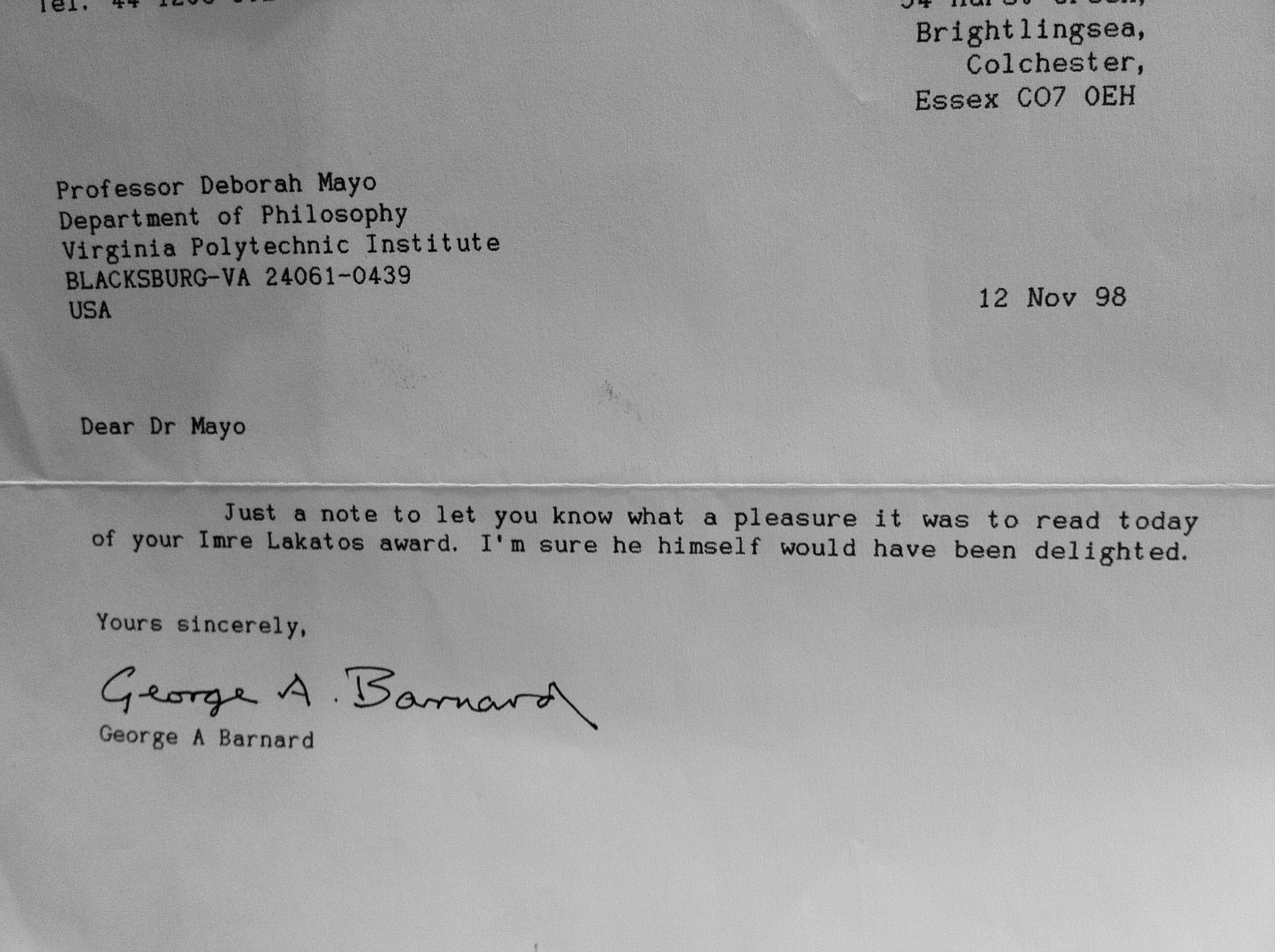
G.A. Barnard’s birthday is 9/23, so, here’s a snippet of his discussion with Savage (1962) (link below [i]) that connects to our 2 recent issues: stopping rules, and background information here and here (at least of one type).
Barnard: I have been made to think further about this issue of the stopping rule since I first suggested that the stopping rule was irrelevant (Barnard 1947a,b). This conclusion does not follow only from the subjective theory of probability; it seems to me that the stopping rule is irrelevant in certain circumstances. Since 1947 I have had the great benefit of a long correspondence—not many letters because they were not very frequent, but it went on over a long time—with Professor Bartlett, as a result of which I am considerably clearer than I was before. My feeling is that, as I indicated [on p. 42], we meet with two sorts of situation in applying statistics to data One is where we want to have a single hypothesis with which to confront the data. Do they agree with this hypothesis or do they not? Now in that situation you cannot apply Bayes’s theorem because you have not got any alternatives to think about and specify—not yet. I do not say they are not specifiable—they are not specified yet. And in that situation it seems to me the stopping rule is relevant. Continue reading
More on using background info
For the second* bit of background on the use of background info (for the new U-Phil for 9/21/12 9/25/12, I’ll reblog:
Background Knowledge: Not to Quantify, But To Avoid Being Misled By, Subjective Beliefs
…I am discovering that one of the biggest sources of confusion about the foundations of statistics has to do with what it means or should mean to use “background knowledge” and “judgment” in making statistical and scientific inferences. David Cox and I address this in our “Conversation” in RMM (2011)….
Insofar as humans conduct science and draw inferences, and insofar as learning about the world is not reducible to a priori deductions, it is obvious that “human judgments” are involved. True enough, but too trivial an observation to help us distinguish among the very different ways judgments should enter according to contrasting inferential accounts. When Bayesians claim that frequentists do not use or are barred from using background information, what they really mean is that frequentists do not use prior probabilities of hypotheses, at least when those hypotheses are regarded as correct or incorrect, if only approximately. So, for example, we would not assign relative frequencies to the truth of hypotheses such as (1) prion transmission is via protein folding without nucleic acid, or (2) the deflection of light is approximately 1.75” (as if, as Pierce puts it, “universes were as plenty as blackberries”). How odd it would be to try to model these hypotheses as themselves having distributions: to us, statistical hypotheses assign probabilities to outcomes or values of a random variable. Continue reading
U-Phil (9/25/12) How should “prior information” enter in statistical inference?
Andrew Gelman, sent me an interesting note of his, “Ethics and the statistical use of prior information,”[i]. In section 3 he comments on some of David Cox’s remarks in a conversation we recorded:
“A Statistical Scientist Meets a Philosopher of Science: A Conversation between Sir David Cox and Deborah Mayo,“ published in Rationality, Markets and Morals [iii] (Section 2 has some remarks on L. Wasserman.)
This was a part of a highly informal, frank, and entirely unscripted conversation, with minimal editing from the tape-recording [ii]. It was first posted on this blog on Oct. 19, 2011. A related, earlier discussion on Gelman’s blog is here.
I want to open this for your informal comments ( “U-Phil”, ~750 words,by September 21 25)[iv]. (send to error@vt.edu)
Before I give my own “deconstruction” of Gelman on the relevant section, I will post a bit of background to the question of background. For starters, here’s the relevant portion of the conversation:
COX: Deborah, in some fields foundations do not seem very important, but we both think foundations of statistical inference are important; why do you think that is?
MAYO: I think because they ask about fundamental questions of evidence, inference, and probability. I don’t think that foundations of different fields are all alike; because in statistics we’re so intimately connected to the scientific interest in learning about the world, we invariably cross into philosophical questions about empirical knowledge and inductive inference.
COX: One aspect of it is that it forces us to say what it is that we really want to know when we analyze a situation statistically. Do we want to put in a lot of information external to the data, or as little as possible. It forces us to think about questions of that sort.
MAYO: But key questions, I think, are not so much a matter of putting in a lot or a little information. …What matters is the kind of information, and how to use it to learn. This gets to the question of how we manage to be so successful in learning about the world, despite knowledge gaps, uncertainties and errors. To me that’s one of the deepest questions and it’s the main one I care about. I don’t think a (deductive) Bayesian computation can adequately answer it. Continue reading
Return to the comedy hour…(on significance tests)
These days, so many theater productions are updated reviews of older standards. Same with the comedy hours at the Bayesian retreat, and task force meetings of significance test reformers. So (on the 1-year anniversary of this blog) let’s listen in to one of the earliest routines (with highest blog hits), but with some new reflections (first considered here and here).
‘ “Did you hear the one about the frequentist . . .
“who claimed that observing “heads” on a biased coin that lands heads with probability .05 is evidence of a statistically significant improvement over the standard treatment of diabetes, on the grounds that such an event occurs with low probability (.05)?”
The joke came from J. Kadane’s Principles of Uncertainty (2011, CRC Press*).
“Flip a biased coin that comes up heads with probability 0.95, and tails with probability 0.05. If the coin comes up tails reject the null hypothesis. Since the probability of rejecting the null hypothesis if it is true is 0.05, this is a valid 5% level test. It is also very robust against data errors; indeed it does not depend on the data at all. It is also nonsense, of course, but nonsense allowed by the rules of significance testing.” (439)
Much laughter.
___________________
But is it allowed? I say no. The null hypothesis in the joke can be in any field, perhaps it concerns mean transmission of Scrapie in mice (as in my early Kuru post). I know some people view significance tests as merely rules that rarely reject erroneously, but I claim this is mistaken. Both in significance tests and in scientific hypothesis testing more generally, data indicate inconsistency with H only by being counter to what would be expected under the assumption that H is correct (as regards a given aspect observed). Were someone to tell Prusiner that the testing methods he follows actually allow any old “improbable” event (a stock split in Apple?) to reject a hypothesis about prion transmission rates, Prusiner would say that person didn’t understand the requirements of hypothesis testing in science. Since the criticism would hold no water in the analogous case of Prusiner’s test, it must equally miss its mark in the case of significance tests**. That, recall, was Rule #1. Continue reading
Stephen Senn: The nuisance parameter nuisance
Stephen Senn
Competence Centre for Methodology and Statistics
CRP Santé
Strassen, Luxembourg
“The nuisance parameter nuisance”
A great deal of statistical debate concerns ‘univariate’ error, or disturbance, terms in models. I put ‘univariate’ in inverted commas because as soon as one writes a model of the form (say) Yi =Xiβ + Єi, i = 1 … n and starts to raise questions about the distribution of the disturbance terms, Єi one is frequently led into multivariate speculations, such as, ‘is the variance identical for every disturbance term?’ and, ‘are the disturbance terms independent?’ and not just speculations such as, ‘is the distribution of the disturbance terms Normal?’. Aris Spanos might also want me to put inverted commas around ‘disturbance’ (or ‘error’) since what I ought to be thinking about is the joint distribution of the outcomes, Yi conditional on the predictors.
However, in my statistical world of planning and analysing clinical trials, the differences made to inferences according to whether one uses parametric versus non-parametric methods is often minor. Of course, using non-parametric methods does nothing to answer the problem of non-independent observations but for experiments, as opposed to observational studies, you can frequently design-in independence. That is a major potential pitfall avoided but then there is still the issue of Normality. However, in my experience, this is rarely where the action is. Inferences rarely change dramatically on using ‘robust’ approaches (although one can always find examples with gross-outliers where they do). However, there are other sorts of problem that can affect data which can make a very big difference. Continue reading
After dinner Bayesian comedy hour….
Given it’s the first anniversary of this blog, which opened with the howlers in “Overheard at the comedy hour …” let’s listen in as a Bayesian holds forth on one of the most famous howlers of the lot: the mysterious role that psychological intentions are said to play in frequentist methods such as statistical significance tests. Here it is, essentially as I remember it (though shortened), in the comedy hour that unfolded at my dinner table at an academic conference:
Did you hear the one about the researcher who gets a phone call from the guy analyzing his data? First the guy congratulates him and says, “The results show a statistically significant difference at the .05 level—p-value .048.” But then, an hour later, the phone rings again. It’s the same guy, but now he’s apologizing. It turns out that the experimenter intended to keep sampling until the result was 1.96 standard deviations away from the 0 null—in either direction—so they had to reanalyze the data (n=169), and the results were no longer statistically significant at the .05 level.
Much laughter.
So the researcher is tearing his hair out when the same guy calls back again. “Congratulations!” the guy says. “I just found out that the experimenter actually had planned to take n=169 all along, so the results are statistically significant.”
Howls of laughter.
But then the guy calls back with the bad news . . .
It turns out that failing to score a sufficiently impressive effect after n’ trials, the experimenter went on to n” trials, and so on and so forth until finally, say, on trial number 169, he obtained a result 1.96 standard deviations from the null.
It continues this way, and every time the guy calls in and reports a shift in the p-value, the table erupts in howls of laughter! From everyone except me, sitting in stunned silence, staring straight ahead. The hilarity ensues from the idea that the experimenter’s reported psychological intentions about when to stop sampling is altering the statistical results. Continue reading
Failing to Apply vs Violating the Likelihood Principle
In writing a new chapter on the Strong Likelihood Principle [i] the past few weeks, I noticed a passage in G. Casella and R. Berger (2002) that in turn recalled a puzzling remark noted in my Jan. 3, 2012 post. The post began:
A question arose from a Bayesian acquaintance:
“Although the Birnbaum result is of primary importance for sampling theorists, I’m still interested in it because many Bayesian statisticians think that model checking violates the (strong) likelihood principle (SLP), as if this principle is a fundamental axiom of Bayesian statistics”.
But this is puzzling for two reasons. First, if the LP does not preclude testing for assumptions (and he is right that it does not[ii]), then why not simply explain that rather than appeal to a disproof of something that actually never precluded model testing? To take the disproof of the LP as grounds to announce: “So there! Now even Bayesians are free to test their models” would seem only to ingrain the original fallacy.
You can read the rest of the original post here.
The remark in G. Casella and R. Berger seems to me equivocal on this point: Continue reading
Frequentist Pursuit
A couple of readers sent me notes about a recent post on (Normal Deviate)* that introduces the term “frequentist pursuit”:
“If we manipulate the data to get a posterior that mimics the frequentist answer, is this really a success for Bayesian inference? Is it really Bayesian inference at all? Similarly, if we choose a carefully constructed prior just to mimic a frequentist answer, is it really Bayesian inference? We call Bayesian inference which is carefully manipulated to force an answer with good frequentist behavior, frequentist pursuit. There is nothing wrong with it, but why bother?
If you want good frequentist properties just use the frequentist estimator.”(Robins and Wasserman)
I take it that the Bayesian response to the question (“why bother?”) is that the computations yield that magical posterior (never mind just how to interpret them).
Cox and Mayo 2010 say, about a particular example of “frequentist envy pursuit”:
“Reference priors yield inferences with some good frequentist properties, at least in one-dimensional problems – a feature usually called matching. … First, as is generally true in science, the fact that a theory can be made to match known successes does not redound as strongly to that theory as did the successes that emanated from first principles or basic foundations. This must be especially so where achieving the matches seems to impose swallowing violations of its initial basic theories or principles.
Even if there are some cases where good frequentist solutions are more neatly generated through Bayesian machinery, it would show only their technical value for goals that differ fundamentally from their own.” (301)
Imitation, some say, is the most sincere form of flattery. I don’t agree, but doubtless it is a good thing that we see a degree of self-imposed and/or subliminal frequentist constraints on much Bayesian work in practice. Some (many?) Bayesians suggest that this is merely a nice extra rather than necessary, forfeiting the (non-trivial) pursuit of frequentist (error statistical foundations) for Bayesian pursuits**.
*I had noticed this, but had no time to work through the thicket of the example he considers. I welcome a very simple upshot.
**At least some of them.
knowledge/evidence not captured by mathematical prob.
Equivocations between informal and formal uses of “probability” (as well as “likelihood” and “confidence”) are responsible for much confusion in statistical foundations, as is remarked in a famous paper I was rereading today by Allan Birnbaum:
“It is of course common nontechnical usage to call any proposition probable or likely if it is supported by strong evidence of some kind. .. However such usage is to be avoided as misleading in this problem-area, because each of the terms probability, likelihood and confidence coefficient is given a distinct mathematical and extramathematical usage.” (1969, 139 Note 4).
For my part, I find that I never use probabilities to express degrees of evidence (either in mathematical or extramathematical uses), but I realize others might. Even so, I agree with Birnbaum “that such usage is to be avoided as misleading in” foundational discussions of evidence. We know, infer, accept, and detach from evidence, all kinds of claims without any inclination to add an additional quantity such as a degree of probability or belief arrived at via, and obeying, the formal probability calculus.
It is interesting, as a little exercise, to examine scientific descriptions of the state of knowledge in a field. A few days ago, I posted something from Weinberg on the Higgs particle. Here are some statements, with some terms emphasized:
The general features of the electroweak theory have been well tested; their validity is not what has been at stake in the recent experiments at CERN and Fermilab, and would not be seriously in doubt even if no Higgs particle had been discovered.
I see no suggestion of a formal application of Bayesian probability notions. Continue reading
“Did Higgs Physicists Miss an Opportunity by Not Consulting More With Statisticians?”
On August 20 I posted the start of “Discussion and Digest” by Bayesian statistician Tony O’Hagan– an oveview of responses to his letter (ISBA website) on the use of p-values in analyzing the Higgs data, prompted, in turn, by a query of subjective Bayesian Dennis Lindley. I now post the final section in which he discusses his own view. I think it raises many questions of interest both as regards this case, and more generally about statistics and science. My initial July 11 post is here.
“Higgs Boson – Digest and Discussion” By Tony O’Hagan
Discussion
So here are some of my own views on this.
There are good reasons for being cautious and demanding a very high standard of evidence before announcing something as momentous as H. It is acknowledged by those who use it that the 5-sigma standard is a fudge, though. They would surely be willing to make such an announcement if they were, for instance, 99.99% certain of H’s existence, as long as that 99.99% were rigorously justified. 5-sigma is used because they don’t feel able to quantify the probability of H rigorously. So they use the best statistical analysis that they know how to do, but because they also know there are numerous factors not taken into account by this analysis – the multiple testing, the likelihood of unrecognised or unquantified deficiencies in the data, experiment or statistics, and the possibility of other explanations – they ask for what on the face of it is an absurdly high level of significance from that analysis. Continue reading
Scalar or Technicolor? S. Weinberg, “Why the Higgs?”
My colleague in philosophy at Va Tech, Ben Jantzen*, sent me this piece by Steven Weinberg on the Higgs. Even though it does not deal with the statistics, it manages to clarify some of the general theorizing more clearly than most of the other things I’ve read. (See also my previous post.)
Why the Higgs?
August 16, 2012
Steven Weinberg
The New York Times Review of Books
The following is part of an introduction to James Baggott’s new book Higgs: The Invention and Discovery of the “God Particle,” which will be published in August by Oxford University Press. Baggott wrote his book anticipating the recent announcement of the discovery at CERN near Geneva—with some corroboration from Fermilab—of a new particle that seems to be the long-sought Higgs particle. Much further research on its exact identity is to come.
It is often said that what was at stake in the search for the Higgs particle was the origin of mass. True enough, but this explanation needs some sharpening.
By the 1980s we had a good comprehensive theory of all observed elementary particles and the forces (other than gravitation) that they exert on one another. One of the essential elements of this theory is a symmetry, like a family relationship, between two of these forces, the electromagnetic force and the weak nuclear force. Electromagnetism is responsible for light; the weak nuclear force allows particles inside atomic nuclei to change their identity through processes of radioactive decay. The symmetry between the two forces brings them together in a single “electroweak” structure. The general features of the electroweak theory have been well tested; their validity is not what has been at stake in the recent experiments at CERN and Fermilab, and would not be seriously in doubt even if no Higgs particle had been discovered. Continue reading
Higgs Boson: Bayesian “Digest and Discussion”
Professor O’Hagan sent around (to the ISBA list ) his summary of the comments he received in response to his request for information about the use of p-values in in relation to the Higgs boson data. My original July 11 post including O’Hagan’s initial letter is here. His “digest” begins:
Before going further, I should say that the wording of this message, including the somewhat inflammatory nature of some parts of it, was mine; I was not quoting Dennis Lindley directly. The wording was, though, quite deliberately intended to provoke discussion. In that objective it was successful – I received more than 30 substantive comments in reply. All of these were thoughtful and I learnt a great deal from them. I promised to construct a digest of the discussion. This document is that digest and a bit more – it includes some personal reflections on the issues. Continue reading