P-values

Hocus pocus! Adopt a magician’s stance, if you want to reveal statistical sleights of hand

images-3

.

When they sought to subject Uri Geller to the scrutiny of scientists, magicians had to be brought in because only they were sufficiently trained to spot the subtle sleight of hand shifts by which the magician tricks by misdirection. We, too, have to be magicians to discern the subtle misdirections and shifts of meaning in the discussions of statistical significance tests (and other methods)—even by the same statistical guide. We needn’t suppose anything deliberately devious is going on at all! Often, the statistical guidebook reflects shifts of meaning that grow out of one or another critical argument. These days, they trickle down quickly to statistical guidebooks, thanks to popular articles on the “statistics crisis in science”. The danger is that their own guidebooks contain inconsistencies. To adopt the magician’s stance is to be on the lookout for standard sleights of hand. There aren’t that many.[0]

I don’t know Jim Frost, but he gives statistical guidance at the minitab blog. The purpose of my previous post is to point out that Frost uses the probability of a Type I error in two incompatible ways in his posts on significance tests. I assumed he’d want to clear this up, but so far he has not. His response to a comment I made on his blog is this: Continue reading

Categories: P-values, reforming the reformers, statistical tests | 2 Comments

“P-values overstate the evidence against the null”: legit or fallacious?

The allegation that P-values overstate the evidence against the null hypothesis continues to be taken as gospel in discussions of significance tests. All such discussions, however, assume a notion of “evidence” that’s at odds with significance tests–generally likelihood ratios, or Bayesian posterior probabilities (conventional or of the “I’m selecting hypotheses from an urn of nulls” variety). I’m reblogging the bulk of an earlier post as background for a new post to appear tomorrow.  It’s not that a single small P-value provides good evidence of a discrepancy (even assuming the model, and no biasing selection effects); Fisher and others warned against over-interpreting an “isolated” small P-value long ago.  The problem is that the current formulation of the “P-values overstate the evidence” meme is attached to a sleight of hand (on meanings) that is introducing brand new misinterpretations into an already confused literature! 


Categories: Bayesian/frequentist, fallacy of rejection, highly probable vs highly probed, P-values | 3 Comments

Sir Harold Jeffreys’ (tail area) one-liner: Sat night comedy [draft ii]

Comedy hour icon

This headliner appeared two years ago, but to a sparse audience (likely because it was during winter break), so Management’s giving him another chance… 

You might not have thought there could be new material for 2014, but there is, and if you look a bit more closely, you’ll see that it’s actually not Jay Leno [1] who is standing up there at the mike ….

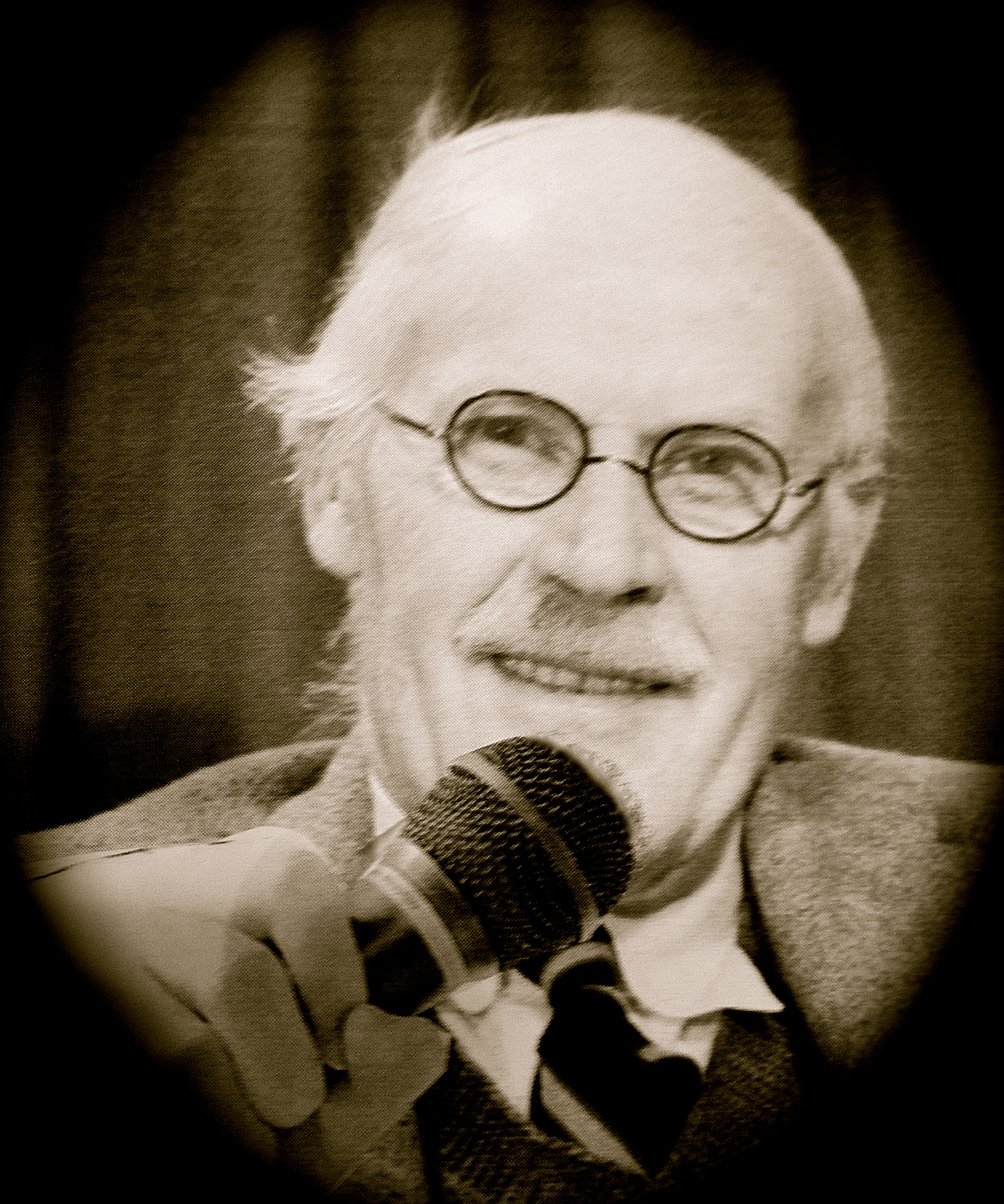
IMG_1547It’s Sir Harold Jeffreys himself! And his (very famous) joke, I admit, is funny. So, since it’s Saturday night, let’s listen in on Sir Harold’s howler* in criticizing the use of p-values.

“Did you hear the one about significance testers rejecting H0 because of outcomes H0 didn’t predict?

‘What’s unusual about that?’ you ask?

What’s unusual, is that they do it when these unpredicted outcomes haven’t even occurred!”

Much laughter.

[The actual quote from Jeffreys: Using p-values implies that “An hypothesis that may be true is rejected because it has failed to predict observable results that have not occurred. This seems a remarkable procedure.” (Jeffreys 1939, 316)]

I say it’s funny, so to see why I’ll strive to give it a generous interpretation. Continue reading

Categories: Comedy, Fisher, Jeffreys, P-values | 9 Comments

Stephen Senn: Double Jeopardy?: Judge Jeffreys Upholds the Law (sequel to the pathetic P-value)[4]

S. Senn

S. Senn

Stephen Senn
Head of Competence Center for Methodology and Statistics (CCMS)
Luxembourg Institute of Health

Double Jeopardy?: Judge Jeffreys Upholds the Law*[4]

“But this could be dealt with in a rough empirical way by taking twice the standard error as a criterion for possible genuineness and three times the standard error for definite acceptance”. Harold Jeffreys(1) (p386)

This is the second of two posts on P-values. In the first, The Pathetic P-Value, I considered the relation of P-values to Laplace’s Bayesian formulation of induction, pointing out that that P-values, whilst they had a very different interpretation, were numerically very similar to a type of Bayesian posterior probability. In this one, I consider their relation or lack of it, to Harold Jeffreys’s radically different approach to significance testing. (An excellent account of the development of Jeffreys’s thought is given by Howie(2), which I recommend highly.)

The story starts with Cambridge philosopher CD Broad (1887-1971), who in 1918 pointed to a difficulty with Laplace’s Law of Succession. Broad considers the problem of drawing counters from an urn containing n counters and supposes that all m drawn had been observed to be white. He now considers two very different questions, which have two very different probabilities and writes: Continue reading

Categories: Jeffreys, P-values, reforming the reformers, Stephen Senn | Tags: | 11 Comments

Stephen Senn: The pathetic P-value (Guest Post) [3]

S. Senn

S. Senn

Stephen Senn
Head of Competence Center for Methodology and Statistics (CCMS)
Luxembourg Institute of Health

The pathetic P-value* [3]

This is the way the story is now often told. RA Fisher is the villain. Scientists were virtuously treading the Bayesian path, when along came Fisher and gave them P-values, which they gladly accepted, because they could get ‘significance’ so much more easily. Nearly a century of corrupt science followed but now there are signs that there is a willingness to return to the path of virtue and having abandoned this horrible Fisherian complication:

We shall not cease from exploration
And the end of all our exploring
Will be to arrive where we started …

A condition of complete simplicity..

And all shall be well and
All manner of thing shall be well

TS Eliot, Little Gidding

Consider, for example, distinguished scientist David Colquhoun citing the excellent scientific journalist Robert Matthews as follows

“There is an element of truth in the conclusion of a perspicacious journalist:

‘The plain fact is that 70 years ago Ronald Fisher gave scientists a mathematical machine for turning baloney into breakthroughs, and flukes into funding. It is time to pull the plug. ‘

Robert Matthews Sunday Telegraph, 13 September 1998.” [1]

However, this is not a plain fact but just plain wrong. Even if P-values were the guilty ‘mathematical machine’ they are portrayed to be, it is not RA Fisher’s fault. Putting the historical record right helps one to understand the issues better. As I shall argue, at the heart of this is not a disagreement between Bayesian and frequentist approaches but between two Bayesian approaches: it is a conflict to do with the choice of prior distributions[2].

Fisher did not persuade scientists to calculate P-values rather than Bayesian posterior probabilities; he persuaded them that the probabilities that they were already calculating and interpreting as posterior probabilities relied for this interpretation on a doubtful assumption. He proposed to replace this interpretation with one that did not rely on the assumption. Continue reading

Categories: P-values, S. Senn, statistical tests, Statistics | 27 Comments

Beware of questionable front page articles warning you to beware of questionable front page articles (2)

RR

.

Such articles have continued apace since this blogpost from 2013. During that time, meta-research, replication studies, statistical forensics and fraudbusting have become popular academic fields in their own right. Since I regard the ‘programme’ (to use a Lakatosian term) as essentially a part of the philosophy and methodology of science, I’m all in favor of it—I employed the term “metastatistics” eons ago–but, as a philosopher, I claim there’s a pressing need for meta-meta-research, i.e., a conceptual, logical, and methodological scrutiny of presuppositions and gaps in meta-level work itself.  There was an issue I raised in the section “But what about the statistics?” below that hasn’t been addressed. I question the way size and power (from statistical hypothesis testing) are employed in a “diagnostics and screening” computation that underlies most “most findings are false” articles. (This is (2) in my new “Let PBP” series, and follows upon my last post, comments in burgandy are added, 12/5/15.)

In this time of government cut-backs and sequester, scientists are under increased pressure to dream up ever new strategies to publish attention-getting articles with eye-catching, but inadequately scrutinized, conjectures. Science writers are under similar pressures, and to this end they have found a way to deliver up at least one fire-breathing, front page article a month. How? By writing minor variations on an article about how in this time of government cut-backs and sequester, scientists are under increased pressure to dream up ever new strategies to publish attention-getting articles with eye-catching, but inadequately scrutinized, conjectures. (I’m prepared to admit that meta-research consciousness raising, like “self help books,” warrant frequent revisiting. Lessons are forgotten, and there are always new users of statistics.)

Thus every month or so we see retreads on why most scientific claims are unreliable, biased, wrong, and not even wrong. Maybe that’s the reason the authors of a recent article in The Economist (“Trouble at the Lab“) remain anonymous. (I realize that is their general policy.)  Continue reading

Categories: junk science, Let PBP, P-values, science-wise screening, Statistics | 23 Comments

Erich Lehmann: Neyman-Pearson & Fisher on P-values

IMG_1896

lone book on table

Today is Erich Lehmann’s birthday (20 November 1917 – 12 September 2009). Lehmann was Neyman’s first student at Berkeley (Ph.D 1942), and his framing of Neyman-Pearson (NP) methods has had an enormous influence on the way we typically view them.

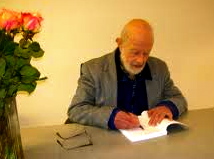
I got to know Erich in 1997, shortly after publication of EGEK (1996). One day, I received a bulging, six-page, handwritten letter from him in tiny, extremely neat scrawl (and many more after that).  He began by telling me that he was sitting in a very large room at an ASA (American Statistical Association) meeting where they were shutting down the conference book display (or maybe they were setting it up), and on a very long, wood table sat just one book, all alone, shiny red.  He said he wondered if it might be of interest to him!  So he walked up to it….  It turned out to be my Error and the Growth of Experimental Knowledge (1996, Chicago), which he reviewed soon after[0]. (What are the chances?) Some related posts on Lehmann’s letter are here and here.

One of Lehmann’s more philosophical papers is Lehmann (1993), “The Fisher, Neyman-Pearson Theories of Testing Hypotheses: One Theory or Two?” We haven’t discussed it before on this blog. Here are some excerpts (blue), and remarks (black)

Erich Lehmann 20 November 1917 – 12 September 2009

Erich Lehmann 20 November 1917 – 12 September 2009

…A distinction frequently made between the approaches of Fisher and Neyman-Pearson is that in the latter the test is carried out at a fixed level, whereas the principal outcome of the former is the statement of a p value that may or may not be followed by a pronouncement concerning significance of the result [p.1243].

The history of this distinction is curious. Throughout the 19th century, testing was carried out rather informally. It was roughly equivalent to calculating an (approximate) p value and rejecting the hypothesis if this value appeared to be sufficiently small. … Fisher, in his 1925 book and later, greatly reduced the needed tabulations by providing tables not of the distributions themselves but of selected quantiles. … These tables allow the calculation only of ranges for the p values; however, they are exactly suited for determining the critical values at which the statistic under consideration becomes significant at a given level. As Fisher wrote in explaining the use of his [chi square] table (1946, p. 80):

In preparing this table we have borne in mind that in practice we do not want to know the exact value of P for any observed [chi square], but, in the first place, whether or not the observed value is open to suspicion. If P is between .1 and .9, there is certainly no reason to suspect the hypothesis tested. If it is below .02, it is strongly indicated that the hypothesis fails to account for the whole of the facts. We shall not often be astray if we draw a conventional line at .05 and consider that higher values of [chi square] indicate a real discrepancy.

Similarly, he also wrote (1935, p. 13) that “it is usual and convenient for experimenters to take 5 percent as a standard level of significance, in the sense that they are prepared to ignore all results which fail to reach this standard .. .” …. Continue reading

Categories: Neyman, P-values, phil/history of stat, Statistics | Tags: , | 4 Comments

WHIPPING BOYS AND WITCH HUNTERS (ii)

.

At least as apt today as 3 years ago…HAPPY HALLOWEEN! Memory Lane with new comments in blue

In an earlier post I alleged that frequentist hypotheses tests often serve as whipping boys, by which I meant “scapegoats”, for the well-known misuses, abuses, and flagrant misinterpretations of tests (both simple Fisherian significance tests and Neyman-Pearson tests, although in different ways)—as well as for what really boils down to a field’s weaknesses in modeling, theorizing, experimentation, and data collection.  Checking the history of this term however, there is a certain disanalogy with at least the original meaning of a “whipping boy,” namely, an innocent boy who was punished when a medieval prince misbehaved and was in need of discipline.  It was thought that seeing an innocent companion, often a friend, beaten for his own transgressions would supply an effective way to ensure the prince would not repeat the same mistake. But significance tests floggings, rather than a tool for a humbled self-improvement and commitment to avoiding flagrant rule violations, has tended instead to yield declarations that it is the rules that are invalid! The violators are excused as not being able to help it! The situation is more akin to that of witch hunting that in some places became an occupation in its own right.

Now some early literature, e.g., Morrison and Henkel’s Significance Test Controversy (1962), performed an important service over fifty years ago.  They alerted social scientists to the fallacies of significance tests: misidentifying a statistically significant difference with one of substantive importance, interpreting insignificant results as evidence for the null hypothesis—especially problematic with insensitive tests, and the like. Chastising social scientists for applying significance tests in slavish and unthinking ways, contributors call attention to a cluster of pitfalls and fallacies of testing. Continue reading

Categories: P-values, reforming the reformers, significance tests, Statistics | Tags: , , | Leave a comment

Statistical “reforms” without philosophy are blind (v update)

following-leader-off-cliff

.

Is it possible, today, to have a fair-minded engagement with debates over statistical foundations? I’m not sure, but I know it is becoming of pressing importance to try. Increasingly, people are getting serious about methodological reforms—some are quite welcome, others are quite radical. Too rarely do the reformers bring out the philosophical presuppositions of the criticisms and proposed improvements. Today’s (radical?) reform movements are typically launched from criticisms of statistical significance tests and P-values, so I focus on them. Regular readers know how often the P-value (that most unpopular girl in the class) has made her appearance on this blog. Here, I tried to quickly jot down some queries. (Look for later installments and links.) What are some key questions we need to ask to tell what’s true about today’s criticisms of P-values? 

I. To get at philosophical underpinnings, the single most import question is this:

(1) Do the debaters distinguish different views of the nature of statistical inference and the roles of probability in learning from data? Continue reading

Categories: Bayesian/frequentist, Error Statistics, P-values, significance tests, Statistics, strong likelihood principle | 193 Comments

P-value madness: A puzzle about the latest test ban (or ‘don’t ask, don’t tell’)

images-1

.

Given the excited whispers about the upcoming meeting of the American Statistical Association Committee on P-Values and Statistical Significance, it’s an apt time to reblog my post on the “Don’t Ask Don’t Tell” policy that began the latest brouhaha!

A large number of people have sent me articles on the “test ban” of statistical hypotheses tests and confidence intervals at a journal called Basic and Applied Social Psychology (BASP)[i]. Enough. One person suggested that since it came so close to my recent satirical Task force post, that I either had advance knowledge or some kind of ESP. Oh please, no ESP required.None of this is the slightest bit surprising, and I’ve seen it before; I simply didn’t find it worth blogging about (but Saturday night is a perfect time to read/reread the (satirical) Task force post [ia]). Statistical tests are being banned, say the editors, because they purport to give probabilities of null hypotheses (really?) and do not, hence they are “invalid”.[ii] (Confidence intervals are thrown in the waste bin as well—also claimed “invalid”).“The state of the art remains uncertain” regarding inferential statistical procedures, say the editors.  I don’t know, maybe some good will come of all this.

Yet there’s a part of their proposal that brings up some interesting logical puzzles, and logical puzzles are my thing. In fact, I think there is a mistake the editors should remedy, lest authors be led into disingenuous stances, and strange tangles ensue. I refer to their rule that authors be allowed to submit papers whose conclusions are based on allegedly invalid methods so long as, once accepted, they remove any vestiges of them! Continue reading

Categories: P-values, pseudoscience, reforming the reformers, Statistics | 7 Comments

In defense of statistical recipes, but with enriched ingredients (scientist sees squirrel)

cropped-imgp587612

Scientist sees squirrel

Evolutionary ecologist, Stephen Heard (Scientist Sees Squirrel) linked to my blog yesterday. Heard’s post asks: “Why do we make statistics so hard for our students?” I recently blogged Barnard who declared “We need more complexity” in statistical education. I agree with both: after all, Barnard also called for stressing the overarching reasoning for given methods, and that’s in sync with Heard. Here are some excerpts from Heard’s (Oct 6, 2015) post. I follow with some remarks.

This bothers me, because we can’t do inference in science without statistics*. Why are students so unreceptive to something so important? In unguarded moments, I’ve blamed it on the students themselves for having decided, a priori and in a self-fulfilling prophecy, that statistics is math, and they can’t do math. I’ve blamed it on high-school math teachers for making math dull. I’ve blamed it on high-school guidance counselors for telling students that if they don’t like math, they should become biology majors. I’ve blamed it on parents for allowing their kids to dislike math. I’ve even blamed it on the boogie**. Continue reading

Categories: fallacy of rejection, frequentist/Bayesian, P-values, Statistics | 20 Comments

“Statistical Significance” According to the U.S. Dept. of Health and Human Services (ii)

Mayo elbow

Mayo, frustrated

Someone linked this to me on Twitter. I thought it was a home blog at first. Surely the U.S. Dept of Health and Human Services can give a better definition than this.

U.S. Department of Health and Human Services
Effective Health Care Program
Glossary of Terms

We know that many of the concepts used on this site can be difficult to understand. For that reason, we have provided you with a glossary to help you make sense of the terms used in Comparative Effectiveness Research. Every word that is defined in this glossary should appear highlighted throughout the Web site…..

Statistical Significance

Definition: A mathematical technique to measure whether the results of a study are likely to be true. Statistical significance is calculated as the probability that an effect observed in a research study is occurring because of chance. Statistical significance is usually expressed as a P-value. The smaller the P-value, the less likely it is that the results are due to chance (and more likely that the results are true). Researchers generally believe the results are probably true if the statistical significance is a P-value less than 0.05 (p<.05).

Example: For example, results from a research study indicated that people who had dementia with agitation had a slightly lower rate of blood pressure problems when they took Drug A compared to when they took Drug B. In the study analysis, these results were not considered to be statistically significant because p=0.2. The probability that the results were due to chance was high enough to conclude that the two drugs probably did not differ in causing blood pressure problems.

You can find it here.  First of all, one should never use “likelihood” and “probability” in what is to be a clarification of formal terms, as these mean very different things in statistics.Some of the claims given actually aren’t so bad if “likely” takes its statistical meaning, but are all wet if construed as mathematical probability. Continue reading

Categories: P-values, Statistics | 69 Comments

Higgs discovery three years on (Higgs analysis and statistical flukes)

3rd-birthday-cake2

.

2015: The Large Hadron Collider (LHC) is back in collision mode in 2015[0]. There’s a 2015 update, a virtual display, and links from ATLAS, one of two detectors at (LHC)) here. The remainder is from one year ago. (2014) I’m reblogging a few of the Higgs posts at the anniversary of the 2012 discovery. (The first was in this post.) The following, was originally “Higgs Analysis and Statistical Flukes: part 2″ (from March, 2013).[1]

Some people say to me: “This kind of reasoning is fine for a ‘sexy science’ like high energy physics (HEP)”–as if their statistical inferences are radically different. But I maintain that this is the mode by which data are used in “uncertain” reasoning across the entire landscape of science and day-to-day learning (at least, when we’re trying to find things out)[2] Even with high level theories, the particular problems of learning from data are tackled piecemeal, in local inferences that afford error control. Granted, this statistical philosophy differs importantly from those that view the task as assigning comparative (or absolute) degrees-of-support/belief/plausibility to propositions, models, or theories. 

“Higgs Analysis and Statistical Flukes: part 2”images

Everyone was excited when the Higgs boson results were reported on July 4, 2012 indicating evidence for a Higgs-like particle based on a “5 sigma observed effect”. The observed effect refers to the number of excess events of a given type that are “observed” in comparison to the number (or proportion) that would be expected from background alone, and not due to a Higgs particle. This continues my earlier post (part 1). It is an outsider’s angle on one small aspect of the statistical inferences involved. But that, apart from being fascinated by it, is precisely why I have chosen to discuss it: we [philosophers of statistics] should be able to employ a general philosophy of inference to get an understanding of what is true about the controversial concepts we purport to illuminate, e.g., significance levels. Continue reading

Categories: Higgs, highly probable vs highly probed, P-values, Severity | 1 Comment

From our “Philosophy of Statistics” session: APS 2015 convention

aps_2015_logo_cropped-1

.

“The Philosophy of Statistics: Bayesianism, Frequentism and the Nature of Inference,” at the 2015 American Psychological Society (APS) Annual Convention in NYC, May 23, 2015:


D. Mayo: “Error Statistical Control: Forfeit at your Peril” 


S. Senn: “‘Repligate’: reproducibility in statistical studies. What does it mean and in what sense does it matter?”


A. Gelman: “The statistical crisis in science” (this is not his exact presentation, but he focussed on some of these slides)


For more details see this post.

Categories: Bayesian/frequentist, Error Statistics, P-values, reforming the reformers, reproducibility, S. Senn, Statistics | 10 Comments

Stephen Senn: Double Jeopardy?: Judge Jeffreys Upholds the Law (sequel to the pathetic P-value)

S. Senn

S. Senn

Stephen Senn
Head of Competence Center for Methodology and Statistics (CCMS)
Luxembourg Institute of Health

Double Jeopardy?: Judge Jeffreys Upholds the Law

“But this could be dealt with in a rough empirical way by taking twice the standard error as a criterion for possible genuineness and three times the standard error for definite acceptance”. Harold Jeffreys(1) (p386)

This is the second of two posts on P-values. In the first, The Pathetic P-Value, I considered the relation of P-values to Laplace’s Bayesian formulation of induction, pointing out that that P-values, whilst they had a very different interpretation, were numerically very similar to a type of Bayesian posterior probability. In this one, I consider their relation or lack of it, to Harold Jeffreys’s radically different approach to significance testing. (An excellent account of the development of Jeffreys’s thought is given by Howie(2), which I recommend highly.)

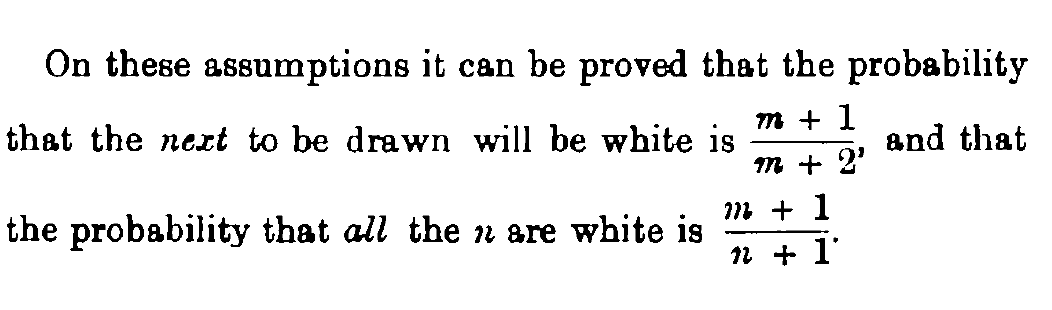
The story starts with Cambridge philosopher CD Broad (1887-1971), who in 1918 pointed to a difficulty with Laplace’s Law of Succession. Broad considers the problem of drawing counters from an urn containing n counters and supposes that all m drawn had been observed to be white. He now considers two very different questions, which have two very different probabilities and writes:

C.D. Broad quoteNote that in the case that only one counter remains we have n = m + 1 and the two probabilities are the same. However, if n > m+1 they are not the same and in particular if m is large but n is much larger, the first probability can approach 1 whilst the second remains small.

The practical implication of this just because Bayesian induction implies that a large sequence of successes (and no failures) supports belief that the next trial will be a success, it does not follow that one should believe that all future trials will be so. This distinction is often misunderstood. This is The Economist getting it wrong in September 2000

The canonical example is to imagine that a precocious newborn observes his first sunset, and wonders whether the sun will rise again or not. He assigns equal prior probabilities to both possible outcomes, and represents this by placing one white and one black marble into a bag. The following day, when the sun rises, the child places another white marble in the bag. The probability that a marble plucked randomly from the bag will be white (ie, the child’s degree of belief in future sunrises) has thus gone from a half to two-thirds. After sunrise the next day, the child adds another white marble, and the probability (and thus the degree of belief) goes from two-thirds to three-quarters. And so on. Gradually, the initial belief that the sun is just as likely as not to rise each morning is modified to become a near-certainty that the sun will always rise.

See Dicing with Death(3) (pp76-78).

The practical relevance of this is that scientific laws cannot be established by Laplacian induction. Jeffreys (1891-1989) puts it thus

Thus I may have seen 1 in 1000 of the ‘animals with feathers’ in England; on Laplace’s theory the probability of the proposition, ‘all animals with feathers have beaks’, would be about 1/1000. This does not correspond to my state of belief or anybody else’s. (P128)

Continue reading

Categories: Jeffreys, P-values, reforming the reformers, Statistics, Stephen Senn | 42 Comments

Stephen Senn: The pathetic P-value (Guest Post)

S. Senn

S. Senn

Stephen Senn
Head of Competence Center for Methodology and Statistics (CCMS)
Luxembourg Institute of Health

The pathetic P-value

This is the way the story is now often told. RA Fisher is the villain. Scientists were virtuously treading the Bayesian path, when along came Fisher and gave them P-values, which they gladly accepted, because they could get ‘significance’ so much more easily. Nearly a century of corrupt science followed but now there are signs that there is a willingness to return to the path of virtue and having abandoned this horrible Fisherian complication:

We shall not cease from exploration
And the end of all our exploring
Will be to arrive where we started …

A condition of complete simplicity..

And all shall be well and
All manner of thing shall be well

TS Eliot, Little Gidding

Consider, for example, distinguished scientist David Colquhoun citing the excellent scientific journalist Robert Matthews as follows

“There is an element of truth in the conclusion of a perspicacious journalist:

‘The plain fact is that 70 years ago Ronald Fisher gave scientists a mathematical machine for turning baloney into breakthroughs, and flukes into funding. It is time to pull the plug. ‘

Robert Matthews Sunday Telegraph, 13 September 1998.” [1]

However, this is not a plain fact but just plain wrong. Even if P-values were the guilty ‘mathematical machine’ they are portrayed to be, it is not RA Fisher’s fault. Putting the historical record right helps one to understand the issues better. As I shall argue, at the heart of this is not a disagreement between Bayesian and frequentist approaches but between two Bayesian approaches: it is a conflict to do with the choice of prior distributions[2].

Fisher did not persuade scientists to calculate P-values rather than Bayesian posterior probabilities; he persuaded them that the probabilities that they were already calculating and interpreting as posterior probabilities relied for this interpretation on a doubtful assumption. He proposed to replace this interpretation with one that did not rely on the assumption. Continue reading

Categories: P-values, S. Senn, statistical tests, Statistics | 148 Comments

A puzzle about the latest test ban (or ‘don’t ask, don’t tell’)

images-1

.

A large number of people have sent me articles on the “test ban” of statistical hypotheses tests and confidence intervals at a journal called Basic and Applied Social Psychology (BASP)[i]. Enough. One person suggested that since it came so close to my recent satirical Task force post, that I either had advance knowledge or some kind of ESP. Oh please, no ESP required.None of this is the slightest bit surprising, and I’ve seen it before; I simply didn’t find it worth blogging about. Statistical tests are being banned, say the editors, because they purport to give probabilities of null hypotheses (really?) and do not, hence they are “invalid”.[ii] (Confidence intervals are thrown in the waste bin as well—also claimed “invalid”).“The state of the art remains uncertain” regarding inferential statistical procedures, say the editors.  I don’t know, maybe some good will come of all this.

Yet there’s a part of their proposal that brings up some interesting logical puzzles, and logical puzzles are my thing. In fact, I think there is a mistake the editors should remedy, lest authors be led into disingenuous stances, and strange tangles ensue. I refer to their rule that authors be allowed to submit papers whose conclusions are based on allegedly invalid methods so long as, once accepted, they remove any vestiges of them!

Question 1. Will manuscripts with p-values be desk rejected automatically?

Answer to Question 1. No. If manuscripts pass the preliminary inspection, they will be sent out for review. But prior to publication, authors will have to remove all vestiges of the NHSTP (p-values, t-values, F-values, statements about “significant” differences or lack thereof, and so on).”

Now if these measures are alleged to be irrelevant and invalid instruments for statistical inference, then why should they be included in the peer review process at all? Will reviewers be told to ignore them? That would only seem fair: papers should not be judged by criteria alleged to be invalid, but how will reviewers blind themselves to them? It would seem the measures should be excluded from the get-go. If they are included in the review, why shouldn’t the readers see what the reviewers saw when they recommended acceptance?

But here’s where the puzzle really sets in. If the authors must free their final papers from such encumbrances as sampling distributions and error probabilities, what will be the basis presented for their conclusions in the published paper? Presumably, from the notice, they are allowed only mere descriptive statistics or non-objective Bayesian reports (added: actually can’t tell which kind of Bayesianism they allow, given the Fisher reference which doesn’t fit*). Won’t this be tantamount to requiring authors support their research in a way that is either (actually) invalid, or has little to do with the error statistical properties that were actually reported and on which the acceptance was based?[ii] Continue reading

Categories: P-values, reforming the reformers, Statistics | 73 Comments

“Probabilism as an Obstacle to Statistical Fraud-Busting”

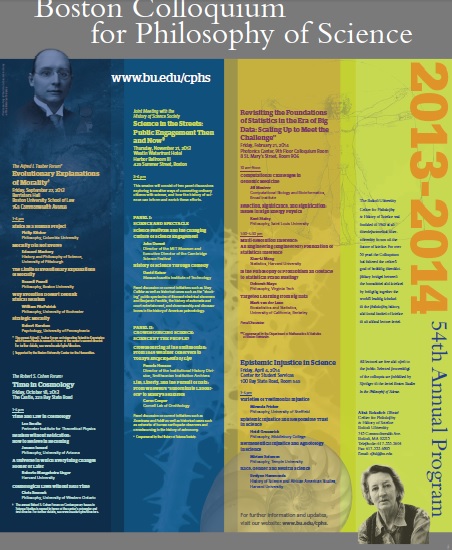
Boston Colloquium 2013-2014

.

“Is the Philosophy of Probabilism an Obstacle to Statistical Fraud Busting?” was my presentation at the 2014 Boston Colloquium for the Philosophy of Science):“Revisiting the Foundations of Statistics in the Era of Big Data: Scaling Up to Meet the Challenge.”  

 As often happens, I never put these slides into a stand alone paper. But I have incorporated them into my book (in progress*), “How to Tell What’s True About Statistical Inference”. Background and slides were posted last year.

Slides (draft from Feb 21, 2014) 

Download the 54th Annual Program

Cosponsored by the Department of Mathematics & Statistics at Boston University.

Friday, February 21, 2014
10 a.m. – 5:30 p.m.
Photonics Center, 9th Floor Colloquium Room (Rm 906)
8 St. Mary’s Street

*Seeing a light at the end of tunnel, finally.
Categories: P-values, significance tests, Statistical fraudbusting, Statistics | 7 Comments

Sir Harold Jeffreys’ (tail area) one-liner: Saturday night comedy (b)

Comedy hour icon

.

This headliner appeared before, but to a sparse audience, so Management’s giving him another chance… His joke relates to both Senn’s post (about alternatives), and to my recent post about using (1 – β)/α as a likelihood ratio--but for very different reasons. (I’ve explained at the bottom of this “(b) draft”.)

 ….If you look closely, you’ll see that it’s actually not Jay Leno who is standing up there at the mike, (especially as he’s no longer doing the Tonight Show) ….

IMG_1547

.

It’s Sir Harold Jeffreys himself! And his (very famous) joke, I admit, is funny. So, since it’s Saturday night, let’s listen in on Sir Harold’s howler joke* in criticizing the use of p-values.

“Did you hear the one about significance testers rejecting H0 because of outcomes H0 didn’t predict?

‘What’s unusual about that?’ you ask?

What’s unusual is that they do it when these unpredicted outcomes haven’t even occurred!”

Much laughter.

[The actual quote from Jeffreys: Using p-values implies that “An hypothesis that may be true is rejected because it has failed to predict observable results that have not occurred. This seems a remarkable procedure.” (Jeffreys 1939, 316)]

I say it’s funny, so to see why I’ll strive to give it a generous interpretation. Continue reading

Categories: Comedy, Discussion continued, Fisher, Jeffreys, P-values, Statistics, Stephen Senn | 7 Comments

Philosophy of Science Assoc. (PSA) symposium on Philosophy of Statistics in the Higgs Experiments “How Many Sigmas to Discovery?”

psa-home

.

The biennial meeting of the Philosophy of Science Association (PSA) starts this week (Nov. 6-9) in Chicago, together with the History of Science Society. I’ll be part of the symposium:


How Many Sigmas to Discovery?
Philosophy and Statistics in the Higgs Experiments


on Nov.8 with Robert Cousins, Allan Franklin, and Kent Staley. If you’re in the neighborhood stop by.


Summary

“A 5 sigma effect!” is how the recent Higgs boson discovery was reported. Yet before the dust had settled, the very nature and rationale of the 5 sigma (or 5 standard deviation) discovery criteria began to be challenged and debated both among scientists and in the popular press. Why 5 sigma? How is it to be interpreted? Do p-values in high-energy physics (HEP) avoid controversial uses and misuses of p-values in social and other sciences? The goal of our symposium is to combine the insights of philosophers and scientists whose work interrelates philosophy of statistics, data analysis and modeling in experimental physics, with critical perspectives on how discoveries proceed in practice. Our contributions will link questions about the nature of statistical evidence, inference, and discovery with questions about the very creation of standards for interpreting and communicating statistical experiments. We will bring out some unique aspects of discovery in modern HEP. We also show the illumination the episode offers to some of the thorniest issues revolving around statistical inference, frequentist and Bayesian methods, and the philosophical, technical, social, and historical dimensions of scientific discovery.

   Questions:

1) How do philosophical problems of statistical inference interrelate with debates about inference and modeling in high energy physics (HEP)?

2) Have standards for scientific discovery in particle physics shifted? And if so, how has this influenced when a new phenomenon is “found”?

3) Can understanding the roles of statistical hypotheses tests in HEP resolve classic problems about their justification in both physical and social sciences?

4) How do pragmatic, epistemic and non-epistemic values and risks influence the collection, modeling, and interpretation of data in HEP?


Abstracts for Individual Presentations

robert cousins(1) Unresolved Philosophical Issues Regarding Hypothesis Testing in High Energy Physics
Robert D. Cousins.
Professor, Department of Physics and Astronomy, University of California, Los Angeles (UCLA)

The discovery and characterization of a Higgs boson in 2012-2013 provide multiple examples of statistical inference as practiced in high energy physics (elementary particle physics).  The main methods employed have a decidedly frequentist flavor, drawing in a pragmatic way on both Fisher’s ideas and the Neyman-Pearson approach.  A physics model being tested typically has a “law of nature” at its core, with parameters of interest representing masses, interaction strengths, and other presumed “constants of nature”.  Additional “nuisance parameters” are needed to characterize the complicated measurement processes.  The construction of confidence intervals for a parameter of interest q is dual to hypothesis testing, in that the test of the null hypothesis q=q0 at significance level (“size”) a is equivalent to whether q0 is contained in a confidence interval for q with confidence level (CL) equal to 1-a.  With CL or a specified in advance (“pre-data”), frequentist coverage properties can be assured, at least approximately, although nuisance parameters bring in significant complications.  With data in hand, the post-data p-value can be defined as the smallest significance level a at which the null hypothesis would be rejected, had that a been specified in advance.  Carefully calculated p-values (not assuming normality) are mapped onto the equivalent number of standard deviations (“s”) in a one-tailed test of the mean of a normal distribution. For a discovery such as the Higgs boson, experimenters report both p-values and confidence intervals of interest. Continue reading

Categories: Error Statistics, Higgs, P-values | Tags: | 18 Comments

Blog at WordPress.com.