
Statistics

Neyman’s Nursery (NN2): Power and Severity [Continuation of Oct. 22 Post]:

Let me pick up where I left off in “Neyman’s Nursery,” [built to house Giere’s statistical papers-in-exile]. The  main goal of the discussion is to get us to exercise correctly our “will to understand power”, if only little by little.  One of the two surprising papers I came across the night our house was hit by lightening has the tantalizing title “The Problem of Inductive Inference” (Neyman 1955).  It reveals a use of statistical tests strikingly different from the long-run behavior construal most associated with Neyman.  Surprising too, Neyman is talking to none other than the logical positivist philosopher of confirmation, Rudof Carnap:

I am concerned with the term “degree of confirmation” introduced by Carnap.  …We have seen that the application of the locally best one-sided test to the data … failed to reject the hypothesis [that the n observations come from a source in which the null hypothesis is true].  The question is: does this result “confirm” the hypothesis that H0 is true of the particular data set? (Neyman, pp 40-41).

Neyman continues:

The answer … depends very much on the exact meaning given to the words “confirmation,” “confidence,” etc.  If one uses these words to describe one’s intuitive feeling of confidence in the hypothesis tested H0, then…. the attitude described is dangerous.… [T]he chance of detecting the presence [of discrepancy from the null], when only [n] observations are available, is extremely slim, even if [the discrepancy is present].  Therefore, the failure of the test to reject H0 cannot be reasonably considered as anything like a confirmation of H0.  The situation would have been radically different if the power function [corresponding to a discrepancy of interest] were, for example, greater than 0.95. (ibid.)

The general conclusion is that it is a little rash to base one’s intuitive confidence in a given hypothesis on the fact that a test failed to reject this hypothesis. A more cautious attitude would be to form one’s intuitive opinion only after studying the power function of the test applied.

Neyman alludes to a one-sided test of the mean of a Normal distribution with n iid samples, and known standard deviation, call it test T+. (Whether Greek symbols will appear where they should, I cannot say; it’s being worked on back at Elba).

H0: µ ≤ µ0 against H1: µ > µ0.

The test statistic d(X) is the standardized sample mean.

The test rule: Infer a (positive) discrepancy from µ0 iff {d(x0) > cα) where cα corresponds to a difference statistically significant at the α level.

In Carnap’s example the test could not reject the null hypothesis, i.e., d(x0) ≤ cα, but (to paraphrase Neyman) the problem is that the chance of detecting the presence of discrepancy δ from the null, with so few observations, is extremely slim, even if [δ is present].

We are back to our old friend: interpreting negative results!

“One may be confident in the absence of that discrepancy only if the power to detect it were high.”

The power of the test T+ to detect discrepancy δ:

(1)  P(d(X) > cα; µ =  µ0 + δ)

It is interesting to hear Neyman talk this way since it is at odds with the more behavioristic construal he usually championed.  He sounds like a Cohen-style power analyst!  Still, power is calculated relative to an outcome just missing the cutoff  cα.  This is, in effect, the worst case of a negative (non significant) result, and if the actual outcome corresponds to a larger p-value, that should be taken into account in interpreting the results.  It is more informative, therefore, to look at the probability of getting a worse fit (with the null hypothesis) than you did:

(2)  P(d(X) > d(x0); µ = µ0 + δ)

In this example, this gives a measure of the severity (or degree of corroboration) for the inference µ < µ0 + δ.

Although (1) may be low, (2) may be high (For numbers, see Mayo and Spanos 2006).

Spanos and I (Mayo and Spanos 2006) couldn’t find a term in the literature defined precisely this way–the way I’d defined it in Mayo (1996) and before.  We were thinking at first of calling it “attained power” but then came across what some have called “observed power” which is very different (and very strange).  Those measures are just like ordinary power but calculated assuming the value of the mean equals the observed mean!  (Why  anyone would want to do this and then apply power analytic reasoning is unclear.  I’ll come back to this in my next post.)  Anyway, we refer to it as the Severity Interpretation of “Acceptance” (SIA) in Mayo and Spanos 2006.

The claim in (2) could also be made out viewing the p-value as a random variable, calculating its distribution for various alternatives (Cox 2006, 25).  This reasoning yields a core frequentist principle of evidence  (FEV) in Mayo and Cox 2010, 256):

FEV:1 A moderate p-value is evidence of the absence of a discrepancy d from H0 only if there is a high probability the test would have given a worse fit with H0 (i.e., smaller p value) were a discrepancy d to exist.

It is important to see that it is only in the case of a negative result that severity for various inferences is in the same direction as power.  In the case of significant results, d(x) in excess of the cutoff, the opposite concern arises—namely, the test is too sensitive. So severity is always relative to the particular inference being entertained: speaking of the “severity of a test” simpliciter is an incomplete statement in this account.  These assessments enable sidestepping classic fallacies of tests that are either too sensitive or not sensitive enough.2
________________________________________

The full version of our frequentist principle of evidence FEV corresponds to the interpretation of a small p-value:

x is evidence of a discrepancy d from H0 iff, if H0 is a correct description of the mechanism generating x, then, with high probability a less discordant result would have occurred.

Severity (SEV) may be seen as a meta-statistical principle that follows the same logic as FEV reasoning within the formal statistical analysis.

By making a SEV assessment relevant to the inference under consideration, we obtain a measure where high (low) values always correspond to good (poor) evidential warrant.
It didn’t have to be done this way, but I decided it was best, even though it means appropriately swapping out the claim H for which one wants to assess SEV.

NOTE: There are 5 Neyman’s Nursery posts (NN1-NN5). NN3 is here. Search this blog for the others.

REFERENCES:

Cohen, J. (1992) A Power Primer.
Cohen, J. (1988), Statistical Power Analysis for the Behavioral Sciences, 2nd ed. Hillsdale, Erlbaum, NJ.

Mayo, D. and Spanos, A. (2006), “Severe Testing as a Basic Concept in a Neyman-Pearson Philosophy of Induction,” British Journal of Philosophy of Science, 57: 323-357.

Mayo, D. and Cox, D. (2010), “Frequentist Statistics as a Theory of Inductive Inference,” in D. Mayo and A. Spanos (2011), pp. 247-275.

Mayo, D. and Spanos, A. (eds.) (2010), Error and Inference, Recent Exchanges on Experimental Reasoning, Reliability, and the Objectivity and Rationality of Science, CUP.

Neyman, J. (1955), “The Problem of Inductive Inference,” Communications on Pure and Applied Mathematics, VIII, 13-46.
Categories: Neyman's Nursery, Statistics | Tags: , , , | Leave a comment

Skeleton Key and Skeletal Points for (Esteemed) Ghost Guest

Secret Key

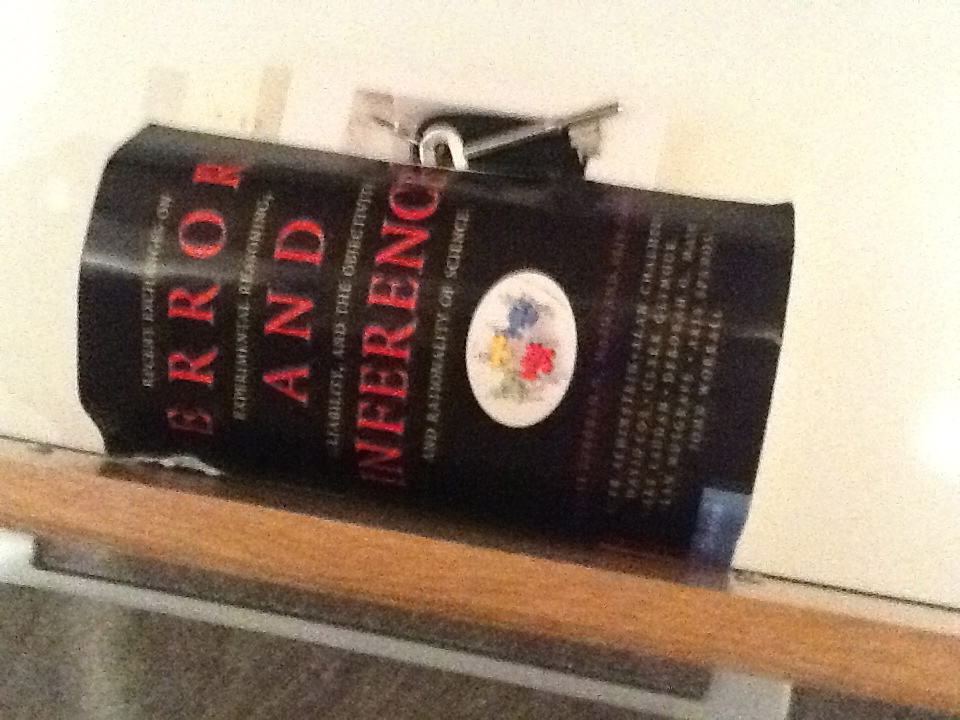
Why attend presentations of interesting papers or go to smashing London sites when you can spend better than an hour racing from here to there because the skeleton key to your rented flat won’t turn the lock (after working fine for days)? [3 other neighbors tried, by the way, it wasn’t just me.] And what are the chances of two keys failing, including the porter’s key, and then a third key succeeding–a spare I’d never used but had placed in a hollowed-out volume of Error and Inference, and kept in an office at the London School of Economics?  (Yes, that is what the photo is!  A anonymous e-mailer guessed it right, so they must have spies!)  As I ran back and forth one step ahead of the locksmith, trying to ignore my still-bum knee (I left the knee brace in the flat) and trying not to get run over—not easy, in London, for me—I mulled over the perplexing query from one of my Ghost Guests (who asked for my positive account). Continue reading

Categories: philosophy of science, Statistics | Tags: , , | Leave a comment

Who is Really Doing the Work?*

A common assertion (of which I was reminded in Leiden*) is that in scientific practice, by and large, the frequentist sampling theorist (error statistician) ends up in essentially the “same place” as Bayesians, as if to downplay the importance of disagreements within the Bayesian family, let alone between the Bayesian and frequentist.   Such an utterance, in my experience, is indicative of a frequentist in exile (as described on this blog). [1]  Perhaps the claim makes the frequentist feel less in exile; but it also renders any subsequent claims to prefer the frequentist philosophy as just that—a matter of preference, without a pressing foundational imperative. Yet, even if one were to grant an agreement in numbers, it is altogether crucial to ascertain who or what is really doing the work.  If we don’t understand what is really responsible for success stories in statistical inference, we cannot hope to improve those methods, adjudicate rival assessments when they do arise, or get ideas for extending and developing tools when entering brand new arenas.  Clearly, understanding the underlying foundations of one or another approach is crucial for a philosopher of statistics, but practitioners too should care, at least some of the time. Continue reading

Categories: Statistics | Tags: | Leave a comment

RMM-4: Special Volume on Stat Scie Meets Phil Sci

The article “Foundational Issues in Statistical Modeling: Statistical Model Specification and Validation*” by Aris Spanos has now been published in our special volume of the on-line journal, Rationality, Markets, and Morals (Special Topic: Statistical Science and Philosophy of Science: Where Do/Should They Meet?”)

Abstract:
Statistical model specification and validation raise crucial foundational problems whose pertinent resolution holds the key to learning from data by securing the reliability of frequentist inference. The paper questions the judiciousness of several current practices, including the theory-driven approach, and the Akaike-type model selection procedures, arguing that they often lead to unreliable inferences. This is primarily due to the fact that goodness-of-fit/prediction measures and other substantive and pragmatic criteria are of questionable value when the estimated model is statistically misspecified. Foisting one’s favorite model on the data often yields estimated models which are both statistically and substantively misspecified, but one has no way to delineate between the two sources of error and apportion blame. The paper argues that the error statistical approach can address this Duhemian ambiguity by distinguishing between statistical and substantive premises and viewing empirical modeling in a piecemeal way with a view to delineate the various issues more effectively. It is also argued that Hendry’s general to specific procedures does a much better job in model selection than the theory-driven and the Akaike-type procedures primary because of its error statistical underpinnings.

Categories: Philosophy of Statistics, Statistics | Tags: , , | Leave a comment

Oxford Gaol: Statistical Bogeymen

Oxford Jail is an entirely fitting place to be on Halloween!

Moreover, rooting around this rather lavish set of jail cells (what used to be a single cell is now a dressing room) is every bit as conducive to philosophical reflection as is exile on Elba!  My goal (while in this gaol—as the English sometimes spell it) is to try and free us from the bogeymen and bogeywomen often associated with “classical” statistics. As a start, the very term “classical statistics” should I think be shelved, not that names should matter.

In appraising statistical accounts at the foundational level, we need to realize the extent to which accounts are viewed through the eyeholes of a mask or philosophical theory.  Moreover, the mask some wear while pursuing this task might well be at odds with their ordinary way of looking at evidence, inference, and learning. In any event, to avoid non-question-begging criticisms, the standpoint from which the appraisal is launched must itself be independently defended.   But for Bayesian critics of error statistics the assumption that uncertain inference demands a posterior probability for claims inferred is thought to be so obvious as not to require support. Critics are implicitly making assumptions that are at odds with the frequentist statistical philosophy. In particular, they assume a certain philosophy about statistical inference (probabilism), often coupled with the allegation that error statistical methods can only achieve radical behavioristic goals, wherein all that matters are long-run error rates (of some sort)

Criticisms then follow readily: the form of one or both:

  • Error probabilities do not supply posterior probabilities in hypotheses, interpreted as if they do (and some say we just can’t help it), they lead to inconsistencies
  • Methods with good long-run error rates can give rise to counterintuitive inferences in particular cases.
  • I have proposed an alternative philosophy that replaces these tenets with different ones:
  • the role of probability in inference is to quantify how reliably or severely claims (or discrepancies from claims) have been tested
  • the severity goal directs us to the relevant error probabilities, avoiding the oft-repeated statistical fallacies due to tests that are overly sensitive, as well as those insufficiently sensitive to particular errors.
  • Control of long run error probabilities, while necessary is not sufficient for good tests or warranted inferences.

Continue reading

Categories: Statistics | Tags: , | 1 Comment

Background Knowledge: Not to Quantify, But To Avoid Being Misled By, Subjective Beliefs

Increasingly, I am discovering that one of the biggest sources of confusion about the foundations of statistics has to do with what it means or should mean to use “background knowledge” and “judgment” in making statistical and scientific inferences. David Cox and I address this in our “Conversation” in RMM (2011); it is one of the three or four topics in that special volume that I am keen to take up.

Insofar as humans conduct science and draw inferences, and insofar as learning about the world is not reducible to a priori deductions, it is obvious that “human judgments” are involved. True enough, but too trivial an observation to help us distinguish among the very different ways judgments should enter according to contrasting inferential accounts. When Bayesians claim that frequentists do not use or are barred from using background information, what they really mean is that frequentists do not use prior probabilities of hypotheses, at least when those hypotheses are regarded as correct or incorrect, if only approximately. So, for example, we would not assign relative frequencies to the truth of hypotheses such as (1) prion transmission is via protein folding without nucleic acid, or (2) the deflection of light is approximately 1.75” (as if, as Pierce puts it, “universes were as plenty as blackberries”). How odd it would be to try to model these hypotheses as themselves having distributions: to us, statistical hypotheses assign probabilities to outcomes or values of a random variable. Continue reading

Categories: Statistics | Tags: , | 23 Comments

RMM-3: Special Volume on Stat Scie Meets Phil Sci

The article “Empirical Economic Model Discovery and Theory Evaluation” by Sir David Hendry has now been published in our special volume of the on-line journal, Rationality, Markets, and Morals (Special Topic: Statistical Science and Philosophy of Science: Where Do/Should They Meet?”)

Abstract: 
Economies are so high dimensional and non-constant that many features of models can- not be derived by prior reasoning, intrinsically involving empirical discovery and requiring theory evaluation. Despite important differences, discovery and evaluation in economics are similar to those of science. Fitting a pre-specified equation limits discovery, but automatic methods can formulate much more general initial models with many possible variables, long lag lengths and non-linearities, allowing for outliers, data contamination, and parameter shifts; then select congruent parsimonious-encompassing models even with more candidate variables than observations, while embedding the theory; finally rigorously evaluate selected models to ascertain their viability.

Categories: Philosophy of Statistics, Statistics | Tags: , | Leave a comment

The Will to Understand Power: Neyman’s Nursery (NN1)

Way back when, although I’d never met him, I sent my doctoral dissertation, Philosophy of Statistics, to one person only: Professor Ronald Giere. (And he would read it, too!) I knew from his publications that he was a leading defender of frequentist statistical methods in philosophy of science, and that he’d worked for a time with Birnbaum in NYC. Continue reading

Categories: Neyman's Nursery, Statistics | Tags: , | 1 Comment

RMM-2: "A Conversation Between Sir David Cox & D.G. Mayo"

Published today in Rationality, Markets and Morals

Studies at the Intersection of Philosophy and Economics

 “A Statistical Scientist Meets a Philosopher of Science: A Conversation between Sir David Cox and Deborah Mayo”

(as recorded, June, 2011)

Categories: Philosophy of Statistics, Statistics | Tags: , | Leave a comment

Objectivity #3: Clean(er) Hands With Metastatistics

I claim that all but the first of the “dirty hands” argument’s five premises are flawed. Even the first premise too directly identifies a policy decision with a statistical report. But the key flaws begin with premise 2. Although risk policies may be based on a statistical report of evidence, it does not follow that the considerations suitable for judging risk policies are the ones suitable for judging the statistical report. They are not. The latter, of course, should not be reduced to some kind of unthinking accept/reject report. If responsible, it must clearly and completely report the nature and extent of (risk-related) effects that are and are not indicated by the data, making plain how the methodological choices made in the generation, modeling, and interpreting of data raise or lower the chances of finding evidence of specific risks. These choices may be called risk assessment policy (RAP) choices. Continue reading

Categories: Objectivity, Objectivity, Statistics | Tags: , | 10 Comments

King Tut Includes ErrorStatistics in Top 50 Statblogs!

http://www.thebestcolleges.org/best-statistics-blogs/

I didn’t think our little rag tag blog-in-exile was even noticed. I’m glad to discover several other sites I was unaware of (providing yet more grist for our mills).

(Note: I am not at all happy with the way the comments are appearing here; there’s insufficient space.  I will be investigating better solutions…..I’m aware of the problem.)

I will soon be departing from this cushy chateau, where even King Tut reads EGEK.

(1) PSX-Second International Workshop on the Philosophy of Scientific Experimentation, 21-2 October, University of Konstanz

http://www.uni-konstanz.de/FuF/Philo/Philosophie/philosophie/329-1-PSX2.html

(2) Lorentz Center: Error in the Sciences, 24-28 October

http://www.lorentzcenter.nl/lc/web/2011/460/info.php3?wsid=460

Then on to England, in time for Halloween.

My Halloween costume?  You can take a guess to win  an authentic, chef-signed napkin from the Elbar room (no winners last week).

Categories: Statistics | Tags: | 1 Comment

Objectivity #2: The “Dirty Hands” Argument for Ethics in Evidence

Some argue that generating and interpreting data for purposes of risk assessment invariably introduces ethical (and other value) considerations that might not only go beyond, but might even conflict with, the “accepted canons of objective scientific reporting.”  This thesis, we may call it the thesis of ethics in evidence and inference, some think, shows that an ethical interpretation of evidence may warrant violating canons of scientific objectivity, and even that a scientist must choose between norms of morality and objectivity.

The reasoning is that since the scientists’ hands must invariably get “dirty” with policy and other values, they should opt for interpreting evidence in a way that promotes ethically sound values, or maximizes public benefit (in some sense).

I call this the “dirty hands” argument, alluding to a term used by philosopher Carl Cranor (1994).1

I cannot say how far its proponents would endorse taking the argument.2 However, it seems that if this thesis is accepted, it may be possible to regard as “unethical” the objective reporting of scientific uncertainties in evidence.  This consequence is worrisome: in fact, it would conflict with the generally accepted imperative for an ethical interpretation of scientific evidence.

Nevertheless, the “dirty hands” argument as advanced has apparently plausible premises, one or more of which would need to be denied to avoid the conclusion which otherwise follows deductively. It goes roughly as follows:

  1. Whether observed data are taken as evidence of a risk depends on a methodological decision as to when to reject the null hypothesis of no risk  H0 (and infer the data are evidence of a risk).
  2. Thus interpreting data to feed into policy decisions with potentially serious risks to the public, the scientist is actually engaged in matters of policy (what is generally framed as an issue of evidence and science, is actually an issue of policy values, ethics, and politics).
  3.  The public funds scientific research and the scientist should be responsible for promoting the public good, so scientists should interpret risk evidence so as to maximize public benefit.
  4. Therefore, a responsible (ethical) interpretation of scientific data on risks is one that maximizes public benefit–and one that does not do so is irresponsible or unethical.
  5. Public benefit is maximized by minimizing the chance of failing to find a risk.  This leads to the conclusion in 6:
  6. CONCLUSION: In situations of risk assessment the ethical interpreter of evidence will maximize the chance of inferring there is a risk–even if this means inferring a risk when there is none with high probability (or at least a probability much higher than is normally countenanced)

The argument about ethics in evidence is often put in terms of balancing type 1 and 2 errors.

Type I error:test T finds evidence of an increased risk ( H0 is rejected), when in fact the risk is absent (false positive)

Type II error:
test T does not find evidence of an increased risk ( H0 is accepted), when in fact an increased risk δ is present (false negative).

The traditional balance of type I and type II error probabilities, wherein type I errors are minimized, some argue, is unethical. Rather than minimize type I errors, it might be  claimed, an “ethical” tester should minimize type II errors.

I claim that at least 3 of the premises, while plausible-sounding, are false.  What do you think?
_____________________________________________________

(1) Cranor (to my knowledge) was among the first to articulate the argument in philosophy, in relation to statistical significance tests (it is echoed by more recent philosophers of evidence based policy):

Scientists should adopt more health protective evidentiary standards, even when they are not consistent with the most demanding inferential standards of the field.  That is, scientists may be forced to choose between the evidentiary ideals of their fields and the moral value of protecting the public from exposure to toxins, frequently they cannot realize both (Cranor 1994, pp. 169-70).

Kristin Shrader-Frechette has advanced analogous arguments in numerous risk research contexts.

(2) I should note that Cranor is aware that properly scrutinizing statistical tests can advance matters here.

Cranor, C. (1994), “Public Health Research and Uncertainty”, in K. Shrader-Frechette, Ethics of Sciencetific Research.  Rowman and Littlefield, pp. 169-186.

Shrader-Frechette, K. (1994), Ethics of Scientific Research, Rowman and Littlefield

Categories: Objectivity, Objectivity, Statistics | Tags: , , , , | 17 Comments

Objectivity #1. Will the Real Junk Science Please Stand Up?

Have you ever noticed in wranglings over evidence-based policy that it’s always one side that’s politicizing the evidence—the side whose policy one doesn’t like? The evidence on the near side, or your side, however, is solid science. Let’s call those who first coined the term “junk science” Group 1. For Group 1, junk science is bad science that is used to defend pro-regulatory stances, whereas sound science would identify errors in reports of potential risk. For the challengers—let’s call them Group 2—junk science is bad science that is used to defend the anti-regulatory stance, whereas sound science would identify potential risks, advocate precautionary stances, and recognize errors where risk is denied.

Both groups agree that politicizing science is very, very bad—but it’s only the other group that does it!

A given print exposé exploring the distortions of fact on one side or the other routinely showers wild praise on their side’s—their science’s and their policy’s—objectivity, their adherence to the facts, just the facts. How impressed might we be with the text or the group that admitted to its own biases?

Take, say, global warming, genetically modified crops, electric-power lines, medical diagnostic testing. Group 1 alleges that those who point up the risks (actual or potential) have a vested interest in construing the evidence that exists (and the gaps in the evidence) accordingly, which may bias the relevant science and pressure scientists to be politically correct. Group 2 alleges the reverse, pointing to industry biases in the analysis or reanalysis of data and pressures on scientists doing industry-funded work to go along to get along.

When the battle between the two groups is joined, issues of evidence—what counts as bad/good evidence for a given claim—and issues of regulation and policy—what are “acceptable” standards of risk/benefit—may become so entangled that no one recognizes how much of the disagreement stems from divergent assumptions about how models are produced and used, as well as from contrary stands on the foundations of uncertain knowledge and statistical inference. The core disagreement is mistakenly attributed to divergent policy values, at least for the most part.

Over the years I have tried my hand in sorting out these debates (e.g., Mayo and Hollander 1991). My account of testing actually came into being to systematize reasoning from statistically insignificant results in evidence based risk policy: no evidence of risk is not evidence of no risk! (see October 5). Unlike the disputants who get the most attention, I have argued that the current polarization cries out for critical or meta-scientific scrutiny of the uncertainties, assumptions, and risks of error that are part and parcel of the gathering and interpreting of evidence on both sides. Unhappily, the disputants tend not to welcome this position—and are even hostile to it.  This used to shock me when I was starting out—why would those who were trying to promote greater risk accountability not want to avail themselves of ways to hold the agencies and companies responsible when they bury risks in fallacious interpretations of statistically insignificant results?  By now, I am used to it.

This isn’t to say that there’s no honest self-scrutiny going on, but only that all sides are so used to anticipating conspiracies of bias that my position is likely viewed as yet another politically motivated ruse. So what we are left with is scientific evidence having less and less a role in constraining or adjudicating disputes. Even to suggest an evidential adjudication risks being attacked as a paid insider.

I agree with David Michaels (2008, 61) that “the battle for the integrity of science is rooted in issues of methodology,” but winning the battle would demand something that both sides are increasingly unwilling to grant. It comes as no surprise that some of the best scientists stay as far away as possible from such controversial science.

Mayo,D. and Hollander. R. (eds.). 1991. Acceptable Evidence: Science and Values in Risk Management, Oxford.

Mayo. 1991. Sociological versus Metascientific Views of Risk Assessment, in D. Mayo and R. Hollander (eds.), Acceptable Evidence: 249-79.

Michaels, D. 2008. Doubt Is Their Product, Oxford.

Categories: Objectivity, Statistics | Tags: , , , , | 3 Comments

RMM-1: Special Volume on Stat Sci Meets Phil Sci

Little by little the articles on Stat Sci Meets Phil Sci are appearing in “Rationality, Markets and Morals,”  online.

The article “Statistical Science and Philosophy of Science: Where Do/Should They Meet in 2011 (and Beyond)?” has now been published.

Categories: philosophy of science, Philosophy of Statistics, Statistics | Tags: , | 4 Comments

Blogging the (Strong) Likelihood Principle

I am guilty of not having provided the detailed responses that are owed to the several entries in Christian Robert’s blog on Mayo and Spanos (eds.), ERROR AND INFERENCE: Recent Exchanges on Experimental Reasoning Reliability, and the Objectivity and Rationality of Science (E.R.R.O.R.S.)  (2010, CUP).  Today, I couldn’t resist writing a (third) follow-up comment having to do with my argument on the (strong) Likelihood Principle, even though I wasn’t planning to jump into that issue on this blog just yet. Having been lured to react, and even sketch the argument, I direct interested readers to his blog:

http://xianblog.wordpress.com/

As you can guess, hard copies of our book play a useful role in propping open doors to breeze through marble floors in a wheelchair!  Since I’m nearly free of it (thanks to the ministrations of the recovery team here at Chatfield Chateau), a picture seemed in order!

For an interesting, longish review of the book that I just encountered by Adam La Caze (Note Dame Philosophical Reviews) see: http://ndpr.nd.edu/news/24435-error-and-inference-recent-exchanges-on-experimental-reasoning-reliability-and-the-objectivity-and-rationality-of-science/

Categories: Likelihood Principle, Statistics | Tags: , , | Leave a comment

Formaldehyde Hearing: How to Tell the Truth With Statistically Insignificant Results

One of the first examples I came across of problems in construing statistically insignificant (or “negative”) results was a House Science and Technology investigation of an EPA ruling on formaldehyde in the 1980’s. Investigators of the EPA (led by Senator Al Gore!) used rather straightforward, day-to-day reasoning: No evidence of risk is not evidence of no risk. Given the growing interest in science and values both in philosophy and in science and technology studies, I made the “principle” explicit. I thought it was pretty obvious, aside from my Popperian leanings. I’m surprised it’s still an issue.

The case involved the Occupational Safety and Health Administration (OSHA), and possible risks of formaldehyde in the workplace. In 1982, the new EPA assistant administrator, who had come in with Ronald Reagan, “reassessed” the data from the previous administration and, reversing an earlier ruling, announced: “There does not appear to be any relationship, based on the existing data base on humans, between exposure [to formaldehyde] and cancer” (Hearing p. 260). Continue reading

Categories: Statistics | Tags: , , , , | Leave a comment

Part 3: Prionvac: How the Reformers Should Have done Their Job

Here’s how the Prionvac appraisal should have ended:

Prionvac: Our experiments yield a statistically significant increase in survival  among scrapie-infected mice who are given our new vaccine compared to infected mice who are treated with a placebo (p = .01). The data indicate H: an increased survival rate of 9 months, compared to untreated mice.

Reformer: You are exaggerating what your data show. In fact, there is a fairly high probability, more than .5, that your study would produce a p = .01 difference, even if the actual increased rate of survival were only 1 month! (That is, the power to reject the null and infer H: increase of 1 months, is more than .5.) Continue reading

Categories: Reformers: Prionvac, Statistics | Tags: , , , | 3 Comments

Part 2 Prionvac: The Will to Understand Power

As a Nietzschean, I am fond of the statistical notion of power; yet it is often misunderstood by critics of testing. Consider leaders of the reform movement in economics, Ziliac and McCloskey (Michigan, 2009).

In this post, I will adhere precisely to the text, and offer no new interpretation of tests. Type 1 and 2 errors and power are just formal notions with formal definitions.  But we need to get them right (especially if we are giving expert advice).  You can hate them; just define them correctly please.  They write: Continue reading

Categories: Reformers: Prionvac, Statistics | Tags: , , | 9 Comments

Part 1: Imaginary scientist at an imaginary company, Prionvac, and an imaginary Reformer

Prionvac: Our experiments yield a statistically significant increase in survival among scrapie-infected mice who are given our new vaccine (p = .01) compared to infected mice who are treated with a placebo. The data indicate H: an increased survival time of 9 months, compared to untreated mice.* Continue reading

Categories: Reformers: Prionvac, Statistics | Tags: , | 2 Comments

WHIPPING BOYS AND WITCH HUNTERS

In an earlier post I alleged that frequentist hypotheses tests often serve as whipping boys, by which I meant “scapegoats”, for the well-known misuses, abuses, and flagrant misinterpretations of tests (both simple Fisherian significance tests and Neyman-Pearson tests, although in different ways).  Checking the history of this term however, there is a certain disanalogy with at least the original meaning of a of “whipping boy,” namely, an innocent boy who was punished when a medieval prince misbehaved and was in need of discipline.   It was thought that seeing an innocent companion, often a friend, beaten for his own transgressions would supply an effective way to ensure the prince would not repeat the same mistake. But significance tests floggings, rather than a tool for a humbled self-improvement and commitment to avoiding flagrant rule violations, has tended instead to yield declarations that it is the rules that are invalid! The violators are excused as not being able to help it! The situation is more akin to that of witch hunting, that in some places became an occupation in its own right. Continue reading

Categories: Statistics | Tags: , , | 8 Comments

Blog at WordPress.com.