Stephen Senn: Rothamsted Statistics meets Lord’s Paradox (Guest Post)

.

Stephen Senn
Consultant Statistician
Edinburgh

The Rothamsted School

I never worked at Rothamsted but during the eight years I was at University College London (1995-2003) I frequently shared a train journey to London from Harpenden (the village in which Rothamsted is situated) with John Nelder, as a result of which we became friends and I acquired an interest in the software package Genstat®.

That in turn got me interested in John Nelder’s approach to analysis of variance, which is a powerful formalisation of ideas present in the work of others associated with Rothamsted. Nelder’s important predecessors in this respect include, at least, RA Fisher (of course) and Frank Yates and others such as David Finney and Frank Anscombe. John died in 2010 and I regard Rosemary Bailey, who has done deep and powerful work on randomisation and the representation of experiments through Hasse diagrams, as being the greatest living proponent of the Rothamsted School. Another key figure is Roger Payne who turned many of John’s ideas into code in Genstat®. Continue reading

Categories: Error Statistics | 12 Comments

Souvenir C: A Severe Tester’s Translation Guide (Excursion 1 Tour II)

.

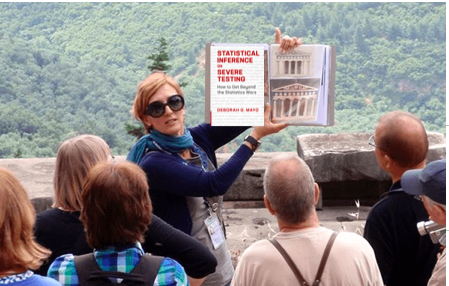
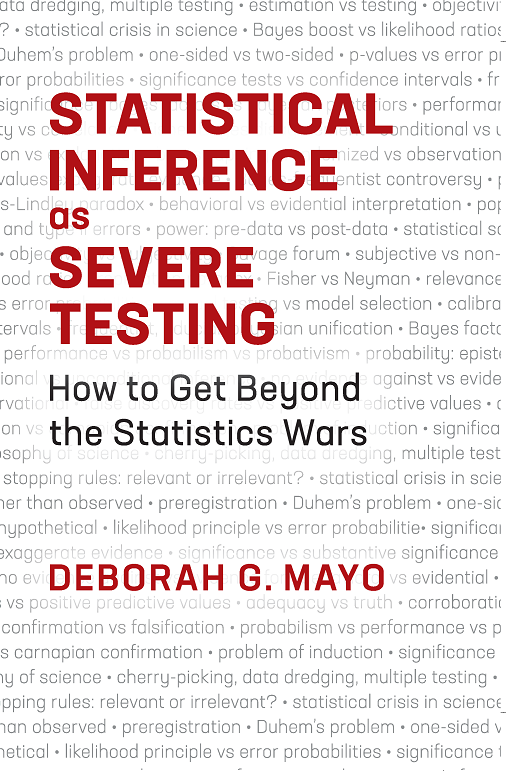
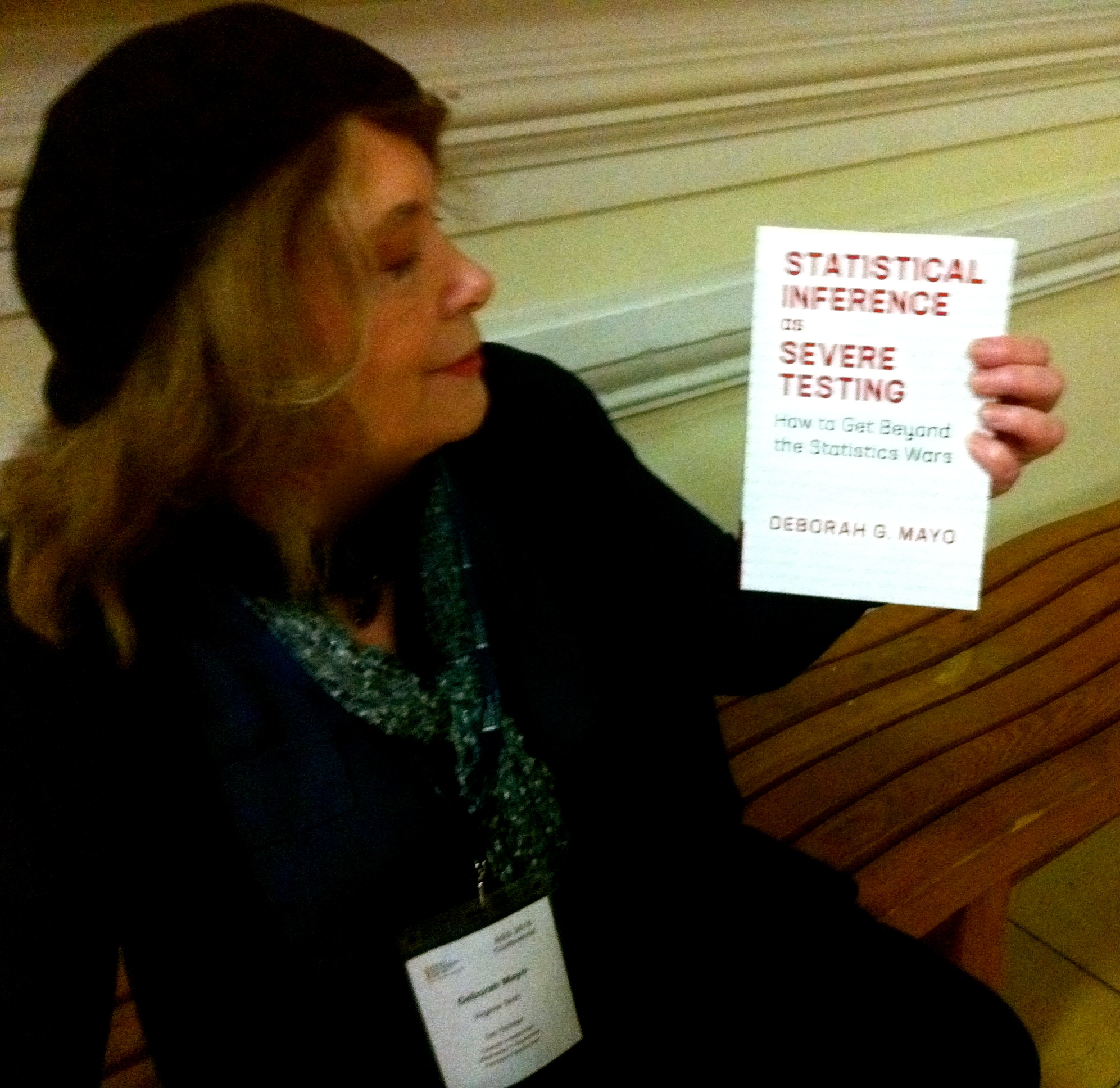
I will continue to post mementos and, at times, short excerpts following the pace of one “Tour” a week, in sync with some book clubs reading Statistical Inference as Severe Testing: How to Get Beyond the Statistics Wars (SIST or Statinfast 2018, CUP), e.g., Lakens. This puts us at Excursion 2 Tour I, but first, here’s a quick Souvenir (Souvenir C) from Excursion 1 Tour II:

Souvenir C: A Severe Tester’s Translation Guide

Just as in ordinary museum shops, our souvenir literature often probes treasures that you didn’t get to visit at all. Here’s an example of that, and you’ll need it going forward. There’s a confusion about what’s being done when the significance tester considers the set of all of the outcomes leading to a d(x) greater than or equal to 1.96, i.e., {x: d(x) ≥ 1.96}, or just d(x) ≥ 1.96. This is generally viewed as throwing away the particular x, and lumping all these outcomes together. What’s really happening, according to the severe tester, is quite different. What’s actually being signified is that we are interested in the method, not just the particular outcome. Those who embrace the LP make it very plain that data-dependent selections and stopping rules drop out. To get them to drop in, we signal an interest in what the test procedure would have yielded. This is a counterfactual and is altogether essential in expressing the properties of the method, in particular, the probability it would have yielded some nominally significant outcome or other. Continue reading
Categories: Statistical Inference as Severe Testing | 8 Comments

The Replication Crises and its Constructive Role in the Philosophy of Statistics-PSA2018

Below are my slides from a session on replication at the recent Philosophy of Science Association meetings in Seattle.


Categories: Error Statistics | Leave a comment

Tour Guide Mementos (Excursion 1 Tour II of How to Get Beyond the Statistics Wars)

Stat Museum

Excursion 1 Tour II: Error Probing Tools vs. Logics of Evidence 

Blurb. Core battles revolve around the relevance of a method’s error probabilities. What’s distinctive about the severe testing account is that it uses error probabilities evidentially: to assess how severely a claim has passed a test. Error control is necessary but not sufficient for severity. Logics of induction focus on the relationships between given data and hypotheses–so outcomes other than the one observed drop out. This is captured in the Likelihood Principle (LP). Tour II takes us to the crux of central wars in relation to the Law of Likelihood (LL) and Bayesian probabilism. (1.4) Hypotheses deliberately designed to accord with the data can result in minimal severity. The likelihoodist wishes to oust them via degrees of belief captured in prior probabilities. To the severe tester, such gambits directly alter the evidence by leading to inseverity. (1.5) Stopping rules: If a tester tries and tries again until significance is reached–optional stopping–significance will be attained erroneously with high probability. According to the LP, the stopping rule doesn’t alter evidence. The irrelevance of optional stopping is an asset for holders of the LP, it’s the opposite for a severe tester. The warring sides talk past each other. Continue reading

Categories: SIST, Statistical Inference as Severe Testing | 1 Comment

A small amendment to Nuzzo’s tips for communicating p-values

.

I’ve been asked if I agree with Regina Nuzzo’s recent note on p-values [i]. I don’t want to be nit-picky, but one very small addition to Nuzzo’s helpful tips for communicating statistical significance can make it a great deal more helpful. Here’s my friendly amendment. She writes: Continue reading

Categories: P-values, science communication | 2 Comments

severe testing or severe sabotage? Christian Robert and the book slasher.

severe testing or severe sabotage? [not a book review]


I came across this anomaly on Christian Robert’s blog

Last week, I received this new book of Deborah Mayo, which I was looking forward reading and annotating!, but thrice alas, the book had been sabotaged: except for the preface and acknowledgements, the entire book is printed upside down [a minor issue since the entire book is concerned] and with some part of the text cut on each side [a few letters each time but enough to make reading a chore!]. I am thus waiting for a tested copy of the book to start reading it in earnest!

How bizarre, my book has been slashed with a knife, cruelly stabbing the page,letting words bleed out helter skelter. Some part of the text cut on each side? It wasn’t words with “Bayesian” in them was it? The only anomalous volume I’ve seen has a slightly crooked cover. Do you think it is the Book Slasher out for Halloween, or something more sinister? It’s a bit like serving the Michelin restaurant reviewer by dropping his meal on the floor, or accidentally causing a knife wound. I hope they remedy this quickly. (Talk about Neyman and quality control).

Readers: Feel free to use the comments to share you particular tale of woe in acquiring the book.

Categories: Statistical Inference as Severe Testing | 5 Comments

Tour Guide Mementos (Excursion 1, Tour I of How to Get Beyond the Statistics Wars)

.

Tour guides in your travels jot down Mementos and Keepsakes from each Tour[i] of my new book: Statistical Inference as Severe Testing: How to Get Beyond the Statistics Wars (CUP 2018). Their scribblings, which may at times include details, at other times just a word or two, may be modified through the Tour, and in response to questions from travelers (so please check back). Since these are just mementos, they should not be seen as replacements for the more careful notions given in the journey (i.e., book) itself. Still, you’re apt to flesh out your notes in greater detail, so please share yours (along with errors you’re bound to spot), and we’ll create Meta-Mementos. Continue reading

Categories: Error Statistics, Statistical Inference as Severe Testing | 8 Comments

Philosophy of Statistics & the Replication Crisis in Science: A philosophical intro to my book (slides)

a road through the jungle

In my talk yesterday at the Philosophy Department at Virginia Tech, I introduced my new book: Statistical Inference as Severe Testing: How to Get Beyond the Statistics Wars (Cambridge 2018). I began with my preface (explaining the meaning of my title), and turned to the Statistics Wars, largely from Excursion 1 of the book. After the sum-up at the end, I snuck in an example from the replication crisis in psychology. Here are the slides.


Categories: Error Statistics | Leave a comment

Excursion 2 Tour II (3rd stop): Falsification, Pseudoscience, Induction (2.3)

StatSci/PhilSci Museum

Where you are in the Journey*  We’ll move from the philosophical ground floor to connecting themes from other levels, from Popperian falsification to significance tests, and from Popper’s demarcation to current-day problems of pseudoscience and irreplication. An excerpt from our Museum Guide gives a broad-brush sketch of the first few sections of Tour II:

Karl Popper had a brilliant way to “solve” the problem of induction: Hume was right that enumerative induction is unjustified, but science is a matter of deductive falsification. Science was to be demarcated from pseudoscience according to whether its theories were testable and falsifiable. A hypothesis is deemed severely tested if it survives a stringent attempt to falsify it. Popper’s critics denied he could sustain this and still be a deductivist …

Popperian falsification is often seen as akin to Fisher’s view that “every experiment may be said to exist only in order to give the facts a chance of disproving the null hypothesis” (1935a, p. 16). Though scientists often appeal to Popper, some critics of significance tests argue that they are used in decidedly non-Popperian ways. Tour II explores this controversy.

While Popper didn’t make good on his most winning slogans, he gives us many seminal launching-off points for improved accounts of falsification, corroboration, science versus pseudoscience, and the role of novel evidence and predesignation. These will let you revisit some thorny issues in today’s statistical crisis in science. Continue reading

Categories: Statistical Inference as Severe Testing | 11 Comments

“It should never be true, though it is still often said, that the conclusions are no more accurate than the data on which they are based”

.

My new book, Statistical Inference as Severe Testing: How to Get Beyond the Statistics Wars,” you might have discovered, includes Souvenirs throughout (A-Z). But there are some highlights within sections that might be missed in the excerpts I’m posting. One such “keepsake” is a quote from Fisher at the very end of Section 2.1

These are some of the first clues we’ll be collecting on a wide difference between statistical inference as a deductive logic of probability, and an inductive testing account sought by the error statistician. When it comes to inductive learning, we want our inferences to go beyond the data: we want lift-off. To my knowledge, Fisher is the only other writer on statistical inference, aside from Peirce, to emphasize this distinction.

In deductive reasoning all knowledge obtainable is already latent in the postulates. Rigour is needed to prevent the successive inferences growing less and less accurate as we proceed. The conclusions are never more accurate than the data. In inductive reasoning we are performing part of the process by which new knowledge is created. The conclusions normally grow more and more accurate as more data are included. It should never be true, though it is still often said, that the conclusions are no more accurate than the data on which they are based. (Fisher 1935b, p. 54)

How do you understand this remark of Fisher’s? (Please share your thoughts in the comments.) My interpretation, and its relation to the “lift-off” needed to warrant inductive inferences, is discussed in an earlier section, 1.2, posted here.   Here’s part of that. 

Continue reading

Categories: induction, keepsakes from Stat Wars, Statistical Inference as Severe Testing | 7 Comments

Excursion 2: Taboos of Induction and Falsification: Tour I (first stop)

StatSci/PhilSci Museum

Where you are in the Journey* 

Cox: [I]n some fields foundations do not seem very important, but we both think that foundations of statistical inference are important; why do you think that is?

Mayo: I think because they ask about fundamental questions of evidence, inference, and probability … we invariably cross into philosophical questions about empirical knowledge and inductive inference. (Cox and Mayo 2011, p. 103)

Contemporary philosophy of science presents us with some taboos: Thou shalt not try to find solutions to problems of induction, falsification, and demarcating science from pseudoscience. It’s impossible to understand rival statistical accounts, let alone get beyond the statistics wars, without first exploring how these came to be “lost causes.” I am not talking of ancient history here: these problems were alive and well when I set out to do philosophy in the 1980s. I think we gave up on them too easily, and by the end of Excursion 2 you’ll see why. Excursion 2 takes us into the land of “Statistical Science and Philosophy of Science” (StatSci/PhilSci). Our Museum Guide gives a terse thumbnail sketch of Tour I. Here’s a useful excerpt:

Once the Problem of Induction was deemed to admit of no satisfactory, non-circular solutions (~1970s), philosophers of science turned to building formal logics of induction using the deductive calculus of probabilities, often called Confirmation Logics or Theories. A leader of this Confirmation Theory movement was Rudolf Carnap. A distinct program, led by Karl Popper, denies there is a logic of induction, and focuses on Testing and Falsification of theories by data. At best a theory may be accepted or corroborated if it fails to be falsified by a severe test. The two programs have analogues to distinct methodologies in statistics: Confirmation theory is to Bayesianism as Testing and Falsification are to Fisher and Neyman–Pearson.

.

Continue reading

Categories: induction, Statistical Inference as Severe Testing | 2 Comments

All She Wrote (so far): Error Statistics Philosophy: 7 years on

Error Statistics Philosophy: Blog Contents (7 years) [i]
By: D. G. Mayo

Dear Reader: I began this blog 7 years ago (Sept. 3, 2011)! A big celebration is taking place at the Elbar Room this evening, both for the blog and the appearance of my new book: Statistical Inference as Severe Testing: How to Get Beyond the Statistics Wars (CUP). While a special rush edition made an appearance on Sept 3, in time for the RSS meeting in Cardiff, it was decided to hold off on the festivities until copies of the book were officially available (yesterday)! If you’re in the neighborhood, stop by for some Elba Grease

.

Many of the discussions in the book were importantly influenced (corrected and improved) by reader’s comments on the blog over the years. I thank readers for their input. Please peruse the offerings below, taking advantage of the discussions by guest posters and readers! I posted the first 3 sections of Tour I (in Excursion i) here, here, and here.
This blog will return to life, although I’m not yet sure of exactly what form it will take. Ideas are welcome. The tone of a book differs from a blog, so we’ll have to see what voice emerges here.

Sincerely,

D. Mayo Continue reading

Categories: 3-year memory lane, 4 years ago!, blog contents, Metablog | 2 Comments

Excursion 1 Tour I (3rd stop): The Current State of Play in Statistical Foundations: A View From a Hot-Air Balloon (1.3)

.

How can a discipline, central to science and to critical thinking, have two methodologies, two logics, two approaches that frequently give substantively different answers to the same problems? … Is complacency in the face of contradiction acceptable for a central discipline of science? (Donald Fraser 2011, p. 329)

We [statisticians] are not blameless … we have not made a concerted professional effort to provide the scientific world with a unified testing methodology. (J. Berger 2003, p. 4)

From the aerial perspective of a hot-air balloon, we may see contemporary statistics as a place of happy multiplicity: the wealth of computational ability allows for the application of countless methods, with little handwringing about foundations. Doesn’t this show we may have reached “the end of statistical foundations”? One might have thought so. Yet, descending close to a marshy wetland, and especially scratching a bit below the surface, reveals unease on all sides. The false dilemma between probabilism and long-run performance lets us get a handle on it. In fact, the Bayesian versus frequentist dispute arises as a dispute between probabilism and performance. This gets to my second reason for why the time is right to jump back into these debates: the “statistics wars” present new twists and turns. Rival tribes are more likely to live closer and in mixed neighborhoods since around the turn of the century. Yet, to the beginning student, it can appear as a jungle.

Statistics Debates: Bayesian versus Frequentist

These days there is less distance between Bayesians and frequentists, especially with the rise of objective [default] Bayesianism, and we may even be heading toward a coalition government. (Efron 2013, p. 145)

Continue reading

Categories: Statistical Inference as Severe Testing | 1 Comment

Excursion 1 Tour I (2nd stop): Probabilism, Performance, and Probativeness (1.2)

1.2

I shall be concerned with the foundations of the subject. But in case it should be thought that this means I am not here strongly concerned with practical applications, let me say right away that confusion about the foundations of the subject is responsible, in my opinion, for much of the misuse of the statistics that one meets in fields of application such as medicine, psychology, sociology, economics, and so forth. (George Barnard 1985, p. 2)

While statistical science (as with other sciences) generally goes about its business without attending to its own foundations, implicit in every statistical methodology are core ideas that direct its principles, methods, and interpretations. I will call this its statistical philosophy. To tell what’s true about statistical inference, understanding the associated philosophy (or philosophies) is essential. Discussions of statistical foundations tend to focus on how to interpret probability, and much less on the overarching question of how probability ought to be used in inference. Assumptions about the latter lurk implicitly behind debates, but rarely get the limelight. If we put the spotlight on them, we see that there are two main philosophies about the roles of probability in statistical inference: We may dub them performance (in the long run) and probabilism. Continue reading

Categories: Statistical Inference as Severe Testing | 3 Comments

Excursion 1 Tour I: Beyond Probabilism and Performance: Severity Requirement (1.1)

The cruise begins…

I’m talking about a specific, extra type of integrity that is [beyond] not lying, but bending over backwards to show how you’re maybe wrong, that you ought to have when acting as a scientist. (Feynman 1974/1985, p. 387)

It is easy to lie with statistics. Or so the cliché goes. It is also very difficult to uncover these lies without statistical methods – at least of the right kind. Self- correcting statistical methods are needed, and, with minimal technical fanfare, that’s what I aim to illuminate. Since Darrell Huff wrote How to Lie with Statistics in 1954, ways of lying with statistics are so well worn as to have emerged in reverberating slogans:

  • Association is not causation.
  • Statistical significance is not substantive significamce
  • No evidence of risk is not evidence of no risk.
  • If you torture the data enough, they will confess.

Exposés of fallacies and foibles ranging from professional manuals and task forces to more popularized debunking treatises are legion. New evidence has piled up showing lack of replication and all manner of selection and publication biases. Even expanded “evidence-based” practices, whose very rationale is to emulate experimental controls, are not immune from allegations of illicit cherry picking, significance seeking, P-hacking, and assorted modes of extra- ordinary rendition of data. Attempts to restore credibility have gone far beyond the cottage industries of just a few years ago, to entirely new research programs: statistical fraud-busting, statistical forensics, technical activism, and widespread reproducibility studies. There are proposed methodological reforms – many are generally welcome (preregistration of experiments, transparency about data collection, discouraging mechanical uses of statistics), some are quite radical. If we are to appraise these evidence policy reforms, a much better grasp of some central statistical problems is needed.

Continue reading

Categories: Statistical Inference as Severe Testing, Statistics | 9 Comments

The Physical Reality of My New Book! Here at the RSS Meeting

.

Categories: SIST | 3 Comments

RSS 2018 – Significance Tests: Rethinking the Controversy

.

Day 2, Wednesday 05/09/2018:

The 2018 Meeting of the Royal Statistical Society (Cardiff)

11:20 – 13:20

Keynote 4 – Significance Tests: Rethinking the Controversy Assembly Room

Speakers:
Sir David Cox, Nuffield College, Oxford
Deborah Mayo, Virginia Tech
Richard Morey, Cardiff University
Aris Spanos, Virginia Tech

Intermingled in today’s statistical controversies are some long-standing, but unresolved, disagreements on the nature and principles of statistical methods and the roles for probability in statistical inference and modelling. In reaction to the so-called “replication crisis” in the sciences, some reformers suggest significance tests as a major culprit. To understand the ramifications of the proposed reforms, there is a pressing need for a deeper understanding of the source of the problems in the sciences and a balanced critique of the alternative methods being proposed to supplant significance tests. In this session speakers offer perspectives on significance tests from statistical science, econometrics, experimental psychology and philosophy of science. There will be also be panel discussion.

Cox

Mayo

Morey

Spanos

Categories: Error Statistics | 2 Comments

3 YEARS AGO (AUGUST 2015): MEMORY LANE

3 years ago...

3 years ago…

MONTHLY MEMORY LANE: 3 years ago: August 2015. I mark in red 3-4 posts that seem most apt for general background on key issues in this blog, excluding those reblogged recently[1], and in green up to 3 others of relevance to philosophy of statistics [2]. Posts that are part of a “unit” or a group count as one.

August 2015

  • 08/05 Neyman: Distinguishing tests of statistical hypotheses and tests of significance might have been a lapse of someone’s pen
  • 08/08  Statistical Theater of the Absurd: “Stat on a Hot Tin Roof”
  • 08/11 A. Spanos: Egon Pearson’s Neglected Contributions to Statistics (recently reblogged)
  • 08/14 Performance or Probativeness? E.S. Pearson’s Statistical Philosophy
  • 08/15  Severity in a Likelihood Text by Charles Rohde
  • 08/19 Statistics, the Spooky Science
  • 08/20 How to avoid making mountains out of molehills, using power/severity
  • 08/24 3 YEARS AGO (AUGUST 2012): MEMORY LANE
  • 08/31 The Paradox of Replication, and the vindication of the P-value (but she can go deeper) 9/2/15 update (ii)

[1] Monthly memory lanes began at the blog’s 3-year anniversary in Sept, 2014.

[2] New Rule, July 30, 2016, March 30,2017 -a very convenient way to allow data-dependent choices (note why it’s legit in selecting blog posts, on severity grounds).


Save

Save

Save

Save

Save

Save

Save

Save

Save

Save

Categories: 3-year memory lane | Leave a comment

A. Spanos: Egon Pearson’s Neglected Contributions to Statistics

Continuing with the discussion of E.S. Pearson in honor of his birthday:

Egon Pearson’s Neglected Contributions to Statistics

by Aris Spanos

    Egon Pearson (11 August 1895 – 12 June 1980), is widely known today for his contribution in recasting of Fisher’s significance testing into the Neyman-Pearson (1933) theory of hypothesis testing. Occasionally, he is also credited with contributions in promoting statistical methods in industry and in the history of modern statistics; see Bartlett (1981). What is rarely mentioned is Egon’s early pioneering work on:

(i) specification: the need to state explicitly the inductive premises of one’s inferences,

(ii) robustness: evaluating the ‘sensitivity’ of inferential procedures to departures from the Normality assumption, as well as

(iii) Mis-Specification (M-S) testing: probing for potential departures from the Normality  assumption.

Arguably, modern frequentist inference began with the development of various finite sample inference procedures, initially by William Gosset (1908) [of the Student’s t fame] and then Fisher (1915, 1921, 1922a-b). These inference procedures revolved around a particular statistical model, known today as the simple Normal model: Continue reading

Categories: E.S. Pearson, Egon Pearson, Statistics | 1 Comment

Egon Pearson’s Heresy

E.S. Pearson: 11 Aug 1895-12 June 1980.

Today is Egon Pearson’s birthday. In honor of his birthday, I am posting “Statistical Concepts in Their Relation to Reality” (Pearson 1955). I’ve posted it several times over the years, but always find a new gem or two, despite its being so short. E. Pearson rejected some of the familiar tenets that have come to be associated with Neyman and Pearson (N-P) statistical tests, notably the idea that the essential justification for tests resides in a long-run control of rates of erroneous interpretations–what he termed the “behavioral” rationale of tests. In an unpublished letter E. Pearson wrote to Birnbaum (1974), he talks about N-P theory admitting of two interpretations: behavioral and evidential:

“I think you will pick up here and there in my own papers signs of evidentiality, and you can say now that we or I should have stated clearly the difference between the behavioral and evidential interpretations. Certainly we have suffered since in the way the people have concentrated (to an absurd extent often) on behavioral interpretations”.

Continue reading

Categories: phil/history of stat, Philosophy of Statistics, Statistics | Tags: , , | 2 Comments

Blog at WordPress.com.