Mayo: (first 2 sections) “StatSci and PhilSci: part 2”

Here are the first two sections of my new paper: “Statistical Science Meets Philosophy of Science Part 2: Shallow versus Deep Explorations” SS & POS 2. (Alternatively, go to the RMM page and scroll down to the Sept 26, 2012 entry.)

1. Comedy Hour at the Bayesian Retreat[i]

 Overheard at the comedy hour at the Bayesian retreat: Did you hear the one about the frequentist…

 “who defended the reliability of his radiation reading, despite using a broken radiometer, on the grounds that most of the time he uses one that works, so on average he’s pretty reliable?”

or

 “who claimed that observing ‘heads’ on a biased coin that lands heads with probability .05 is evidence of a statistically significant improvement over the standard treatment of diabetes, on the grounds that such an event occurs with low probability (.05)?”

Such jests may work for an after-dinner laugh, but if it turns out that, despite being retreads of ‘straw-men’ fallacies, they form the basis of why some statisticians and philosophers reject frequentist methods, then they are not such a laughing matter. But surely the drubbing of frequentist methods could not be based on a collection of howlers, could it? I invite the reader to stay and find out. Continue reading

Categories: Error Statistics, Philosophy of Statistics, Severity | 2 Comments

Query

I was reviewing blog comments and various links people have sent me. I have noticed a kind of comment often arises about a type of (subjective?) Bayesian who does not assign probabilities to a general hypothesis H but only to observable events. In this way, it is claimed, one can avoid various criticisms but retain the Bayesian position, label it (A):

(A) the warrant accorded to an uncertain claim is in terms of probability assignments (to events).

But what happens when H’s predictions are repeatedly and impressively born out in a variety of experiments? Either one can say nothing about the warrant for H (having assumed A), or else one seeks a warrant for H other than a probability assignment to  H*.

Take the former. In that case what good is it to have passed many of H’s predictions? We cannot say we have grounds to accept H in some non-probabilistic sense (since that’s been ruled out by (A)). We also cannot say that the impressive successes in the past warrant predicting that future successes are probable because events do not warrant other events. It is only through some general claim or statistical hypothesis that we may deduce predicted probabilities of events. Continue reading

Categories: Philosophy of Statistics, Statistics | 50 Comments

RMM-8: New Mayo paper: “StatSci and PhilSci: part 2 (Shallow vs Deep Explorations)”

A new article of mine,  “Statistical Science and Philosophy of Science Part 2: Shallow versus Deep Explorations” has been published in the on-line journal, Rationality, Markets, and Morals (Special Topic: Statistical Science and Philosophy of Science: Where Do/Should They Meet?”).

The contributions to this special volume began with the conference we ran in June 2010. (See web poster.)   My first article in this collection was essentially just my introduction to the volume, whereas this new one discusses my work. If you are a reader of this blog, you will recognize portions from early posts, as I’d been revising it then.

The sections are listed below. I will be posting portions in the next few days. We invite comments for this blog, and for possible publication in this special volume of RMM, if received before the end of this year.

This is the 8th RMM announcement. Many thanks to Sailor for digging up the previous 7, and listing them at the end*. (The paper’s title stemmed from the Deepwater Horizon oil spill of spring 2010**).

Abstract:

Inability to clearly defend against the criticisms of frequentist methods has turned many a frequentist away from venturing into foundational battlegrounds. Conceding the distorted perspectives drawn from overly literal and radical expositions of what Fisher, Neyman, and Pearson ‘really thought’, some deny they matter to current practice. The goal of this paper is not merely to call attention to the howlers that pass as legitimate criticisms of frequentist error statistics, but also to sketch the main lines of an alternative statistical philosophy within which to better articulate the roles and value of frequentist tools.

Statistical Science Meets Philosophy of Science Part 2:
Shallow versus Deep Explorations

 1. Comedy Hour at the Bayesian Retreat

2. Popperians Are to Frequentists as Carnapians Are to Bayesians
2.1 Severe Tests
2.2 Another Egregious Violation of the Severity Requirement
2.3 The Rationale for Severity is to Find Things Out Reliably
2.4 What Can Be Learned from Popper; What Can Popperians Be Taught?

3. Frequentist Error-Statistical Tests
3.1 Probability in Statistical Models of Experiments
3.2 Statistical Test Ingredients
3.3. Hypotheses and Events
3.4. Hypotheses Inferred Need Not Be Predesignated Continue reading

Categories: Philosophy of Statistics, Statistics | Tags: , | Leave a comment

New Kvetch: race-based academics in Fla

See Rejected Posts.

Categories: Rejected Posts | 1 Comment

Mayo Responds to U-Phils on Background Information

Thanks to Emrah Aktunc and Christian Hennig for their U-Phils on my September 12 post: “How should ‘prior information’ enter in statistical inference?” and my subsequent deconstruction of Gelman[i] (starting here, and ending with part 3).  I’ll begin with some remarks on Emrah Aktunc’s contribution.

First, we need to avoid an ambiguity that clouds prior information and prior probability. In a given experiment, prior information may be stronger than the data: to take but one example, say that we’ve already falsified Newton’s theory of gravity in several domains, but in our experiment the data (e.g., one of the sets of eclipse data from 1919) accords with the Newtonian prediction (of half the amount of deflection as that predicted by Einstein’s general theory of relativity [GTR]). The pro-Newton data, in and of itself, would be rejected because of all that we already know. Continue reading

Categories: Background knowledge, Error Statistics, Philosophy of Statistics, Statistics, U-Phil | Tags: , , | 4 Comments

U-Phils: Hennig and Aktunc on Gelman 2012

I am posting two U-Phils I received in relation to the 9/12 call call on Andrew Gelman’s (2012): “Ethics and the statistical use of prior information”

A Deconstruction of Gelman by Mayo in 3 parts:
(10/5/12) Part 1: “A Bayesian wants everybody else to be a non-Bayesian”
(10/7/12) Part 2: Using prior Information
(10/9/12) Part 3: beauty and the background knowledge

Comments on “How should prior information enter in statistical inference”

Christian Hennig 
Department of Statistical Science
University College London

Reading the blog entries on this topic, the Cox-Mayo Conversation and the linked paper by Gelman, I appreciate the valuable thoughts in both, which to me all make sense, specifying situations where prior information is rather not desired to enter, or rather in the Bayesian way.

Thinking more about the issue, however, I find both the frequentist and the Bayesian approach seriously wanting in this respect (and I don’t have a better one myself either).

A difference between the approaches seems to be that Cox/Mayo rather look at the analysis of data in an isolated situation whereas Gelman rather writes about conclusions from not only analysing a particular data set, but from aggregating all the information available.

Cox/Mayo do not advocate to ignore prior knowledge, but they prefer to keep it out of the process of actually analysing the data. Mayo talks of a piecemeal approach in which results from different data analyses can be put together in order to get an overall picture. Continue reading

Categories: Background knowledge, Error Statistics, Philosophy of Statistics, Statistics, Testing Assumptions, U-Phil | 11 Comments

Last part (3) of the deconstruction: beauty and background knowledge

Please see parts 1 and 2 and links therein. The background began in my Sept 12 post.

Gelman (2012) considers a case where the overall available evidence, E, is at odds with the indication of the results x from a given study:

Consider the notorious study in which a random sample of a few thousand people was analyzed, and it was found that the most beautiful parents were 8 percentage points more likely to have girls, compared to less attractive parents. The result was statistically significant (p<.05) and published in a reputable journal. But in this case we have good prior information suggesting that the difference in sex ratios in the population, comparing beautiful to less-beautiful parents, is less than 1 percentage point. A (non-Bayesian) design analysis reveals that, with this level of true difference, any statistically-significant observed difference in the sample is likely to be noise. At this point, you might well say that the original analysis should never have been done at all—but, given that it has been done, it is essential to use prior information (even if not in any formal Bayesian way) to interpret the data and generalize from sample to population.

Where did Fisher’s principle go wrong here? The answer is simple—and I think Cox would agree with me here. We’re in a setting where the prior information is much stronger than the data. (p. 3)

Let me simply grant Gelman that this prior information warrants (with severity) the hypothesis H:

H: “difference in sex ratios in the population, comparing beautiful to less-beautiful parents, is less than 1 percentage point,” (ibid.)

especially given my suspicions of the well-testedness of claims to show the effects of “beautiful to less-beautiful” on anything. I will simply take it as a given that it is well-tested background “knowledge.” Presumably, the well-tested claim goes beyond those individuals observed, and is generalizing at least to some degree. So we are given that the hypothesis H is one for which there is strong evidence. Continue reading

Categories: Background knowledge, Error Statistics, Philosophy of Statistics, Statistics, U-Phil | 14 Comments

Deconstructing Gelman part 2: Using prior Information

(Please see part 1 for links and references):

A Bayesian, Gelman tells us, “wants everybody else to be a non-Bayesian” (p. 5). Despite appearances, the claim need not be seen as self-contradictory, at least if we interpret it most generously, as Rule #2 (of this blog) directs. Whether or not “a Bayesian” refers to all Bayesians or only non-standard Bayesians (i.e., those wearing a hat of which Gelman approves), his meaning might be simply that when setting out with his own inquiry, he doesn’t want your favorite priors (be that beliefs or formally derived constructs) getting in the way. A Bayesian, says Gelman (in this article) is going to make inferences based on “trying to extract information from the data” in order to determine what to infer or believe (substitute your preferred form of output) about some aspect of a population (or mechanism) generating the data, as modeled. He just doesn’t want the “information from the data” muddied by your particular background knowledge. He would only have to subtract out all of this “funny business” to get at your likelihoods. He would only have to “divide away” your prior distributions before getting to his own analysis (p. 5). As in Gelman’s trial analogy (p. 5.), he prefers to combine your “raw data,” and your likelihoods, with his own well-considered background information. We can leave open whether he will compute posteriors (at least in the manner he recommends here) or not (as suggested in other work). So perhaps we have arrived at a sensible deconstruction of Gelman, free of contradiction. Whether or not this leaves texts open to some charge of disingenuity, I leave entirely to one side.

Now at this point I wonder: do Bayesian reports provide the ingredients for such “dividing away”?  I take it that they’d report the priors, which could be subtracted out, but how is the rest of the background knowledge communicated and used? It would seem to include assorted background knowledge of instruments, of claims that had been sufficiently well corroborated to count as knowledge, of information about that which was not previously well tested, of flaws and biases and threats of error to take into account in future designs, etc. (as in our ESP examples 9/22 and 9/25). The evidence for any background assumptions should also be made explicit and communicated (unless it consists of trivial common knowledge). Continue reading

Categories: Background knowledge, Error Statistics, Philosophy of Statistics, Statistics | 12 Comments

Deconstructing Gelman, Part 1: “A Bayesian wants everybody else to be a non-Bayesian.”

I was to have philosophically deconstructed a few paragraphs from (the last couple of sections) in a column Andrew Gelman sent me on “Ethics and the statistical use of prior information”[i]. The discussion begins with my Sept 12 post, and follows through several posts over the second half of September (see [ii]), all by way of background. But I got called away before finishing the promised deconstruction, and it was only this evening that I tried to wade through a circuitous swamp of remarks. I will just post the first part (of 2 or perhaps 3?), which is already too long.

Since I have a tendency to read articles from back to front, on a first read at least, let me begin with his last section titled:  “A Bayesian wants everybody else to be a non-Bayesian.”  Surely that calls for philosophical deconstruction, if anything does. It seems at the very least an exceptional view. Whether it’s widely held I can’t say (please advise). But suppose it’s true: Bayesians are publicly calling on everybody to use Bayesian methods, even though, deep down, they really, really hope everybody else won’t blend everything together before they can use the valid parts from the data—and they really, really hope that everybody else will provide the full panoply of information about what happened in other experiments, and what background theories are well corroborated, and about the precision of the instruments relied upon, and about other experiments that appear to conflict with the current one and with each other, etc., etc. Suppose that Bayesians actually would prefer, and are relieved to find, that, despite their exhortations, “everybody else” doesn’t report their posterior probabilities (whichever version of Bayesianism they are using) because then they can introduce their own background and figure out what is and is not warranted (in whatever sense seems appropriate).

At first glance, I am tempted to say that I don’t think Gelman really believes this statement himself if it were taken literally. Since he calls himself a Bayesian, at least of a special sort, then if he is wearing his Bayesian hat when he advocates others be non-Bayesian, then the practice of advocating others be non-Bayesian would itself be a Bayesian practice (not a non-Bayesian practice). But we philosophers know the danger of suggesting that authors under our scrutiny do not mean what they say—we may be missing their meaning and interpreting their words in a manner that is implausible. Though we may think, through our flawed interpretation, that they cannot possibly mean what they say, what we have done is substitute a straw view for the actual view (the straw man fallacy). (Note: You won’t get that I am mirroring Gelman unless you look at the article that began this deconstruction here.) Rule #2 of this blog[iii] is to interpret any given position in the most generous way possible; to do otherwise is to weaken our critical evaluation of it. This requires that we try to imagine a plausible reading, taking into account valid background information (e.g., other writings) that might bolster plausibility. This, at any rate, is what we teach our students in philosophy. So to begin with, what does Gelman actually say in the passage (in Section 4)?

“Bayesian inference proceeds by taking the likelihoods from different data sources and then combining them with a prior distribution (or, more generally, a hierarchical model). The likelihood is key. . . . No funny stuff, no posterior distributions, just the likelihood. . . . I don’t want everybody coming to me with their posterior distribution—I’d just have to divide away their prior distributions before getting to my own analysis. Sort of like a trial, where the judge wants to hear what everybody saw—not their individual inferences, but their raw data.” (p.5)

So if this is what he means by being a non-Bayesian, then his assertion that “a Bayesian wants everybody else to be a non-Bayesian” seems to mean that Bayesians want others to basically report their likelihoods. But again, if Gelman is wearing his Bayesian hat when he advocates others not wear theirs, i.e., be non-Bayesian, then his advising that everybody else not be Bayesian (in the sense of not combining priors and likelihoods), is itself a Bayesian practice (not a non-Bayesian practice). So either Gelman is not wearing his Bayesian hat when he recommends this, or his claim is self-contradictory—and I certainly do not want to attribute an inconsistent position to him. Moreover, I am quite certain that he would not advance any such inconsistent position.

Now, I do have some background knowledge. To ignore it is to fail to supply the most generous interpretation. Our background information—that is, Gelman’s (2011) RMM paper [iv]—tells me that he rejects the classic inductive philosophy that he has (correctly) associated with the definition of Bayesianism found on Wikipedia:

“Our key departure from the mainstream Bayesian view (as expressed, for example, [in Wikipedia]) is that we do not attempt to assign posterior probabilities to models or to select or average over them using posterior probabilities. Instead, we use predictive checks to compare models to data and use the information thus learned about anomalies to motivate model improvements” (p. 71).

So now Gelman’s assertion that “a Bayesian wants everybody else to be a non-Bayesian” makes sense and is not self-contradictory. Bayesian, in the term non-Bayesian, would mean something like a standard inductive Bayesian (where priors can be subjective or non-subjective). Gelman’s non-standard Bayesian wants everybody else not to be standard inductive Bayesians, but rather, something more akin to a likelihoodist. (I don’t know whether he wants only the likelihoods rather than the full panoply of background information, but I will return to this.) If Gelman’s Bayesian is not going to assign posterior probabilities to models, or select or average over them using posterior probabilities, then it’s pretty clear he will not find it useful to hear a report of your posterior probabilities. To allude to his trial analogy, the judge surely doesn’t want to hear your posterior probability in Ralph’s guilt, if he doesn’t even think it’s the proper way of couching inferences. Perhaps the judge finds it essential to know whether mistaken judgments of the pieces of evidence surrounding Ralph’s guilt have been well or poorly ruled out.That would be to require an error probabilistic assessment.

But a question might be raised: By “a Bayesian,” doesn’t Gelman clearly mean Bayesians in general, and not just one? And if he means all Bayesians, it would be wrong to think, as I have, that he was alluding to non-standard Bayesians (i.e., those wearing a hat of which Gelman approves). But there is no reason to suppose he means all Bayesians rather than all Bayesians who reject standard, Wiki-style Bayesianism, but instead favor something closer to the view in Gelman 2011, among other places.

Having gotten this far, however, I worry about using the view in Gelman 2011 to deconstruct the passages in the current article, in which, speaking of a Bayesian combining prior distributions and likelihoods, Gelman sounds more like a standard Bayesian. It would not help that he may be alluding to Bayesians in general for purposes of the article, because it is in this article that we find the claim: “A Bayesian wants everybody else to be a non-Bayesian.” So despite my attempts to sensibly deconstruct him, it appears that we are back to the initial problem, in which his claim that a Bayesian wants everybody else to be a non-Bayesian looks self-contradictory or at best disingenuous—and this in a column on ethics in statistics!

But we are not necessarily led to that conclusion!  Stay tuned for part 2, and part 3…..

(On how to do a philosophical analysis see here.)

[i]Gelman, A. “Ethics and the statistical use of prior information”

[ii] The main posts, following the first one, were:

More on using background info (9/15/12)
Statistics and ESP research (Diaconis) (9/22/12)
Insevere tests and pseudoscience (9/25/12)
Levels of inquiry (9/26/12)

[iii] This the Philosopher’s rule of “generous interpretation”, first introduced in this post.

[iv] Gelman, A. (2011).  “Induction and Deduction in Bayesian Data Analysis“, Rationality,  Markets, and Morals (RMM) 2, 67-78.
Categories: Background knowledge, Philosophy of Statistics, Statistics | 2 Comments

Metablog: Rejected posts (blog within a blog)

I’ve been speculating for awhile on the idea of creating a blog within a blog, and now it exists. From now on items under “rejected posts” (on any topic including phil stat), “msc kvetches”, “phil stock” and assorted other irrelevant, irreverent, absurd, or dangerous meanderings that I feel like writing, will all be banished to: http://rejectedpostsofdmayo.com/

I am not recommending it, and in all likelihood will only announce additions to it under the “rejected posts” page on this blog, if that.  I’m guessing that readers haven’t even noticed that all the entries under the pages Msc Kvetchs, Rejected posts, and others, have been stripped from this blog. Most, but not all, made it over the very low hurdle of the official “rejected posts” blog (others were rejected, by me, from even that).
Of course, it’s just like a regular wordpress blog with its usual features.
Categories: Announcement, Metablog | Tags: , , , | Leave a comment

PhilStatLaw: Infections in the court

Nathan Schachtman appropriately refers to the way in which “dicta infects Daubert” in his latest blogpost Siracusano Dicta Infects Daubert Decisions. Here the “dicta” (or dictum?) is a throwaway remark on (lack of) statistical significance and causal inference by the Supreme Court, in an earlier case involving the drug company Matrixx (Matrixx Initiatives, Inc. v. Siracusano). As I note in my post of last Feb,

“the ruling had nothing to do with what’s required to show cause and effect, but only what information a company is required to reveal to its shareholders in order not to mislead them (as regards information that could be of relevance to them in their cost-benefit assessments of the stock’s value and future price).”(See “Distortions in the Court”)

obiter dicta

  1. A judge’s incidental expression of opinion, not essential to the decision and not establishing precedent.
  2. An incidental remark.

It was already surprising that the Supreme Court took up that earlier case; the way they handled the irrelevant statistical issues was more so. Continue reading

Categories: PhilStatLaw, Statistics | Tags: , , , , | 5 Comments

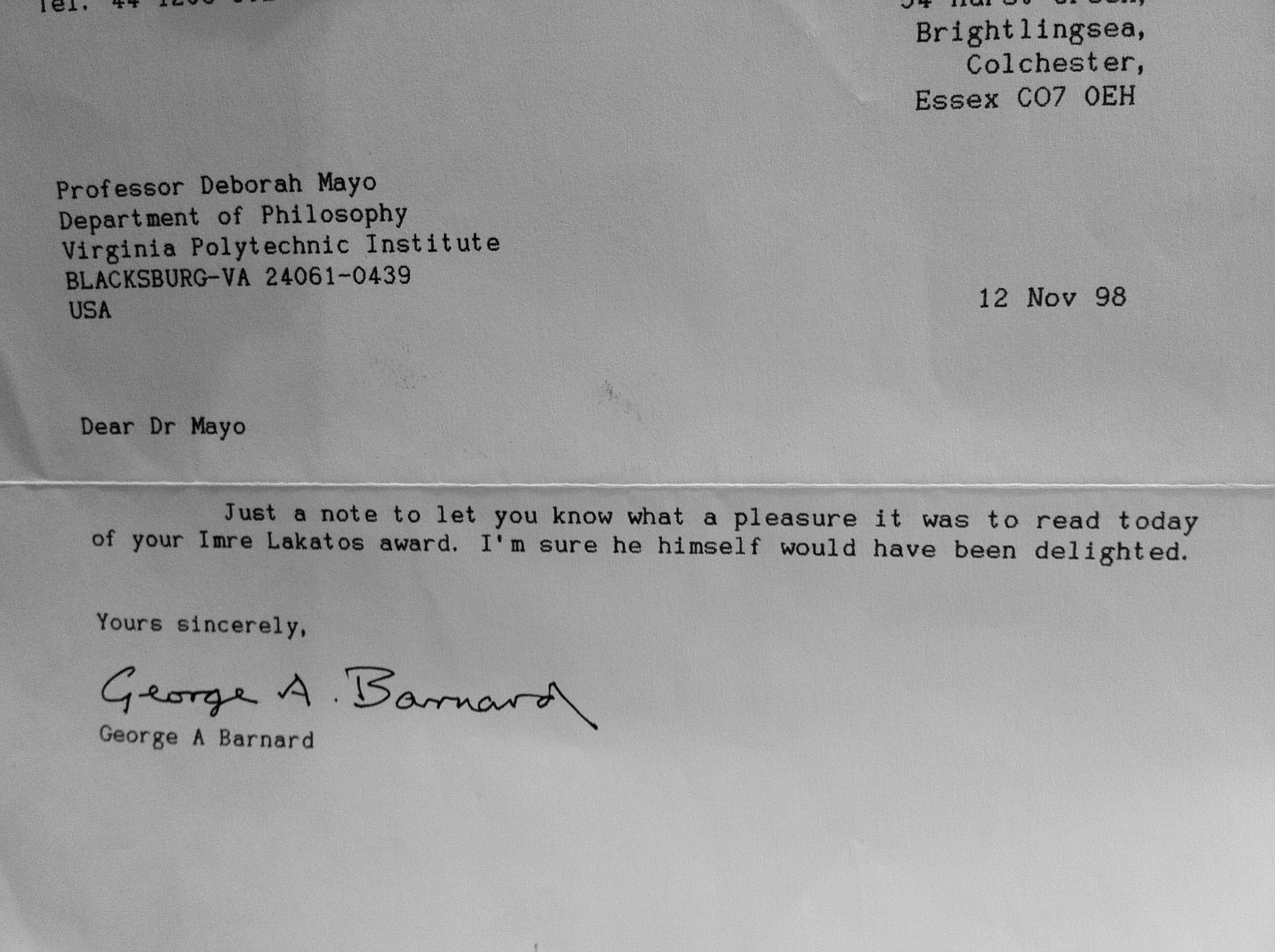
Letter from George (Barnard)

George Barnard sent me this note on hearing of my Lakatos Prize. He was to have been at my Lakatos dinner at the LSE (March 17, 1999)—winners are permitted to invite ~2-3 guests—but he called me at the LSE at the last minute to say he was too ill to come to London.  Instead we had a long talk on the phone the next day, which I can discuss at some point.

Categories: phil/history of stat | Tags: , | Leave a comment

Stephen Senn: On the (ir)relevance of stopping rules in meta-analysis

Senn in China

Stephen Senn

Competence Centre for Methodology and Statistics
CRP Santé
Strassen, Luxembourg

George Barnard has had an important influence on the way I think about statistics. It was hearing him lecture in Aberdeen (I think) in the early 1980s (I think) on certain problems associated with Neyman confidence intervals that woke me to the problem of conditioning. Later as a result of a lecture he gave to the International Society of Clinical Biostatistics meeting in Innsbruck in 1988 we began a correspondence that carried on at irregular intervals until 2000. I continue to have reasons to be grateful for the patience an important and senior theoretical statistician showed to a junior and obscure applied one.

One of the things Barnard was adamant about was that you had to look at statistical problems with various spectacles. This is what I propose to do here, taking as an example meta-analysis. Suppose that it is the case that a meta-analyst is faced with a number of trials in a given field and that these trials have been carried out sequentially. In fact, to make the problem both simpler and more acute, suppose that no stopping rule adjustments have been made. Suppose, unrealistically, that each trial has identical planned maximum size but that a single interim analysis is carried out after a fraction f of information has been collected. For simplicity we suppose this fraction f to be the same for every trial. The questions is ‘should the meta-analyst ignore the stopping rule employed’? The answer is ‘yes’ or ‘no’ depending on how (s)he combines the information and, interestingly, this is not a question of whether the meta-analyst is Bayesian or not. Continue reading

Categories: Philosophy of Statistics, Statistics | Tags: , , , | 2 Comments

Levels of Inquiry

levels: data-statistics-theory

Many fallacious uses of statistical methods result from supposing that the statistical inference licenses a jump to a substantive claim that is ‘on a different level’ from a statistical one being probed. Given the familiar refrain that statistical significance is not substantive significance, it may seem surprising how often criticisms of significance tests depend on running the two together! But it is not just two, but a great many levels that need distinguishing linking collecting, modeling and analyzing data to a variety of substantive claims of inquiry (though for simplicity I often focus on the three depicted, described in various ways).

A question that continues to arise revolves around a blurring of levels, and is behind my recent ESP post.  It goes roughly like this:

If we are prepared to take a statistically significant proportion of successes (greater than .5) in n Binomial trials as grounds for inferring a real (better than chance) effect (perhaps of two teaching methods) but not as grounds for inferring Uri’s ESP (at guessing outcomes, say), then aren’t we implicitly invoking a difference in prior probabilities?  The answer is no, but there are two very different points to be made:

First, merely finding evidence of a non-chance effect is at a different “level” from a subsequent question about the explanation or cause of a non-chance effect. To infer from the former to the latter is an example of a fallacy of rejection.[1] The nature and threats of error in the hypothesis about a specific cause of an effect are very different from those in merely inferring a real effect. There are distinct levels of inquiry and distinct errors at each given level. The severity analysis for the respective claims makes this explicit.[ii] Even a test that did a good job distinguishing and ruling out threats to a hypothesis of “mere chance” would not thereby have probed errors about specific causes or potential explanations. Nor does an “isolated record” of  statistically significant results suffice. Recall Fisher: “In relation to the test of significance, we may say that a phenomenon is experimentally demonstrable when we know how to conduct an experiment which will rarely fail to give us a statistically significant result”(1935, 14).  PSI researchers never managed to demonstrate this. Continue reading

Categories: Background knowledge, Error Statistics, Philosophy of Statistics, Statistics | 2 Comments

Insevere tests and pseudoscience

Against the PSI skeptics of this period (discussed in my last post), defenders of PSI would often erect means to take experimental results as success stories (e.g., if he failed to correctly predict the next card, maybe he was aiming at the second or third card). If the data could not be made to fit some ESP claim or other (e.g., through multiple end points) it might, as a last resort, be explained away as due to negative energy of nonbelievers (or being on the Carson show). They manage to get their ESP hypothesis H to “pass,” but the “test” had little or no capability of finding (uncovering, admitting) the falsity of H, even if H is false. (This is the basis for my term “Gellerization”.) In such cases, I would deny that the results afford any evidence for H. They are terrible evidence for H. Now any domain will have some terrible tests, but a field that routinely passes off terrible tests as success stories I would deem pseudoscientific. 

We get a kind of minimal requirement for a test result to afford any evidence of assertion H, however partial and approximate H may be:  If a hypothesis H is assured of having* “passed” a test T, even if H is false, then test T is a terrible test or no test at all.**

Far from trying to reveal flaws, it masks them or prevents them from being uncovered. No one would be impressed to learn their bank had passed a “stress test” if it turns out that the test had little or no chance of giving a failing score to any bank, regardless of its ability to survive a stressed economy. (Would they?)

There are a million different ways to flesh out the idea, and I welcome hearing others. Now you might say that no one would disagree with this. Great. Because a core requirement for an adequate account of inquiry, as I see it, is that it be able to capture this rationale for pretty terrible evidence and fairly pseudoscientific inquiry– and it should do so in such a way that affords a starting point for not-so-awful tests, and rather reliable learning.

* or very probably would have passed.

**QUESTION: I seek your input: which sounds better, or is more accurate: saying a test T passes a hypothesis H, or that a hypothesis H passes a test T? I’ve used both and want to settle on one.

Categories: Error Statistics, philosophy of science | 5 Comments

Statistics and ESP research (Diaconis)

In the early ‘80s, fresh out of graduate school, I persuaded Persi Diaconis, Jack Good, and Patrick Suppes to participate in a session I wanted to organize on ESP and statistics. It seems remarkable to me now—not only that they agreed to participate*, but the extent that PSI research was taken seriously at the time. It wasn’t much later that all the recurring errors and loopholes, and the persistent cheating self-delusion —despite earnest attempts to trigger and analyze the phenomena—would lead many nearly everyone to label PSI research a “degenerating programme” (in the Popperian-Lakatosian sense).

(Though I’d have to check names and dates, I seem to recall that the last straw was when some of the Stanford researchers were found guilty of (unconscious) fraud. Jack Good continued to be interested in the area, but less so, I think. I do not know about the others.)

It is interesting to see how background information enters into inquiry here. So, even though it’s late on a Saturday night, here’s a snippet from one of the papers that caught my interest in graduate school: Diaconis’s (1978) “Statistical Problems in ESP Research“, in Science, along with some critical “letters”

Summary. In search of repeatable ESP experiments, modern investigators are using more complex targets, richer and freer responses, feedback, and more naturalistic conditions. This makes tractable statistical models less applicable. Moreover, controls often are so loose that no valid statistical analysis is possible. Some common problems are multiple end points, subject cheating, and unconscious sensory cueing. Unfortunately, such problems are hard to recognize from published records of the experiments in which they occur; rather, these problems are often uncovered by reports of independent skilled observers who were present during the experiment. This suggests that magicians and psychologists be regularly used as observers. New statistical ideas have been developed for some of the new experiments. For example, many modern ESP studies provide subjects with feedback—partial information about previous guesses—to reward the subjects for correct guesses in hope of inducing ESP learning. Some feedback experiments can be analyzed with the use of skill-scoring, a statistical procedure that depends on the information available and the way the guessing subject uses this information. (p. 131) Continue reading

Categories: philosophy of science, Philosophy of Statistics, Statistics | 13 Comments

Barnard, background info/ intentions

G.A. Barnard: 23 Sept.1915 – 9 Aug.2002

G.A. Barnard’s birthday is 9/23, so, here’s a snippet of his discussion with Savage (1962) (link below [i]) that connects to our 2 recent issues: stopping rules, and background information here and here (at least of one type).

Barnard: I have been made to think further about this issue of the stopping rule since I first suggested that the stopping rule was irrelevant (Barnard 1947a,b). This conclusion does not follow only from the subjective theory of probability; it seems to me that the stopping rule is irrelevant in certain circumstances.  Since 1947 I have had the great benefit of a long correspondence—not many letters because they were not very frequent, but it went on over a long time—with Professor Bartlett, as a result of which I am considerably clearer than I was before. My feeling is that, as I indicated [on p. 42], we meet with two sorts of situation in applying statistics to data One is where we want to have a single hypothesis with which to confront the data. Do they agree with this hypothesis or do they not? Now in that situation you cannot apply Bayes’s theorem because you have not got any alternatives to think about and specify—not yet. I do not say they are not specifiable—they are not specified yet. And in that situation it seems to me the stopping rule is relevant. Continue reading

Categories: Background knowledge, Error Statistics, Philosophy of Statistics | Leave a comment

More on using background info

For the second* bit of background on the use of background info (for the new U-Phil for 9/21/12 9/25/12, I’ll reblog:

Background Knowledge: Not to Quantify, But To Avoid Being Misled By, Subjective Beliefs

…I am discovering that one of the biggest sources of confusion about the foundations of statistics has to do with what it means or should mean to use “background knowledge” and “judgment” in making statistical and scientific inferences. David Cox and I address this in our “Conversation” in RMM (2011)….

Insofar as humans conduct science and draw inferences, and insofar as learning about the world is not reducible to a priori deductions, it is obvious that “human judgments” are involved. True enough, but too trivial an observation to help us distinguish among the very different ways judgments should enter according to contrasting inferential accounts. When Bayesians claim that frequentists do not use or are barred from using background information, what they really mean is that frequentists do not use prior probabilities of hypotheses, at least when those hypotheses are regarded as correct or incorrect, if only approximately. So, for example, we would not assign relative frequencies to the truth of hypotheses such as (1) prion transmission is via protein folding without nucleic acid, or (2) the deflection of light is approximately 1.75” (as if, as Pierce puts it, “universes were as plenty as blackberries”). How odd it would be to try to model these hypotheses as themselves having distributions: to us, statistical hypotheses assign probabilities to outcomes or values of a random variable. Continue reading

Categories: Background knowledge, philosophy of science, Philosophy of Statistics, Statistics | Tags: , | 21 Comments

U-Phil (9/25/12) How should “prior information” enter in statistical inference?

Andrew Gelman, sent me an interesting note of his, “Ethics and the statistical use of prior information,”[i]. In section 3 he comments on some of David Cox’s remarks in a conversation we recorded:

 A Statistical Scientist Meets a Philosopher of Science: A Conversation between Sir David Cox and Deborah Mayo, published in Rationality, Markets and Morals [iii] (Section 2 has some remarks on L. Wasserman.)

This was a part of a highly informal, frank, and entirely unscripted conversation, with minimal editing from the tape-recording [ii]. It was first posted on this blog on Oct. 19, 2011. A related, earlier discussion on Gelman’s blog is here.

I want to open this for your informal comments ( “U-Phil”, ~750 words,by September 21 25)[iv]. (send to error@vt.edu)

Before I give my own “deconstruction” of Gelman on the relevant section, I will post a bit of background to the question of background. For starters, here’s the relevant portion of the conversation:

COX: Deborah, in some fields foundations do not seem very important, but we both think foundations of statistical inference are important; why do you think that is?

MAYO: I think because they ask about fundamental questions of evidence, inference, and probability. I don’t think that foundations of different fields are all alike; because in statistics we’re so intimately connected to the scientific interest in learning about the world, we invariably cross into philosophical questions about empirical knowledge and inductive inference.

COX: One aspect of it is that it forces us to say what it is that we really want to know when we analyze a situation statistically. Do we want to put in a lot of information external to the data, or as little as possible. It forces us to think about questions of that sort.

MAYO: But key questions, I think, are not so much a matter of putting in a lot or a little information. …What matters is the kind of information, and how to use it to learn. This gets to the question of how we manage to be so successful in learning about the world, despite knowledge gaps, uncertainties and errors. To me that’s one of the deepest questions and it’s the main one I care about. I don’t think a (deductive) Bayesian computation can adequately answer it. Continue reading

Categories: Background knowledge, Philosophy of Statistics, U-Phil | Tags: , | 2 Comments

Return to the comedy hour…(on significance tests)

These days, so many theater productions are updated reviews of older standards. Same with the comedy hours at the Bayesian retreat, and task force meetings of significance test reformers. So (on the 1-year anniversary of this blog) let’s listen in to one of the earliest routines (with highest blog hits), but with some new reflections (first considered here and here).

‘ “Did you hear the one about the frequentist . . .

“who claimed that observing “heads” on a biased coin that lands heads with probability .05 is evidence of a statistically significant improvement over the standard treatment of diabetes, on the grounds that such an event occurs with low probability (.05)?”

The joke came from J. Kadane’s Principles of Uncertainty (2011, CRC Press*).

 “Flip a biased coin that comes up heads with probability 0.95, and tails with probability 0.05.  If the coin comes up tails reject the null hypothesis.  Since the probability of rejecting the null hypothesis if it is true is 0.05, this is a valid 5% level test.  It is also very robust against data errors; indeed it does not depend on the data at all.  It is also nonsense, of course, but nonsense allowed by the rules of significance testing.” (439)

Much laughter.

___________________

But is it allowed?  I say no. The null hypothesis in the joke can be in any field, perhaps it concerns mean transmission of Scrapie in mice (as in my early Kuru post).  I know some people view significance tests as merely rules that rarely reject erroneously, but I claim this is mistaken. Both in significance tests and in scientific hypothesis testing more generally, data indicate inconsistency with H only by being counter to what would be expected under the assumption that H is correct (as regards a given aspect observed). Were someone to tell Prusiner that the testing methods he follows actually allow any old “improbable” event (a stock split in Apple?) to reject a hypothesis about prion transmission rates, Prusiner would say that person didn’t understand the requirements of hypothesis testing in science. Since the criticism would hold no water in the analogous case of Prusiner’s test, it must equally miss its mark in the case of significance tests**.  That, recall, was Rule #1. Continue reading

Categories: Comedy, Philosophy of Statistics, Statistics | Tags: , , , | 8 Comments

Blog at WordPress.com.