The American Statistical Association has announced that it has decided to reverse course and share the recommendations developed by the ASA Task Force on Statistical Significance and Replicability in one of its official channels. The ASA Board created this group [1] in November 2019 “with a charge to develop thoughtful principles and practices that the ASA can endorse and share with scientists and journal editors.” (AMSTATNEWS 1 February 2020). Some members of the ASA Board felt that its earlier decision not to make these recommendations public, but instead to leave the group to publish its recommendations on its own, might give the appearance of a conflict of interest between the obligation of the ASA to represent the wide variety of methodologies used by its members in widely diverse fields, and the advocacy by some members who believe practitioners should stop using the term “statistical significance” and end the practice of using p-value thresholds in interpreting data [the Wasserstein et al. (2019) editorial]. I think that deciding to publicly share the new Task Force recommendations is very welcome, given especially that the Task Force was appointed to avoid just such an apparent conflict of interest. Past ASA President, Karen Kafadar noted: Continue reading
ASA to Release the Recommendations of its Task Force on Statistical Significance and Replication
The Stat Wars and Intellectual conflicts of interest: Journal Editors

Like most wars, the Statistics Wars continues to have casualties. Some of the reforms thought to improve reliability and replication may actually create obstacles to methods known to improve on reliability and replication. At each one of our meeting of the Phil Stat Forum: “The Statistics Wars and Their Casualties,” I take 5 -10 minutes to draw out a proper subset of casualties associated with the topic of the presenter for the day. (The associated workshop that I have been organizing with Roman Frigg at the London School of Economics (CPNSS) now has a date for a hoped for in-person meeting in London: 24-25 September 2021.) Of course we’re interested not just in casualties but in positive contributions, though what counts as a casualty and what a contribution is itself a focus of philosophy of statistics battles.
Continue readingReminder: March 25 “How Should Applied Science Journal Editors Deal With Statistical Controversies?” (Mark Burgman)

The seventh meeting of our Phil Stat Forum*:
The Statistics Wars
and Their Casualties
25 March, 2021
TIME: 15:00-16:45 (London); 11:00-12:45 (New York, NOTE TIME CHANGE TO MATCH UK TIME**)
For information about the Phil Stat Wars forum and how to join, click on this link.

“How should applied science journal editors deal with statistical controversies?“
Mark Burgman Continue reading
Pandemic Nostalgia: The Corona Princess: Learning from a petri dish cruise (reblog 1yr)
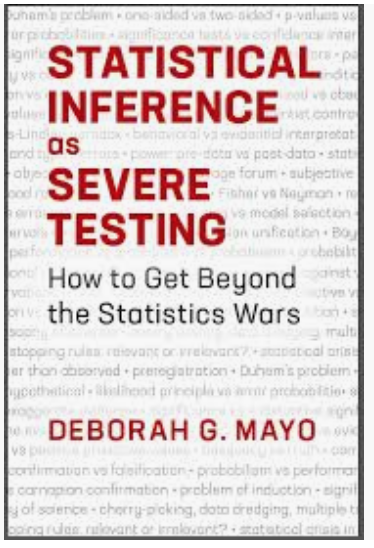
Last week, giving a long postponed talk for the NY/NY Metro Area Philosophers of Science Group (MAPS), I mentioned how my book Statistical Inference as Severe Testing: How to Get Beyond the Statistics Wars (2018, CUP) invites the reader to see themselves on a special interest cruise as we revisit old and new controversies in the philosophy of statistics–noting that I had no idea in writing the book that cruise ships would themselves become controversial in just a few years. The first thing I wrote during early pandemic days last March was this post on the Diamond Princess. The statistics gleaned from the ship remain important resources which haven’t been far off in many ways. I reblog it here. Continue reading
March 25 “How Should Applied Science Journal Editors Deal With Statistical Controversies?” (Mark Burgman)

The seventh meeting of our Phil Stat Forum*:
The Statistics Wars
and Their Casualties
25 March, 2021
TIME: 15:00-16:45 (London); 11:00-12:45 (New York, NOTE TIME CHANGE)
For information about the Phil Stat Wars forum and how to join, click on this link.

“How should applied science journal editors deal with statistical controversies?“
Mark Burgman Continue reading
Falsifying claims of trust in bat coronavirus research: mysteries of the mine (i)-(iv)
Have you ever wondered if people read Master’s (or even Ph.D) theses a decade out? Whether or not you have, I think you will be intrigued to learn the story of why an obscure Master’s thesis from 2012, translated from Chinese in 2020, is now an integral key for unravelling the puzzle of the global controversy about the mechanism and origins of Covid-19. The Master’s thesis by a doctor, Li Xu [1], “The Analysis of 6 Patients with Severe Pneumonia Caused by Unknown Viruses”, describes 6 patients he helped to treat after they entered a hospital in 2012, one after the other, suffering from an atypical pneumonia from cleaning up after bats in an abandoned copper mine in China. Given the keen interest in finding the origin of the 2002–2003 severe acute respiratory syndrome (SARS) outbreak, Li wrote: “This makes the research of the bats in the mine where the six miners worked and later suffered from severe pneumonia caused by unknown virus a significant research topic”. He and the other doctors treating the mine cleaners hypothesized that their diseases were caused by a SARS-like coronavirus from having been in close proximity to the bats in the mine. Continue reading
Aris Spanos: Modeling vs. Inference in Frequentist Statistics (guest post)
Aris Spanos
Wilson Schmidt Professor of Economics
Department of Economics
Virginia Tech
The following guest post (link to updated PDF) was written in response to C. Hennig’s presentation at our Phil Stat Wars Forum on 18 February, 2021: “Testing With Models That Are Not True”. Continue reading
R.A. Fisher: “Statistical methods and Scientific Induction” with replies by Neyman and E.S. Pearson
In Recognition of Fisher’s birthday (Feb 17), I reblog his contribution to the “Triad”–an exchange between Fisher, Neyman and Pearson 20 years after the Fisher-Neyman break-up. The other two are below. My favorite is the reply by E.S. Pearson, but all are chock full of gems for different reasons. They are each very short and are worth your rereading. Continue reading
R. A. Fisher: How an Outsider Revolutionized Statistics (Aris Spanos)
This is a belated birthday post for R.A. Fisher (17 February, 1890-29 July, 1962)–it’s a guest post from earlier on this blog by Aris Spanos that has gotten the highest number of hits over the years.
Happy belated birthday to R.A. Fisher!
‘R. A. Fisher: How an Outsider Revolutionized Statistics’
by Aris Spanos
Few statisticians will dispute that R. A. Fisher (February 17, 1890 – July 29, 1962) is the father of modern statistics; see Savage (1976), Rao (1992). Inspired by William Gosset’s (1908) paper on the Student’s t finite sampling distribution, he recast statistics into the modern model-based induction in a series of papers in the early 1920s. He put forward a theory of optimal estimation based on the method of maximum likelihood that has changed only marginally over the last century. His significance testing, spearheaded by the p-value, provided the basis for the Neyman-Pearson theory of optimal testing in the early 1930s. According to Hald (1998) Continue reading
Reminder: February 18 “Testing with models that are not true” (Christian Hennig)

The sixth meeting of our Phil Stat Forum*:
The Statistics Wars
and Their Casualties
18 February, 2021
TIME: 15:00-16:45 (London); 10-11:45 a.m. (New York, EST)
For information about the Phil Stat Wars forum and how to join, click on this link.

.
“Testing with Models that Are Not True“ Continue reading
S. Senn: The Power of Negative Thinking (guest post)
Stephen Senn
Consultant Statistician
Edinburgh, Scotland
Sepsis sceptic
During an exchange on Twitter, Lawrence Lynn drew my attention to a paper by Laffey and Kavanagh[1]. This makes an interesting, useful and very depressing assessment of the situation as regards clinical trials in critical care. The authors make various claims that RCTs in this field are not useful as currently conducted. I don’t agree with the authors’ logic here although, perhaps, surprisingly, I consider that their conclusion might be true. I propose to discuss this here. Continue reading
February 18 “Testing with models that are not true” (Christian Hennig)

The sixth meeting of our Phil Stat Forum*:
The Statistics Wars
and Their Casualties
18 February, 2021
TIME: 15:00-16:45 (London); 10-11:45 a.m. (New York, EST)
For information about the Phil Stat Wars forum and how to join, click on this link.

.
“Testing with Models that Are Not True“
Christian Hennig
The Covid-19 Mask Wars : Hi-Fi Mask Asks
Effective yesterday, February 1, it is a violation of federal law not to wear a mask on a public conveyance or in a transit hub, including taxis, trains and commercial trucks (The 11 page mandate is here.)
The “mask wars” are a major source of disagreement and politicizing science during the current pandemic, but my interest here is not of clashes between pro-and anti-mask culture warriors, but the clashing recommendations among science policy officials and scientists wearing their policy hats. A recent Washington Post editorial by Joseph Allen, (director of the Healthy Buildings program at the Harvard T.H. Chan School of Public Health), declares “Everyone should be wearing N95 masks now”. In his view: Continue reading
January 28 Phil Stat Forum “How Can We Improve Replicability?” (Alexander Bird)

The fifth meeting of our Phil Stat Forum*:
The Statistics Wars
and Their Casualties
TIME: 15:00-16:45 (London); 10-11:45 a.m. (New York, EST)

.
“How can we improve replicability?”
Alexander Bird
S. Senn: “Beta testing”: The Pfizer/BioNTech statistical analysis of their Covid-19 vaccine trial (guest post)
Stephen Senn
Consultant Statistician
Edinburgh, Scotland
The usual warning
Although I have researched on clinical trial design for many years, prior to the COVID-19 epidemic I had had nothing to do with vaccines. The only object of these amateur musings is to amuse amateurs by raising some issues I have pondered and found interesting. Continue reading
Why hasn’t the ASA Board revealed the recommendations of its new task force on statistical significance and replicability?
A little over a year ago, the board of the American Statistical Association (ASA) appointed a new Task Force on Statistical Significance and Replicability (under then president, Karen Kafadar), to provide it with recommendations. [Its members are here (i).] You might remember my blogpost at the time, “Les Stats C’est Moi”. The Task Force worked quickly, despite the pandemic, giving its recommendations to the ASA Board early, in time for the Joint Statistical Meetings at the end of July 2020. But the ASA hasn’t revealed the Task Force’s recommendations, and I just learned yesterday that it has no plans to do so*. A panel session I was in at the JSM, (P-values and ‘Statistical Significance’: Deconstructing the Arguments), grew out of this episode, and papers from the proceedings are now out. The introduction to my contribution gives you the background to my question, while revealing one of the recommendations (I only know of 2). Continue reading
Next Phil Stat Forum: January 7: D. Mayo: Putting the Brakes on the Breakthrough (or “How I used simple logic to uncover a flaw in …..statistical foundations”)

The fourth meeting of our New Phil Stat Forum*:
The Statistics Wars
and Their Casualties
January 7, 16:00 – 17:30 (London time)
11 am-12:30 pm (New York, ET)**
**note time modification and date change
Putting the Brakes on the Breakthrough,
or “How I used simple logic to uncover a flaw in a controversial 60-year old ‘theorem’ in statistical foundations”
Deborah G. Mayo

.
Midnight With Birnbaum (Remote, Virtual Happy New Year 2020)!
Unlike in the past 9 years since I’ve been blogging, I can’t revisit that spot in the road outside the Elbar Room, looking to get into a strange-looking taxi, to head to “Midnight With Birnbaum”. Because of the pandemic, I refuse to go out this New Year’s Eve, so the best I can hope for is a zoom link that will take me to a hypothetical party with him. (The pic on the left is the only blurry image I have of the club I’m taken to.) I just keep watching my email, to see if a zoom link arrives. My book Statistical Inference as Severe Testing: How to Get Beyond the Statistics Wars (STINT 2018) doesn’t rehearse the argument from my Birnbaum article, but there’s much in it that I’d like to discuss with him. The (Strong) Likelihood Principle–whether or not it is named–remains at the heart of many of the criticisms of Neyman-Pearson (N-P) statistics and statistical significance testing in general. Let’s hope that in 2021 the American Statistical Association 9ASA) will finally reveal the recommendations from the ASA Task Force on Statistical Significance and Replicability that the ASA Board itself created one year ago. They completed their recommendations early–back at the end of July 2020–but no response from the ASA has been forthcoming (to my knowledge). As Birnbaum insisted, the “confidence concept” is the “one rock in a shifting scene” of statistical foundations, insofar as there’s interest in controlling the frequency of erroneous interpretations of data. (See my rejoinder.) Birnbaum bemoaned the lack of an explicit evidential interpretation of N-P methods. I purport to give one in SIST 2018. Maybe it will come to fruition in 2021? Anyway, I was just sent an internet link–but it’s not zoom, not Skype, not Webinex, or anything I’ve ever seen before….no time to describe it now, but I’m recording and the rest of the transcript is live; this year there are some new, relevant additions. Happy New Year! Continue reading
A Perfect Time to Binge Read the (Strong) Likelihood Principle
An essential component of inference based on familiar frequentist notions: p-values, significance and confidence levels, is the relevant sampling distribution (hence the term sampling theory, or my preferred error statistics, as we get error probabilities from the sampling distribution). This feature results in violations of a principle known as the strong likelihood principle (SLP). To state the SLP roughly, it asserts that all the evidential import in the data (for parametric inference within a model) resides in the likelihoods. If accepted, it would render error probabilities irrelevant post data. Continue reading
Cox’s (1958) Chestnut: You should not get credit (or blame) for something you didn’t do
Just as you keep up your physical exercise during the pandemic (sure), you want to keep up with mental gymnastics too. With that goal in mind, and given we’re just a few days from the New Year (and given especially my promised presentation for January 7), here’s one of the two simple examples that will limber you up for the puzzle to ensue. It’s the famous weighing machine example from Sir David Cox (1958)[1]. It is one of the “chestnuts” in the museum exhibits of “chestnuts and howlers” in Excursion 3 (Tour II) of my book Statistical Inference as Severe Testing: How to Get Beyond the Statistics Wars (SIST, 2018). So block everything else out for a few minutes and consider 3 pages from SIST … Continue reading