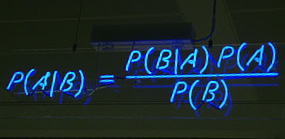
 Andrew Gelman says that as a philosopher, I should appreciate his blog today in which he records his frustration: “Against aggressive definitions: No, I don’t think it helps to describe Bayes as ‘the analysis of subjective beliefs’…” Gelman writes:
I get frustrated with what might be called “aggressive definitions,” where people use a restrictive definition of something they don’t like. For example, Larry Wasserman writes (as reported by Deborah Mayo):
“I wish people were clearer about what Bayes is/is not and what frequentist inference is/is not. Bayes is the analysis of subjective beliefs but provides no frequency guarantees. Frequentist inference is about making procedures that have frequency guarantees but makes no pretense of representing anyone’s beliefs.”
I’ll accept Larry’s definition of frequentist inference. But as for his definition of Bayesian inference: No no no no no. The probabilities we use in our Bayesian inference are not subjective, or, they’re no more subjective than the logistic regressions and normal distributions and Poisson distributions and so forth that fill up all the textbooks on frequentist inference.
To quickly record some of my own frustrations:*: First, I would disagree with Wasserman’s characterization of frequentist inference, but as is clear from Larry’s comments to (my reaction to him), I think he concurs that he was just giving a broad contrast. Please see Note [1] for a remark from my post: Comments on Wasserman’s “what is Bayesian/frequentist inference?” Also relevant is a Gelman post on the Bayesian name: [2].
Second, Gelman’s “no more subjective than…” evokes remarks I’ve made before. For example, in “What should philosophers of science do…” I wrote:
Arguments given for some very popular slogans (mostly by non-philosophers), are too readily taken on faith as canon by others, and are repeated as gospel. Examples are easily found: all models are false, no models are falsifiable, everything is subjective, or equally subjective and objective, and the only properly epistemological use of probability is to supply posterior probabilities for quantifying actual or rational degrees of belief. Then there is the cluster of “howlers” allegedly committed by frequentist error statistical methods repeated verbatim (discussed on this blog).
I’ve written a lot about objectivity on this blog, e.g., here, here and here (and in real life), but what’s the point if people just rehearse the “everything is a mixture…” line, without making deeply important distinctions? I really think that, next to the “all models are false” slogan, the most confusion has been engendered by the “no methods are objective” slogan. However much we may aim at objective constraints, it is often urged, we can never have “clean hands” free of the influence of beliefs and interests, and we invariably sully methods of inquiry by the entry of background beliefs and personal judgments in their specification and interpretation. Continue reading