S. Senn: Randomisation is not about balance, nor about homogeneity but about randomness (Guest Post)

.

Stephen Senn
Consultant Statistician
Edinburgh

The intellectual illness of clinical drug evaluation that I have discussed here can be cured, and it will be cured when we restore intellectual primacy to the questions we ask, not the methods by which we answer them. Lewis Sheiner1

Cause for concern

In their recent essay Causal Evidence and Dispositions in Medicine and Public Health2, Elena Rocca and Rani Lill Anjum challenge, ‘the epistemic primacy of randomised controlled trials (RCTs) for establishing causality in medicine and public health’. That an otherwise stimulating essay by two philosophers, experts on causality, which makes many excellent points on the nature of evidence, repeats a common misunderstanding about randomised clinical trials, is grounds enough for me to address this topic again.  Before, however, explaining why I disagree with Rocca and Anjum on RCTs, I want to make clear that I agree with much of what they say. I loathe these pyramids of evidence, beloved by some members of the evidence-based movement, which have RCTs at the apex or possibly occupying a second place just underneath meta-analyses of RCTs. In fact, although I am a great fan of RCTs and (usually) of intention to treat analysis, I am convinced that RCTs alone are not enough. My thinking on this was profoundly affected by Lewis Sheiner’s essay of nearly thirty years ago (from which the quote at the beginning of this blog is taken). Lewis was interested in many aspects of investigating the effects of drugs and would, I am sure, have approved of Rocca and Anjum’s insistence that there are many layers of understanding how and why things work, and that means of investigating them may have to range from basic laboratory experiments to patient narratives via RCTs. Rocca and Anjum’s essay provides a good discussion of the various ‘causal tasks’ that need to be addressed and backs this up with some excellent examples. Continue reading


Categories: RCTs, S. Senn | 32 Comments

Paradigm Shift in Pandemic (Vent) Protocols?

Lung Scans[0]

As much as doctors and hospitals are raising alarms about a shortage of ventilators for Covid-19 patients, some doctors have begun to call for entirely reassessing the standard paradigm for their use–according to a cluster of articles to appear in the last week. “What’s driving this reassessment is a baffling observation about Covid-19: Many patients have blood oxygen levels so low they should be dead. But they’re not gasping for air, their hearts aren’t racing, and their brains show no signs of blinking off from lack of oxygen.”[1] Within that group of patients, some doctors wonder if the standard use of mechanical ventilators does more harm than good.[2] The issue is controversial; I’ll just report what I find in the articles over the past week. Please share ongoing updates in the comments. Continue reading

Categories: covid-19 | 62 Comments

A. Spanos:  Isaac Newton and his two years in quarantine:  how science could germinate in bewildering ways (Guest post)

.

Aris Spanos
Wilson Schmidt Professor of Economics
Department of Economics
Virginia Tech

Beyond the plenitude of misery and suffering that pandemics bring down on humanity, occasionally they contribute to the betterment of humankind by (inadvertently) boosting creative activity that leads to knowledge, and not just in epidemiology. A case in point is that of Isaac Newton and the pandemic of 1665-6.  Continue reading

Categories: quarantine, Spanos | 14 Comments

April 1, 2020: Memory Lane of April 1’s past

images-15

.

My “April 1” posts for the past 8 years have been so close to the truth or possible truth that they weren’t always spotted as April Fool’s pranks, which is what made them genuine April Fool’s pranks. (After a few days I either labeled them as such, e.g., “check date!”, or revealed it in a comment). Given the level of current chaos and stress, I decided against putting up a planned post for today, so I’m just doing a memory lane of past posts. (You can tell from reading the comments which had most people fooled.) Continue reading

Categories: Comedy, Statistics | Leave a comment

The Corona Princess: Learning from a petri dish cruise (i)

.

Q. Was it a mistake to quarantine the passengers aboard the Diamond Princess in Japan?

A. The original statement, which is not unreasonable, was that the best thing to do with these people was to keep them safely quarantined in an infection-control manner on the ship. As it turned out, that was very ineffective in preventing spread on the ship. So the quarantine process failed. I mean, I’d like to sugarcoat it and try to be diplomatic about it, but it failed. I mean, there were people getting infected on that ship. So something went awry in the process of quarantining on that ship. I don’t know what it was, but a lot of people got infected on that ship. (Dr. A Fauci, Feb 17, 2020)

This is part of an interview of Dr. Anthony Fauci, the coronavirus point person we’ve been seeing so much of lately. Fauci has been the director of the National Institute of Allergy and Infectious Diseases since all the way back to 1984! You might find his surprise surprising. Even before getting our recent cram course on coronavirus transmission, tales of cruises being hit with viral outbreaks are familiar enough. The horror stories from passengers on the floating petri dish were well known by this Feb 17 interview. Even if everything had gone as planned, the quarantine was really only for the (approximately 3700) passengers because the 1000 or so crew members still had to run the ship, as well as cook and deliver food to the passenger’s cabins. Moreover, the ventilation systems on cruise ships can’t filter out particles smaller than 5000 or 1000 nanometers.[1] Continue reading

Categories: covid-19 | 55 Comments

Stephen Senn: Being Just about Adjustment (Guest Post)

.


Stephen Senn
Consultant Statistician
Edinburgh

Correcting errors about corrected estimates

Randomised clinical trials are a powerful tool for investigating the effects of treatments. Given appropriate design, conduct and analysis they can deliver good estimates of effects. The key feature is concurrent control. Without concurrent control, randomisation is impossible. Randomisation is necessary, although not sufficient, for effective blinding. It also is an appropriate way to deal with unmeasured predictors, that is to say suspected but unobserved factors that might also affect outcome. It does this by ensuring that, in the absence of any treatment effect, the expected value of variation between and within groups is the same. Furthermore, probabilities regarding the relative variation can be delivered and this is what is necessary for valid inference. Continue reading

Categories: randomization, S. Senn | 6 Comments

My Phil Stat Events at LSE

.

.

I will run a graduate Research Seminar at the LSE on Thursdays from May 21-June 18:

.

(See my new blog for specifics (phil-stat-wars.com).
I am co-running a workshop
from 19-20 June, 2020 at LSE (Center for the Philosophy of Natural and Social Sciences CPNSS), with Roman Frigg. Participants include:
Alexander Bird (King’s College London), Mark Burgman (Imperial College London), Daniele Fanelli (LSE), David Hand (Imperial College London), Christian Hennig (University of Bologna), Katrin Hohl (City University London), Daniël Lakens (Eindhoven University of Technology), Deborah Mayo (Virginia Tech), Richard Morey (Cardiff University), Stephen Senn (Edinburgh, Scotland).
If you have a particular Phil Stat event you’d like me to advertise, please send it to me.
Categories: Announcement, Philosophy of Statistics | Leave a comment

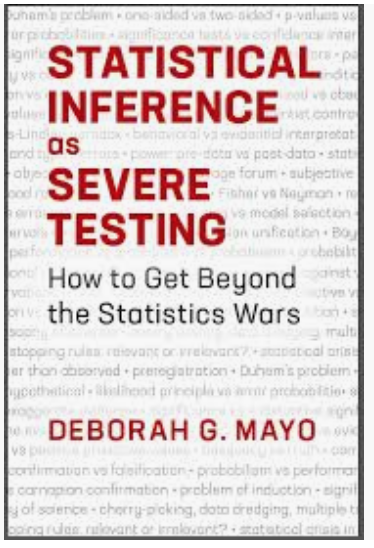
Replying to a review of Statistical Inference as Severe Testing by P. Bandyopadhyay

.

Notre Dame Philosophical Reviews is a leading forum for publishing reviews of books in philosophy. The philosopher of statistics, Prasanta Bandyopadhyay, published a review of my book Statistical Inference as Severe Testing: How to Get Beyond the Statistics Wars (2018, CUP)(SIST) in this journal, and I very much appreciate his doing so. Here I excerpt from his review, and respond to a cluster of related criticisms in order to avoid some fundamental misunderstandings of my project. Here’s how he begins:

In this book, Deborah G. Mayo (who has the rare distinction of making an impact on some of the most influential statisticians of our time) delves into issues in philosophy of statistics, philosophy of science, and scientific methodology more thoroughly than in her previous writings. Her reconstruction of the history of statistics, seamless weaving of the issues in the foundations of statistics with the development of twentieth-century philosophy of science, and clear presentation that makes the content accessible to a non-specialist audience constitute a remarkable achievement. Mayo has a unique philosophical perspective which she uses in her study of philosophy of science and current statistical practice.[1]

Bandyopadhyay

I regard this as one of the most important philosophy of science books written in the last 25 years. However, as Mayo herself says, nobody should be immune to critical assessment. This review is written in that spirit; in it I will analyze some of the shortcomings of the book.
Continue reading

Categories: Statistical Inference as Severe Testing–Review | Tags: | 25 Comments

R. A. Fisher: How an Outsider Revolutionized Statistics (Aris Spanos)

A SPANOS

.

This is a belated birthday post for R.A. Fisher (17 February, 1890-29 July, 1962)–it’s a guest post from earlier on this blog by Aris Spanos. 

Happy belated birthday to R.A. Fisher!

‘R. A. Fisher: How an Outsider Revolutionized Statistics’

by Aris Spanos

Few statisticians will dispute that R. A. Fisher (February 17, 1890 – July 29, 1962) is the father of modern statistics; see Savage (1976), Rao (1992). Inspired by William Gosset’s (1908) paper on the Student’s t finite sampling distribution, he recast statistics into the modern model-based induction in a series of papers in the early 1920s. He put forward a theory of optimal estimation based on the method of maximum likelihood that has changed only marginally over the last century. His significance testing, spearheaded by the p-value, provided the basis for the Neyman-Pearson theory of optimal testing in the early 1930s. According to Hald (1998) Continue reading

Categories: Fisher, phil/history of stat, Spanos | 2 Comments

Bad Statistics is Their Product: Fighting Fire With Fire (ii)

Mayo fights fire w/ fire

I. Doubt is Their Product is the title of a (2008) book by David Michaels, Assistant Secretary for OSHA from 2009-2017. I first mentioned it on this blog back in 2011 (“Will the Real Junk Science Please Stand Up?) The expression is from a statement by a cigarette executive (“doubt is our product”), and the book’s thesis is explained in its subtitle: How Industry’s Assault on Science Threatens Your Health. Imagine you have just picked up a book, published in 2020: Bad Statistics is Their Product. Is the author writing about how exaggerating bad statistics may serve in the interest of denying well-established risks? [Interpretation A]. Or perhaps she’s writing on how exaggerating bad statistics serves the interest of denying well-established statistical methods? [Interpretation B]. Both may result in distorting science and even in dismantling public health safeguards–especially if made the basis of evidence policies in agencies. A responsible philosopher of statistics should care. Continue reading

Categories: ASA Guide to P-values, Error Statistics, P-values, replication research, slides | 33 Comments

My paper, “P values on Trial” is out in Harvard Data Science Review

.

My new paper, “P Values on Trial: Selective Reporting of (Best Practice Guides Against) Selective Reporting” is out in Harvard Data Science Review (HDSR). HDSR describes itself as a A Microscopic, Telescopic, and Kaleidoscopic View of Data Science. The editor-in-chief is Xiao-li Meng, a statistician at Harvard. He writes a short blurb on each article in his opening editorial of the issue. Continue reading

Categories: multiple testing, P-values, significance tests, Statistics | 29 Comments

S. Senn: “Error point: The importance of knowing how much you don’t know” (guest post)

.

Stephen Senn
Consultant Statistician
Edinburgh

‘The term “point estimation” made Fisher nervous, because he associated it with estimation without regard to accuracy, which he regarded as ridiculous.’ Jimmy Savage [1, p. 453] 

First things second

The classic text by David Cox and David Hinkley, Theoretical Statistics (1974), has two extremely interesting features as regards estimation. The first is in the form of an indirect, implicit, message and the second explicit and both teach that point estimation is far from being an obvious goal of statistical inference. The indirect message is that the chapter on point estimation (chapter 8) comes after that on interval estimation (chapter 7). This may puzzle the reader, who may anticipate that the complications of interval estimation would be handled after the apparently simpler point estimation rather than before. However, with the start of chapter 8, the reasoning is made clear. Cox and Hinkley state: Continue reading

Categories: Fisher, randomization, Stephen Senn | Tags: | 8 Comments

Aris Spanos Reviews Statistical Inference as Severe Testing: How to Get Beyond the Statistics Wars

A. Spanos

Aris Spanos was asked to review my Statistical Inference as Severe Testing: how to Get Beyond the Statistics Wars (CUP, 2018), but he was to combine it with a review of the re-issue of Ian Hacking’s classic  Logic of Statistical Inference. The journal is OEconomia: History, Methodology, Philosophy. Below are excerpts from his discussion of my book (pp. 843-860). I will jump past the Hacking review, and occasionally excerpt for length.To read his full article go to external journal pdf or stable internal blog pdf. Continue reading

Categories: Spanos, Statistical Inference as Severe Testing | Leave a comment

The NAS fixes its (main) mistake in defining P-values!

Mayo new elbow

(reasonably) satisfied

Remember when I wrote to the National Academy of Science (NAS) in September pointing out mistaken definitions of P-values in their document on Reproducibility and Replicability in Science? (see my 9/30/19 post). I’d given up on their taking any action, but yesterday I received a letter from the NAS Senior Program officer:

Dear Dr. Mayo,

I am writing to let you know that the Reproducibility and Replicability in Science report has been updated in response to the issues that you have raised.
Two footnotes, on pages 31 35 and 221, highlight the changes. The updated report is available from the following link: NEW 2020 NAS DOC

Thank you for taking the time to reach out to me and to Dr. Fineberg and letting us know about your concerns.
With kind regards and wishes of a happy 2020,
Jenny Heimberg
Jennifer Heimberg, Ph.D.
Senior Program Officer

The National Academies of Sciences, Engineering, and Medicine

Continue reading

Categories: NAS, P-values | 2 Comments

Midnight With Birnbaum (Happy New Year 2019)!

 Just as in the past 8 years since I’ve been blogging, I revisit that spot in the road at 9p.m., just outside the Elbar Room, look to get into a strange-looking taxi, to head to “Midnight With Birnbaum”. (The pic on the left is the only blurry image I have of the club I’m taken to.) I wonder if the car will come for me this year, as I wait out in the cold, now that Statistical Inference as Severe Testing: How to Get Beyond the Statistics Wars (STINT 2018) has been out over a year. STINT doesn’t rehearse the argument from my Birnbaum article, but there’s much in it that I’d like to discuss with him. The (Strong) Likelihood Principle–whether or not it is named–remains at the heart of many of the criticisms of Neyman-Pearson (N-P) statistics (and cognate methods). 2019 was the 61th birthday of Cox’s “weighing machine” example, which was the basis of Birnbaum’s attempted proof. Yet as Birnbaum insisted, the “confidence concept” is the “one rock in a shifting scene” of statistical foundations, insofar as there’s interest in controlling the frequency of erroneous interpretations of data. (See my rejoinder.) Birnbaum bemoaned the lack of an explicit evidential interpretation of N-P methods. Maybe in 2020? Anyway, the cab is finally here…the rest is live. Happy New Year! Continue reading

Categories: Birnbaum Brakes, strong likelihood principle | Tags: , , , | Leave a comment

A Perfect Time to Binge Read the (Strong) Likelihood Principle

An essential component of inference based on familiar frequentist notions: p-values, significance and confidence levels, is the relevant sampling distribution (hence the term sampling theory, or my preferred error statistics, as we get error probabilities from the sampling distribution). This feature results in violations of a principle known as the strong likelihood principle (SLP). To state the SLP roughly, it asserts that all the evidential import in the data (for parametric inference within a model) resides in the likelihoods. If accepted, it would render error probabilities irrelevant post data. Continue reading

Categories: Birnbaum, Birnbaum Brakes, law of likelihood | 8 Comments

Cox’s (1958) Chestnut: You shouldn’t get credit (or blame) for something you didn’t do

.

Just as you regularly keep up your physical exercise during the pandemic (sure), you also want to keep up with brain exercise. Given we’re just a few days from New Year’s eve, and given especially that on January 7 I will attempt (for the first time) a highly informal presentation of a controversial result in statistical foundations), here’s a little 2018 marked 60 years since the famous weighing machine example from Sir David Cox (1958)[1]. it is now 61. It’s one of the “chestnuts” in the exhibits of “chestnuts and howlers” in Excursion 3 (Tour II) of my (still) new book Statistical Inference as Severe Testing: How to Get Beyond the Statistics Wars (SIST, 2018). It’s especially relevant to take this up now, just before we leave 2019, for reasons that will be revealed over the next day or two. For a sneak preview of those reasons, see the “note to the reader” at the end of this post. So, let’s go back to it, with an excerpt from SIST (pp. 170-173). Continue reading

Categories: Birnbaum, Statistical Inference as Severe Testing, strong likelihood principle | Leave a comment

Posts of Christmas Past (1): 13 howlers of significance tests (and how to avoid them)

.

I’m reblogging a post from Christmas past–exactly 7 years ago. Guess what I gave as the number 1 (of 13) howler well-worn criticism of statistical significance tests, haunting us back in 2012–all of which are put to rest in Mayo and Spanos 2011? Yes, it’s the frightening allegation that statistical significance tests forbid using any background knowledge! The researcher is imagined to start with a “blank slate” in each inquiry (no memories of fallacies past), and then unthinkingly apply a purely formal, automatic, accept-reject machine. What’s newly frightening (in 2019) is the credulity with which this apparition is now being met (by some). I make some new remarks below the post from Christmas past: Continue reading

Categories: memory lane, significance tests, Statistics | Tags: | Leave a comment

“Les stats, c’est moi”: We take that step here! (Adopt our fav word or phil stat!)(iii)

les stats, c’est moi

When it comes to the statistics wars, leaders of rival tribes sometimes sound as if they believed “les stats, c’est moi”.  [1]. So, rather than say they would like to supplement some well-known tenets (e.g., “a statistically significant effect may not be substantively important”) with a new rule that advances their particular preferred language or statistical philosophy, they may simply blurt out: “we take that step here!” followed by whatever rule of language or statistical philosophy they happen to prefer (as if they have just added the new rule to the existing, uncontested tenets). Karan Kefadar, in her last official (December) report as President of the American Statistical Association (ASA), expresses her determination to call out this problem at the ASA itself. (She raised it first in her June article, discussed in my last post.) Continue reading

Categories: ASA Guide to P-values | 85 Comments

P-Value Statements and Their Unintended(?) Consequences: The June 2019 ASA President’s Corner (b)

2208388671_0d8bc38714

Mayo writing to Kafadar

I never met Karen Kafadar, the 2019 President of the American Statistical Association (ASA), but the other day I wrote to her in response to a call in her extremely interesting June 2019 President’s Corner: “Statistics and Unintended Consequences“:

  • “I welcome your suggestions for how we can communicate the importance of statistical inference and the proper interpretation of p-values to our scientific partners and science journal editors in a way they will understand and appreciate and can use with confidence and comfort—before they change their policies and abandon statistics altogether.”

I only recently came across her call, and I will share my letter below. First, here are some excerpts from her June President’s Corner (her December report is due any day). Continue reading

Categories: ASA Guide to P-values, Bayesian/frequentist, P-values | 3 Comments

Blog at WordPress.com.