
WINNER: Zachary David
See rejected posts.
 Just as in the past 2 years since I’ve been blogging, I revisit that spot in the road, get into a strange-looking taxi, and head to “Midnight With Birnbaum”. There are a couple of brief (12/31/13) updates at the end.
You know how in that (not-so) recent movie, “Midnight in Paris,” the main character (I forget who plays it, I saw it on a plane) is a writer finishing a novel, and he steps into a cab that mysteriously picks him up at midnight and transports him back in time where he gets to run his work by such famous authors as Hemingway and Virginia Wolf? He is impressed when his work earns their approval and he comes back each night in the same mysterious cab…Well, imagine an error statistical philosopher is picked up in a mysterious taxi at midnight (New Year’s Eve 2011 2012, 2013) and is taken back fifty years and, lo and behold, finds herself in the company of Allan Birnbaum.[i]
ERROR STATISTICIAN: It’s wonderful to meet you Professor Birnbaum; I’ve always been extremely impressed with the important impact your work has had on philosophical foundations of statistics. I happen to be writing on your famous argument about the likelihood principle (LP). (whispers: I can’t believe this!)
BIRNBAUM: Ultimately you know I rejected the LP as failing to control the error probabilities needed for my Confidence concept.
ERROR STATISTICIAN: Yes, but I actually don’t think your argument shows that the LP follows from such frequentist concepts as sufficiency S and the weak conditionality principle WLP.[ii] Sorry,…I know it’s famous…
BIRNBAUM: Well, I shall happily invite you to take any case that violates the LP and allow me to demonstrate that the frequentist is led to inconsistency, provided she also wishes to adhere to the WLP and sufficiency (although less than S is needed).
ERROR STATISTICIAN: Well I happen to be a frequentist (error statistical) philosopher; I have recently (2006) found a hole in your proof,..er…well I hope we can discuss it.
BIRNBAUM: Well, well, well: I’ll bet you a bottle of Elba Grease champagne that I can demonstrate it!
ERROR STATISTICAL PHILOSOPHER: It is a great drink, I must admit that: I love lemons.
BIRNBAUM: OK. (A waiter brings a bottle, they each pour a glass and resume talking). Whoever wins this little argument pays for this whole bottle of vintage Ebar or Elbow or whatever it is Grease.
ERROR STATISTICAL PHILOSOPHER: I really don’t mind paying for the bottle.
BIRNBAUM: Good, you will have to. Take any LP violation. Let x’ be 2-standard deviation difference from the null (asserting m = 0) in testing a normal mean from the fixed sample size experiment E’, say n = 100; and let x” be a 2-standard deviation difference from an optional stopping experiment E”, which happens to stop at 100. Do you agree that:
(0) For a frequentist, outcome x’ from E’ (fixed sample size) is NOT evidentially equivalent to x” from E” (optional stopping that stops at n)
ERROR STATISTICAL PHILOSOPHER: Yes, that’s a clear case where we reject the strong LP, and it makes perfect sense to distinguish their corresponding p-values (which we can write as p’ and p”, respectively). The searching in the optional stopping experiment makes the p-value quite a bit higher than with the fixed sample size. For n = 100, data x’ yields p’= ~.05; while p” is ~.3. Clearly, p’ is not equal to p”, I don’t see how you can make them equal. Continue reading

Professor Larry Wasserman
I had invited Larry to give an update, and I’m delighted that he has! The discussion relates to the last post (by Spanos), which follows upon my deconstruction of Wasserman*. So, for your Saturday night reading pleasure, join me** in reviewing this and the past two blogs and the links within.
“Wasserman on Wasserman: Update! December 28, 2013”
My opinions have shifted a bit.
My reference to Franken’s joke suggested that the usual philosophical debates about the foundations of statistics were un-important, much like the debate about media bias. I was wrong on both counts.
First, I now think Franken was wrong. CNN and network news have a strong liberal bias, especially on economic issues. FOX has an obvious right wing, and anti-atheist bias. (At least FOX has some libertarians on the payroll.) And this does matter. Because people believe what they see on TV and what they read in the NY times. Paul Krugman’s socialist bullshit parading as economics has brainwashed millions of Americans. So media bias is much more than who makes better hummus.
Similarly, the Bayes-Frequentist debate still matters. And people — including many statisticians — are still confused about the distinction. I thought the basic Bayes-Frequentist debate was behind us. A year and a half of blogging (as well as reading other blogs) convinced me I was wrong here too. And this still does matter. Continue reading
This follows up on yesterday’s deconstruction:
Aris Spanos (2012)[i] – Comments on: L. Wasserman “Low Assumptions, High Dimensions” (2011)*
I’m happy to play devil’s advocate in commenting on Larry’s very interesting and provocative (in a good way) paper on ‘how recent developments in statistical modeling and inference have [a] changed the intended scope of data analysis, and [b] raised new foundational issues that rendered the ‘older’ foundational problems more or less irrelevant’.
The new intended scope, ‘low assumptions, high dimensions’, is delimited by three characteristics:
“1. The number of parameters is larger than the number of data points.
2. Data can be numbers, images, text, video, manifolds, geometric objects, etc.
3. The model is always wrong. We use models, and they lead to useful insights but the parameters in the model are not meaningful.” (p. 1)
In the discussion that follows I focus almost exclusively on the ‘low assumptions’ component of the new paradigm. The discussion by David F. Hendry (2011), “Empirical Economic Model Discovery and Theory Evaluation,” RMM, 2: 115-145, is particularly relevant to some of the issues raised by the ‘high dimensions’ component in a way that complements the discussion that follows.
My immediate reaction to the demarcation based on 1-3 is that the new intended scope, although interesting in itself, excludes the overwhelming majority of scientific fields where restriction 3 seems unduly limiting. In my own field of economics the substantive information comes primarily in the form of substantively specified mechanisms (structural models), accompanied with theory-restricted and substantively meaningful parameters.
In addition, I consider the assertion “the model is always wrong” an unhelpful truism when ‘wrong’ is used in the sense that “the model is not an exact picture of the ‘reality’ it aims to capture”. Worse, if ‘wrong’ refers to ‘the data in question could not have been generated by the assumed model’, then any inference based on such a model will be dubious at best! Continue reading
 Larry Wasserman (“Normal Deviate”) has announced he will stop blogging (for now at least). That means we’re losing one of the wisest blog-voices on issues relevant to statistical foundations (among many other areas in statistics). Whether this lures him back or reaffirms his decision to stay away, I thought I’d reblog my (2012) “deconstruction” of him (in relation to a paper linked below)[i]
Deconstructing Larry Wasserman [i] by D. Mayo
The temptation is strong, but I shall refrain from using the whole post to deconstruct Al Franken’s 2003 quip about media bias (from Lies and Lying Liars Who Tell Them: A Fair and Balanced Look at the Right), with which Larry Wasserman begins his paper “Low Assumptions, High Dimensions” (2011) in his contribution to Rationality, Markets and Morals (RMM) Special Topic: Statistical Science and Philosophy of Science:
Wasserman: There is a joke about media bias from the comedian Al Franken:
‘To make the argument that the media has a left- or right-wing, or a liberal or a conservative bias, is like asking if the problem with Al-Qaeda is: do they use too much oil in their hummus?’
According to Wasserman, “a similar comment could be applied to the usual debates in the foundations of statistical inference.”
Although it’s not altogether clear what Wasserman means by his analogy with comedian (now senator) Franken, it’s clear enough what Franken meant if we follow up the quip with the next sentence in his text (which Wasserman omits): “The problem with al Qaeda is that they’re trying to kill us!” (p. 1). The rest of Franken’s opening chapter is not about al Qaeda but about bias in media. Conservatives, he says, decry what they claim is a liberal bias in mainstream media. Franken rejects their claim.
The mainstream media does not have a liberal bias. And for all their other biases . . . , the mainstream media . . . at least try to be fair. …There is, however, a right-wing media. . . . They are biased. And they have an agenda…The members of the right-wing media are not interested in conveying the truth… . They are an indispensable component of the right-wing machine that has taken over our country… . We have to be vigilant. And we have to be more than vigilant. We have to fight back… . Let’s call them what they are: liars. Lying, lying, liars. (Franken, pp. 3-4)
When I read this in 2004 (when Bush was in office), I couldn’t have agreed more. How things change*. Now, of course, any argument that swerves from the politically correct is by definition unsound, irrelevant, and/ or biased. [ii](December 2016 update: This just shows how things get topsy-turvy every 5-8 years. Now we have extremes on both sides.)
But what does this have to do with Bayesian-frequentist foundations? What is Wasserman, deep down, really trying to tell us by way of this analogy (if only subliminally)? Such are my ponderings—and thus this deconstruction. (I will invite your “U-Phils” at the end[a].) I will allude to passages from my contribution to RMM (2011) (in red).
A.What Is the Foundational Issue?
Wasserman: To me, the most pressing foundational question is: how do we reconcile the two most powerful needs in modern statistics: the need to make methods assumption free and the need to make methods work in high dimensions… . The Bayes-Frequentist debate is not irrelevant but it is not as central as it once was. (p. 201)
One may wonder why he calls this a foundational issue, as opposed to, say, a technical one. I will assume he means what he says and attempt to extract his meaning by looking through a foundational lens. Continue reading
 (see rejected posts)
I received a new book today as a present[i]: “(An illustrated book of) Bad Arguments” (Ali Almossawi 2013) [ii]. I wish I’d had it for the critical thinking class I just completed! Here’s the illustration it gives for “hasty generalization”.

The author allows it to be accessed here, I just discovered.
But it’s not just a clever book of cartoons: it does a better job than most texts in its conception of bad inductive arguments. Recall my post, “A critical Look at Critical Thinking”–prior to the start of my class–in which I explained why critical thinking is actually a sophisticated affair that philosophers have never fully sorted out. (We may teach it before “baby (symbolic) logic”, but it’s really very grown-up.) I gave my recommendation there as to where probability ought to enter in understanding bad (inductive) arguments, and Almossawi’s conception is in sync with mine[iii]. The inductive qualification is on the mode of inferring, rather than on the conclusion (or inferential claim H) itself*. The difference might seem subtle, but I swear it’s at the heart of many contemporary controversies about statistical inference, and the most serious among them.
[i] From Aris Spanos—thanks Aris.
[ii] Ali Almossawi, whom I never heard of before, has masters degrees in engineering/CS from MIT and CMU, and is a data visualization designer. The illustrator is: Alejandro Giraldo
[iii] I haven’t read all of it, but I doubt I’ll find any howlers.
*About the mode of inferring: What’s its capability to have avoided (alerted us to) the ways it would be wrong to infer H (from the data).
 Memory Lane: 2 years ago:
My efficient Errorstat Blogpeople1 have put forward the following 3 reader-contributed interpretive efforts2 as a result of the “deconstruction” exercise from December 11, (mine, from the earlier blog, is at the end) of what I consider:
“….an especially intriguing remark by Jim Berger that I think bears upon the current mindset (Jim is aware of my efforts):
Too often I see people pretending to be subjectivists, and then using “weakly informative” priors that the objective Bayesian community knows are terrible and will give ridiculous answers; subjectivism is then being used as a shield to hide ignorance. . . . In my own more provocative moments, I claim that the only true subjectivists are the objective Bayesians, because they refuse to use subjectivism as a shield against criticism of sloppy pseudo-Bayesian practice. (Berger 2006, 463)” (From blogpost, Dec. 11, 2011)
_________________________________________________
Andrew Gelman:
The statistics literature is big enough that I assume there really is some bad stuff out there that Berger is reacting to, but I think that when he’s talking about weakly informative priors, Berger is not referring to the work in this area that I like, as I think of weakly informative priors as specifically being designed to give answers that are _not_ “ridiculous.”
Keeping things unridiculous is what regularization’s all about, and one challenge of regularization (as compared to pure subjective priors) is that the answer to the question, What is a good regularizing prior?, will depend on the likelihood. There’s a lot of interesting theory and practice relating to weakly informative priors for regularization, a lot out there that goes beyond the idea of noninformativity.
To put it another way: We all know that there’s no such thing as a purely noninformative prior: any model conveys some information. But, more and more, I’m coming across applied problems where I wouldn’t want to be noninformative even if I could, problems where some weak prior information regularizes my inferences and keeps them sane and under control. Continue reading
Aris Spanos
I attended a lecture by Aris Spanos to his graduate econometrics class here at Va Tech last week[i]. This course, which Spanos teaches every fall, gives a superb illumination of the disparate pieces involved in statistical inference and modeling, and affords clear foundations for how they are linked together. His slides follow the intro section. Some examples with severity assessments are also included.
Frequentist Hypothesis Testing: A Coherent Approach
Aris Spanos
1 Inherent difficulties in learning statistical testing
Statistical testing is arguably the most important, but also the most difficult and confusing chapter of statistical inference for several reasons, including the following.
(i) The need to introduce numerous new notions, concepts and procedures before one can paint — even in broad brushes — a coherent picture of hypothesis testing.
(ii) The current textbook discussion of statistical testing is both highly confusing and confused. There are several sources of confusion.
(iii) The discussion of frequentist testing is rather incomplete in so far as it has been beleaguered by serious foundational problems since the 1930s. As a result, different applied fields have generated their own secondary literatures attempting to address these problems, but often making things much worse! Indeed, in some fields like psychology it has reached the stage where one has to correct the ‘corrections’ of those chastising the initial correctors!
In an attempt to alleviate problem (i), the discussion that follows uses a sketchy historical development of frequentist testing. To ameliorate problem (ii), the discussion includes ‘red flag’ pointers (¥) designed to highlight important points that shed light on certain erroneous in- terpretations or misleading arguments. The discussion will pay special attention to (iii), addressing some of the key foundational problems.
[i] It is based on Ch. 14 of Spanos (1999) Probability Theory and Statistical Inference. Cambridge[ii].
[ii] You can win a free copy of this 700+ page text by creating a simple palindrome! https://errorstatistics.com/palindrome/march-contest/
double-counting
A paper of mine on “double-counting” and novel evidence just came out: “Some surprising facts about (the problem of) surprising facts” in Studies in History and Philosophy of Science (2013), http://dx.doi.org/10.1016/j.shpsa.2013.10.005
ABSTRACT: A common intuition about evidence is that if data x have been used to construct a hypothesis H, then x should not be used again in support of H. It is no surprise that x fits H, if H was deliberately constructed to accord with x. The question of when and why we should avoid such ‘‘double-counting’’ continues to be debated in philosophy and statistics. It arises as a prohibition against data mining, hunting for significance, tuning on the signal, and ad hoc hypotheses, and as a preference for predesignated hypotheses and ‘‘surprising’’ predictions. I have argued that it is the severity or probativeness of the test—or lack of it—that should determine whether a double-use of data is admissible. I examine a number of surprising ambiguities and unexpected facts that continue to bedevil this debate.
 A comment today by Stephen Senn leads me to post the last few sentences of my (2010) paper with David Cox, “Frequentist Statistics as a Theory of Inductive Inference”:
A fundamental tenet of the conception of inductive learning most at home with the frequentist philosophy is that inductive inference requires building up incisive arguments and inferences by putting together several different piece-meal results; we have set out considerations to guide these pieces[i]. Although the complexity of the issues makes it more difficult to set out neatly, as, for example, one could by imagining that a single algorithm encompasses the whole of inductive inference, the payoff is an account that approaches the kind of arguments that scientists build up in order to obtain reliable knowledge and understanding of a field.” (273)[ii]
A reread for Saturday night?
[i]The pieces hang together by dint of the rationale growing out of a severity criterion (or something akin but using a different term.)
[ii]Error and Inference: Recent Exchanges on Experimental Reasoning, Reliability and the Objectivity and Rationality of Science (D Mayo and A. Spanos eds.), Cambridge: Cambridge University Press: 1-27. This paper appeared in The Second Erich L. Lehmann Symposium: Optimality, 2006, Lecture Notes-Monograph Series, Volume 49, Institute of Mathematical Statistics, pp. 247-275.

2 tough months in exile
October 2013
November 2013
*compiled by N. Jinn & J. Miller
Jeremy Fox often publishes interesting blogposts like today’s. I’m “reblogging” straight from his site as an experiment.
|
 Stephen Senn
Head, Methodology and Statistics Group,
Competence Center for Methodology and Statistics (CCMS),
Luxembourg
“Dawid’s Selection Paradox”
You can protest, of course, that Dawid’s Selection Paradox is no such thing but then those who believe in the inexorable triumph of logic will deny that anything is a paradox. In a challenging paper published nearly 20 years ago (Dawid 1994), Philip Dawid drew attention to a ‘paradox’ of Bayesian inference. To describe it, I can do no better than to cite the abstract of the paper, which is available from Project Euclid, here: http://projecteuclid.org/DPubS/Repository/1.0/Disseminate?
When the inference to be made is selected after looking at the data, the classical statistical approach demands — as seems intuitively sensible — that allowance be made for the bias thus introduced. From a Bayesian viewpoint, however, no such adjustment is required, even when the Bayesian inference closely mimics the unadjusted classical one. In this paper we examine more closely this seeming inadequacy of the Bayesian approach. In particular, it is argued that conjugate priors for multivariate problems typically embody an unreasonable determinism property, at variance with the above intuition.
I consider this to be an important paper not only for Bayesians but also for frequentists, yet it has only been cited 14 times as of 15 November 2013 according to Google Scholar. In fact I wrote a paper about it in the American Statistician a few years back (Senn 2008) and have also referred to it in a previous blogpost (12 May 2012). That I think it is important and neglected is excuse enough to write about it again.
Philip Dawid is not responsible for my interpretation of his paradox but the way that I understand it can be explained by considering what it means to have a prior distribution. First, as a reminder, if you are going to be 100% Bayesian, which is to say that all of what you will do by way of inference will be to turn a prior into a posterior distribution using the likelihood and the operation of Bayes theorem, then your prior distribution has to satisfy two conditions. First, it must be what you would use to bet now (that is to say at the moment it is established) and second no amount of subsequent data will change your prior qua prior. It will, of course, be updated by Bayes theorem to form a posterior distribution once further data are obtained but that is another matter. The relevant time here is your observation time not the time when the data were collected, so that data that were available in principle but only came to your attention after you established your prior distribution count as further data.
Now suppose that you are going to make an inference about a population mean, θ, using a random sample from the population and choose the standard conjugate prior distribution. Then in that case you will use a Normal distribution with known (to you) parameters μ and σ2. If σ2 is large compared to the random variation you might expect for the means in your sample, then the prior distribution is fairly uninformative and if it is small then fairly informative but being uninformative is not in itself a virtue. Being not informative enough runs the risk that your prior distribution is not one you might wish to use to bet now and being too informative that your prior distribution is one you might be tempted to change given further information. In either of these two cases your prior distribution will be wrong. Thus the task is to be neither too informative nor not informative enough. Continue reading
 *See “rejected posts”.
 My rationale for the last post is really just to highlight such passages as:
“Particle physicists have agreed, by convention, not to view an observed phenomenon as a discovery until the probability that it be a statistical fluke be below 1 in a million, a requirement that seems insanely draconian at first glance.” (Strassler)….
Even before the dust had settled regarding the discovery of a Standard Model-like Higgs particle, the nature and rationale of the 5-sigma discovery criterion began to be challenged. But my interest now is not in the fact that the 5-sigma discovery criterion is a convention, nor with the choice of 5. It is the understanding of “the probability that it be a statistical fluke” that interests me, because if we can get this right, I think we can understand a kind of equivocation that leads many to suppose that significance tests are being misinterpreted—even when they aren’t! So given that I’m stuck, unmoving, on this bus outside of London for 2+ hours (because of a car accident)—and the internet works—I’ll try to scratch out my point (expect errors, we’re moving now). Here’s another passage…
“Even when the probability of a particular statistical fluke, of a particular type, in a particular experiment seems to be very small indeed, we must remain cautious. …Is it really unlikely that someone, somewhere, will hit the jackpot, and see in their data an amazing statistical fluke that seems so impossible that it convincingly appears to be a new phenomenon?”
A very sketchy nutshell of the Higgs statistics: There is a general model of the detector, and within that model researchers define a “global signal strength” parameter “such that H0: μ = 0 corresponds to the background only hypothesis and μ = 1 corresponds to the Standard Model (SM) Higgs boson signal in addition to the background” (quote from an ATLAS report). The statistical test may be framed as a one-sided test; the test statistic records differences in the positive direction, in standard deviation or sigma units. The interest is not in the point against point hypotheses, but in finding discrepancies from H0 in the direction of the alternative, and then estimating their values. The improbability of the 5-sigma excess alludes to the sampling Continue reading
 From another blog:
“…If there are 23 people in a room, the chance that two of them have the same birthday is 50 percent, while the chance that two of them were born on a particular day, say, January 1st, is quite low, a small fraction of a percent. The more you specify the coincidence, the rarer it is; the broader the range of coincidences at which you are ready to express surprise, the more likely it is that one will turn up.
Humans are notoriously incompetent at estimating these types of probabilities… which is why scientists (including particle physicists), when they see something unusual in their data, always try to quantify the probability that it is a statistical fluke — a pure chance event. You would not want to be wrong, and celebrate your future Nobel prize only to receive instead a booby prize. (And nature gives out lots and lots of booby prizes.) So scientists, grabbing their statistics textbooks and appealing to the latest advances in statistical techniques, compute these probabilities as best they can. Armed with these numbers, they then try to infer whether it is likely that they have actually discovered something new or not.
And on the whole, it doesn’t work. Unless the answer is so obvious that no statistical argument is needed, the numbers typically do not settle the question.
Despite this remark, you mustn’t think I am arguing against doing statistics. One has to do something better than guessing. But there is a reason for the old saw: “There are three types of falsehoods: lies, damned lies, and statistics.” It’s not that statistics themselves lie, but that to some extent, unless the case is virtually airtight, you can almost always choose to ask a question in such a way as to get any answer you want. … [For instance, in 1991 the volcano Pinatubo in the Philippines had its titanic eruption while a hurricane (or `typhoon’ as it is called in that region) happened to be underway. Oh, and the collapse of Lehman Brothers on Sept 15, 2008 was followed within three days by the breakdown of the Large Hadron Collider (LHC) during its first week of running… Coincidence? I-think-so.] One can draw completely different conclusions, both of them statistically sensible, by looking at the same data from two different points of view, and asking for the statistical answer to two different questions.
To a certain extent, this is just why Republicans and Democrats almost never agree, even if they are discussing the same basic data. The point of a spin-doctor is to figure out which question to ask in order to get the political answer that you wanted in advance. Obviously this kind of manipulation is unacceptable in science. Unfortunately it is also unavoidable. Continue reading
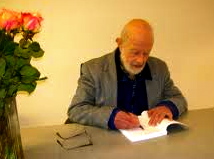
Erich Lehmann 20 November 1917 – 12 September 2009
Today is Erich Lehmann’s birthday. The last time I saw him was at the Second Lehmann conference in 2004, at which I organized a session on philosophical foundations of statistics (including David Freedman and D.R. Cox).
I got to know Lehmann, Neyman’s first student, in 1997. One day, I received a bulging, six-page, handwritten letter from him in tiny, extremely neat scrawl (and many more after that). He told me he was sitting in a very large room at an ASA meeting where they were shutting down the conference book display (or maybe they were setting it up), and on a very long, dark table sat just one book, all alone, shiny red. He said he wondered if it might be of interest to him! So he walked up to it…. It turned out to be my Error and the Growth of Experimental Knowledge (1996, Chicago), which he reviewed soon after. Some related posts on Lehmann’s letter are here and here.
That same year I remember having a last-minute phone call with Erich to ask how best to respond to a “funny Bayesian example” raised by Colin Howson. It is essentially the case of Mary’s positive result for a disease, where Mary is selected randomly from a population where the disease is very rare. See for example here. (It’s just like the case of our high school student Isaac). His recommendations were extremely illuminating, and with them he sent me a poem he’d written (which you can read in my published response here*). Aside from being a leading statistician, Erich had a (serious) literary bent.
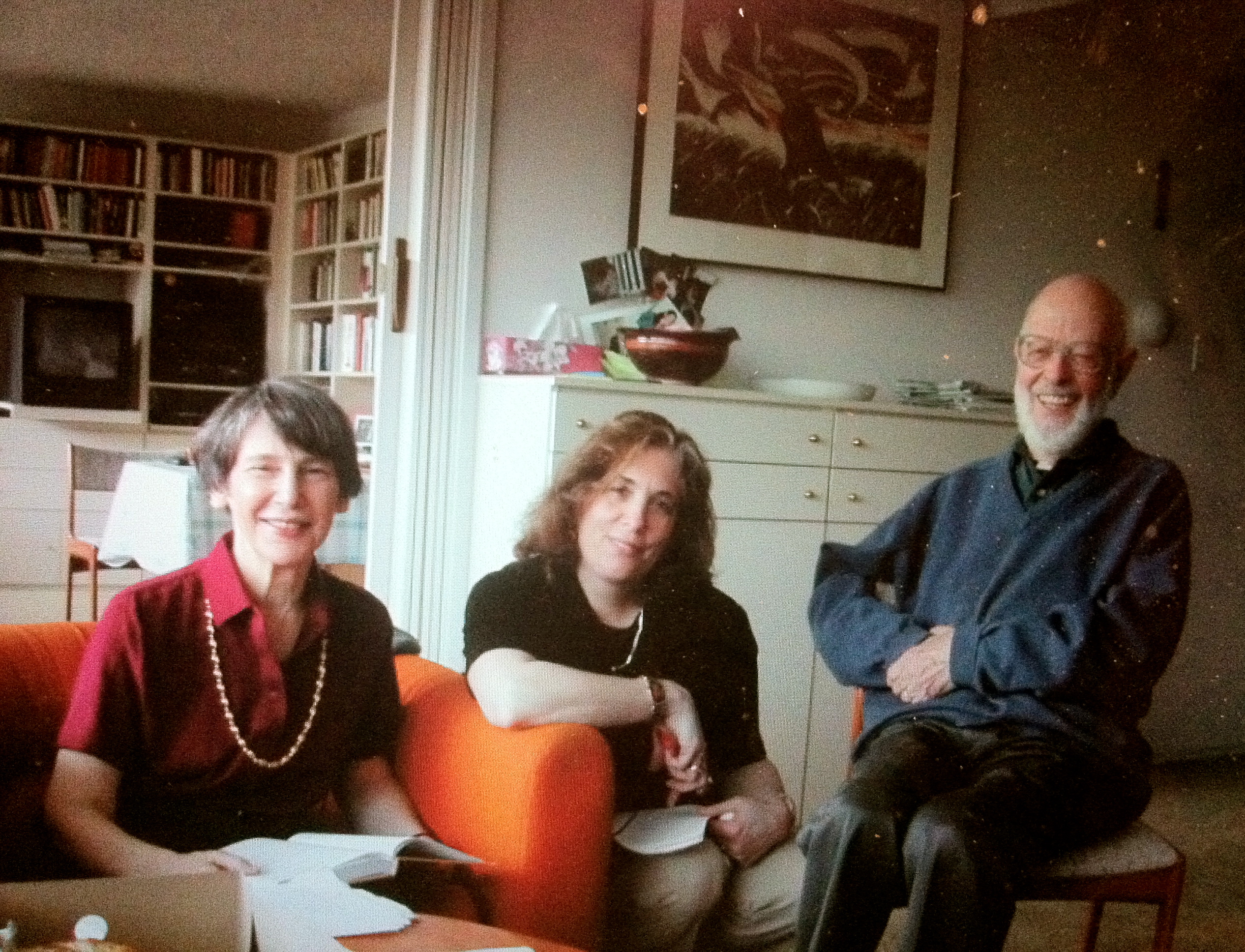
Juliet Shafer, Erich Lehmann, D. Mayo
The picture on the right was taken in 2003 (by A. Spanos).
Mayo, D. G (1997a), “Response to Howson and Laudan,” Philosophy of Science 64: 323-333.
(Selected) Books
Articles (3 of very many)
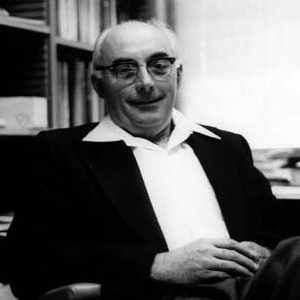
Nov.18, 1924 -April 25, 2000
Today is Lucien Le Cam’s birthday. He was an error statistician whose remarks in an article, “A Note on Metastatisics,” in a collection on foundations of statistics (Le Cam 1977)* had some influence on me. A statistician at Berkeley, Le Cam was a co-editor with Neyman of the Berkeley Symposia volumes. I hadn’t mentioned him on this blog before, so here are some snippets from EGEK (Mayo, 1996, 337-8; 350-1) that begin with a snippet from a passage from Le Cam (1977) (Here I have fleshed it out):
“One of the claims [of the Bayesian approach] is that the experiment matters little, what matters is the likelihood function after experimentation. Whether this is true, false, unacceptable or inspiring, it tends to undo what classical statisticians have been preaching for many years: think about your experiment, design it as best you can to answer specific questions, take all sorts of precautions against selection bias and your subconscious prejudices. It is only at the design stage that the statistician can help you.
Another claim is the very curious one that if one follows the neo-Bayesian theory strictly one would not randomize experiments….However, in this particular case the injunction against randomization is a typical product of a theory which ignores differences between experiments and experiences and refuses to admit that there is a difference between events which are made equiprobable by appropriate mechanisms and events which are equiprobable by virtue of ignorance. …
In spite of this the neo-Bayesian theory places randomization on some kind of limbo, and thus attempts to distract from the classical preaching that double blind randomized experiments are the only ones really convincing.
There are many other curious statements concerning confidence intervals, levels of significance, power, and so forth. These statements are only confusing to an otherwise abused public”. (Le Cam 1977, 158)
Back to EGEK:
Why does embracing the Bayesian position tend to undo what classical statisticians have been preaching? Because Bayesian and classical statisticians view the task of statistical inference very differently,
In [chapter 3, Mayo 1996] I contrasted these two conceptions of statistical inference by distinguishing evidential-relationship or E-R approaches from testing approaches, … .
The E-R view is modeled on deductive logic, only with probabilities. In the E-R view, the task of a theory of statistics is to say, for given evidence and hypotheses, how well the evidence confirms or supports hypotheses (whether absolutely or comparatively). There is, I suppose, a certain confidence and cleanness to this conception that is absent from the error-statistician’s view of things. Error statisticians eschew grand and unified schemes for relating their beliefs, preferring a hodgepodge of methods that are truly ampliative. Error statisticians appeal to statistical tools as protection from the many ways they know they can be misled by data as well as by their own beliefs and desires. The value of statistical tools for them is to develop strategies that capitalize on their knowledge of mistakes: strategies for collecting data, for efficiently checking an assortment of errors, and for communicating results in a form that promotes their extension by others.
Given the difference in aims, it is not surprising that information relevant to the Bayesian task is very different from that relevant to the task of the error statistician. In this section I want to sharpen and make more rigorous what I have already said about this distinction.
…. the secret to solving a number of problems about evidence, I hold, lies in utilizing—formally or informally—the error probabilities of the procedures generating the evidence. It was the appeal to severity (an error probability), for example, that allowed distinguishing among the well-testedness of hypotheses that fit the data equally well… .
A few pages later in a section titled “Bayesian Freedom, Bayesian Magic” (350-1):
A big selling point for adopting the LP (strong likelihood principle), and with it the irrelevance of stopping rules, is that it frees us to do things that are sinful and forbidden to an error statistician.
“This irrelevance of stopping rules to statistical inference restores a simplicity and freedom to experimental design that had been lost by classical emphasis on significance levels (in the sense of Neyman and Pearson). . . . Many experimenters would like to feel free to collect data until they have either conclusively proved their point, conclusively disproved it, or run out of time, money or patience … Classical statisticians … have frowned on [this]”. (Edwards, Lindman, and Savage 1963, 239)1
Breaking loose from the grip imposed by error probabilistic requirements returns to us an appealing freedom.
Le Cam, … hits the nail on the head:
“It is characteristic of [Bayesian approaches] [2] . . . that they … tend to treat experiments and fortuitous observations alike. In fact, the main reason for their periodic return to fashion seems to be that they claim to hold the magic which permits [us] to draw conclusions from whatever data and whatever features one happens to notice”. (Le Cam 1977, 145)
In contrast, the error probability assurances go out the window if you are allowed to change the experiment as you go along. Repeated tests of significance (or sequential trials) are permitted, are even desirable for the error statistician; but a penalty must be paid for perseverance—for optional stopping. Before-trial planning stipulates how to select a small enough significance level to be on the lookout for at each trial so that the overall significance level is still low. …. Wearing our error probability glasses—glasses that compel us to see how certain procedures alter error probability characteristics of tests—we are forced to say, with Armitage, that “Thou shalt be misled if thou dost not know that” the data resulted from the try and try again stopping rule. To avoid having a high probability of following false leads, the error statistician must scrupulously follow a specified experimental plan. But that is because we hold that error probabilities of the procedure alter what the data are saying—whereas Bayesians do not. The Bayesian is permitted the luxury of optional stopping and has nothing to worry about. The Bayesians hold the magic.
Or is it voodoo statistics?
When I sent him a note, saying his work had inspired me, he modestly responded that he doubted he could have had all that much of an impact.
_____________
*I had forgotten that this Synthese (1977) volume on foundations of probability and statistics is the one dedicated to the memory of Allan Birnbaum after his suicide: “By publishing this special issue we wish to pay homage to professor Birnbaum’s penetrating and stimulating work on the foundations of statistics” (Editorial Introduction). In fact, I somehow had misremembered it as being in a Harper and Hooker volume from 1976. The Synthese volume contains papers by Giere, Birnbaum, Lindley, Pratt, Smith, Kyburg, Neyman, Le Cam, and Kiefer.
REFERENCES:
_______(1962). Contribution to discussion in The foundations of statistical inference, edited by L. Savage. London: Methuen.
_______(1975). Sequential Medical Trials. 2nd ed. New York: John Wiley & Sons.
Edwards, W., H. Lindman & L. Savage (1963) Bayesian statistical inference for psychological research. Psychological Review 70: 193-242.
Le Cam, L. (1974). J. Neyman: on the occasion of his 80th birthday. Annals of Statistics, Vol. 2, No. 3 , pp. vii-xiii, (with E.L. Lehmann).
Le Cam, L. (1977). A note on metastatistics or “An essay toward stating a problem in the doctrine of chances.” Synthese 36: 133-60.
Le Cam, L. (1982). A remark on empirical measures in Festschrift in the honor of E. Lehmann. P. Bickel, K. Doksum & J. L. Hodges, Jr. eds., Wadsworth pp. 305-327.
Le Cam, L. (1986). The central limit theorem around 1935. Statistical Science, Vol. 1, No. 1, pp. 78-96.
Le Cam, L. (1988) Discussion of “The Likelihood Principle,” by J. O. Berger and R. L. Wolpert. IMS Lecture Notes Monogr. Ser. 6 182–185. IMS, Hayward, CA
Le Cam, L. (1996) Comparison of experiments: A short review. In Statistics, Probability and Game Theory. Papers in Honor of David Blackwell 127–138. IMS, Hayward, CA.
Le Cam, L., J. Neyman and E. L. Scott (Eds). (1973). Proceedings of the Sixth Berkeley Symposium on Mathematical Statistics and Probability, Vol. l: Theory of Statistics, Vol. 2: Probability Theory, Vol. 3: Probability Theory. Univ. of Calif. Press, Berkeley Los Angeles.
Mayo, D. (1996). [EGEK] Error Statistics and the Growth of Experimental Knowledge. Chicago: University of Chicago Press. (Chapter 10; Chapter 3)
Neyman, J. and L. Le Cam (Eds). (1967). Proceedings of the Fifth Berkeley Symposium on Mathematical Statistics and Probability, Vol. I: Statistics, Vol. II: Probability Part I & Part II. Univ. of Calif. Press, Berkeley and Los Angeles.
[1] For some links on optional stopping on this blog: Highly probably vs highly probed: Bayesian/error statistical differences.; Who is allowed to cheat? I.J. Good and that after dinner comedy hour….; New Summary; Mayo: (section 7) “StatSci and PhilSci: part 2″; After dinner Bayesian comedy hour….; Search for more, if interested.
[2] Le Cam is alluding mostly to Savage, and (what he called) the “neo-Bayesian” accounts.


Experts convene to explore new philosophy of statistics field


 Error Statistics Philosophy