
 Around a year ago on this blog I wrote:
“There are some ironic twists in the way psychology is dealing with its replication crisis that may well threaten even the most sincere efforts to put the field on firmer scientific footing”
That’s philosopher’s talk for “I see a rich source of problems that cry out for ministrations of philosophers of science and of statistics”. Yesterday, I began my talk at the Society for Philosophy and Psychology workshop on “Replication in the Sciences”with examples of two main philosophical tasks: to clarify concepts, and reveal inconsistencies, tensions and ironies surrounding methodological “discomforts” in scientific practice.
Example of a conceptual clarification
Editors of a journal, Basic and Applied Social Psychology, announced they are banning statistical hypothesis testing because it is “invalid” (A puzzle about the latest “test ban”)
It’s invalid because it does not supply “the probability of the null hypothesis, given the finding” (the posterior probability of H0) (2015 Trafimow and Marks)
- Since the methodology of testing explicitly rejects the mode of inference they don’t supply, it would be incorrect to claim the methods were invalid.
- Simple conceptual job that philosophers are good at
(I don’t know if the group of eminent statisticians assigned to react to the “test ban” will bring up this point. I don’t think it includes any philosophers.)
____________________________________________________________________________________
Example of revealing inconsistencies and tensions
Critic: It’s too easy to satisfy standard significance thresholds
You: Why do replicationists find it so hard to achieve significance thresholds?
Critic: Obviously the initial studies were guilty of p-hacking, cherry-picking, significance seeking, QRPs
You: So, the replication researchers want methods that pick up on and block these biasing selection effects.
Critic: Actually the “reforms” recommend methods where selection effects and data dredging make no difference.
________________________________________________________________
Whether this can be resolved or not is separate.
- We are constantly hearing of how the “reward structure” leads to taking advantage of researcher flexibility
- As philosophers, we can at least show how to hold their feet to the fire, and warn of the perils of accounts that bury the finagling
The philosopher is the curmudgeon (takes chutzpah!)
I also think it’s crucial for philosophers of science and statistics to show how to improve on and solve problems of methodology in scientific practice.
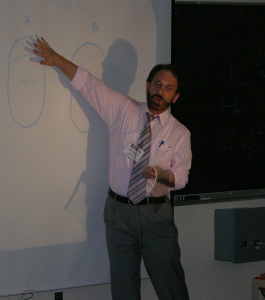
My slides are below; share comments.
























 Error Statistics Philosophy