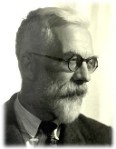
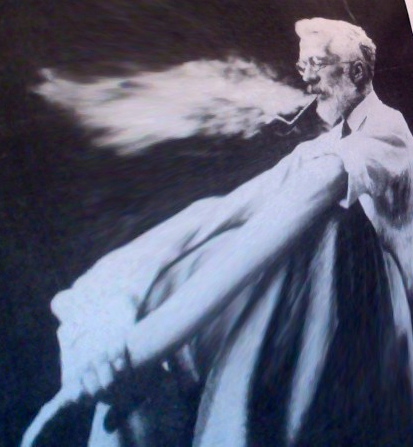
R.A. Fisher: ‘Two New Properties of Mathematical Likelihood’

17 February 1890–29 July 1962

Exactly 1 year ago: I find this to be an intriguing discussion–before some of the conflicts with N and P erupted.  Fisher links his tests and sufficiency, to the Neyman and Pearson lemma in terms of power.  It’s as if we may see them as ending up in a similar place while starting from different origins. I quote just the most relevant portions…the full article is linked below.

by R.A. Fisher, F.R.S.

Proceedings of the Royal Society, Series A, 144: 285-307 (1934)

  The property that where a sufficient statistic exists, the likelihood, apart from a factor independent of the parameter to be estimated, is a function only of the parameter and the sufficient statistic, explains the principle result obtained by Neyman and Pearson in discussing the efficacy of tests of significance.  Neyman and Pearson introduce the notion that any chosen test of a hypothesis H0 is more powerful than any other equivalent test, with regard to an alternative hypothesis H1, when it rejects H0 in a set of samples having an assigned aggregate frequency ε when H0 is true, and the greatest possible aggregate frequency when H1 is true.

If any group of samples can be found within the region of rejection whose probability of occurrence on the hypothesis H1 is less than that of any other group of samples outside the region, but is not less on the hypothesis H0, then the test can evidently be made more powerful by substituting the one group for the other. Continue reading

Categories: Fisher, phil/history of stat, Statistics | Tags: , , , | 1 Comment

Aris Spanos: The Enduring Legacy of R. A. Fisher

spanos 2014

More Fisher insights from A. Spanos, this from 2 years ago:

One of R. A. Fisher’s (17 February 1890 — 29 July 1962) most re­markable, but least recognized, achievement was to initiate the recast­ing of statistical induction. Fisher (1922) pioneered modern frequentist statistics as a model-based approach to statistical induction anchored on the notion of a statistical model, formalized by:

Mθ(x)={f(x;θ); θ∈Θ}; x∈Rn ;Θ⊂Rm; m < n; (1)

where the distribution of the sample f(x;θ) ‘encapsulates’ the proba­bilistic information in the statistical model.

Before Fisher, the notion of a statistical model was vague and often implicit, and its role was primarily confined to the description of the distributional features of the data in hand using the histogram and the first few sample moments; implicitly imposing random (IID) samples. The problem was that statisticians at the time would use descriptive summaries of the data to claim generality beyond the data in hand x0:=(x1,x2,…,xn). As late as the 1920s, the problem of statistical induction was understood by Karl Pearson in terms of invoking (i) the ‘stability’ of empirical results for subsequent samples and (ii) a prior distribution for θ.

Fisher was able to recast statistical inference by turning Karl Pear­son’s approach, proceeding from data x0 in search of a frequency curve f(x;ϑ) to describe its histogram, on its head. He proposed to begin with a prespecified Mθ(x) (a ‘hypothetical infinite population’), and view x0 as a ‘typical’ realization thereof; see Spanos (1999).

In my mind, Fisher’s most enduring contribution is his devising a general way to ‘operationalize’ errors by embedding the material ex­periment into Mθ(x), and taming errors via probabilification, i.e. to define frequentist error probabilities in the context of a statistical model. These error probabilities are (a) deductively derived from the statistical model, and (b) provide a measure of the ‘effectiviness’ of the inference procedure: how often a certain method will give rise to correct in­ferences concerning the underlying ‘true’ Data Generating Mechanism (DGM). This cast aside the need for a prior. Both of these key elements, the statistical model and the error probabilities, have been refined and extended by Mayo’s error statistical approach (EGEK 1996). Learning from data is achieved when an inference is reached by an inductive procedure which, with high probability, will yield true conclusions from valid inductive premises (a statistical model); Mayo and Spanos (2011). Continue reading

Categories: Fisher, phil/history of stat, Statistics | Tags: , , , , , , | 2 Comments

R. A. Fisher: how an outsider revolutionized statistics

A SPANOSToday is R.A. Fisher’s birthday and I’m reblogging the post by Aris Spanos which, as it happens, received the highest number of views of 2013.

by Aris Spanos

Few statisticians will dispute that R. A. Fisher (February 17, 1890 – July 29, 1962) is the father of modern statistics; see Savage (1976), Rao (1992). Inspired by William Gosset’s (1908) paper on the Student’s t finite sampling distribution, he recast statistics into the modern model-based induction in a series of papers in the early 1920s. He put forward a theory of optimal estimation based on the method of maximum likelihood that has changed only marginally over the last century. His significance testing, spearheaded by the p-value, provided the basis for the Neyman-Pearson theory of optimal testing in the early 1930s. According to Hald (1998)

“Fisher was a genius who almost single-handedly created the foundations for modern statistical science, without detailed study of his predecessors. When young he was ignorant not only of the Continental contributions but even of contemporary publications in English.” (p. 738)

What is not so well known is that Fisher was the ultimate outsider when he brought about this change of paradigms in statistical science. As an undergraduate, he studied mathematics at Cambridge, and then did graduate work in statistical mechanics and quantum theory. His meager knowledge of statistics came from his study of astronomy; see Box (1978). That, however did not stop him from publishing his first paper in statistics in 1912 (still an undergraduate) on “curve fitting”, questioning Karl Pearson’s method of moments and proposing a new method that was eventually to become the likelihood method in his 1921 paper. Continue reading

Categories: Fisher, phil/history of stat, Spanos, Statistics | 6 Comments

Fisher and Neyman after anger management?

Photo on 2-15-13 at 11.47 PM

Monday is Fisher’s birthday, and to set the stage for some items to appear, I’m posing the anger management question from a year ago post (please also see the comments from then). Here it is:


Would you agree if your (senior) colleague urged you to use his/her book rather than your own –even if you thought doing so would change for the positive the entire history of your field? My guess is that the answer is no (but see “add on”). For that matter, would you ever try to insist that your (junior) colleague use your book in teaching a course rather than his/her own notes or book?  Again I guess no. But perhaps you’d be more tactful than were Fisher and Neyman.

It wasn’t just Fisher who seemed to need some anger management training, Erich Lehmann (in conversation and in 2011) points to a number of incidences wherein Neyman is the instigator of gratuitous ill-will. Their substantive statistical and philosophical disagreements, I now think, were minuscule in comparison to the huge animosity that developed over many years. Here’s how Neyman describes a vivid recollection he has of the 1935 book episode to Constance Reid (1998, 126). [i]

A couple of months “after Neyman criticized Fisher’s concept of the complex experiment” Neyman vividly recollects  Fisher stopping by his office at University College on his way to a meeting which was to decide on Neyman’s reappointment[ii]: Continue reading

Categories: phil/history of stat, Statistics | 9 Comments

January Blog Table of Contents

2208388671_0d8bc38714

January, and the blogging was easy

BLOG Contents: January 2014
Compiled by Jean Miller and Nicole Jinn

(1/2) Winner of the December 2013 Palindrome Book Contest (Rejected Post)
(1/3) Error Statistics Philosophy: 2013
(1/4) Your 2014 wishing well. …
(1/7) “Philosophy of Statistical Inference and Modeling” New Course: Spring 2014: Mayo and Spanos: (Virginia Tech)
(1/11) Two Severities? (PhilSci and PhilStat)
(1/14) Statistical Science meets Philosophy of Science: blog beginnings
(1/16) Objective/subjective, dirty hands and all that: Gelman/Wasserman blogolog (ii)
(1/18) Sir Harold Jeffreys’ (tail area) one-liner: Sat night comedy [draft ii]
(1/22) Phil6334: “Philosophy of Statistical Inference and Modeling” New Course: Spring 2014: Mayo and Spanos (Virginia Tech) UPDATE: JAN 21
(1/24) Phil 6334: Slides from Day #1: Four Waves in Philosophy of Statistics
(1/25) U-Phil (Phil 6334) How should “prior information” enter in statistical inference?
(1/27) Winner of the January 2014 palindrome contest (rejected post)
(1/29) BOSTON COLLOQUIUM FOR PHILOSOPHY OF SCIENCE: Revisiting the Foundations of Statistics
(1/31) Phil 6334: Day #2 Slides

Categories: Metablog | Leave a comment

Phil6334 Statistical Snow Sculpture

Statistical Snow Sculpture

Statistical Snow Sculpture

No Seminar. Blizzard.

Categories: Announcement, Phil6334 | Leave a comment

Phil6334: Popper self-test

images-10Those reading Popper[i] with us might be interested in an (undergraduate) item I came across: Popper Self-Test Questions. It includes multiple choice questions, quotes to ponder, and thumbnail definitions at the end[ii].
[i]Popper reading (for Feb 13, 2014) from Conjectures and Refutations
[ii]I might note the “No-Pain philosophy” (3 part) Popper posts from this blog: parts 12, and 3.

Categories: Error Statistics | 1 Comment

Is it true that all epistemic principles can only be defended circularly? A Popperian puzzle

images-8Current day Popperians, the “critical rationalists”, espouse the following epistemic principle CR:[i]

(CR) it is reasonable to adopt or believe a claim or theory P which best survives serious criticism.

What justifies CR?  To merely declare it is a reasonable epistemic principle without giving evidence that following it advances any epistemic goals is entirely unsatisfactory, and decidedly un-Popperian in spirit.

Alan Musgrave (1999), leading critical rationalist, mounts a defence of CR that he openly concedes is circular, admitting, as he does, that such circular defences could likewise be used to argue for principles he himself regards as ‘crazy’.
However, he also gives a subtle and clever argument that it’s impossible to do better, that such a circular defense is the only kind possible. So since we’re reading Popper this week (some of us), and since an analogous argument arises in defending principles of statistical inference, try your hand at this conundrum. Continue reading

Categories: philosophy of science, Popper, Statistics | 2 Comments

Phil 6334: Day #3: Feb 6, 2014

img_1249-e1356389909748

Day #3: Spanos lecture notes 2, and reading/resources from Feb 6 seminar 

6334 Day 3 slides: Spanos-lecture-2

___

Crupi & Tentori (2010). Irrelevant Conjunction: Statement and Solution of a New Paradox, Phil Sci, 77, 1–13.

Hawthorne & Fitelson (2004). Re-Solving Irrelevant Conjunction with Probabilistic Independence, Phil Sci 71: 505–514.

Skryms (1975) Choice and Chance 2nd ed. Chapter V and Carnap (pp. 206-211), Dickerson Pub. Co.

Mayo posts on the tacking paradox: Oct. 25, 2013: “Bayesian Confirmation Philosophy and the Tacking Paradox (iv)*” &  Oct 25.

An update on this issue will appear shortly in a separate blogpost.

_

READING FOR NEXT WEEK
Selection (pp. 35-59) from: Popper (1962). Conjectures and RefutationsThe Growth of Scientific Knowledge. Basic Books. 

Categories: Bayes' Theorem, Phil 6334 class material, Statistics | Leave a comment

“Probabilism as an Obstacle to Statistical Fraud-Busting” (draft iii)

IMG_0244Update: Feb. 21, 2014 (slides at end)Ever find when you begin to “type” a paper to which you gave an off-the-cuff title months and months ago that you scarcely know just what you meant or feel up to writing a paper with that (provocative) title? But then, pecking away at the outline of a possible paper crafted to fit the title, you discover it’s just the paper you’re up to writing right now? That’s how I feel about “Is the Philosophy of Probabilism an Obstacle to Statistical Fraud Busting?” (the impromptu title I gave for my paper for the Boston Colloquium for the Philosophy of Science):

The conference is called: “Revisiting the Foundations of Statistics in the Era of Big Data: Scaling Up to Meet the Challenge.”  

 Here are some initial chicken-scratchings (draft (i)). Share comments, queries. (I still have 2 weeks to come up with something*.) Continue reading

Categories: P-values, significance tests, Statistical fraudbusting, Statistics | Leave a comment

PhilStock: Bad news is bad news on Wall St. (rejected post)

stock picture smaillI’ve been asked for a PhilStock tip. Well, remember when it could be said that “bad news is good news on wall street“?

No longer. Now bad is bad. I call these “blood days” on the stock market, and the only statistical advice that has held up over the past turbulent years is: Never try to catch a falling knife*.

*For more, you’ll have to seek my stock blog.

Categories: PhilStock, Rejected Posts | 8 Comments

Comedy hour at the Bayesian (epistemology) retreat: highly probable vs highly probed (vs B-boosts)

Since we’ll be discussing Bayesian confirmation measures in next week’s seminar—the relevant blogpost being here--let’s listen in to one of the comedy hours at the Bayesian retreat as reblogged from May 5, 2012.

Did you hear the one about the frequentist error statistical tester who inferred a hypothesis H passed a stringent test (with data x)?

The problem was, the epistemic probability in H was so low that H couldn’t be believed!  Instead we believe its denial H’!  So, she will infer hypotheses that are simply unbelievable!

So it appears the error statistical testing account fails to serve as an account of knowledge or evidence (i.e., an epistemic account). However severely I might wish to say that a hypothesis H has passed a test, this Bayesian critic assigns a sufficiently low prior probability to H so as to yield a low posterior probability in H[i].  But this is no argument about why this counts in favor of, rather than against, their particular Bayesian computation as an appropriate assessment of the warrant to be accorded to hypothesis H.

To begin with, in order to use techniques for assigning frequentist probabilities to events, their examples invariably involve “hypotheses” that consist of asserting that a sample possesses a characteristic, such as “having a disease” or “being college ready” or, for that matter, “being true.”  This would not necessarily be problematic if it were not for the fact that their criticism requires shifting the probability to the particular sample selected—for example, a student Isaac is college-ready, or this null hypothesis (selected from a pool of nulls) is true.  This was, recall, the fallacious probability assignment that we saw in Berger’s attempt, later (perhaps) disavowed. Also there are just two outcomes, say s and ~s, and no degrees of discrepancy from H. Continue reading

Categories: Comedy, confirmation theory | Tags: , , , , | 28 Comments

Phil 6334: Day #2 Slides


Picture 216 1mayo Day #2, Part 1: D. Mayo: 

Class, Part 2: A. Spanos:picture-072-1-1
Probability/Statistics Lecture Notes 1: Introduction to Probability and Statistical Inference

Day #1 slides are here.

Categories: Phil 6334 class material, Philosophy of Statistics, Statistics | 8 Comments

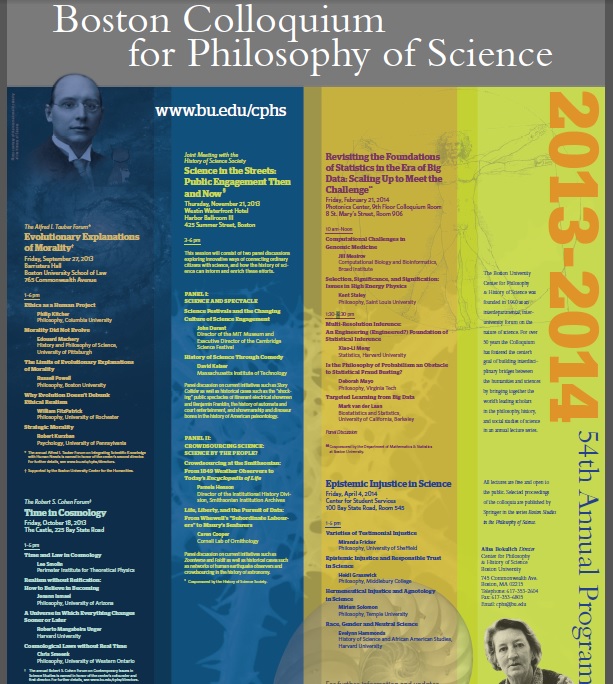
BOSTON COLLOQUIUM FOR PHILOSOPHY OF SCIENCE: Revisiting the Foundations of Statistics

BOSTON COLLOQUIUM FOR PHILOSOPHY OF SCIENCE

2013–2014
54th Annual Program

Download the 54th Annual Program

REVISITING THE FOUNDATIONS OF STATISTICS IN THE ERA OF BIG DATA: SCALING UP TO MEET THE CHALLENGE

Cosponsored by the Department of Mathematics & Statistics at Boston University.
Friday, February 21, 2014
10 a.m. – 5:30 p.m.
Photonics Center, 9th Floor Colloquium Room (Rm 906)
8 St. Mary’s Street

10 a.m.–noon

  • Computational Challenges in Genomic Medicine
    Jill Mesirov Computational Biology and Bioinformatics, Broad Institute
  • Selection, Significance, and Signification: Issues in High Energy Physics
    Kent Staley Philosophy, Saint Louis University

1:30–5:30 p.m.

  • Multi-Resolution Inference: An Engineering (Engineered?) Foundation of Statistical Inference
    Xiao-Li Meng Statistics, Harvard University
  • Is the Philosophy of Probabilism an Obstacle to Statistical Fraud Busting?
    Deborah Mayo Philosophy, Virginia Tech
  • Targeted Learning from Big Data
    Mark van der Laan Biostatistics and Statistics, UC Berkeley

Panel Discussion

Boston Colloquium 2013-2014 (3)

Categories: Announcement, philosophy of science, Philosophy of Statistics, Statistical fraudbusting, Statistics | Leave a comment

Winner of the January 2014 palindrome contest (rejected post)

images-5Winner of the January 2014 Palindrome Context

Karthik Durvasula
Visiting Assistant Professor in Phonology & Phonetics at Michigan State University

Palindrome: Test’s optimal? Agreed! Able to honor? O no! Hot Elba deer gala. MIT-post set.

The requirement was: A palindrome with “optimal” and “Elba”.

BioI’m a Visiting Assistant Professor in Phonology & Phonetics at Michigan State University. My work primarily deals with probing people’s subconscious knowledge of (abstract) sound patterns. Recently, I have been working on auditory illusions that stem from the bias that such subconscious knowledge introduces.

Statement: “Trying to get a palindrome that was at least partially meaningful was fun and challenging. Plus I get an awesome book for my efforts. What more could a guy ask for! I also want to thank Mayo for being excellent about email correspondence, and answering my (sometimes silly) questions tirelessly.”

Book choice: EGEK 1996! 🙂
[i.e.,Mayo (1996): “Error and the Growth of Experimental Knowledge”]

CONGRATULATIONS! And thanks so much for your interest!

February contest: Elba plus deviate (deviation)*

New Rule: Using both deviate and deviant tops an acceptable palindrome that only uses deviate (but can earn 1/2 prize voucher for doubling on another month).

Categories: Announcement, Palindrome, Rejected Posts | Leave a comment

U-Phil (Phil 6334) How should “prior information” enter in statistical inference?

On weekends this spring (in connection with Phil 6334, but not limited to seminar participants) I will post relevant “comedy hours”, invites to analyze short papers or blogs (“U-Phils”, as in “U-philosophize”), and some of my “deconstructions” of articles. To begin with a “U-Phil”, consider a note by Andrew Gelman: “Ethics and the statistical use of prior information,”[i].

RMM: "A Conversation Between Sir David Cox & D.G. Mayo"I invite you to send (to error@vt.edu) informal analyses (“U-Phil”, ~500-750 words) by February 10) [iv]. Indicate if you want your remarks considered for possible posting on this blog.

Writing philosophy differs from other types of writing: Some links to earlier U-Phils are here. Also relevant is this note: “So you want to do a philosophical analysis?”

U-Phil (2/10/14): In section 3 Gelman comments on some of David Cox’s remarks in a (highly informal and non-scripted) conversation we recorded:

 A Statistical Scientist Meets a Philosopher of Science: A Conversation between Sir David Cox and Deborah Mayo,” published in Rationality, Markets and Morals [iii] (Section 2 has some remarks on Larry Wasserman, by the way.)

Here’s the relevant portion of the conversation:

COX: Deborah, in some fields foundations do not seem very important, but we both think foundations of statistical inference are important; why do you think that is?

MAYO: I think because they ask about fundamental questions of evidence, inference, and probability. I don’t think that foundations of different fields are all alike; because in statistics we’re so intimately connected to the scientific interest in learning about the world, we invariably cross into philosophical questions about empirical knowledge and inductive inference.

COX: One aspect of it is that it forces us to say what it is that we really want to know when we analyze a situation statistically. Do we want to put in a lot of information external to the data, or as little as possible. It forces us to think about questions of that sort.

MAYO: But key questions, I think, are not so much a matter of putting in a lot or a little information. …What matters is the kind of information, and how to use it to learn. This gets to the question of how we manage to be so successful in learning about the world, despite knowledge gaps, uncertainties and errors. To me that’s one of the deepest questions and it’s the main one I care about. I don’t think a (deductive) Bayesian computation can adequately answer it.…..

COX: There’s a lot of talk about what used to be called inverse probability and is now called Bayesian theory. That represents at least two extremely different approaches. How do you see the two? Do you see them as part of a single whole? Or as very different? Continue reading

Categories: Background knowledge, Philosophy of Statistics, U-Phil | Tags: , | 2 Comments

Phil 6334: Slides from Day #1: Four Waves in Philosophy of Statistics

images-4First installment 6334 syllabus (Mayo and Spanos)
D. Mayo slides from Day #1: Jan 23, 2014


I will post seminar slides here (they will generally be ragtag affairs), links to the papers are in the syllabus.

Categories: Phil 6334 class material, Philosophy of Statistics, Statistics | 14 Comments

Phil6334: “Philosophy of Statistical Inference and Modeling” New Course: Spring 2014: Mayo and Spanos: (Virginia Tech) UPDATE: JAN 21

FURTHER UPDATED: New course for Spring 2014: Thurs 3:30-6:15 (Randolph 209)

first installment 6334 syllabus_SYLLABUS (first) Phil 6334: Philosophy of Statistical Inference and ModelingPicture 216 1mayo
picture-072-1-1

D. Mayo and A. Spanos

Contact: error@vt.edu

This new course, to be jointly taught by Professors D. Mayo (Philosophy) and A. Spanos (Economics) will provide an introductory, in-depth introduction to graduate level research in philosophy of inductive-statistical inference and probabilistic methods of evidence (a branch of formal epistemology). We explore philosophical problems of confirmation and induction, the philosophy and history of frequentist and Bayesian approaches, and key foundational controversies surrounding tools of statistical data analytics, modeling and hypothesis testing in the natural and social sciences, and in evidence-based policy.

We now have some tentative topics and dates:
 

course flyer pic

1. 1/23 Introduction to the Course: 4 waves of controversy in the philosophy of statistics
2. 1/30 How to tell what’s true about statistical inference: Probabilism, performance and probativeness
3. 2/6 Induction and Confirmation: Formal Epistemology
4. 2/13 Induction, falsification, severe tests: Popper and Beyond
5. 2/20 Statistical models and estimation: the Basics
6. 2/27 Fundamentals of significance tests and severe testing
7. 3/6 Five sigma and the Higgs Boson discovery Is it “bad science”?
SPRING BREAK Statistical Exercises While Sunning
 8. 3/20  Fraudbusting and Scapegoating: Replicability and big data: are most scientific results false?
9. 3/27 How can we test the assumptions of statistical models?
All models are false; no methods are objective: Philosophical problems of misspecification testing: Spanos method
10. 4/3 Fundamentals of Statistical Testing: Family Feuds and 70 years of controversy
11. 4/10 Error Statistical Philosophy: Highly Probable vs Highly Probed
Some howlers of testing
12. 4/17 What ever happened to Bayesian Philosophical Foundations? Dutch books etc. Fundamental of Bayesian statistics
13. 4/24 Bayesian-frequentist reconciliations, unifications, and O-Bayesians
14. 5/1 Overview: Answering the critics: Should statistical philosophy be divorced from methodology?
(15. TBA) Topic to be chosen (Resampling statistics and new journal policies? Likelihood principle)

 Interested in attending? E.R.R.O.R.S.* can fund travel (presumably driving) and provide accommodation for Thurs. night in a conference lodge in Blacksburg for a few people through (or part of)  the semester. If interested, write ASAP for details (with a brief description of your interest and background) to error@vt.edu. (Several people asked about long-distance hook-ups: We will try to provide some sessions by Skype, and will put each of the seminar items here (also check the Phil6334 page on this blog). 

A sample of questions we consider*:

  • What makes an inquiry scientific? objective? When are we warranted in generalizing from data?
  • What is the “traditional problem of induction”?  Is it really insoluble?  Does it matter in practice?
  • What is the role of probability in uncertain inference? (to assign degrees of confirmation or belief? to characterize the reliability of test procedures?) 3P’s: Probabilism, performance and probativeness
  • What is probability? Random variables? Estimates? What is the relevance of long-run error probabilities for inductive inference in science?
  • What did Popper really say about severe testing, induction, falsification? Is it time for a new definition of pseudoscience?
  • Confirmation and falsification: Carnap and Popper, paradoxes of confirmation; contemporary formal epistemology
  • What is the current state of play in the “statistical wars” e.g., between frequentists, likelihoodists, and (subjective vs. “non-subjective”) Bayesians?
  • How should one specify and interpret p-values, type I and II errors, confidence levels?  Can one tell the truth (and avoid fallacies) with statistics? Do the “reformers” themselves need reform?
  • Is it unscientific (ad hoc, degenerating) to use the same data both in constructing and testing hypotheses? When and why?
  • Is it possible to test assumptions of statistical models without circularity?
  • Is the new research on “replicability” well-founded, or an erroneous use of screening statistics for long-run performance?
  • Should randomized studies be the “gold standard” for “evidence-based” science and policy?
  • What’s the problem with big data: cherry-picking, data mining, multiple testing
  • The many faces of Bayesian statistics: Can there be uninformative prior probabilities? (No) Principles of indifference over the years
  • Statistical fraudbusting: psychology, economics, evidence-based policy
  • Applied controversies (selected): Higgs experiments, climate modeling, social psychology, econometric modeling, development economic

D. Mayo (books):

How to Tell What’s True About Statistical Inference, (Cambridge, in progress).

Error and the Growth of Experimental KnowledgeChicago: Chicago University Press, 1996. (Winner of 1998 Lakatos Prize).

Acceptable Evidence: Science and Values in Risk Managementco-edited with Rachelle Hollander, New York: Oxford University Press, 1994.

Aris Spanos (books):

Probability Theory and Statistical Inference, Cambridge, 1999.

Statistical Foundations of Econometric Modeling, Cambridge, 1986.

Joint (books): Error and Inference: Recent Exchanges on Experimental Reasoning, Reliability and the Objectivity and Rationality of Science, D. Mayo & A. Spanos (eds.), Cambridge: Cambridge University Press, 2010. [Intro, Background & Chapter 1. (The book includes both papers and exchanges between Mayo and A. Chalmers, A. Musgrave, P. Achinstein, J. Worrall, C. Glymour, A. Spanos, and joint papers with Mayo and Sir David Cox)].

Categories: Announcement, Error Statistics, Statistics | 5 Comments

Sir Harold Jeffreys’ (tail area) one-liner: Sat night comedy [draft ii]

Comedy hour iconYou might not have thought there could be new material for 2014, but there is, and if you look a bit more closely, you’ll see that it’s actually not Jay Leno who is standing up there at the mike ….

IMG_1547It’s Sir Harold Jeffreys himself! And his (very famous) joke, I admit, is funny. So, since it’s Saturday night, let’s listen in on Sir Harold’s howler* in criticizing the use of p-values.

“Did you hear the one about significance testers rejecting H0 because of outcomes H0 didn’t predict?

‘What’s unusual about that?’ you ask?

Well, what’s unusual, is that they do it when these unpredicted outcomes haven’t even occurred!”

Much laughter.

[The actual quote from Jeffreys: Using p-values implies that “An hypothesis that may be true is rejected because it has failed to predict observable results that have not occurred. This seems a remarkable procedure.” (Jeffreys 1939, 316)]

I say it’s funny, so to see why I’ll strive to give it a generous interpretation.

We can view p-values in terms of rejecting H0, as in the joke: There’s a test statistic D such that H0 is rejected if its observed value d0 reaches or exceeds a cut-off d* where Pr(D > d*; H0) is small, say .025.
           Reject H0 if Pr(D > d0H0) < .025.
The report might be “reject Hat level .025″.
Example:  H0: The mean light deflection effect is 0. So if we observe a 1.96 standard deviation difference (in one-sided Normal testing) we’d reject H0 .

Now it’s true that if the observation were further into the rejection region, say 2, 3 or 4 standard deviations, it too would result in rejecting the null, and with an even smaller p-value. It’s also true that H0 “has not predicted” a 2, 3, 4, 5 etc. standard deviation difference in the sense that differences so large are “far from” or improbable under the null. But wait a minute. What if we’ve only observed a 1 standard deviation difference (p-value = .16)? It is unfair to count it against the null that 1.96, 2, 3, 4 etc. standard deviation differences would have diverged seriously from the null, when we’ve only observed the 1 standard deviation difference. Yet the p-value tells you to compute Pr(D > 1; H0), which includes these more extreme outcomes! This is “a remarkable procedure” indeed! [i]

So much for making out the howler. The only problem is that significance tests do not do this, that is, they do not reject with, say, D = 1 because larger D values might have occurred (but did not). D = 1 does not reach the cut-off, and does not lead to rejecting H0. Moreover, looking at the tail area makes it harder, not easier, to reject the null (although this isn’t the only function of the tail area): since it requires not merely that Pr(D = d0 ; H0 ) be small, but that Pr(D > d0 ; H0 ) be small. And this is well justified because when this probability is not small, you should not regard it as evidence of discrepancy from the null. Before getting to this …. Continue reading

Categories: Comedy, Fisher, Jeffreys, P-values, Statistics, Stephen Senn | 12 Comments

Objective/subjective, dirty hands and all that: Gelman/ Wasserman blogolog (ii)

Objectivity #2: The “Dirty Hands” Argument for Ethics in EvidenceAndrew Gelman says that as a philosopher, I should appreciate his blog today in which he records his frustration: “Against aggressive definitions: No, I don’t think it helps to describe Bayes as ‘the analysis of subjective beliefs’…”  Gelman writes:

I get frustrated with what might be called “aggressive definitions,” where people use a restrictive definition of something they don’t like. For example, Larry Wasserman writes (as reported by Deborah Mayo):

“I wish people were clearer about what Bayes is/is not and what 
frequentist inference is/is not. Bayes is the analysis of subjective
 beliefs but provides no frequency guarantees. Frequentist inference 
is about making procedures that have frequency guarantees but makes no 
pretense of representing anyone’s beliefs.”

I’ll accept Larry’s definition of frequentist inference. But as for his definition of Bayesian inference: No no no no no. The probabilities we use in our Bayesian inference are not subjective, or, they’re no more subjective than the logistic regressions and normal distributions and Poisson distributions and so forth that fill up all the textbooks on frequentist inference.

To quickly record some of my own frustrations:*: First, I would disagree with Wasserman’s characterization of frequentist inference, but as is clear from Larry’s comments to (my reaction to him), I think he concurs that he was just giving a broad contrast. Please see Note [1] for a remark from my post: Comments on Wasserman’s “what is Bayesian/frequentist inference?” Also relevant is a Gelman post on the Bayesian name: [2].

Second, Gelman’s “no more subjective than…” evokes  remarks I’ve made before. For example, in “What should philosophers of science do…” I wrote:

Arguments given for some very popular slogans (mostly by non-philosophers), are too readily taken on faith as canon by others, and are repeated as gospel. Examples are easily found: all models are false, no models are falsifiable, everything is subjective, or equally subjective and objective, and the only properly epistemological use of probability is to supply posterior probabilities for quantifying actual or rational degrees of belief. Then there is the cluster of “howlers” allegedly committed by frequentist error statistical methods repeated verbatim (discussed on this blog).

I’ve written a lot about objectivity on this blog, e.g., here, here and here (and in real life), but what’s the point if people just rehearse the “everything is a mixture…” line, without making deeply important distinctions? I really think that, next to the “all models are false” slogan, the most confusion has been engendered by the “no methods are objective” slogan. However much we may aim at objective constraints, it is often urged, we can never have “clean hands” free of the influence of beliefs and interests, and we invariably sully methods of inquiry by the entry of background beliefs and personal judgments in their specification and interpretation. Continue reading

Categories: Bayesian/frequentist, Error Statistics, Gelman, Objectivity, Statistics | 41 Comments

Blog at WordPress.com.