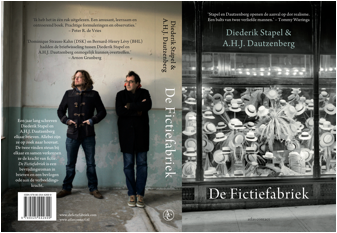
 So I hear that Diederik Stapel is the co-author of a book Fictionfactory (in Dutch,with a novelist, Dautzenberg)[i], and of what they call their “Fictionfactory peepshow”, only it’s been disinvited at the last minute from a Dutch festival on“truth and reality” (due to have run 9/26/14), and all because of Stapel’s involvement. Here’s an excerpt from an article in last week’s Retraction Watch (article is here):*
Here’s a case of art imitating science.
The organizers of a Dutch drama festival have put a halt to a play about the disgraced social psychologist Diederik Stapel, prompting protests from the authors of the skit — one of whom is Stapel himself.
According to an article in NRC Handelsblad:
The Amsterdam Discovery Festival on science and art has canceled at the last minute, the play written by Anton Dautzenberg and former professor Diederik Stapel. Co-sponsor, The Royal Netherlands Academy of Arts and Sciences (KNAW), doesn’t want Stapel, who committed science fraud, to perform at a festival that’s associated with the KNAW.
FICTION FACTORY
The management of the festival, planned for September 26th at the Tolhuistuin in Amsterdam, contacted Stapel and Dautzenberg 4 months ago with the request to organize a performance of their book and lecture project ‘The Fictionfactory”. Especially for this festival they [Stapel and Dautzenberg] created a ‘Fictionfactory-peepshow’.
“Last Friday I received a call [from the management of the festival] that our performance has been canceled at the last minute because the KNAW will withdraw their subsidy if Stapel is on the festival program”, says Dautzenberg. “This looks like censorship, and by an institution that also wants to represents arts and experiments”.
Well this is curious, as things with Stapel always are. What’s the “Fichtionfactory Peepshow”? If you go to Stapel’s homepage, it’s all in Dutch, but Google translation isn’t too bad, and I have a pretty good description of the basic idea. So since it’s Saturday night,let’s take a peek, or peep (at what it might have been)…
^^^^^^^^^^^^^^^^^^^^^^^^^^^^^^^^^^^^^^^^^^^^^^^^^^^^^^^^^^^^^^^^^^^^^^
Here we are at the “Truth and Reality” Festival: first stop (after some cotton candy): the Stapel Fictionfactory Peepshow! It’s all dark, I can’t see a thing. What? It says I have to put some coins in a slot if I want to turn turn him it on (but that they also take credit cards). So I’m to look down in this tiny window. The curtains are opening!…I see a stage with two funky looking guys– one of them is Stapel. They’re reading, or reciting from some magazine with big letters: “Fact, Fiction and the Frictions we Hide”.

Stapel and Dautzenberg
STAPEL: Welkom.You can ask us any questions! In response, you will always be given an option: ‘Do you want to know the truth or do you want to be comforted with fictions and feel-good fantasy?’
“Well I’ve brought some data with me from a study in social psychology. My question is this: “Is there a statistically significant effect here?”
STAPEL:Do you want to know the truth or do you want to be comforted with fictions and feel-good fantasy?
“Fiction please”.
STAPEL: I can massage your data, manipulate your numbers, reveal the taboos normally kept under wraps. For a few more coins I will let you see the secrets behind unreplicable results, and for a large bill will manufacture for you a sexy statistical story to turn on the editors.
(Then after the dirty business is all done [ii].)
STAPEL: Do you have more questions for me?
“Will it be published (fiction please)?”
STAPEL: “yes”
“will anyone find out about this (fiction please)?”
STAPEL: “No, I mean yes, I mean no.”
“I’d like to change to hearing the truth now. I have three questions”.
STAPEL: No problem, we take credit cards. Dank u. What are your questions?’
“Will Uri Simonsohn be able to fraudbust my results using the kind of tests he used on others? and if so, how long will it take him? (truth, please)?
STAPEL: “Yes.But not for at least 6 months to one year.”
“Here’s my final question. Are these data really statistically significant and at what level?” (truth please)
Nothing. Blank screen suddenly! With an acrid smelling puff of smoke, ew. But I’d already given the credit card! (Tricked by the master trickster).
What if he either always lies or always tells the truth? Then what would you ask him if you want to know the truth about your data? (Liar’s paradox variant)
Feel free to share your queries/comments.
* I thank Caitlin Parker for sending me the article
[i]Diederik Stapel was found guilty of science fraud in psychology in 2011, made up data out of whole cloth, retracted over 50 papers.. http://www.nytimes.com/2013/04/28/magazine/diederik-stapels-audacious-academic-fraud.html?pagewanted=all&_r=0
Bookjacket:
[ii] Perhaps they then ask you how much you’ll pay for a bar of soap (because you’d sullied yourself). Why let potential priming data go to waste? Oh wait, he doesn’t use real data…. Perhaps the peepshow was supposed to be a kind of novel introduction to research ethics.
Some previous posts on Stapel:
- Phil/Stat/Law: 50 Shades of gray between error and fraud (July 3, 2013)
- How to hire a fraudster chauffeur (Sept 18, 2013)